This site is supported by our readers. We may earn a commission, at no cost to you, if you purchase through links.

Most people assume parrots are the undisputed champions of avian longevity, but you’d be wrong. The real record-holders include a Laysan albatross named Wisdom, still raising chicks at 74 years old, and a kakapo that defied expectations by living beyond 90 years. These aren’t just lucky outliers—they represent species that have cracked the code on surviving decades longer than most birds ever will.
Understanding what bird lives the longest reveals patterns that challenge everything scientists thought they knew about aging, from flight mechanics that reduce predation to genetic quirks that slow cellular decline.
The birds that break longevity records share traits you wouldn’t expect, and their survival strategies offer insights into how some creatures escape the usual constraints of time.
Table Of Contents
- Key Takeaways
- What Bird Lives The Longest?
- Lifespans of Long-Lived Bird Species
- Factors Influencing Bird Longevity
- Characteristics of Long-Lived Birds
- Conservation Challenges for Long-Lived Birds
- Frequently Asked Questions (FAQs)
- What bird can live for 100 years?
- Which bird lives up to 300 years?
- Which bird lives the longest life?
- Which bird has the longest span?
- How does bird lifespan compare to human lifespan?
- Can diet affect a birds longevity?
- How do scientists accurately determine a birds age?
- Are there differences in lifespan between male and female birds?
- How do scientists determine a birds exact age?
- Can bird lifespan be extended through special diets?
- Conclusion
Key Takeaways
- The longest-lived birds include Wisdom the Laysan albatross at 74+ years, kakapos reaching 90+ years, and cockatoos like Cookie at 83 years—these aren’t flukes but species with unique genetic and metabolic adaptations that slow cellular aging.
- Larger body size, superior flight capability to avoid predators, slow reproductive rates, and enhanced DNA repair mechanisms are the biological traits that consistently separate century-spanning birds from their short-lived relatives.
- Captive birds often live dramatically longer than wild ones—parrots and cockatoos can surpass 80 years indoors while their wild counterparts rarely hit 40—because they dodge predation, disease, and starvation that normally cut lives short.
- Conservation matters because long-lived birds like albatrosses and condors can’t bounce back from population crashes quickly due to late maturity and few offspring, making habitat loss and climate impacts especially devastating to their survival.
What Bird Lives The Longest?
If you’ve ever wondered which feathered creatures clock the longest time on Earth, you’re in good company. The records might surprise you, with a handful of birds truly outlasting the rest.
Here’s a look at the species and standout individuals that have set the bar for bird longevity.
Verified Longevity Records in Birds
In a universe of feathered survivors, verified bird lifespans often sound legendary, but the science keeps us honest. Every record—whether from banding, Guinness World Records, or longevity research—relies on concrete tracking.
Here are five standout Avian Longevity Records:
- Wisdom, Laysan Albatross – 74+ years
- Cookie, Pink Cockatoo – 83 years
- Thaao, Andean Condor – 79 years
- Kakapo – 90+ years
- Scarlet Macaw – 75 years
To study these striking lifespans, researchers often use bird banding methods.
Longest-Lived Bird Species Worldwide
When you scan the ranks of the longest-living bird species, you’ll spot names like the Laysan albatross, Andean condor, and scarlet macaw—each rewriting the rules of avian longevity. Bird Longevity Factors, from body size to wild bird survival skills, shape these records.
In captivity, careful bird care stretches lifespans even further, revealing the secrets behind avian aging. Researchers study bird aging processes to understand the factors that contribute to these extraordinary lifespans.
Notable Individual Birds With Exceptional Ages
Some birds shatter expectations, living long enough to become legends. Take Cocky Bennett, the sulphur-crested cockatoo, whose 120-year story outpaces most records. Wisdom’s reproduction at 74, Fred’s longevity past 103, Cookie’s care through 83 years, and Greater’s age as an 83-year-old flamingo all shape our understanding of longest-living birds and lifespan records.
Some birds shatter expectations, living long enough to become legends—Cocky Bennett reached 120 years, while Wisdom, Fred, Cookie, and Greater all surpassed 70
- Cocky Bennett: 120 years
- Wisdom: 74+ years, still reproducing
- Fred: 103+ years
- Cookie: 83 years in captivity
- Greater: 83-year-old flamingo
Lifespans of Long-Lived Bird Species
Some birds outlast nearly everything else in the animal kingdom, clocking lifespans that might surprise you. If you’re curious which species are the real record-breakers, you’re in the right spot.
Let’s take a closer look at the birds that truly stand the test of time.
Parrots With Remarkable Longevity
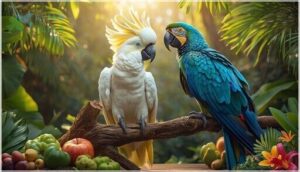
Ever wondered why parrots outlive most feathered friends? Parrot Genetics and Longevity Factors play a starring role—think telomerase activity and DNA repair.
Add in Avian Diet, solid Captive Care, and sharp Beak Health, and you’ve got some of the Longest-Living Birds around.
Sulphur-Crested Cockatoos and Blue Macaws often surpass 70 years, making Avian Longevity a bold reality.
Albatross Lifespan and Records

Take the Laysan Albatross, for example—Wisdom’s Legacy has shattered records, flying 3.7 million miles and living at least 74 years. Albatross Senescence unfolds slowly, with late Breeding Cycles and impressive Flight Distances.
Black-Footed Albatrosses also rival the Longest-Living Birds. When you run a bird lifespan comparison, their avian longevity stands out, despite formidable Conservation Challenges.
Other Notable Long-Lived Birds (Condors, Swans, Flamingos)

Condor Lifespans stretch the boundaries of avian longevity, with the Andean condor living up to 79 years in captivity. Swan Longevity follows, as mute and trumpeter swans sometimes reach 40 years. Flamingo Aging shows resident Greater Flamingos can surpass 50 years.
Captivity Effects boost these records, but wild populations face steep Conservation Status challenges among the Longest-Living Birds.
Factors Influencing Bird Longevity

What shapes how long a bird sticks around? It’s a mix of their biology, their home, and how their lives play out in the wild or under human care.
Let’s break down what really sets these lifespans apart.
Species-Specific Biological Traits
Regarding stretching the avian lifespan, nature deals in trade-offs. Body Size plays a key role—larger bird species like albatrosses and macaws often outlast their smaller cousins. Flight Capability shields some from danger, lowering Predation Risk.
Genetic Adaptations and slow Reproductive Rates also set the pace, shaping each bird’s life history traits and overall physiology for the long haul.
Environmental and Habitat Influences
What’s the secret to a bird’s long life? Your answer often lies in the landscape beneath their wings. Habitat Quality, Climate Variability, and Food Resources shape survival, while Urbanization Effects and Environmental Stressors chip away at longevity. When habitat loss or deforestation strikes, even the boldest species struggle. Protecting wild places isn’t just noble—it’s necessary.
- Diverse, stable food boosts bird fitness
- Untouched habitats increase survivorship
- Urbanization changes survival odds
- Climate extremes shorten lifespans
- Habitat alteration drives population decline
Captivity Vs. Wild Lifespan Differences
Captivity benefits often extend bird lifespans dramatically, though not all species adapt equally. Captive birds escape predation and disease, pushing macaws and cockatoos past 80 years—wild counterparts rarely reach half that age.
Yet fast-living species gain the most, while slow-paced birds show minimal improvement. Mortality factors shift indoors: stress replaces starvation, and breeding trends reveal shortened reproductive windows despite longer overall survival.
Characteristics of Long-Lived Birds

When you look at birds that break the age barrier, you’ll notice they’re not just lucky—they’ve got something special going on. These long-lived species share traits that help them outlast their shorter-lived cousins, from the way they think and interact to how their bodies handle the wear and tear of decades.
Let’s break down what sets these notable birds apart.
Social Behaviors and Intelligence
You might be surprised to learn that bird behavior plays a massive role in how long birds stick around. Research shows species with larger brain sizes and complex social bonds often outlive their simpler-minded cousins. Here’s why social smarts matter for avian longevity factors:
- Cooperative breeding reduces adult mortality, helping birds like ravens thrive longer.
- Social learning lets species like crows share knowledge about threats and food sources.
- Problem-solving abilities in parrots and jays help them navigate changing environments.
Even Wisdom, that famous albatross, benefits from strong social connections.
Adaptations for Survival and Longevity
Beyond sharp minds, you’ll find that long-lived bird species pack some serious biological firepower. Their cells resist oxidative damage through enhanced antioxidant pathways and DNA repair mechanisms that other animals can’t match. Life-history traits like slow maturation combine with stress resistance to create aging and resilience advantages.
Check out these adaptations for survival:
| Cellular Defense | Metabolic Strategy | Lifehistory Traits |
|---|---|---|
| NRF2 activation | Lower oxidative stress | Delayed maturity |
| Telomere protection | Efficient energy use | Fewer offspring |
| Enhanced DNA repair | Balanced metabolism | Extended parental care |
| Membrane stability | Tropical pace-of-life | High adult survival |
These avian longevity factors explain why kakapos and albatrosses outlive expectations.
Conservation Challenges for Long-Lived Birds

Long-lived birds face threats that put their survival at risk, from disappearing habitats to human interference. These species can’t bounce back quickly from population losses because they mature slowly and raise fewer young.
Understanding what endangers them—and why their protection matters—helps you see how fragile their future really is.
Threats to Long-Lived Bird Species
Despite their resilience, long-lived birds face mounting threats to their survival. Habitat destruction tops the list, with grassland species losing 53% of their populations since 1970.
Climate impacts hit tropical birds especially hard—understory species now see up to 75% reduced survival during extreme droughts.
You’ll also find these birds caught in illegal trade networks, with nearly 4,000 arrests made in recent trafficking raids. Pollution effects like widespread plastic ingestion further contribute to population decline, making intervention inevitable.
Importance of Protecting Long-Lived Birds
Protecting long-lived birds isn’t just about saving individual species—it’s about preserving entire ecosystems. These birds play a crucial role in maintaining ecological balance through seed dispersal and nutrient cycling. Their absence can lead to a significant 60% drop in forest seedling establishment. Conservation efforts not only support biodiversity but also generate substantial economic benefits, with the global birding industry contributing $279 billion annually.
Wildlife protection programs have demonstrated remarkable success, as seen in the recovery of the California condor population to 566 individuals from near-extinction. This achievement highlights the effectiveness of targeted avian conservation efforts, particularly when prioritizing evolutionary distinctiveness and the conservation status of long-living birds.
| Conservation Benefit | Measurable Impact | Supporting Example |
|---|---|---|
| Ecosystem Services | 60% decline in seedling rates without birds | Forest regeneration studies |
| Economic Value | $279 billion annual output | Global birding industry |
| Population Recovery | 566 individuals from near-extinction | California condor program |
| Protected Area Success | Population doubling over 45 years | Targeted avian research measures |
Frequently Asked Questions (FAQs)
What bird can live for 100 years?
The kakapo holds the record among centenarian birds, reaching up to 100 years under favorable conditions. Sulphur-crested cockatoos have also achieved considerable longevity, with verified individuals surpassing a century in captivity.
Which bird lives up to 300 years?
No bird lives 300 years—that’s pure myth. The longest-living birds, like the kakapo and certain cockatoos, max out around 90-120 years. Scientific records confirm no avian species approaches such legendary longevity.
Which bird lives the longest life?
The Laysan albatross Wisdom, verified at 74+ years, holds the record for wild birds.
For captivity, Cocky Bennett reached 120 years, demonstrating how captivity effects and longevity factors vary across longest-living bird species.
Which bird has the longest span?
Scientists recognize the kakapo as the longest-living bird species worldwide, with verified individuals reaching 90 to 100 years.
Captivity longevity records and wild lifespans confirm this remarkable avian longevity through rigorous age factors analysis.
How does bird lifespan compare to human lifespan?
Think of longevity as a great leveler—yet avian species often tip the scales. Parrots can outlive humans, while most birds reach only 2–10 years, compared to our 72-year average.
Can diet affect a birds longevity?
Absolutely. Dietary diversity and nutrient balance directly influence avian longevity. Omnivorous birds outlive others, while antioxidant intake reduces cellular aging.
Food quality, caloric restriction, and appropriate supplementation all strengthen disease resilience, ultimately extending lifespans across species.
How do scientists accurately determine a birds age?
Like detectives piecing together clues from a cold case, ornithologists use bird banding, plumage changes, bone analysis, molecular methods, and statistical modeling to accurately age birds in their avian science investigations.
Are there differences in lifespan between male and female birds?
Yes, male birds generally outlive females in most species. Males show about 5% longer lifespans on average.
Egg production impact and genetic stability drive this pattern, though captivity effects can narrow the gap.
How do scientists determine a birds exact age?
Scientists pinpoint bird ages using banding techniques, feather analysis, and skull ossification checks.
New epigenetic clocks read DNA methylation patterns, offering single-year precision.
These methods reveal true avian longevity and transform conservation efforts.
Can bird lifespan be extended through special diets?
While genetics set the baseline, you can improve avian longevity through targeted nutrition.
Dietary antioxidants and caloric restriction slow cellular aging in captive bird care, though experimental interventions show these metabolic adaptations don’t guarantee longer bird lifespans.
Conclusion
The theory that bigger brains buy more time holds up when you examine what bird lives the longest. Wisdom, kakapos, and macaws don’t just outlast their peers—they’ve evolved social intelligence, delayed reproduction, and metabolic safeguards that rewrite aging’s rulebook.
These birds prove longevity isn’t luck; it’s adaptation fine-tuned over millions of years. Protecting them means preserving genetic blueprints that could reveal answers to survival itself, answers we’re only beginning to decode.