This site is supported by our readers. We may earn a commission, at no cost to you, if you purchase through links.
 You’ll find over 4,000 bird species calling rainforests home, making these tropical hotspots nature’s ultimate bird paradise.
Facts about birds in the rainforest reveal incredible adaptations that’ll blow your mind. Toucans sport oversized bills that work like built-in air conditioners, keeping them cool in steamy jungle heat.
Hummingbirds can fly backwards and hover like tiny helicopters, while macaws use their powerful beaks as climbing tools. These feathered engineers don’t just look pretty—they’re ecosystem MVPs, pollinating flowers, spreading seeds across vast distances, and keeping bug populations under control.
Their specialized survival tricks and ecological importance reveal fascinating secrets about nature’s ingenuity.
Table Of Contents
- Key Takeaways
- Rainforest Bird Diversity
- Bird Species Characteristics
- Ecological Roles of Birds
- Bird Adaptations and Traits
- Threats and Conservation Efforts
- Frequently Asked Questions (FAQs)
- What do birds do in the rainforest?
- What are 5 facts about rainforest animals?
- What are some facts about tropical birds?
- What is the rarest bird in the rainforest?
- How do rainforest birds navigate dense vegetation?
- What sounds do rainforest birds make at night?
- How long do rainforest birds typically live?
- When do rainforest birds migrate or move seasonally?
- How do rainforest birds build their nests?
- Conclusion
Key Takeaways
- You’ll find over 4,000 bird species in rainforests, with a single 220-acre patch hosting up to 250 different species—that’s five times more diversity than temperate forests offer.
- You’re looking at nature’s most specialized engineers: toucans use oversized bills as air conditioners, hummingbirds can fly backwards at 80 wing beats per second, and macaws’ beaks apply over 300 pounds of pressure for climbing.
- You can’t underestimate these birds’ ecological impact—they’re essential pollinators, seed dispersers who spread plants across vast distances, and pest controllers who consume thousands of insects daily to maintain forest balance.
- You’re witnessing a conservation crisis where habitat destruction and illegal pet trade threaten over 150 critically endangered species, making rainforest protection efforts crucial for preventing ecosystem collapse.
Rainforest Bird Diversity
You’ll find that tropical rainforests support an extraordinary variety of bird species, with a single 220-acre patch hosting up to 250 different species compared to just 40-50 in temperate forests.
A single rainforest acre can host more bird species than an entire temperate forest – nature’s ultimate avian apartment complex.
This remarkable diversity exists because rainforests provide abundant food sources, stable climates, and complex layered habitats that have evolved over millions of years to support everything from tiny hummingbirds to massive harpy eagles, showcasing the extraordinary variety of bird species and the complex layered habitats.
Tropical Rainforest Ecosystems
Tropical rainforest ecosystems create perfect havens for avian diversity through their complex Forest Layers and stable environmental conditions.
These biodiverse hotspots support countless tropical birds through consistent Rainforest Abiotic Factors like abundant sunlight, fresh water, and year-round warmth.
The tropical rainforest maintains Ecosystem Stability through:
- Continuous Nutrient Cycling between soil and vegetation
- Predictable climate patterns enabling Species Interdependence
- Layered canopy structures providing multiple habitat niches
Unique Bird Species Found
You’ll discover an incredible array of Endemic Birdlife when exploring rainforest canopies.
From brilliant Scarlet Macaws to elusive Harpy Eagles, these Rare Avian Species showcase remarkable avian diversity.
Bird Identification becomes easier when you understand their unique features and Conservation Status.
| Tropical Birds | Key Features |
|---|---|
| Toucans | Oversized colorful bills, fruit-eating specialists |
| Hummingbirds | Rapid wing beats, nectar feeders weighing under one ounce |
| Hornbills | Casque-topped beaks, impressive size and calls |
Role of Birds in Ecosystems
Birds function as ecosystem engineers in rainforests, maintaining ecological balance through three critical roles.
You’ll find seed dispersers like toucans and parrots spreading plant genetics across vast distances, while hummingbirds provide essential pollination services.
Insectivorous birds control pest populations, preventing plant damage, and these pollinators and pest controllers create complex food webs that sustain rainforest biodiversity.
Importance of Rainforests for Birds
You’ll find that rainforest birds depend entirely on these lush ecosystems for survival.
These tropical rainforest environments provide critical habitat provision, offering abundant nesting sites and reliable food sources year-round.
The climate regulation maintains stable temperatures perfect for breeding, while ecosystem balance supports incredible rainforest biodiversity.
Without proper bird conservation protecting these bird habitats, countless species would face extinction.
Bird Species Characteristics
When you explore rainforest bird species, you’ll discover remarkable creatures with specialized traits that help them thrive in dense tropical environments.
These birds showcase incredible diversity, from tiny hummingbirds that hover with wings beating 80 times per second to massive toucans with bills nearly as long as their bodies, exhibiting incredible diversity.
Hummingbirds and Their Traits

You’ll find hummingbirds throughout the Americas, from Alaska to South America’s tip.
These tiny powerhouses measure just 3-5 inches and weigh under an ounce.
Their incredible hovering ability comes from wings beating up to 80 times per second.
Here’s what makes them special:
- Feed on nectar, insects, and pollen
- Smallest species measures only 2 inches
- Essential pollinators in rainforest ecosystems
- Masters of rapid wing flapping for precise flight control
Toucans and Their Distinctive Bills

You’ll spot toucans by their oversized, colorful bills that seem almost cartoonish.
These lightweight yet strong structures aren’t just for show—they’re masterpieces of bill evolution. The Toco Toucan’s large orange bill helps with thermoregulation function, cooling the bird like a built-in air conditioner.
Their bill composition includes honeycomb-like bones, making feeding adaptations possible while maintaining bill strength.
| Species | Bill Features | Primary Function |
|---|---|---|
| Toco Toucan | Large orange bill with black spots | Thermoregulation and fruit access |
| Keel-Billed Toucan | Rainbow-colored, lightweight structure | Reaching distant fruits |
| Channel-Billed Toucan | Ridged surface, yellow-orange coloring | Enhanced grip for feeding |
| Choco Toucan | Smaller, proportionate to body size | Specialized insect catching |
Macaws and Their Bright Plumage

Macaw colorful plumage serves multiple purposes beyond just looking spectacular.
You’ll find that vibrant coloration plays a key role in mate selection and visual communication among True Macaws.
Scarlet Macaw displays brilliant reds and blues, while BlueAndYellow Macaw showcases contrasting hues.
Feather pigments create these stunning displays through millions of years of plumage evolution, with species variation reflecting different environmental pressures, highlighting the importance of visual communication.
Other Unique Rainforest Bird Species
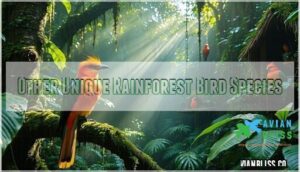
Beyond the famous macaws and toucans, you’ll discover rainforest gems like the Hoatzin with its distinctive Hoatzin Odor from fermenting leaves, and vibrant Trogons showcasing brilliant Trogon Colors.
The flashy CockOfTheRock displays orange plumage, while Cotingas sport jewel-like feathers.
Oropendolas weave hanging nests, and you’ll observe unique Ibis Behavior, specialized Cormorant Diet, and fascinating Jacana Nesting on floating vegetation.
Ecological Roles of Birds
You’ll discover that rainforest birds serve as nature’s essential workers, acting as seed dispersers who help forests regenerate, pollinators who support plant reproduction, and pest controllers who maintain ecological balance.
These feathered species function as both predators and prey within the food chain, creating a complex web of interactions that keeps rainforest ecosystems healthy and thriving, with roles such as pollinators and pest controllers being crucial.
Seed Dispersal and Pollination

Many rainforest birds act as nature’s gardeners through seed dispersal and bird pollination services.
Fruit-eating birds like toucans and parrots create mutualistic relationships with rainforest flora, swallowing seeds and depositing them miles away through their droppings.
This plant reproduction partnership maintains ecosystem health, ensuring tropical rainforest diversity thrives through these essential seed dispersal methods.
Pest Control and Population Regulation

Beyond spreading seeds, you’ll find these feathered friends working as nature’s pest controllers.
Insectivorous birds consume thousands of insects daily, maintaining ecological balance by regulating invertebrate populations.
Their diverse bird diets create powerful insectivore impact throughout food web dynamics.
Without this natural insect control, pest populations would explode, disrupting ecosystem balance and threatening plant health across the rainforest.
Birds as Predators and Prey

Rainforest birds constantly navigate complex predator-prey relationships that maintain ecosystem balance.
You’ll find raptors like Harpy Eagles hunting smaller species, while those same prey birds control insect populations.
This intricate food web demonstrates how each species contributes to population control through specialized predator adaptations and prey strategies.
- Harpy Eagles use powerful talons and silent flight to catch sloths, monkeys, and other birds
- Toucans become prey for larger raptors despite their size and strength advantages
- Small insectivorous birds serve as prey while simultaneously acting as predators to insects
- Hawks and vultures occupy different predator niches, from active hunters to scavengers
- Bird diet diversity creates multiple food web connections, from seed-eaters to carnivores
Importance of Birds in Rainforest Recovery

When deforestation strikes, you’d think forests are doomed forever.
But rainforest birds act as ecosystem engineers, shuttling seeds across fragmented landscapes and kickstarting rainforest regeneration.
Their seed dispersal efforts can boost carbon recovery by 38% when bird movement isn’t restricted.
Without these feathered helpers, deforestation recovery becomes nearly impossible, making bird conservation efforts absolutely essential for restoration success.
Bird Adaptations and Traits

You’ll discover that rainforest birds have evolved remarkable features like bright plumage, specialized feet for climbing, and unique communication methods to survive in dense forest environments.
These adaptations, including short broad wings for maneuvering through vegetation and distinct vocalizations that carry through thick canopy, demonstrate how species adapt to their complex habitat challenges, showcasing their ability to thrive with unique communication methods.
Brightly Colored Feathers and Their Purpose
You’ll notice rainforest birds are Earth’s most colorful creatures, but these vibrant colors aren’t just for show.
Dense vegetation makes traditional feather camouflage pointless, so colorful birds evolved brilliant plumage for mate attraction and species recognition instead.
These vibrant colors come from specialized pigment sources in their diet, helping them stand out in the shadowy forest canopy for successful breeding.
Strength, Speed, and Plumage for Protection
While feather camouflage isn’t their strong suit, rainforest birds rely on impressive physical abilities and vibrant plumage as predator deterrents.
These exotic birds have evolved remarkable survival strategies that showcase nature’s ingenuity.
- Harpy eagles crush prey bones with talons exerting over 300 pounds of pressure
- Hummingbirds escape danger through rapid flight, reaching incredible speeds instantly
- Hyacinth macaws use powerful beaks applying 300+ pounds per square inch pressure, which is a testament to their physical abilities.
Communication Methods and Distinct Sounds
Birds master impressive call strategies through Vocalization Adaptations that’ll amaze you.
Larger species like macaws use loud calls and distinct whistles to pierce dense canopy, while smaller birds employ Sonic Camouflage with haunting sounds that mask their locations.
You’ll hear Avian Mimicry and Interspecies Communication as skilled ventriloquists like bowerbirds use Rainforest Acoustics to confuse predators and communicate effectively.
Specialized Feet and Climbing Abilities
Rainforest bird species have evolved remarkable climbing adaptations to navigate dense canopies.
You’ll find many possess pincerlike feet called zygodactyl arrangements, where two toes point forward and two backward. This convergent evolution appears across unrelated groups, making them agile climbers despite specialized demands.
Here are three key arboreal locomotion features:
- Zygodactyl feet – Trogons, parrots, and toucans grip branches like living vises
- Curved talons – Enable secure holds on smooth bark surfaces
- Flexible ankle joints – Allow 180-degree rotation for better positioning
Threats and Conservation Efforts

You’ll discover that rainforest birds face serious challenges from habitat destruction, climate change, and illegal wildlife trade, with over 150 species currently listed as critically endangered or endangered.
Conservation groups are working to protect these remarkable creatures through habitat restoration, reserve protection, and reforestation efforts that have already planted millions of trees across threatened ecosystems.
Habitat Loss and Fragmentation
Deforestation impacts rainforest habitats at an alarming rate, with forest fragmentation isolating bird populations from food sources and mates.
You’ll find that habitat degradation destroys seven million acres annually in the Americas alone.
This bird habitat loss creates scattered patches where species can’t migrate or breed effectively.
Conservation strategies now focus on connecting fragmented areas to prevent further bird fragmentation disasters.
Climate Change and Its Effects
Rising temperatures from climate change create habitat shifts that force rainforest birds to relocate or adapt quickly.
You’ll notice breeding changes as seasonal patterns become unpredictable, while food scarcity affects survival rates.
Migration patterns shift dramatically, leaving some species stranded in unsuitable environments.
These environmental pressures substantially increase extinction risks for endangered species already struggling with deforestation and habitat loss.
Illegal Pet Trade and Conservation Status
While exotic birds fetch high prices on black markets, this wildlife trade devastates rainforest populations. You’ll find that Pet Trade Impacts include severe bird population decline and Species Endangerment across hundreds of species.
- Bird trade impact removes breeding adults from wild populations
- Conservation Strategies struggle against billion-dollar illegal networks
- Enforcement Challenges limit protection in remote rainforest areas
- Bird habitat loss compounds illegal capture pressures
- Sustainable Solutions require international cooperation and stricter penalties
Protecting Rainforest Reserves and Restoration Efforts
Successful rainforest conservation combines Reserve Effectiveness with smart Reforestation Strategies that actually work.
You’ll find Community Involvement drives the best bird habitat restoration projects, while Funding Conservation efforts protect critical bird reserves.
Policy Enforcement guarantees these bird conservation efforts stick around long-term. Consider products that help to protect reserves.
When communities lead bird habitat conservation initiatives, forests bounce back faster than you’d expect, which supports the importance of Reserve Effectiveness and Funding Conservation.
Frequently Asked Questions (FAQs)
What do birds do in the rainforest?
Coincidentally, you’ll find birds performing nature’s most essential jobs in rainforests.
They pollinate flowers, scatter seeds across miles, control insect populations, and create the forest’s soundtrack while building intricate nests in towering canopies.
What are 5 facts about rainforest animals?
You’ll find rainforest animals boast incredible diversity, with a single acre housing over 250 bird species.
They’ve evolved vibrant colors for communication, specialized diets, unique adaptations like prehensile tails, and complex social structures, which are all part of their incredible diversity.
What are some facts about tropical birds?
You’ll discover tropical birds boast vibrant plumage, you’ll find they’re nature’s seed dispersers, and you’ll notice they’ve evolved incredible diversity.
These feathered gems inhabit rainforests where abundant food sources support over 250 species per forest patch, making them incredible diversity of species.
What is the rarest bird in the rainforest?
You’ll struggle to pinpoint one "rarest" rainforest bird since over 150 species are critically endangered.
The Hyacinth Macaw, with fewer than 6,500 individuals remaining, ranks among the most threatened large rainforest birds today.
How do rainforest birds navigate dense vegetation?
You’ll find rainforest birds use short, broad wings for tight maneuvers between branches.
They rely on keen eyesight, memorized flight paths, and agile movements to dart through dense vegetation without colliding with obstacles.
What sounds do rainforest birds make at night?
You’d expect silence, but rainforest nights erupt with haunting calls you can’t pinpoint.
Smaller birds produce eerie, ventriloquial sounds that mask their locations, while larger species boom with distinct whistles and cackles through darkness, creating an atmosphere filled with haunting calls.
How long do rainforest birds typically live?
You’ll find rainforest birds have incredibly varied lifespans depending on their species.
Smaller birds like hummingbirds typically live 3-5 years, while larger species such as macaws can reach 50-100 years in the wild.
When do rainforest birds migrate or move seasonally?
You’ll find most rainforest birds don’t migrate like their temperate cousins.
They’re homebodies who stay put year-round since tropical climates provide consistent food and nesting conditions, making seasonal movement unnecessary for survival.
How do rainforest birds build their nests?
Rainforest birds craft nests with creativity—some weave intricate hanging baskets, while others use tree hollows or floating vegetation.
Materials like twigs, leaves, and mud are common, ensuring sturdy homes to protect their eggs and chicks.
Conclusion
Contrary to popular belief that rainforest birds are merely decorative, these remarkable creatures serve as essential ecosystem engineers.
You’ve discovered how facts about birds in the rainforest reveal their critical roles as pollinators, seed dispersers, and pest controllers.
Their specialized adaptations—from cooling bills to backwards flight—aren’t just evolutionary curiosities but survival necessities.
By protecting these feathered architects, you’re safeguarding entire forest systems that depend on their tireless ecological work for regeneration and balance.