This site is supported by our readers. We may earn a commission, at no cost to you, if you purchase through links.
 You’ll find that binoculars with image stabilization birding transforms your wildlife watching experience by eliminating the shaky views that plague traditional optics.
These specialized binoculars use gyroscopic technology to counteract hand tremors, giving you crystal-clear images even at high magnifications like 12x or 15x.
Canon’s IS series leads the pack, offering waterproof construction and impressive battery life for all-day field use.
The stabilization works like having steady hands on autopilot, making it easier to track fast-moving birds and spot fine details in their plumage.
Different magnification options suit various birding scenarios, from close woodland observations to distant waterfowl identification across open marshes.
Table Of Contents
- Key Takeaways
- Canon 12×36 IS III Binoculars
- Choosing The Right Magnification and Lens Size
- Key Features to Consider for Birding Binoculars
- Tips for Using Stabilized Binoculars Effectively
- Frequently Asked Questions (FAQs)
- Are image stabilized binoculars good for bird watching?
- Which is better, 8×42 or 10×42 binoculars for birding?
- What is the best image stabilizing binoculars?
- Is image stabilization worth it for binoculars?
- How does image stabilization affect battery consumption?
- Can stabilized binoculars work without battery power?
- Whats the difference between optical and electronic stabilization?
- Are image stabilized binoculars worth the extra cost?
- Do stabilized binoculars require special carrying cases?
- Conclusion
Key Takeaways
- You’ll get crystal-clear views at high magnifications like 12x or 15x with image stabilization technology that eliminates hand tremors, making it easier to track fast-moving birds without needing a tripod.
- You should choose Canon’s IS series for reliable performance, as they offer waterproof construction, 9-12 hour battery life, and advanced gyroscopic stabilization that works like having steady hands on autopilot.
- You’ll need to balance magnification power with lens size based on your birding needs—8x offers wider field of view for flight tracking, while 12x-15x brings distant birds closer for detailed observation.
- You can maximize your investment by selecting lightweight, ergonomic designs with waterproof construction, proper eye relief adjustment, and maintaining your binoculars with gentle lens cleaning and dry storage.
Canon 12×36 IS III Binoculars
When you need steady views without the bulk of a tripod, the Canon 12×36 IS III delivers exceptional performance for birding adventures.
Transform shaky views into crystal-clear bird watching with Canon’s advanced stabilization technology—no tripod required.
This compact powerhouse combines 12x magnification with Canon’s advanced Image Stabilization technology, using Vari-Angle prisms and gyro sensors to eliminate hand shake instantly.
You’ll appreciate the bright 36mm objective lenses that gather ample light for early morning or late evening birding sessions.
The Porro II prisms enhance image sharpness while the doublet field-flattener guarantees crisp detail from edge to edge.
Multi-coated lenses provide excellent contrast and color fidelity.
The lightweight design won’t weigh you down during long hikes, and the water-resistant rubber coating offers a secure grip in various weather conditions.
Battery life extends up to nine hours with standard AA batteries.
While you’ll need to hold the IS button continuously, the steady, shake-free views make it worthwhile for serious birders.
Best For: Serious birdwatchers and outdoor enthusiasts who want high-magnification binoculars with image stabilization for steady, detailed views.
- Advanced Image Stabilization eliminates hand shake for steady views.
- Bright 36mm objective lenses perform well in low-light conditions.
- Lightweight, compact design with a secure, non-slip grip.
- Continuous IS button press required, which may cause inconvenience.
- Not fully waterproof and can be damaged by water exposure.
- Limited performance for detailed astronomical viewing of planets.
Choosing The Right Magnification and Lens Size
When you’re selecting image-stabilized binoculars for birding, you’ll need to balance magnification power with objective lens diameter to match your specific viewing needs.
Higher magnification like 12x or 15x brings distant birds closer, but larger lens sizes such as 42mm or 50mm gather more light for brighter images in early morning or late evening conditions.
Magnification Options From 8x to 18x
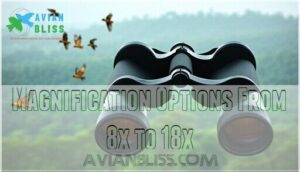
Magnification tradeoffs become clear when selecting birding binoculars. Higher power binoculars bring distant birds closer but reduce image steadiness without stabilization technology.
Here’s your magnification breakdown:
- 8x magnification – Wide field of view, excellent for target acquisition
- 10x-12x range – Best balance for most birding situations
- 15x-16x options – Ideal for open habitats and shy species
- 18x high power – Maximum detail but requires steady hands
For all-around birdwatching, consider binoculars with 8x magnification due to their wider field of view.
A larger objective lens will enhance brightness, especially in low light conditions, but also adds weight, so consider the aperture’s impact on portability.
Importance of Lens Size for Brightness
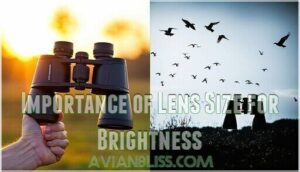
Your objective lens diameter directly impacts light gathering power for birding binoculars.
Larger lenses like 42mm or 50mm collect more light than 30mm versions, dramatically improving image clarity during dawn, dusk, and overcast conditions.
This enhanced light collection means better twilight performance when birds are most active.
However, bigger lenses add weight to your stabilized binoculars, so balance portability with low light needs.
Testers prioritized binoculars with brightness and clarity for birding.
Key Features to Consider for Birding Binoculars
When you’re selecting image-stabilized binoculars for birding, you’ll need to focus on features that enhance your field experience and viewing comfort.
The most important considerations include lightweight construction for extended use, waterproof housing for weather protection, and reliable battery life that won’t leave you stranded during long birding sessions.
Lightweight and Ergonomic Designs
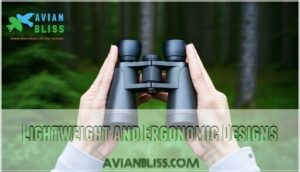
Comfort considerations matter when you’re tracking birds for hours.
Modern stabilized binoculars feature lightweight design with ergonomic grips that reduce hand fatigue.
Material impact shows in carbon fiber housings that cut weight without sacrificing durability.
Many users specifically search for lightweight binocular options for enhanced comfort.
Portability benefits shine during long hikes, while design evolution has created birding binoculars that mold naturally to your hands, enhancing user experience.
Waterproof and Fog-Proof Construction

Since weather rarely cooperates with your birding plans, waterproof and fog-proof construction becomes essential for reliable performance.
Weather never waits for perfect birding conditions—your binoculars should be ready for anything nature throws your way.
Quality binoculars feature sealed optics and nitrogen purging to prevent internal fogging during temperature changes.
Key weather resistance features include:
- Immersion ratings (IPX7 or higher) for complete waterproofing
- Sealed optics preventing moisture infiltration at lens joints
- Nitrogen purging eliminating internal condensation risks
- Temperature effects resistance from -10°F to 140°F
- All-weather gaskets protecting electronic components from elements
To guarantee longevity, consider investing in fully waterproof binoculars.
Long Battery Life for Extended Use

Battery life becomes your birding companion’s heartbeat during those marathon dawn-to-dusk sessions.
Canon’s 12×36 IS III delivers approximately 9 hours with alkaline batteries, while Fujifilm’s Techno-Stabi offers 12 hours of runtime.
Power consumption varies with temperature—expect reduced performance in cold conditions.
Look for models with battery indicators and efficient stabilization systems to maximize your field time without interruptions.
Prioritize binoculars with fully multi-coated lenses for enhanced image clarity and to ensure efficient stabilization.
Tips for Using Stabilized Binoculars Effectively

You’ll get the best performance from your stabilized binoculars when you understand how to properly adjust the eye relief and maintain steady viewing positions.
Proper technique and regular maintenance will maximize your investment and guarantee clear, comfortable birding sessions for years to come.
Adjusting Eye Relief for Maximum Comfort
Finding your sweet spot with eye relief transforms your birding experience from frustrating to fantastic.
Eye Relief Defined means the distance between your eye and the eyepiece where you see the complete field of view. For Eyeglass Wearers, look for 14mm or more eye relief in binoculars.
Adjusting Mechanisms on quality models let you customize positioning. Individual Variation matters—what works for others mightn’t suit you.
Weather-proofing is important for consistent birding performance. Proper Positioning guarantees user comfort during extended birding sessions, accommodating eye relief needs perfectly, ensuring a fantastic birding experience with the right eye relief.
Minimizing Handshake for Clearer Views
Even with image stabilization technology, proper technique maximizes your binoculars’ vibration reduction capabilities.
Hold them with both hands, keeping elbows close to your body for natural stability. Breathe steadily and avoid sudden movements when tracking birds.
These stabilized binoculars work as an excellent tripod alternative, but combining their technology overview with good form delivers truly shake-free viewing for ideal birdwatching comfort.
Caring for Your Binoculars to Extend Lifespan
Proper lens cleaning with microfiber cloths protects delicate lens coating from scratches. Smart storage solutions in padded cases prevent impact damage, while humidity control keeps moisture away from internal components.
Your binoculars’ rubber coating provides durability, but avoiding drops matters most. Many users purchase a specialized cleaning kit for this purpose.
Here’s your maintenance roadmap:
- Clean lenses gently using circular motions with lens-safe cloths
- Store in dry environments with silica gel packets for humidity control
- Use tripod mounting during extended sessions to prevent handling wear
Frequently Asked Questions (FAQs)
Are image stabilized binoculars good for bird watching?
Steady sightings make spotting songbirds simpler.
You’ll appreciate image-stabilized binoculars for birdwatching since they eliminate hand shake, reduce eyestrain during long observations, and provide clearer views when tracking fast-moving birds across varying distances.
Which is better, 8×42 or 10×42 binoculars for birding?
You’ll find 8×42 binoculars offer a wider field of view and steadier images, making them ideal for tracking birds in flight.
However, 10×42 models bring distant subjects closer, perfect for detailed observation of stationary birds.
What is the best image stabilizing binoculars?
When tracking that elusive warbler through dense foliage, you’ll want Canon’s 10x42L IS WP binoculars.
They’re the gold standard with superior optical quality, reliable stabilization technology, and weatherproof construction for serious birders.
The binoculars offer superior optical quality, which is essential for birders.
Is image stabilization worth it for binoculars?
Image stabilization transforms shaky views into steady, clear images.
You’ll reduce eyestrain during long birding sessions and won’t need a tripod.
It’s especially valuable with higher magnifications where hand tremors become magnified, making image stabilization a crucial feature.
How does image stabilization affect battery consumption?
Like a flashlight burning bright, your stabilized binoculars drain batteries faster than traditional models.
Electronic gyroscopes and motors consume power continuously, typically lasting 6-12 hours per charge.
So you’ll need backup batteries for extended birding sessions.
Can stabilized binoculars work without battery power?
Most stabilized binoculars can’t function without battery power since they rely on electronic systems for stabilization.
However, you’ll still get standard binocular viewing – just without the shake-reducing benefits that make them special.
Whats the difference between optical and electronic stabilization?
Your camera’s steady-shot feature mirrors optical stabilization – physical lens elements move to counteract shake.
Electronic stabilization uses digital sensors and motors instead, like your phone’s gyroscope correcting video wobble through software processing.
Are image stabilized binoculars worth the extra cost?
Yes, they’re worth it if you frequently watch birds at high magnifications or for extended periods.
The steadier view reduces eyestrain and lets you track fast-moving birds more easily, especially without a tripod.
Do stabilized binoculars require special carrying cases?
Think of it as armor for your investment—most stabilized binoculars don’t need special cases, but you’ll want padded protection.
Standard binocular cases work fine, though manufacturers often include custom-fitted cases for superior protection.
Conclusion
Don’t put all your eggs in one basket when selecting your perfect viewing companion.
Binoculars with image stabilization birding equipment revolutionizes your wildlife observation experience through advanced gyroscopic technology that eliminates hand tremors.
You’ll discover crystal-clear images at higher magnifications, making distant bird identification effortless.
Canon’s waterproof models offer exceptional battery life for extended field sessions.
Choose magnification levels based on your birding environment, prioritize ergonomic designs for comfort, and maintain proper care routines to maximize your investment’s longevity and performance.
- https://www.digitalcameraworld.com/buying-guides/best-image-stabilized-binoculars
- https://en.wikipedia.org/wiki/IP_Code
- http://gdlp01.c-wss.com/gds/0/0300019570/01/10x42liswp-im-eng.pdf
- https://www.amazon.com/Canon-12x36-Image-Stabilization-Binoculars/dp/B00XOD5C1W
- https://www.bhphotovideo.com/c/product/1149461-REG/canon_9526b002_12x36_is_iii_binoculars.html