This site is supported by our readers. We may earn a commission, at no cost to you, if you purchase through links.
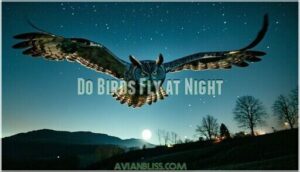 You’d be surprised to learn that yes, many birds do fly at night.
While you’re fast asleep, millions of birds are cruising through the darkness like feathered night owls. Nocturnal hunters such as owls and nighthawks are naturally built for nighttime flight, but here’s the kicker – tons of regular songbirds like warblers and thrushes actually prefer migrating at night.
They’re not crazy; it’s actually genius. Flying after dark helps them dodge daytime predators and beat the heat.
These nighttime aviators use stars, magnetic fields, and super-sharp hearing to navigate safely through the black sky. There’s a whole secret world of nighttime navigation tricks these birds have mastered.
Table Of Contents
- Key Takeaways
- Birds Active at Night
- Do Birds Fly at Night
- Night Flight Patterns
- Birds That Fly at Night
- Nighttime Bird Behavior
- Frequently Asked Questions (FAQs)
- Is it normal for birds to fly at night?
- What kind of bird flies in the night?
- Why are birds not out at night?
- Do birds sleep while they fly?
- Do regular birds fly at night?
- Why don’t you see birds flying at night?
- Do birds fly by night?
- Where do birds go at night time?
- What birds fly at night?
- Do migratory birds fly through the night?
- Conclusion
Key Takeaways
- You’ll discover that millions of birds actively fly at night, including nocturnal hunters like owls and nighthawks, plus migrating songbirds that travel under cover of darkness to avoid predators and beat the heat.
- You can’t easily spot nighttime flyers because they navigate using stars, magnetic fields, and enhanced hearing rather than visual landmarks, making them nearly invisible to human observers in the dark.
- You’ll find that 90% of migrating birds begin their journeys within 69 minutes after dusk, taking advantage of cooler temperatures, calmer winds, and reduced predation risks during their long-distance travels.
- You’re missing an entire secret world above your head while you sleep, as seabirds like petrels cruise moonlit oceans and songbirds like warblers cross continents using sophisticated celestial navigation systems.
Birds Active at Night
You’d be surprised to learn that while you’re sleeping, millions of birds are wide awake and actively flying through the darkness above your house.
These night-shift flyers include master hunters like owls that silently patrol for prey, long-distance travelers like warblers crossing entire continents during migration, and seabirds like petrels that spend most of their lives soaring over moonlit oceans.
While you sleep, millions of feathered night-shift workers patrol the skies above your home.
They also encompass a variety of species, but the text does not explicitly state this, however, it does mention that these include long-distance travelers.
Nocturnal Birds Like Owls and Nightjars
When darkness falls, nocturnal birds like owls transform into silent hunters.
You’ll find these remarkable creatures equipped with extraordinary owl adaptations—oversized eyes that gather faint light and asymmetrical ears for pinpoint hearing.
Nightjars complement this nighttime crew with their nightjar diet of insects, using wide mouths like aerial nets.
Their sensory adaptations and hunting strategies make them masters of the night sky.
Migratory Birds Flying at Night
Migration happens like clockwork for most birds—90% begin their journey within 69 minutes after dusk.
You’ll discover night flying birds use cooler temperatures to reduce energy expenditure while avoiding daytime predators.
Their avian navigation relies on celestial cues from stars and Earth’s magnetic fields.
Many species benefit from calmer air conditions during these nocturnal flights.
However, light pollution disrupts these bird migration patterns, creating significant migration risks for nocturnal navigation.
Seabirds Like Petrels and Shearwaters
While most birds sleep during darkness, seabirds like petrels and shearwaters break the rules entirely.
These ocean wanderers visit their breeding colonies under cover of night after spending daylight hours hunting offshore.
You’ll find them using nocturnal foraging strategies and petrel navigation skills during shearwater migration journeys.
Their unique avian navigation and bird adaptations make nighttime their preferred time for colony visits, utilizing petrel navigation skills and exhibiting remarkable avian navigation.
Do Birds Fly at Night
You’ve probably wondered if those feathered friends outside your window take to the skies after dark. The answer might surprise you – absolutely! Many birds are natural night owls, and their reasons for nighttime adventures are pretty fascinating.
Most birds active at night fall into two camps: the true nocturnal species and the long-distance travelers. Owls, nighthawks, and their crew have incredible night vision and specialized hearing that puts your late-night Netflix sessions to shame.
Meanwhile, millions of songbirds use darkness as their highway during migration seasons. Why birds fly at night often comes down to survival smarts. Cooler temperatures mean less energy spent, fewer predators lurk in darkness, and there’s less air traffic from daytime fliers.
Their retinas are packed with light-sensitive rod cells to help with this. Bird behavior shifts dramatically after sunset – it’s like a whole different world opens up once the sun goes down.
Night Flight Patterns

You’d be amazed at how different night flying looks compared to daytime bird travel – it’s like watching nature switch from easy mode to expert level.
When darkness falls, birds must navigate using stars and magnetic fields instead of familiar landmarks, all while dodging more predators and finding fewer snacks along the way, which is a truly remarkable feat.
Celestial Cues Aid Navigation
Just like ancient sailors, migrating birds use a sophisticated celestial compass system to navigate through darkness.
Like feathered astronomers, these night flyers read star maps better than any GPS device ever could.
You’d be amazed how these feathered pilots read the night sky better than most GPS devices!
Here’s how their stellar navigation works:
- Star Navigation – Birds memorize rotating star patterns and use them as reference points during long migration routes
- Lunar Guidance – The moon’s position helps birds maintain direction when star visibility is limited by clouds
- Magnetic Fields – Earth’s magnetic field acts like an invisible highway system that birds detect through specialized cells
- Polarized Light – Even faint celestial light provides navigational cues that human eyes can’t perceive
Bird migration studies reveal these animals possess an incredible biological compass.
Bird migration tracking shows they’ll adjust flight paths based on celestial positioning, making real-time course corrections throughout their journey.
Bird migration patterns analysis demonstrates how polarized light from stars helps maintain accurate bearings even during overcast conditions.
This celestial compass system explains why bird behavior changes dramatically on cloudy nights – they’re basically flying blind without their stellar roadmap!
Lack of Visual Acuity in Low Light
The darkness poses real challenges for our feathered friends.
Most birds can’t see well when light fades, unlike cats or owls with specialized night vision.
Their rod/cone ratio limits light sensitivity, making prey detection nearly impossible in pitch black conditions.
Capturing images of these birds requires understanding challenges of low light.
| Vision Type | Light Level | Flight Ability |
|---|---|---|
| Diurnal Birds | Bright daylight | Excellent navigation |
| Nocturnal Adaptations | Low light | Enhanced rod cells |
| Visual Limitations | Complete darkness | Crash risk increases |
The table summarizes the visual limitations of birds in different light conditions, highlighting the importance of understanding these factors for successful bird photography, especially in low light environments.
Increased Risk of Predation at Night
Flying after dark turns you into a sitting duck—literally. Nocturnal hunters like owls and snakes capitalize on your sensory limitations, making predator visibility a real threat to avian vulnerability.
Your night flight becomes incredibly risky because:
- Nocturnal animals have superior night vision compared to most birds
- Night predators use specialized hunting strategies targeting sleepy fliers
- Bird sleep patterns make you less alert to approaching danger
- Animal behavior shifts dramatically, increasing roost defense challenges
Reduced Availability of Food Sources
When darkness falls, you’ll notice foraging efficiency plummets for most birds.
Natural food sources become harder to spot, forcing dietary adaptations that favor nocturnal behavior specialists. Competition intensifies around limited nighttime resources, pushing energy conservation strategies.
Poor habitat quality compounds these challenges, disrupting normal bird sleep patterns and feeding patterns.
Smart hunting strategies help nocturnal species thrive despite these obstacles.
Birds That Fly at Night
You’ll find three main groups of birds that take to the skies after sunset, each with their own reasons for choosing darkness over daylight.
Night-flying specialists like nighthawks hunt insects under cover of darkness, long-distance migrants such as warblers and thrushes use cooler temperatures and calmer winds to their advantage.
Ocean-wandering seabirds like gulls and albatrosses follow different schedules than their land-based cousins.
Nocturnal Birds Like Nighthawks
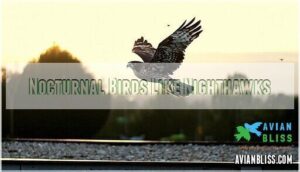
Nighthawks master the art of nocturnal hunting with their specialized nocturnal behavior and incredible camouflage techniques.
These bird species aren’t your typical night bird sounds makers – they’re silent predators whose nighthawk diet consists of flying insects caught mid-air.
Here’s what makes these birds that hunt at night so fascinating:
- Wide-gaping mouths that work like aerial vacuum cleaners, scooping up beetles and moths
- Mottled brown plumage providing perfect camouflage techniques against tree bark and rocks
- Booming dive displays during mating rituals that sound like distant thunder
- Ground-nesting habits in their habitat selection, choosing gravel rooftops and open areas
- Declining populations affecting their conservation status due to urban development
Their bird behavior includes incredible aerial acrobatics during twilight hunts.
Migratory Birds Like Warblers and Thrushes

You’ll witness millions of warblers and thrushes taking nighttime navigation seriously during migration seasons.
These songbirds prefer flying at specific migration altitude levels, using cooler air and celestial cues for direction.
Bird migration patterns research shows they follow established bird migration routes, though light pollution increasingly disrupts their natural timing and stopover ecology needs.
Seabirds Like Gulls and Albatrosses

Over vast ocean expanses, you’ll spot gulls and albatrosses mastering nighttime flight like seasoned pilots.
Gull nocturnal behavior includes scavenging under moonlight, while albatross foraging habits involve gliding effortlessly for hours.
These seabird migration patterns cover thousands of miles, using offshore roosting sites as pit stops.
Despite seabird conservation threats, their bird flight abilities remain remarkable examples of nature’s engineering.
Nighttime Bird Behavior
You’ve probably wondered what birds do when the sun goes down, and the answer’s more fascinating than you’d expect.
While some species take to the skies for epic nighttime journeys, most birds settle into carefully chosen roosting spots like dense trees, thick bushes, or even cozy communal hangouts where they can rest safely until dawn, often in cozy locations.
Roosting Sites Like Trees and Bushes

You’ll find most birds prefer specific roosting habits when choosing nighttime hideouts.
Dense branches provide perfect bird roosts, protecting against wind and predators.
Roost selection depends on microclimate factors like temperature and shelter quality.
Many owl species claim prime spots, creating roosting competition among smaller birds.
Consider purchasing roosting trees to enhance your backyard bird habitat.
Roost site fidelity means your backyard visitors return to the same bird habitats nightly, unless roost disturbance forces relocation.
Communal Roosts for Some Species
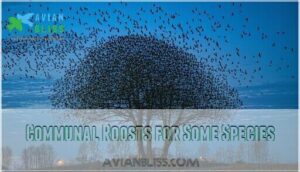
Many bird species huddle together like old friends at a sleepover, choosing communal bird roosts for safety and warmth.
You’ll spot starlings, blackbirds, and some owl species gathering in massive groups.
These roosting habits offer incredible roosting benefits – shared body heat, predator protection, and social interactions.
Bird behavior studies show roost selection depends on shelter quality, while diurnal birds sleep at night.
Roost defense involves coordinated responses to threats.
Safe, Sheltered Locations to Rest

Birds become master real estate agents when selecting nighttime hideouts, prioritizing safety above all else.
Their choosy nature regarding roosting microclimates reflects sophisticated predator avoidance strategies that’ve evolved over millennia.
Here’s what makes the perfect bird bedroom:
- Dense vegetation providing multiple escape routes and concealment
- Elevated perches offering clear views of approaching threats
- Natural shelter materials like thick foliage or tree cavities
- Strategic roosting sociality balancing group protection with individual space
Frequently Asked Questions (FAQs)
Is it normal for birds to fly at night?
Like ancient travelers with their own compass, you’ll see nocturnal flight‘s perfectly normal for birds.
Owls hunt, waterfowl migrate, and songbirds journey under darkness’s cover.
They’re natural night pilots guiding by stars and instinct.
What kind of bird flies in the night?
You’ll spot owls, nighthawks, and mockingbirds cruising after dark.
Waterfowl like ducks and geese migrate at night too.
Even some songbirds travel under cover of darkness, using stars for navigation while avoiding daytime predators.
Why are birds not out at night?
Actually, you’ll find plenty of birds active after dark.
Nocturnal species like owls, nighthawks, and mockingbirds thrive in darkness.
Diurnal birds rest at night, but night shift workers definitely exist in the bird world.
Do birds sleep while they fly?
Slumbering soaring isn’t something you’ll spot in most species.
Most birds can’t sleep while flying since they’d crash without conscious control.
However, frigatebirds and some seabirds briefly doze during flight using half-brain sleep patterns.
Do regular birds fly at night?
You’ll find many regular birds do fly at night.
Most songbirds migrate during darkness to avoid predators and take advantage of cooler temperatures.
Owls, nighthawks, and other nocturnal species hunt actively after sunset.
Why don’t you see birds flying at night?
You can’t see most birds flying at night because they’re asleep, tucked away in trees and bushes.
Plus, it’s dark outside!
Only owls, nighthawks, and a few others are night fliers.
Do birds fly by night?
Yes, many birds fly at night.
You’ll spot nocturnal hunters like owls patrolling for prey, while migrating birds travel under darkness for cooler temperatures and fewer predators—it’s nature’s rush hour.
Where do birds go at night time?
Like ancient knights retreating to their castles, you’ll find birds roosting in trees, shrubs, and cozy nooks when darkness falls.
They seek sheltered spots that protect them from predators and harsh weather while they rest.
What birds fly at night?
Many birds are nocturnal flyers! You’ll spot owls hunting silently, nighthawks swooping for insects, and herons fishing in darkness.
Migrating songbirds also travel at night when it’s cooler and safer from predators.
Do migratory birds fly through the night?
Migratory birds absolutely fly through the night.
You’ll find most long-distance travelers prefer nighttime journeys when it’s cooler and safer from predators.
They navigate using stars, making darkness their highway to distant destinations.
Conclusion
Absolutely mind-blowing discoveries await when you start paying attention to nighttime skies!
Now you know that countless birds do fly at night, from sneaky owls hunting prey to millions of songbirds undertaking epic migrations.
Next time you’re outside after dark, listen carefully – you might catch the soft calls of warblers overhead or spot a nighthawk diving for insects.
The night sky’s bustling with feathered travelers you never knew existed.