This site is supported by our readers. We may earn a commission, at no cost to you, if you purchase through links.
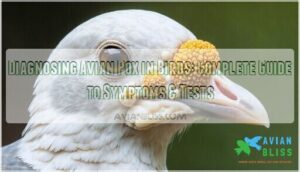 Diagnosing avian pox in birds starts with spotting those telltale wart-like bumps on unfeathered areas like beaks, legs, and around the eyes.
You’ll notice these crusty, raised lesions that look like tiny cauliflowers. The wet form affects mucous membranes, causing breathing difficulties and mouth sores.
While these visual clues give you a strong hint, confirming the diagnosis requires lab work. Veterinarians use PCR testing, virus isolation, or microscopic tissue examination to nail down the exact diagnosis.
Most cases are like a bad cold – they’ll clear up on their own with some TLC. The trick lies in distinguishing avian pox from other skin conditions that might fool even experienced bird watchers.
Table Of Contents
- Key Takeaways
- Avian Pox Overview
- Identifying Avian Pox
- Transmission Risk Factors
- Diagnosing Avian Pox
- Treatment Control Measures
- Frequently Asked Questions (FAQs)
- How do you diagnose avian pox?
- How to test for fowl pox?
- What is the best medicine for pox in birds?
- What is the mortality rate for avian pox?
- How long does avian pox take to heal?
- Can infected birds spread pox to humans?
- Should I remove sick birds from feeders?
- What disinfectants work best against avipoxvirus?
- Do vaccinations exist for wild birds?
- Conclusion
Key Takeaways
- You’ll identify avian pox by spotting characteristic wart-like growths on unfeathered areas like beaks, legs, and around eyes, plus watching for breathing difficulties in the wet form that affects mouth and throat tissues.
- You can’t rely on visual symptoms alone—you’ll need laboratory confirmation through PCR testing, virus isolation, or tissue examination to distinguish avian pox from other skin conditions that look similar.
- You won’t find a cure since it’s viral, but you can provide supportive care with fluids, soft foods, and wound management while most birds recover naturally in 2-4 weeks.
- You’ll prevent future outbreaks by controlling mosquito populations around bird feeding areas, cleaning feeders weekly, and temporarily removing feeders during outbreaks to reduce bird-to-bird transmission.
Avian Pox Overview
You’ll encounter avian pox when examining birds with characteristic wart-like growths on their skin or breathing difficulties.
This viral disease, caused by avipoxviruses, affects over 200 bird species worldwide and presents in two distinct forms that require different diagnostic approaches.
Causative Agents
When you’re dealing with avian pox, you’re facing a double-stranded DNA virus from the Poxviridae family.
These avipoxviruses pack a punch with their remarkable virus survival abilities, persisting in the environment for weeks or even months.
- Fowl pox virus – primarily affects domestic poultry and wild turkeys
- Pigeon pox virus – targets pigeons and related species
- Canary pox virus – infects canaries and other songbirds
- Multiple avipoxvirus strains – show species specificity across bird families
Affected Bird Species
You’ll encounter avian pox across over 200 wild bird species, with songbirds like finches showing the highest species susceptibility.
Wild bird impact varies by region – turkeys, doves, and quail face significant vulnerability in southeastern areas.
Domestic poultry also experience infections, though passerine infections occur more frequently than waterfowl cases, creating distinct regional prevalence patterns.
The disease is caused by viruses in Avipoxvirus, which leads to significant vulnerability and regional prevalence patterns.
Clinical Forms
Avian pox manifests in two primary clinical forms that affect birds differently.
Dry Pox creates wartlike growths on unfeathered skin areas, while Wet Pox targets mucous membranes in the respiratory and digestive tracts.
Understanding these distinct presentations helps you recognize avian pox diagnosis early and assess lesion severity appropriately.
The disease is widespread, but prevention includes vaccination and hygiene.
- Dry Pox (80% prevalence) – Wartlike lesions appear on feet, legs, beak base, and around eyes with potential for secondary infections
- Wet Pox (20% prevalence) – Yellow, cheesy deposits form in mouth, throat, and trachea causing breathing difficulties
- Form Prevalence – Clinical signs vary markedly between cutaneous and diphtheritic presentations affecting treatment approaches
- Lesion Severity – Avian pox lesions range from small nodules to large masses that impair feeding, vision, and flight capabilities
Identifying Avian Pox
You’ll recognize avian pox by its distinctive wart-like lesions that appear on unfeathered areas of infected birds.
The disease presents in two main forms – dry pox with skin growths and wet pox affecting the mouth and throat – each requiring different diagnostic approaches.
Dry Form Symptoms
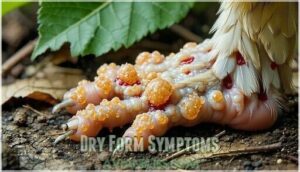
Wart-like growths appear as the telltale sign of dry-form avian pox, developing on featherless areas like feet, legs, and around the beak.
Those telltale wart-like growths signal trouble brewing on your bird’s unfeathered skin.
These lesions start small but progress into crusty, bleeding nodules that can impair your bird’s feeding and preening abilities, making early avian pox diagnosis essential for proper care.
The disease is often linked to seasonal mosquito cycles, which is a critical factor in understanding and managing the spread of avian pox.
Wet Form Symptoms
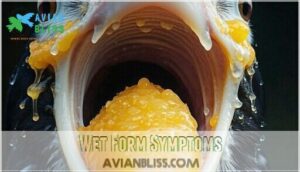
While dry form creates external wart-like growths, wet form avian pox targets your bird’s internal passages.
You’ll notice cheesy plaques coating mouth lesions and throat areas, causing severe breathing difficulties.
These yellow-white formations block airways and make swallowing painful, and eye involvement often occurs alongside throat impact, creating discharge and swelling that impairs vision during avian pox diagnosis.
Birds may also show behavioral symptoms, such as lethargy.
General Symptoms
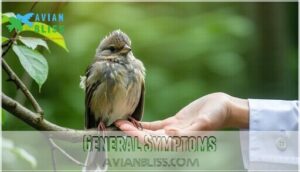
Beyond the specific lesions, you’ll notice broader clinical signs that signal your bird’s declining health.
Appetite loss often appears first, followed by obvious lethargy signs like drooping wings and reluctance to move.
Feather issues become apparent as birds stop preening properly, creating a ruffled, unkempt appearance.
Weight changes occur rapidly in infected birds, making them appear thin and weak.
Secondary infections frequently develop, complicating recovery and requiring immediate veterinary attention for rapid intervention.
Transmission Risk Factors
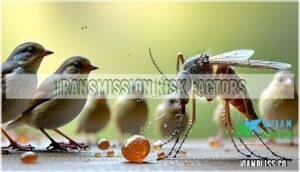
You’ll need to understand how avian pox spreads to effectively identify and prevent outbreaks in your backyard birds.
The virus travels through three main pathways: mosquito bites, direct bird-to-bird contact, and contaminated feeding stations.
Mosquito Vectors
Mosquitoes act as the primary biological vectors for avian pox, with at least 10 mosquito species capable of transmitting the virus between birds.
Ten mosquito species carry the avian pox virus, making these tiny insects deadly disease couriers for backyard birds.
Understanding transmission dynamics helps you recognize outbreak patterns and implement effective control strategies.
- Vector competence varies among mosquito species, affecting transmission rates
- Outbreak correlation shows seasonal patterns matching mosquito breeding cycles
- PCR testing confirms viral presence in mosquito populations during surveillance
- Transmission occurs when mosquitoes feed on infected birds, then bite healthy ones
- Control strategies focus on eliminating standing water breeding sites near bird habitats
Direct Contact
Direct contact between birds creates the perfect storm for avian pox transmission.
When birds gather closely, skin abrasions from feather picking and social behavior expose the conjunctiva to infection.
Overcrowding effects amplify transmission risks, making diagnosing bird diseases essential for flock health.
| Contact Type | Risk Level | Common Locations |
|---|---|---|
| Feather Picking | High | Roosting areas |
| Wound Contact | Very High | Fighting sites |
| Conjunctiva Exposure | Medium | Feeding stations |
| Skin Abrasions | High | Perching spots |
| Social Grooming | Medium | Nesting areas |
Bird pox virus spreads rapidly through direct contact when infected birds touch healthy ones through wounds or abraded skin, making early detection of bird skin lesions essential.
Indirect Transmission
Unfortunately, mosquitoes aren’t your only concern regarding avian pox transmission.
The virus spreads through multiple pathways that make backyard birdfeeders particularly risky. Contaminated surfaces harbor the virus for months, while airborne particles can drift between feeding areas.
Understanding how to mitigate these risks is essential, as dirty feeders pose risks to bird health.
Here’s what increases transmission risk:
- Feed contamination from infected bird droppings mixing with seed
- Environmental persistence allowing mechanical vectors to spread disease for weeks
- Vector survival on contaminated perches and water sources
- Airborne particles carrying viral material between nearby feeding stations
Diagnosing Avian Pox
When you suspect avian pox in a bird, you’ll need to confirm your suspicions through proper diagnostic methods.
While the characteristic wart-like lesions often make identification straightforward, laboratory testing provides definitive confirmation and rules out similar conditions, leading to a more accurate diagnosis of the bird’s condition.
Preliminary Diagnosis
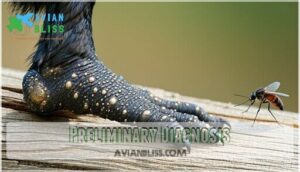
Recognizing avian pox starts with careful visual inspection during your physical exam.
Look for characteristic wart-like lesions on unfeathered areas like feet, legs, and around the beak.
Note any changes in bird behavior, such as difficulty feeding or reduced activity.
Document the bird’s exposure history to infected flocks or mosquito-heavy environments, as this strengthens your preliminary diagnosis before confirming through laboratory testing.
Transmission can occur through contaminated surfaces, so disinfection is key, and understanding the role of mosquito-heavy environments is crucial.
Confirmation Methods
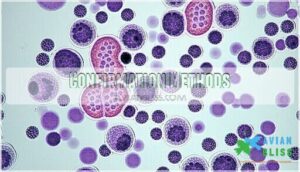
When preliminary signs point to avian pox, you’ll need definitive confirmation through laboratory testing.
Virus isolation involves culturing samples in specialized cell cultures, while PCR testing detects viral DNA with high accuracy.
Histopathology examines tissue samples under microscopes, identifying characteristic Bollinger bodies that confirm infection.
DNA sequencing helps differentiate between virus strains, and tissue examination reveals cellular changes typical of poxvirus infections.
Laboratory Tests

Several laboratory tests can confirm your avian pox diagnosis when visual symptoms aren’t enough.
These sophisticated methods help veterinarians pinpoint the exact virus strain and rule out other diseases that might look similar.
- PCR Testing – Detects avipoxvirus DNA with 90% accuracy, providing quick molecular confirmation
- Histopathology – Examines tissue samples under microscope with 97.4% sensitivity for head lesions
- Virus Isolation – Cultures live virus from samples, requiring specialized lab equipment and expertise
- Biopsy Analysis – Removes small tissue samples to identify characteristic cellular changes and inclusion bodies
- DNA Sequencing – Determines specific virus strain, helping track outbreak sources and transmission patterns
Treatment Control Measures
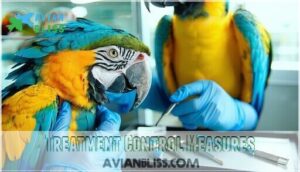
Once you’ve confirmed an avian pox diagnosis, there’s no cure-all treatment, but you can still help infected birds recover through supportive care and smart prevention measures.
Your best bet is focusing on comfort care for sick birds while implementing control strategies to stop the virus from spreading to healthy populations, which is a key part of prevention measures.
Supportive Care
Once you’ve confirmed avian pox through diagnosis, you’ll need to provide supportive care since there’s no direct treatment.
Focus on fluid therapy to prevent dehydration, pain management for comfort, and offering soft foods that won’t irritate lesions.
Ensuring your bird’s comfort often requires specialized pain relief for proper wound care.
Proper wound care helps prevent secondary infections, while isolation methods protect other birds from exposure during recovery.
Prevention Strategies
Staying ahead of avian pox requires smart prevention tactics rather than waiting for outbreaks to strike your feathered friends.
Vaccination research shows promising results, though availability varies by location and species.
- Implement biosecurity protocols – Clean feeders weekly and rotate feeding locations
- Promote habitat diversity – Scatter multiple food sources to reduce crowding at single sites
- Monitor genetic resistance – Some bird populations show natural immunity patterns
- Control transmission pathways – Address wounds and stress factors that increase susceptibility
- Educate community members – Share bird disease prevention knowledge with neighbors and local birding groups
Mosquito Control Measures
Reducing mosquito populations cuts avian pox transmission by targeting the primary disease vector.
Apply larvicide to standing water sources like birdbaths, gutters, and puddles where mosquitoes breed.
Use habitat reduction by eliminating water-holding containers around your property.
Install mosquito traps near bird feeding areas and apply repellent products to outdoor surfaces.
Using effective mosquito larvicide can help control mosquito populations.
Public awareness campaigns help neighbors implement coordinated control strategies for maximum effectiveness.
Frequently Asked Questions (FAQs)
How do you diagnose avian pox?
Like a detective solving a mystery, you’ll diagnose avian pox by spotting characteristic wart-like lesions on unfeathered areas. Confirm through PCR testing or tissue examination for definitive results.
How to test for fowl pox?
You’ll identify fowl pox through visual examination of characteristic wart-like lesions on unfeathered areas, then confirm with PCR testing or biopsy for definitive diagnosis.
What is the best medicine for pox in birds?
Here’s the straight story: there’s no magic bullet for avian pox.
You can’t cure it with medicine since it’s viral.
Instead, you’ll provide supportive care like fluids, soft foods, and antibiotics to prevent secondary bacterial infections.
What is the mortality rate for avian pox?
You’ll find avian pox mortality rates vary substantially depending on the bird’s age and immune status.
Young and immunocompromised birds face higher death rates, while healthy adults often recover naturally from infection.
How long does avian pox take to heal?
Time becomes a patient healer when avian pox strikes your feathered friends.
You’ll typically see lesions resolve in 2-4 weeks with proper supportive care, though severe cases may take longer to fully recover.
Can infected birds spread pox to humans?
No, you don’t need to worry about catching avian pox from infected birds. The virus is species-specific and only affects birds, not humans or other pets.
Should I remove sick birds from feeders?
You should remove sick birds if possible, but don’t handle them directly. Instead, temporarily take down your feeders for 1-2 weeks to disperse flocks and reduce transmission among healthy birds.
What disinfectants work best against avipoxvirus?
Think of disinfection like a superhero battle—you’re fighting an invisible foe that laughs at weak solutions.
Sodium hypochlorite (25–5% bleach) effectively inactivates poxviruses within one minute, making it your go-to weapon against avipoxvirus contamination.
Do vaccinations exist for wild birds?
Vaccines aren’t available for wild birds since vaccination isn’t a feasible method of control and isn’t a plausible method of control for wild bird populations.
Vaccines exist only for domestic poultry like chickens.
Conclusion
Successfully diagnosing avian pox in birds requires recognizing characteristic symptoms and confirming with laboratory tests.
You’ll spot the dry form’s warty lesions on unfeathered skin or identify the wet form’s respiratory complications.
Don’t rely solely on visual identification—PCR testing, virus isolation, or histopathology provide definitive confirmation.
Early detection leads to better outcomes through supportive care and prevention measures.
Remember, mosquito control remains your best defense against future outbreaks in your feathered friends.
- https://www.sciencedirect.com/topics/neuroscience/poxviridae
- https://abcbirds.org/birds/avian-pox/
- https://www.cdc.gov/poxvirus/avianpox/index.html
- https://www.poultryimprovement.org/default.cfm?CFID=2166947&CFTOKEN=ba674761b697fff9-CF624FD3-A0E0-62CD-A60AE7992C809AF6
- https://www.ncwildlife.gov/connect/have-wildlife-problem/wildlife-conflicts/common-wildlife-diseases/bird-diseases