This site is supported by our readers. We may earn a commission, at no cost to you, if you purchase through links.
 Mount your bluebird house at the ideal bluebird house mounting pole height of 4-6 feet above ground for best results.
This height keeps eggs and nestlings safe from ground predators like cats and snakes while remaining accessible for monitoring and cleaning.
You’ll want to use a metal or PVC pole rather than wood, which attracts climbing predators.
The sweet spot balances predator protection with practical maintenance – too low invites trouble, too high makes inspection a circus act.
Position your pole in open areas with scattered perches nearby, avoiding dense woods where cavity competitors lurk.
Getting the height right sets the foundation for everything else.
Table Of Contents
- Key Takeaways
- Choosing Bluebird House Location
- Bluebird House Design Requirements
- Mounting Pole Height Importance
- Bluebird House Orientation Matters
- Environmental Considerations
- Placement Strategies for Success
- Maintenance and Monitoring Tips
- Optimizing Bluebird House Placement
- Frequently Asked Questions (FAQs)
- Conclusion
Key Takeaways
- Mount your bluebird house at 4-6 feet high to balance predator protection with easy maintenance access – this height keeps ground predators like cats and snakes at bay while letting you monitor and clean without ladders.
- Choose metal or PVC poles over wood since they’re harder for predators to climb and resist weather damage better – wood attracts climbing threats and deteriorates quickly outdoors.
- Position your house in open areas with short grass where bluebirds can hunt insects easily, keeping it at least 50 feet from dense woods or buildings to avoid territorial competitors like house wrens.
- Install predator baffles like stovepipe guards 3-4 feet up your pole and face the entrance east for morning warmth while avoiding prevailing winds that could drive rain into the nest box.
Choosing Bluebird House Location
You’ll need to carefully select the right spot for your bluebird house to guarantee these cavity-nesting birds feel secure and find plenty of food.
Right location equals happy bluebirds and successful nesting seasons.
The perfect location balances open space for hunting insects with nearby perches that give them a safe vantage point to survey their territory, which is crucial for these cavity-nesting birds.
Open Habitat Requirements
Bluebirds thrive in open areas with short grass, making insect hunting easier and providing clear flight paths.
Your bluebird house pole needs proper placement in minimal vegetation zones where these birds can spot prey from above.
Open space around your mounting pole height creates the habitat balance bluebirds seek.
Choosing the right location is key to attracting bluebirds.
- Rolling meadows with scattered wildflowers and ankle-high grass
- Golf course fairways bordered by native shrubs and trees
- Suburban yards with mowed lawns and strategic perch access
- Agricultural fields with fence lines offering open area views
Bluebirds are attracted to areas that provide the necessary conditions for their survival, and by placing the house in the right location, you can create a bluebird-friendly environment.
Nearby Perching Spots
You’ll want to position hunting perches within 25-100 feet of your bluebird house pole.
These perches serve as launching pads for insect hunting and security lookouts.
Strategic perch placement dramatically improves nesting success rates.
| Perch Type | Ideal Height | Distance from House |
|---|---|---|
| Fence Posts | 3-5 feet | 25-50 feet |
| Dead Branches | 4-6 feet | 50-100 feet |
| Wire Stakes | 2-4 feet | 15-75 feet |
Natural perching spots like fence lines, utility wires, or dead snags work perfectly.
Your birdhouse pole height should complement nearby perch provision – if natural perches are scarce, consider adding a few metal stakes with crossbars.
Perch function is critical for successful territory establishment, and perch material doesn’t matter much.
Territorial Space Needs
In the sphere of bluebird house placement, spacing distances matter just as much as birdhouse pole height.
Overlapping territories can spark territorial disputes and ramp up competition.
To minimize competition and support healthy population density, keep recommended distances—100 to 300 yards apart—between houses.
The right habitat size guarantees each pair claims enough ground, reducing squabbles and helping your bluebirds thrive.
Bluebird House Design Requirements
You’ll need to get the dimensions right when building your bluebird house, since these cavity-nesting birds have specific requirements for safe and comfortable nesting.
The floor size, entry hole diameter, and proper ventilation determine whether bluebirds will actually use your house or pass it by for better options, which involves considering complete concepts and ensuring proper ventilation.
Floor Size Specifications
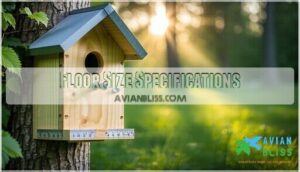
Getting your birdhouse floor dimensions right makes all the difference between a cozy home and a cramped space.
Your bluebird house needs a floor measuring 4.5 to 5.5 square inches to give adult birds enough room without being too spacious.
This size prevents overcrowding while maintaining the snug feel bluebirds prefer for nesting success.
The depth impact from your bluebird house mounting pole height affects how comfortable birds feel inside their new home, which is crucial for nesting success and providing a cozy home.
Entry Hole Diameter
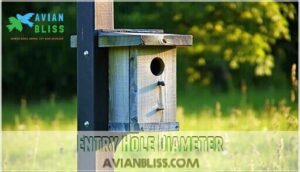
The right entrance hole diameter keeps your bluebird houses safe and species-appropriate.
Eastern and Western Bluebirds need 1½-inch holes, while Mountain Bluebirds require 1 9/16-inch openings.
This precise sizing prevents larger predators from entering while allowing easy access for your target species.
Always verify hole smoothness to prevent wing injuries, and center the opening on your bluebird house pole’s front panel for ideal bird safety, ensuring the entrance is properly aligned for your target species.
Ventilation and Drainage Holes
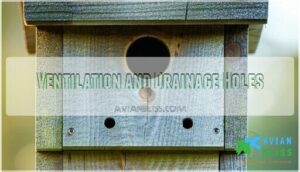
Why settle for a birdhouse that becomes a soggy mess? Proper ventilation and drainage keep your feathered friends comfortable and healthy.
Essential airflow design and moisture control features include:
- Ventilation holes: 1/4-inch diameter holes on sides under the roof for airflow design
- Drainage holes: 1/4-inch holes in each corner of the bottom for moisture control
- Hole placement: Position ventilation holes high to prevent rain entry while maintaining airflow
- Preventing clogging: Check holes regularly during birdhouse maintenance on your birdhouse mounting pole
- Proper birdhouse ventilation: Guarantees temperature regulation and reduces humidity buildup
These features work together with your birdhouse pole height recommendations to create an ideal nesting environment. Good ventilation helps to reduce humidity buildup.
Mounting Pole Height Importance
When you mount your bluebird house at the right height, you’re giving these beautiful birds the best chance at successful nesting while keeping predators at bay.
The proper mounting height creates a sweet spot that’s high enough to deter ground predators but low enough for you to easily monitor and maintain the nest box throughout the breeding season, which is crucial for successful nesting.
Predator Prevention
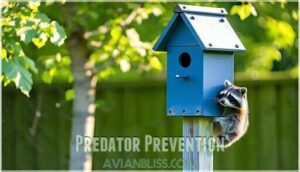
Mounting your bluebird house at proper height creates a fortress against climbing predators like raccoons and cats.
Install your birdhouse pole at 5-6 feet with a quality predator guard pole system. Baffle types include stovepipe designs that stop determined climbers cold. Choose metal pole material over wood since it’s harder to grip.
The height and predator guard are essential, especially given the nesting site shortage that bluebirds face.
Regular guard maintenance keeps deterrent placement effective against sneaky threats year-round.
Easy Monitoring and Cleaning
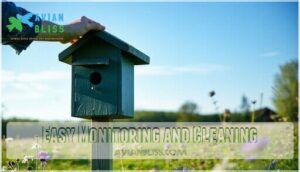
With accessibility design in mind, you’ll find convenient monitoring becomes second nature when your nest box sits at the right height.
Proper birdhouse pole height guidelines guarantee safe inspection without ladders or stretching, while screw mounting systems allow easy removal for thorough cleaning. Consider using a sturdy mounting option for added stability.
- Peace of mind – Regular birdhouse monitoring protects your feathered friends
- Simple maintenance – Easy observation means healthier nesting environments
- Quick cleaning – Accessible nest box hygiene prevents disease buildup
- Consistent care – Proper monitoring frequency keeps families thriving
Recommended Height Range
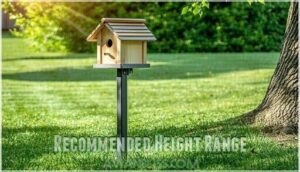
You’ll want to aim for the sweet spot of 4-6 feet above ground for ideal height and bird safety.
This range offers the perfect balance—high enough to limit predator access from cats and raccoons, yet low enough for monitoring ease during nest checks.
Following these birdhouse pole height guidelines guarantees installation tips work effectively while meeting birdhouse pole height standards that prioritize both convenience and protection.
A complete set includes necessary mounting components for easy setup.
Bluebird House Orientation Matters

You’ll get the best nesting success when you face your bluebird house in the right direction and consider environmental factors.
The entrance should face east for morning warmth, while avoiding prevailing winds and balancing sunlight exposure throughout the day to ensure morning warmth.
Facing Directions for Nesting
The ideal orientation creates a comfortable environment for your feathered tenants.
Bluebirds show clear preferences for specific directions:
- East-facing: Primary choice for morning sunlight exposure and wind protection
- Northeast-facing: Secondary option providing balanced sun exposure throughout the day
- North or south: Alternative directions when east-facing isn’t possible due to regional variations
Experimental setups demonstrate that birdhouse orientation substantially affects occupancy rates.
You can find an east facing birdhouse online.
Morning sun helps warm the nest box naturally, while afternoon sunlight can create excessive heat that discourages nesting.
Avoiding Prevailing Winds
Wind direction matters more than you think when positioning your birdhouse pole.
Face the entrance away from prevailing winds to prevent rain intrusion and protect nestlings from harsh weather exposure.
Strong winds can destabilize your birdhouse pole, creating unsafe conditions.
Selecting a durable nesting box can help mitigate these issues.
Consider your area’s microclimate effects—constant wind exposure stresses birds and affects box stability, making proper wind direction assessment vital for successful nesting, and ensuring the birdhouse remains stable in strong winds to protect nestlings.
Sunlight and Shade Considerations
Proper sunlight exposure creates the perfect microclimate for your bluebird family’s comfort and nestling health.
Morning sunlight warms the box naturally, while afternoon shade prevents overheating during peak temperatures.
Consider these temperature regulation strategies:
- Morning sunlight – Provides gentle warming for chicks
- Afternoon shade – Prevents dangerous overheating
- Regional climates – Adjust placement based on local conditions
- Shading strategies – Use natural cover when needed
Smart sun exposure keeps everyone happy.
Environmental Considerations
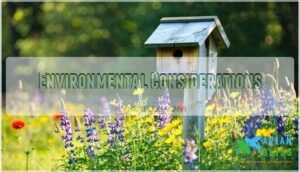
You’ll need to take into account the surrounding environment carefully when positioning your bluebird house at the proper pole height.
The location you choose affects everything from predator access to your birds’ daily feeding success, making environmental factors just as important as the mounting height itself, considering complete concepts.
Nearby Water Sources
Providing bluebirds with water sources near your nest box creates an irresistible habitat combination.
Fresh water for hydration and bathing opportunities keeps these beautiful birds healthy and comfortable.
Place shallow birdbaths, dripping fountains, or small ponds within 50-100 feet of your bluebird house.
Clean water sources regularly to prevent disease transmission and maintain proper water levels during dry spells for consistent availability, ensuring the bluebirds have fresh water and bathing opportunities.
Avoiding Dense Vegetation
Dense vegetation creates a fortress that blocks your bluebird’s hunting success.
Keep birdhouse pole kit installations at least 50 feet from wooded areas to maintain sunlight access and airflow quality.
This open area placement guarantees insect availability while providing visibility concerns protection.
Surrounding vegetation balance matters for wren deterrence – these competitors thrive in brushy spots.
Strategic bluebird house placement with proper predator deterrents maximizes nesting success.
Competing Species and Predators
Your bluebird house faces threats from House Wren attacks and Sparrow Competition that can destroy nests or claim territory.
Install Predator Baffles and Snake Deterrents on your birdhouse pole height to stop climbing predators like snakes and raccoons.
Regular Nest Monitoring helps you spot problems early and maintain predator deterrents effectiveness for successful breeding seasons.
Placement Strategies for Success

You’ll need a well-planned strategy to maximize your bluebird house success and create a thriving bird habitat on your property.
The right spacing, placement distance from structures, and trail design can mean the difference between attracting one pair of bluebirds or establishing a thriving colony.
Spacing Between Multiple Houses
Maintaining proper spacing between multiple bluebird houses prevents territorial conflicts and resource competition.
You’ll need 100 yards between Eastern and Western Bluebird houses, while Mountain Bluebirds require 200-300 yards due to their larger territorial boundaries.
This spacing respects their territorial nature and reduces competition for insects and nesting sites.
Proper trail management with adequate distances guarantees effective territory establishment and supports healthy population density within your habitat’s carrying capacity.
Proximity to Buildings and Trees
You’ll want to keep bluebird houses at least 50 yards from buildings to minimize human disturbance and avoid building reflection that can confuse birds.
Position houses 50-200 feet from wooded areas, as tree shade can attract house wrens that destroy bluebird nests.
This distance also reduces predator access while maintaining wind protection for your birdhouse placement success, ensuring a better chance of bluebird nesting.
Creating Bluebird Trails
Beyond single houses, you can establish multiple boxes to create bluebird trails that support entire populations.
Strategic trail spacing and habitat diversity maximize nesting success across your property.
Consider these trail expansion essentials:
- Trail Spacing – Place boxes 100-300 yards apart depending on bluebird species in your area
- Habitat Diversity – Include varied landscapes like meadows, pastures, and field edges along routes
- Monitoring Frequency – Check boxes weekly during breeding season for maintenance needs
- Community Involvement – Partner with neighbors to extend trails across property boundaries
- Trail Expansion – Add boxes gradually each season based on occupancy rates and success
Proper bluebird house placement along trails creates corridors that connect isolated populations.
Consistent birdhouse pole height tips guarantee uniform installation standards, while strategic bluebird house installation maximizes territorial coverage.
Each pole for birdhouse mounting becomes part of a larger conservation network.
Maintenance and Monitoring Tips
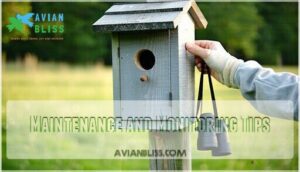
You’ll need to establish a regular maintenance routine to keep your bluebird houses functioning at their best throughout the nesting season.
Proper monitoring and cleaning practices guarantee healthy broods while preventing disease buildup that could harm future occupants, which is crucial for maintaining a healthy environment.
Regular Nest Box Inspection
Check your nest boxes weekly during breeding season to spot potential issues early.
Look for predator signs like claw marks or disturbed nesting material around the entrance.
Monitor from a distance to avoid stressing parent birds, but get close enough to assess repair needs and overall box condition for your cleaning schedule.
Cleaning and Disinfecting Procedures
Regular disinfection protects your bluebird house from harmful bacteria and parasites that accumulate between broods.
Clean the box after each brood fledges using a mild bleach solution (one part bleach to nine parts water). Wear gloves and make certain proper ventilation during cleaning.
Scrub all surfaces thoroughly, then rinse and dry completely before reinstalling. This creates a hygienic environment that prevents mold and disease transmission.
To maintain a healthy environment, consider following some bird cage cleaning tips for a healthy environment and to prevent disease transmission.
Replenishing Nesting Materials
You don’t need to actively replenish nesting materials during the breeding season since bluebirds naturally gather what they need.
However, periodic nest inspection helps guarantee nesting safety by checking for damaged or contaminated material types.
If you discover harmful debris or wet materials during nesting activities, gentle removal protects the brood.
Natural options like dried grasses work best for additional provision when replacement becomes necessary, but avoid synthetic materials that could cause harm.
Optimizing Bluebird House Placement
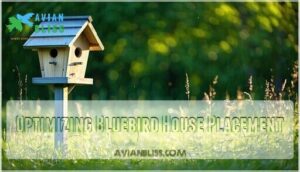
You’ll maximize your bluebird house’s success by getting the mounting pole height just right and adding proper predator protection.
The perfect setup combines strategic placement with smart accessories that keep both birds and maintenance needs in mind, ensuring a successful bluebird house with proper predator protection.
Using Baffles for Predator Protection
You’ll need predator deterrents to protect your bluebird house pole kit from climbing threats.
Install stovepipe baffles using 8-inch galvanized pipe with hardware cloth caps to block snakes, raccoons, and cats.
Position baffles 3-4 feet above ground, leaving no gaps between pole and baffle materials.
Test effectiveness monthly by checking for loose steel wool or hardware damage.
Selecting The Right Mounting Pole
Your mounting pole choice determines your bluebird house’s long-term success.
Powder-coated steel poles offer superior weather resistance, while electrical conduit provides smooth surfaces that deter climbing predators.
Choose poles with 0.5-1 inch diameter for maximum stability.
Two-piece designs with quick-connect mechanisms simplify seasonal cleaning, and proper installation depth of 12-24 inches guarantees wind resistance during storms.
Ensuring Easy Access for Maintenance
Position your birdhouse pole at the perfect height for effortless maintenance access.
A 5-foot mounting height allows you to monitor nest activity without ladders while enabling safe removal for nest replacement.
This accessibility guarantees simple monitoring throughout the breeding season.
Easy cleaning becomes routine when you can reach the box comfortably, and proper birdhouse maintenance protects your feathered tenants year-round.
Consider eastern bluebird preferences for ideal placement.
Frequently Asked Questions (FAQs)
What height should a birdhouse be mounted?
Mount your birdhouse between 4-6 feet high on a pole. This height deters ground predators, allows easy monitoring, and provides bluebirds with their preferred hunting perch for catching insects.
What pole materials work best outdoors?
Metal poles resist rust and weather damage better than wood, which rots and attracts pests.
Steel or aluminum work best – they’re strong, lightweight, and won’t warp.
You’ll get years of reliable use without constant replacements, which makes them a practical choice for long-term use, providing reliable service.
How deep should poles be installed?
You’ll want to bury your pole about 18-24 inches deep, depending on soil conditions. Harder ground needs less depth, while sandy soil requires deeper installation for stability.
Can adjustable height poles be used?
Yes, you can use adjustable height poles for bluebird houses.
They’re handy for maintenance and monitoring, but make certain they lock securely at the proper 5-6 foot height to prevent wobbling or collapse, with a key feature being that they lock securely.
What diameter pole prevents house wobbling?
As the saying goes, "measure twice, cut once" – you’ll want a 1-inch diameter steel pole to prevent wobbling.
This will guarantee your bluebird house stays steady in wind and weather conditions.
Do galvanized poles rust over time?
Galvanized poles can develop rust over time, especially where the coating gets scratched or damaged. You’ll typically see rust spots appearing after several years of weather exposure.
Conclusion
Why settle for anything less than perfect regarding your bluebird house mounting pole height?
Getting this vital detail right at 4-6 feet creates the foundation for successful nesting seasons ahead.
You’ve learned that proper height protects against predators while keeping maintenance manageable.
Remember to pair your correctly positioned pole with metal construction, strategic location choices, and regular monitoring.
When you combine the ideal bluebird house mounting pole height with these essential factors, you’re setting up both yourself and your feathered friends for years of rewarding backyard wildlife watching.
- http://www.nabluebirdsociety.org/PDF/NABSFactsheetGettingStarted.pdf
- http://static.birds.cornell.edu/Publications/Birdscope/Spring2001/preference.html
- https://michiganbluebirds.org/nest-boxes/nestbox-basics
- https://georgiawildlife.com/sites/default/files/wrd/pdf/CreatingPerfectHomeforBluebirds.pdf
- https://ohiobluebirdsociety.org/about-bluebirds/bluebird-nestbox-baffles/