This site is supported by our readers. We may earn a commission, at no cost to you, if you purchase through links.
 You’ll discover that birds have evolved remarkable adaptations for their specific environments, from the Arctic tern’s 44,000-mile migration to the desert-dwelling roadrunner’s efficient kidneys.
Bird facts about their habitats reveal how species like woodpeckers develop chisel-like beaks for forest drilling, while shorebirds sport long, sensitive bills for probing mudflats.
Each habitat type—whether alpine peaks, tropical rainforests, or urban landscapes—shapes everything from wing structure to breeding behavior.
What’s fascinating is how these adaptations work together like pieces of a puzzle, creating survival strategies that have taken millions of years to perfect, and are a result of their specific environments.
Table Of Contents
- Key Takeaways
- Bird Habitat Types
- Habitat Requirements
- Adaptations to Habitats
- Human Impact on Habitats
- Importance of Habitats
- Frequently Asked Questions (FAQs)
- What are the habitats of birds?
- How do birds live in their environment?
- What are the habitat requirements for birds?
- Why do birds live in different habitats?
- How do birds choose their specific nesting locations?
- What determines a birds territorial boundaries?
- How do seasonal weather patterns affect habitat use?
- Do birds return to exact same locations yearly?
- How do young birds learn habitat preferences?
- Conclusion
Key Takeaways
- You’ll find birds have evolved specialized adaptations – from Arctic terns’ 44,000-mile migrations to roadrunners’ efficient kidneys – that perfectly match their specific environments through millions of years of evolution.
- Each habitat type shapes everything about a bird’s survival – whether it’s woodpeckers developing chisel-like beaks for forest drilling or shorebirds sporting long, sensitive bills for probing mudflats.
- Birds need specific habitat requirements to thrive – including reliable food sources, safe nesting sites, adequate shelter from predators and weather, and suitable migration routes for seasonal travelers.
- Human activities threaten nearly 1,500 bird species through habitat destruction, fragmentation, climate change, and pollution, making conservation efforts and habitat restoration crucial for protecting these remarkable creatures.
Bird Habitat Types
You’ll discover that birds have adapted to virtually every habitat on Earth, from freezing mountain peaks to scorching deserts.
Each environment shapes how these remarkable creatures look, behave, and survive in their chosen homes.
Alpine and Mountain Habitats

When you explore mountain bird species above 2,000 meters, you’ll discover incredible High-altitude Adaptations that showcase nature’s resilience.
Mountain peaks above 2,000 meters reveal nature’s most resilient aviators conquering thin air and freezing temperatures.
These alpine habitats challenge birds with extreme temperatures, thin air, and harsh UV radiation, yet over 100 species thrive here through remarkable Mountain Avian Ecology strategies.
- Unique Species like Ptarmigan and Snow Finches use thick plumage and high metabolic rates for survival
- Habitat requirements include specialized feet for rocky terrain and seasonal migration patterns
- Climate Impacts force birds to adapt behaviorally through huddling and reduced activity during storms
- Alpine Conservation efforts focus on protecting these fragile ecosystems from human disturbance and climate change
Desert Landscapes and Grasslands
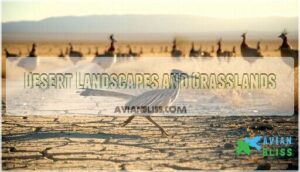
Where can you find over 1,200 bird species thriving in seemingly impossible conditions?
Desert and grassland habitats support incredible diversity despite harsh environments.
These arid landscapes host specialized species like Roadrunners and Prairie-Chickens, each perfectly adapted to survive extreme temperatures and limited water through remarkable evolutionary strategies.
| Desert Adaptations | Grassland Features |
|---|---|
| Water conservation through specialized kidneys | Ground-nesting with camouflaged eggs |
| Heat tolerance up to 120°F | Long legs for covering vast distances |
| Seed-based diets requiring minimal water | Seasonal diet shifts following insect cycles |
| Opportunistic breeding after rainfall | Synchronized breeding with food abundance |
Forest Ecosystems and Savannas

You’ll discover that forest ecosystems and savanna habitats support remarkably diverse bird communities through their unique canopy structure and fire ecology patterns.
Forest biodiversity thrives in these forested habitats, where habitat connectivity allows species to move freely between territories. Oak-hickory forests can support up to 200 bird species.
- Forest bird species like Harpy Eagles hunt beneath dense canopies
- Savanna wildlife includes ostriches roaming open grasslands with scattered trees
- Forest habitats provide multilayered nesting sites from ground to treetops
- Fire ecology shapes savanna ecosystems, creating ideal conditions for ground-nesting birds
Wetland and Aquatic Environments

Within wetland ecosystems, you’ll find over 800 wetland bird species thriving in brackish water and aquatic environments.
These aquatic habitats support shorebird migration patterns while providing essential aquatic vegetation for feeding.
However, water pollution threatens these delicate wetland ecosystems, making wetland conservation essential for protecting species that depend on these important aquatic habitats for survival.
Habitat Requirements
You’ll discover that birds have specific habitat requirements that determine where they can successfully live and reproduce.
These essential needs include reliable food sources, safe nesting sites, adequate shelter from predators and weather, and suitable migration routes for seasonal travelers.
Food and Water Sources

You’ll discover that water availability shapes where birds choose to live, with some species traveling miles to reliable sources while others extract moisture from their prey.
Bird foraging strategies vary dramatically – hummingbirds sip nectar, hawks hunt live prey, and finches crack seeds using specialized beaks.
Seasonal resources like migrating insects or ripening berries trigger feeding frenzies that support entire populations.
Creating a habitat with abundant food sources is essential for attracting birds to an ideal bird habitat.
Nesting and Breeding Sites
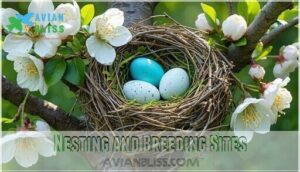
You’ll find that successful breeding depends on finding the right real estate.
Birds select nesting sites based on safety, accessibility, and proximity to food sources.
Nest building varies dramatically – from simple ground scrapes to elaborate woven structures.
Clutch size ranges from one egg to over a dozen, while incubation periods span 10-80 days depending on species.
Consider providing safe nesting locations to increase local bird populations.
Parental care strategies differ widely, affecting fledgling success rates across diverse breeding habitats, which is crucial for the local bird populations and overall breeding habitats.
Shelter and Protection

Birds need secure hideouts that serve as their lifeline against predators and harsh weather.
You’ll find these feathered architects using everything from dense vegetation to rocky crevices for their survival toolkit.
Here are 5 key shelter strategies birds use:
- Predator Avoidance – Dense shrubs and tree canopies provide quick escape routes from hawks and cats
- Thermal Cover – Evergreen trees and thick brush offer insulation during cold snaps and scorching heat
- Roosting Strategies – Communal roosts in protected areas help birds share warmth and watch for danger
- Territory Defense – Strategic shelter locations allow birds to guard their turf while staying hidden
- Nesting Materials – Secure sites with nearby twigs, moss, and fibers enable safe nest construction
Migration Patterns

Throughout the year, countless birds set out on remarkable journeys, following ancient migration patterns that connect distant habitats.
You’ll witness complete migrations where entire populations travel seasonally, partial migrations involving only some individuals, and irregular irruptive movements triggered by food shortages or environmental stress.
| Migration Type | Distance Examples | Navigation Methods |
|---|---|---|
| Complete Migration | Arctic Tern: 25,000+ miles annually | Magnetic field detection |
| Partial Migration | Some robins migrate, others stay | Sun and star positioning |
| Irruptive Migration | Snowy owls moving south irregularly | Landmark recognition |
| Altitudinal Migration | Mountain birds descending in winter | Magnetoreceptors in eyes |
| Nomadic Movement | Following food sources unpredictably | Wind pattern utilization |
Migration triggers include seasonal temperature changes, food availability, and hormonal shifts called zugunruhe. Climate impacts are disrupting traditional timing, creating mismatches with peak food resources.
Stopover ecology becomes vital as birds need refueling sites along established flyways. Conservation challenges mount as habitat degradation affects these critical rest areas, threatening bird migration success across all habitat types.
Adaptations to Habitats
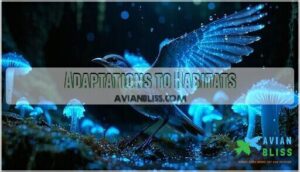
You’ll discover how birds have evolved remarkable adaptations that help them thrive in their chosen habitats.
From the Snowy Owl’s white plumage that provides perfect Arctic camouflage to the Oilbird’s echolocation abilities in pitch-dark caves, these adaptations showcase nature’s incredible problem-solving skills, including remarkable adaptations.
Coloration and Camouflage
Three key coloration adaptations help birds thrive in their habitats.
You’ll see disruptive coloration breaking up body outlines, like woodpeckers’ bold patterns.
Habitat matching lets birds blend seamlessly – think snowy owls’ white plumage against Arctic snow.
Seasonal changes alter plumage colors for predator avoidance and mate selection, ensuring survival across different environments.
Some species even use cryptic coloration techniques to blend into their surroundings, utilizing cryptic coloration and habitat matching to survive, and these adaptations include seasonal changes.
Physical Features and Thermoregulation
From Arctic tundra to scorching deserts, you’ll find birds sporting remarkable physical adaptations that regulate their body temperature.
Plumage density varies dramatically—penguins pack thousands of feathers per square inch for cold adaptations, while desert species have sparse, loose feathering for heat adaptations.
Leg adaptations include feathered feet in snowy owls and long, bare legs in flamingos for wading.
Bill morphology also aids thermoregulation through specialized blood vessels.
Behavioral Adaptations and Migration
When you observe birds in their natural environments, you’ll notice remarkable foraging strategies that match their surroundings perfectly.
Cardinals crack seeds with powerful beaks, while herons stand motionless for hours waiting to strike.
Social behavior varies dramatically—some species flock together for protection, others remain solitary.
Mating rituals showcase elaborate dances and calls, and predator avoidance techniques include alarm calls and synchronized movements.
Migratory navigation relies on celestial cues and magnetic fields, enabling incredible journeys across continents, utilizing magnetic fields.
Specialized Features and Echolocation
You’ll discover that echolocation mechanisms in birds create remarkable nocturnal adaptations for cave navigation.
Oilbirds and swiftlets use clicking sounds to navigate pitch-black caves, showcasing incredible sensory biology and avian intelligence.
These physical adaptations allow environmental adaptation in challenging bird habitats, where traditional vision fails, demonstrating how bird behavior evolves for survival.
Their specialized habitat features demonstrate how bird behavior evolves for survival.
Human Impact on Habitats

Human activities have transformed bird habitats worldwide, with nearly 1,500 species now threatened primarily due to habitat destruction and fragmentation.
You’ll discover how deforestation, urbanization, climate change, and pollution create unprecedented challenges for our feathered friends.
While conservation efforts work to protect what remains, these efforts are crucial in the face of such significant threats, including climate change.
Habitat Loss and Fragmentation
You’re witnessing the biggest threat to bird populations worldwide.
Deforestation impacts and urban sprawl destroy millions of acres annually, while agricultural expansion fragments remaining habitats into isolated patches.
These fragmentation effects prevent birds from finding mates, food, and safe nesting sites.
Human activities create deadly barriers that many species can’t overcome, making conservation strategies essential for survival.
Climate Change and Pollution
Climate change disrupts breeding patterns and food sources, while pollution from human activities causes health issues and mortality among bird populations.
You’ll find that rising temperatures force species to shift their ranges, affecting migration timing and habitat suitability.
Pollution impacts include pesticide exposure, plastic ingestion, and toxic contamination that degrades traditional nesting sites, requiring urgent mitigation efforts.
Invasive Species and Human Activities
Nearly 40% of bird species face threats from invasive species and human activities.
Invasive mammals have eliminated 9% of island birds, while invasive plants reduce food availability by 30%.
Your urban sprawl creates habitat fragmentation, disrupting migration routes for 22% of species.
Human footprint through agriculture and infrastructure development isolates populations, reducing genetic diversity and increasing species competition for remaining resources.
Homeowners can protect birds by minimizing hazards to help conserve bird species and reduce the impact of human activities on their habitat fragmentation.
Conservation Efforts and Protected Areas
Conservation efforts are making a real difference through strategic habitat restoration and species recovery programs.
You’ll find these approaches proving most effective in bird conservation efforts:
- Habitat Restoration – Wetland projects increased waterbird breeding success by 18%
- Species Recovery – California Condor population grew from 27 to over 500 birds
- Community Engagement – Local participation boosts compliance rates by 60%
- Funding Strategies – Protected areas now cover 20 million square kilometers globally
National parks and preserves protect 75% of threatened species, though endangered bird habitats still face challenges from insufficient policy enforcement and bird habitat loss.
Addressing these issues often requires exploring varied funding options.
Importance of Habitats

You’ll discover that bird habitats aren’t just addresses—they’re complex ecosystems that determine whether over 700 species can survive and thrive on our planet.
Each habitat type supports unique communities of birds while providing essential services that keep our natural world balanced and functioning, which is crucial for the survival of these species.
Biodiversity and Ecosystem Services
You’ll discover that birds serve as nature’s workforce, maintaining ecosystem health through pollination services, seed dispersal, and pest control.
Their habitat interdependence creates a delicate ecological balance where bird species diversity directly supports biodiversity.
When habitats thrive, birds flourish—and when birds flourish, entire ecosystems benefit from their essential contributions to environmental stability.
Habitat Diversity and Bird Species
You’ll find habitat diversity directly drives bird species richness through specialized niches.
Different environments support unique communities through niche partitioning and habitat specialization.
Consider these remarkable patterns:
- Tropical forests – Host over 40% of all bird species despite covering just 6% of Earth’s surface
- Wetland mosaics – Support 15+ species per acre through habitat heterogeneity
- Mountain gradients – Create distinct biogeographic zones every 1,000 feet elevation
- Desert oases – Concentrate 50+ species in tiny habitat patches
- Urban parks – Maintain surprising ecological diversity with proper habitat management
This community structure reflects how habitat heterogeneity shapes global bird species diversity patterns.
Conservation Strategies and Habitat Rehabilitation
You’ll find that habitat restoration can recover 70% of degraded bird environments through active intervention.
Reforestation and wetland projects boost species richness by 40%, while native plant use increases nesting success by 25%.
Protected areas covering 15% of bird habitats reduce loss by 30%, and community involvement improves compliance by 50%.
Many people purchase items related to bird habitat products, and sustainable practices help endangered species populations grow by 15%, which is a result of active intervention.
Human-Bird Interactions and Coexistence
You can transform your backyard into bird-friendly environments by providing native plants, water sources, and nesting boxes.
Urban birding reveals how city sparrows and pigeons adapt to human activities, while conservation partnerships between communities and wildlife organizations create sustainable urban habitats.
Simple bird-friendly practices like reducing human disturbance help urban bird species thrive alongside us.
Frequently Asked Questions (FAQs)
What are the habitats of birds?
Like a vast apartment complex with different neighborhoods, you’ll find birds inhabiting forests, grasslands, wetlands, deserts, mountains, coasts, and cities—each habitat perfectly matching their unique needs for food, shelter, and breeding.
How do birds live in their environment?
Birds survive by adapting their bodies and behaviors to specific environments.
You’ll see wading birds with long legs for marshes, thick-feathered arctic species for cold climates, and desert birds using cacti for shelter.
What are the habitat requirements for birds?
You’ll need to provide specific habitat requirements based on each bird species’ unique needs.
Adequate food sources, suitable nesting sites, proper shelter from predators and weather, clean water access, and appropriate vegetation structure for their particular lifestyle.
Why do birds live in different habitats?
Have you ever wondered why feathered neighbors don’t all flock together?
Different habitats provide unique resources, shelter, and food sources that match birds’ specialized adaptations, physical features, and survival needs perfectly.
They also offer unique resources that are essential for the birds’ survival.
How do birds choose their specific nesting locations?
You’ll find birds select nesting spots based on safety from predators.
Food availability, proper shelter, and specific habitat features like vegetation structure, water access, and territorial boundaries that match their species’ needs.
What determines a birds territorial boundaries?
Territorial tactics truly depend on your bird’s available resources, population density, and breeding season demands.
You’ll find they defend areas containing adequate food sources, suitable nesting sites, and safe shelter from predators and competitors.
How do seasonal weather patterns affect habitat use?
You’ll notice birds shift their habitat use as seasons change.
Moving to warmer areas during winter, seeking breeding grounds in spring, and adjusting foraging patterns based on food availability and weather conditions.
Do birds return to exact same locations yearly?
You’d think birds possess GPS-like precision, but most don’t return to identical spots yearly. They show "site fidelity" to general areas, not exact locations, adapting to environmental changes.
How do young birds learn habitat preferences?
Young birds learn habitat preferences through a combination of innate instincts and learning from their parents.
They’ll follow mom and dad to suitable feeding spots, observing which environments provide the best resources and safety for their survival needs.
Conclusion
Understanding bird facts about their habitats is like watching nature’s greatest architectural masterpiece unfold across the globe.
You’ve seen how 700+ species have crafted specialized tools for survival, from the Arctic tern’s marathon migrations to the woodpecker’s precision drilling equipment.
These adaptations aren’t accidents—they’re evolutionary solutions to habitat challenges that took millions of years to perfect, and are a result of millions of years of development, leading to specialized tools for each species, which are incredible habitat relationships.
As you explore your local environment, you’ll start recognizing these incredible habitat relationships everywhere.