
This site is supported by our readers. We may earn a commission, at no cost to you, if you purchase through links.
 You’ll discover an incredible diversity of birds in coastal regions, from sandpipers scurrying along beaches to majestic pelicans soaring overhead.
These specialized species have evolved remarkable adaptations—webbed feet for swimming, salt glands for processing seawater, and varied beak shapes for different feeding strategies.
Coastal environments support everything from tiny plovers that nest in sand dunes to great blue herons stalking through marshes.
Whether you’re watching terns dive-bomb for fish or observing migrating shorebirds refuel during epic journeys, coastal areas offer year-round birding opportunities.
The secret lies in understanding each species’ preferred habitat and timing your visits right to witness the incredible diversity of birds in their natural habitats, with remarkable adaptations.
Table Of Contents
- Key Takeaways
- Coastal Bird Species
- Feeding Behavior Patterns
- Habitat Distribution Variations
- Migration Behavior Traits
- Conservation Threats Solutions
- Frequently Asked Questions (FAQs)
- What are coastal birds called?
- What type of birds live at the beach?
- What birds are associated with the ocean?
- What are those little birds on the beach?
- How do coastal birds navigate during storms?
- What sounds do different coastal birds make?
- Which coastal birds are best for birdwatching?
- How do coastal birds care for young?
- What time of year do coastal birds mate?
- Conclusion
Key Takeaways
- You’ll find coastal birds with specialized adaptations like salt glands, webbed feet, and varied beak shapes that help them thrive in harsh marine environments where freshwater birds can’t survive.
- You can observe over 300 coastal bird species with distinct feeding strategies—from pelicans’ dramatic dive-bombing to herons’ patient stalking—each perfectly adapted to their specific habitat niche.
- You’ll discover that coastal birds serve as essential ecosystem indicators, controlling fish populations, cycling nutrients between marine and terrestrial environments, and signaling overall habitat health.
- You should know that 25% of coastal bird species need immediate protection due to habitat loss, climate change, and development pressures, making conservation efforts critical for maintaining these vital ecosystems.
Coastal Bird Species
You’ll discover over 300 bird species that call coastal regions home, from dramatic diving pelicans to tiny sandpipers scurrying along the waves.
These specialized birds have evolved remarkable adaptations to thrive in harsh saltwater environments, making them essential indicators of ocean health.
Beach Birds Characteristics
You’ll easily identify beach birds by their remarkable adaptations for coastal living.
These coastal bird species showcase distinctive features that help them thrive in sandy environments.
Key beach bird characteristics include:
- Specialized feet – webbed or partially webbed for stable movement on shifting sand
- Cryptic feather coloration – sandy hues provide camouflage from predators
- Robust bird beak shapes – pointed bills perfect for probing buried invertebrates
Their beach bird plumage and shorebird legs work together perfectly for shoreline survival.
Marine Birds Adaptations
Through adaptations forged by ocean life, marine birds showcase remarkable evolutionary solutions.
You’ll observe their Salt Glands removing excess sodium, while specialized Feather Structure provides waterproofing.
Diving Techniques vary dramatically—some plunge from heights, others swim underwater.
Beak Adaptations reflect feeding strategies, from pelican pouches to skimmer blades.
Wing Morphology enables soaring or rapid pursuit.
These bird adaptations help coastal bird species thrive in challenging seabird habitats, supporting seabird conservation efforts.
Seabirds Roles in Ecosystems
Seabirds serve as nature’s quality control team, maintaining coastal health through their diverse ecological roles.
Nature’s coastal guardians patrol our shores, keeping marine ecosystems balanced and thriving through their essential ecological work.
You’ll find these marine birds acting as both predators and prey, creating essential ecosystem balance that supports entire food webs.
Here’s how seabirds contribute to coastal ecosystems:
- Nutrient cycling – They transport marine nutrients to terrestrial environments through guano deposits
- Population control – Marine birds regulate fish populations, preventing overgrazing of marine resources
- Indicator species – Their presence signals healthy coastal environments for seabird conservation efforts
- Seed dispersal – Coastal bird species spread vegetation across islands and shorelines
Seabirds play a vital role in ecosystem health, often serving as key ecosystem indicators that reflect the overall condition of their habitats.
Feeding Behavior Patterns
You’ll observe fascinating feeding adaptations that help coastal birds capture prey in challenging marine environments.
Each species has evolved specialized techniques, from the dramatic plunge-diving of pelicans to the patient stalking strategies of herons in shallow waters, which are dramatic examples of adaptation.
Seabirds Diet and Foraging

How do seabirds fuel their ocean lifestyle?
Fish make up 60-80% of most seabird diets, with these marine bird species consuming roughly 10 million tons annually worldwide.
Their foraging strategies range from surface seizing to deep pursuit dives extending 100 kilometers from shore.
Seabird research reveals these coastal bird ecology masters prefer energy-rich prey like oily fish, adapting their feeding habits seasonally based on availability and nutritional needs.
Understanding seabird food sources is essential for conservation efforts and to know their ocean lifestyle.
Wading Birds Feeding Strategies
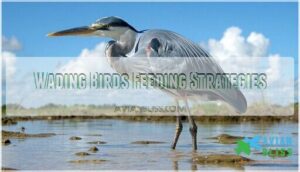
You’ll notice wading birds employ patience as their primary weapon, standing motionless for minutes before striking.
Their feeding strategies showcase remarkable adaptations for coastal ecosystems. Understanding wading bird habitats is essential for appreciating these adaptations.
- Wading Techniques: Great Blue Herons use deliberate, slow movements to avoid disturbing prey in shallow waters
- Prey Capture: Sharp bills and lightning-fast reflexes allow precise strikes at fish and crustaceans
- Foraging Methods: Different leg lengths enable species to hunt at various water depths simultaneously
Ospreys Hunting Techniques
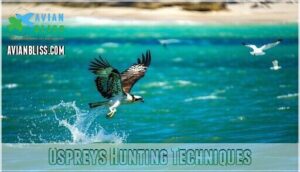
You’ll witness Osprey’s remarkable aerial hunting prowess as they soar above coastal waters, scanning for fish with telescopic vision.
Their specialized water entry technique involves closing nostrils and angling wings backward, demonstrating why coastal birdwatching enthusiasts consider ospreys masters of talon use in coastal ecosystems.
These fish hawks execute precise dive strategies, plunging feet-first with talons extended for efficient fish capture.
Habitat Distribution Variations
You’ll find coastal birds distributed across dramatically different habitats, from the rocky cliffs of Maine to the mangrove swamps of Florida.
Each species has evolved specific adaptations that match their preferred coastal environment, whether it’s the sandy beaches where plovers nest or the deep waters where cormorants hunt, showcasing their ability to thrive in various coastal settings.
Regional Endemics and Conservation

How do Endemic Species survive in isolated coastal regions?
Over 50 regional endemics face critical threats, with 40% endangered due to habitat loss and invasive predators.
Conservation efforts including protected areas, captive breeding programs, and community engagement have increased habitat preservation by 30%.
These specialized birds serve as essential indicators of ecosystem health, making coastal bird conservation essential for maintaining biodiversity and preventing further species decline.
Coastal Wetlands and Estuaries
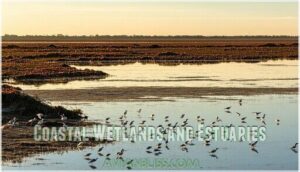
You’ll find coastal wetlands and estuaries serve as nature’s nurseries, supporting seventeen wading bird species in Florida alone.
These dynamic Marine Habitats change with Tidal Patterns, creating rich feeding grounds where saltwater meets fresh.
Estuary Ecosystems provide critical resources for shorebird migration through:
- Protected nesting areas in salt marshes
- Abundant invertebrate populations in mudflats
- Freshwater sources for drinking and bathing
Understanding coastal bird habitats requires knowledge of shorebird characteristics to effectively identify species, and recognize the importance of nature’s nurseries and estuary ecosystems.
Beach and Shoreline Bird Habitats

You’ll discover diverse coastal bird habitats where Beach Ecosystems support specialized species through unique Shoreline Dynamics.
Sandy beaches provide nesting sites for plovers and terns, while rocky shores offer shelter for oystercatchers amid abundant marine life.
Coastal Geology shapes these bird habitats, creating mudflats rich in invertebrates that attract migrating shorebirds during their coastal wildlife journeys, influenced by Shoreline Dynamics.
Migration Behavior Traits

You’ll witness remarkable journeys as coastal birds navigate thousands of miles along major flyways, with some shorebirds traveling over 10,000 kilometers between breeding and wintering grounds.
These migration patterns follow precise timing linked to tidal cycles and seasonal food availability, making coastal stopover sites critical for refueling during their epic travels.
Shorebirds Migration Patterns
You’ll witness remarkable journeys as shorebirds undertake long distance travel exceeding 10,000 kilometers along major flyway routes.
These coastal bird populations rely on precise migration timing and critical stopover sites to refuel during their epic adventures.
Their flocking behavior creates spectacular displays while following ancient bird migration patterns that connect continents through shorebird migration corridors.
Waterfowl Population Trends
You’ll notice coastal bird populations fluctuating dramatically across regions, with some waterfowl showing remarkable population growth while others face significant waterfowl decline.
Habitat loss remains the primary driver behind these bird population trends, though conservation efforts have sparked impressive species recovery in protected areas.
Shorebird migration patterns reveal how these coastal birding hotspots support millions of birds annually, making coastal waterfowl monitoring essential for understanding broader ecosystem health.
Understanding waterfowl population dynamics is vital for effective conservation strategies.
Conservation Status and Efforts
Today, coastal bird conservation faces unprecedented challenges as over 25% of species require immediate protection.
You’ll find that successful conservation depends on coordinated efforts across multiple fronts.
- Species Protection: Endangered species like Piping Plovers benefit from nest monitoring and predator control programs
- Habitat Restoration: Wetland restoration projects create essential breeding grounds for herons and egrets
- Climate Action: Sea-level rise mitigation protects nesting beaches from flooding
- Wildlife Preservation: Marine conservation areas safeguard feeding territories for diving birds
Conservation Threats Solutions

You’ll face significant challenges protecting coastal birds from habitat destruction, climate change, and development pressures threatening over 25% of species.
Understanding these threats and proven conservation strategies helps you support effective protection efforts for these essential ecosystem indicators.
Habitat Destruction and Climate Change
Climate change devastates coastal bird populations through habitat destruction and rising sea levels.
You’ll witness shorebird declines of 30-40% over fifty years as coastal erosion eliminates nesting sites.
Sea level rise floods low-lying habitats, forcing birds inland while habitat loss fragments remaining areas.
Conservation efforts focus on wetland restoration and climate adaptation strategies. Understanding bird conservation threats is essential for developing effective protection plans.
Coastal Development Impacts
Beyond natural threats, human activities reshape coastal landscapes where birds depend on stable environments for survival.
Coastal development transforms pristine shorelines into bustling urban centers, triggering habitat loss and coastal erosion that disrupts nesting sites.
- Beachfront construction blocks traditional nesting areas, forcing birds to relocate or abandon breeding entirely
- Marina development creates coastal pollution through fuel spills and increased boat traffic disturbing feeding grounds
- Urbanization effects include artificial lighting that confuses migrating birds and window strikes in high-rise buildings
- Sea level rise accelerates erosion around developed areas, eliminating critical mudflats and salt marshes essential for coastal ecosystems
Conservation Strategies and Initiatives
Multiple conservation strategies work together to protect coastal birds and their fragile habitats.
You’ll find habitat restoration projects boost breeding success by 40%, while invasive species control leads to 50% population recovery in seabird colonies.
| Strategy | Impact |
|---|---|
| Habitat Restoration | 40% breeding success increase |
| Invasive Species Control | 50% population recovery |
| Community Engagement | 35% conservation success boost |
Coastal management combines marine protected areas with eco tourism initiatives.
These bird conservation efforts create coastal bird sanctuaries while supporting local economies through sustainable wildlife conservation practices.
Effective conservation requires the use of specialized bird conservation products to support habitat restoration and species protection.
Frequently Asked Questions (FAQs)
What are coastal birds called?
You’ll encounter two main types of coastal birds: seabirds and shorebirds.
Seabirds like pelicans and cormorants live on open ocean waters, while shorebirds such as plovers and sandpipers inhabit beaches and mudflats along coastlines.
What type of birds live at the beach?
You’ll find several types of birds at beaches, including shorebirds like sandpipers and plovers, seabirds such as pelicans and terns, plus gulls that scavenge along the shoreline.
What birds are associated with the ocean?
Marine birds represent 3% of all bird species globally, yet they’re perfectly adapted for ocean life.
You’ll spot albatrosses, petrels, and pelagic cormorants gliding over waves, plus diving specialists like murres and auks hunting fish underwater, which showcases their unique ability to thrive in their environment.
What are those little birds on the beach?
Those little birds you’ll spot scurrying along the beach are mostly sanderlings and sandpipers – small shorebirds with sand-colored plumage that helps them blend in perfectly while hunting for tiny crustaceans and insects.
They have specific characteristics, such as sand-colored plumage, that aid in their survival and hunting habits.
How do coastal birds navigate during storms?
During storms, you’ll notice coastal birds use magnetoreception and visual landmarks to navigate. They detect magnetic fields through specialized cells and follow coastlines when visibility drops, often seeking shelter.
What sounds do different coastal birds make?
Like a dawn chorus echoing across tide pools, you’ll hear pelicans’ guttural grunts, herons’ harsh squawks, and gulls’ raucous calls creating nature’s coastal symphony through distinct vocalizations.
Which coastal birds are best for birdwatching?
You’ll find pelicans, herons, and ospreys offer excellent viewing opportunities with their distinctive features and predictable behaviors.
These large coastal birds display clear identifying characteristics, making them perfect for both beginner and experienced birdwatchers seeking memorable encounters with distinctive features.
How do coastal birds care for young?
Coastal birds demonstrate remarkable parental care through shared duties. You’ll observe parents alternating incubation shifts, regurgitating food for chicks, and fiercely defending nests from predators until fledglings achieve independence.
What time of year do coastal birds mate?
Most coastal birds mate during spring and summer months when you’ll find abundant food sources and favorable weather conditions.
Timing varies by species and location, but breeding typically occurs between March and August for ideal chick survival.
Conclusion
Like a well-oiled migration machine, birds in coastal regions showcase nature’s remarkable engineering through specialized adaptations.
You’ve explored how these species thrive in challenging marine environments, from salt-filtering glands to specialized feeding behaviors.
Understanding their habitat preferences and migration patterns helps you appreciate the delicate balance these ecosystems maintain.
Whether you’re spotting sandpipers or tracking pelican flights, coastal birding offers endless opportunities to witness evolutionary marvels in action.