This site is supported by our readers. We may earn a commission, at no cost to you, if you purchase through links.
 Birds possess extraordinary vision that puts human eyesight to shame.
You’ll be amazed to learn that these feathered creatures can see up to eight times better than we can, with some species detecting ultraviolet light invisible to us.
Their eyes often outweigh their brains and take up massive space in their skulls.
Owls can hunt mice in light 10 to 100 times dimmer than what you’d need to see clearly.
Most birds have tetrachromatic vision, meaning they see four primary colors compared to our three.
This gives them access to a visual world we can barely imagine, where flowers display hidden UV patterns and prey becomes easier to spot against complex backgrounds.
Their rapid processing speed makes our vision seem sluggish in comparison.
They can see up to eight times better than we can, with some species detecting ultraviolet light invisible to us, and their vision is supported by eyes that often outweigh their brains.
Table Of Contents
- Key Takeaways
- Birds Eye Structure
- Color Vision Capabilities
- Night Vision Abilities
- Eye Movement and Protection
- Visual Acuity and Brain Processing
- Unique Eye Features and Functions
- Frequently Asked Questions (FAQs)
- Do birds have big eyes?
- Do all birds have good eyes?
- What are the unique features of bird eyes?
- Do birds have sharp vision?
- Why are bird eyes so powerful?
- Why do birds have better vision than humans?
- How far can a bird’s eye see?
- What bird has the longest eyesight?
- Do birds have 20-5 vision?
- Which bird has the least eyesight?
- Conclusion
Key Takeaways
- You’ll see colors beyond imagination – Birds have tetrachromatic vision with four color receptors, including ultraviolet light, giving them access to hidden patterns on flowers and prey that you can’t detect with your three-color human vision.
- Their eyes are massive compared to yours – Bird eyes take up 15% of their head mass, versus your measly 2%, and they’re roughly twice the size of mammal eyes relative to body weight, creating space for superior light-gathering power.
- You’d be amazed by their night vision capabilities – Owls can hunt in light 10 to 100 times dimmer than what you need to see clearly, thanks to specialized tubular eyes, dense rod cells, and reflective structures that amplify available light.
- They process movement at lightning speed – Birds can detect motion and process visual information at rates up to 150 frames per second, compared to your 24 fps, allowing them to spot prey from miles away and navigate through dense forests at high speeds.
Birds Eye Structure
You’ll be amazed by how birds pack incredible visual power into their skulls, with eyes that can take up to 15% of their head mass compared to just 2% in humans.
Birds dedicate an astounding 15% of their skull to vision – that’s seven times more than humans manage with their tiny 2% commitment to eyesight.
These oversized organs aren’t just for show – they’re precision instruments that give birds visual abilities that make our eyesight look like we’re squinting through fog.
Large Eyes and Vision
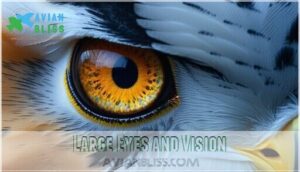
Bird vision starts with eyes that pack serious punch. You’ll find birds have eyes roughly twice the size of mammals relative to their body weight – that’s some serious Avian Eye Weight dedication to sight.
This Eye Size Evolution creates larger Visual Field Size and boosts Light Receptor Density, dramatically improving Image Quality. Think of it like upgrading from a small TV to a massive screen with more pixels.
Bird eye anatomy reveals these oversized peepers account for 15% of head mass compared to your measly 2%. This impressive bird eye resolution and visual acuity make hawk-eyed comparisons totally justified.
Some species, like owls, have evolved to have disproportionately large eyes for superior night vision, which is a result of their unique Visual Field Size and Light Receptor Density.
Eye Size and Activity Time
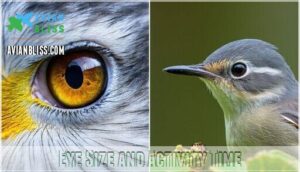
You’ll notice fascinating Eye Size Correlation patterns in bird vision.
Early Dawn Bird Vision requires larger eyes than later-active species, maximizing Visual Receptor Count for low-light conditions.
Diurnal birds sport smaller eyes since they don’t need extra light-gathering power.
This size difference directly impacts Eagle Visual Acuity and overall performance.
Crepuscular species fall between these extremes, balancing sensitivity with sharpness, and your favorite backyard birds likely have eye sizes perfectly matched to their daily schedules, utilizing their bird vision effectively.
Nocturnal Birds and Eye Adaptations
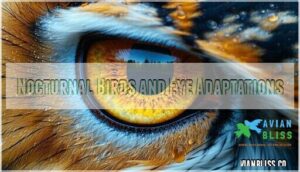
Most nocturnal birds have evolved remarkable eye adaptations that’ll blow your mind.
These night hunters sport specialized features that make human vision look pretty basic in comparison.
Here are five key nocturnal bird eye adaptations:
- Tubular eyes – Owls possess elongated, tube-shaped eyes that gather maximum light
- Oversized pupils – Night-flying birds have massive pupils that open wide like camera apertures
- Dense rod cells – Nightjar hunting relies on packed light-detecting cells for spotting tiny insects
- Reflective tapetum – Some species bounce light back through their retinas for enhanced sensitivity
- Specialized oil droplets – These filter specific wavelengths to improve contrast in darkness
Interestingly, the kiwi breaks this pattern completely – it’s traded sharp night vision for enhanced smell and touch senses instead.
Many enthusiasts explore specialized birding equipment to better observe these creatures.
Color Vision Capabilities
You’ll be amazed to discover that birds see the world in colors you can’t even imagine – they’re tetrachromats with four types of color receptors compared to your three, giving them access to ultraviolet wavelengths that remain completely invisible to human eyes.
These colored oil droplets in their cone cells act like tiny filters, potentially creating a visual experience so rich and vibrant that it makes your HD television look like an old black-and-white movie by comparison.
Tetrachromatic Vision
Unlike your three-colored world, you’re equipped with tetrachromatic vision—seeing UV, red, green, and blue wavelengths simultaneously.
This superpower transforms how you’d perceive mate signaling and foraging efficiency.
| Vision Type | Color Receptors | Advantage |
|---|---|---|
| Human | 3 (Red, Green, Blue) | Basic color discrimination |
| Bird | 4 (UV, Red, Green, Blue) | Enhanced species recognition |
| Tetrachromatic | UV + Standard Colors | Superior UV plumage detection |
Your color discrimination abilities would revolutionize survival—spotting ripe berries invisible to predators, recognizing family members through UV patterns, and detecting the perfect mate whose plumage shimmers with hidden ultraviolet brilliance.
Ultraviolet Perception
Beyond seeing the world in brilliant detail, you’ll discover that birds possess UV vision that reveals a hidden rainbow invisible to human eyes.
Their tetrachromatic vision includes ultraviolet perception, revolutionizing mate selection through UV plumage patterns.
This ultraviolet vision enhances foraging efficiency by revealing UV-reflective berries and serves as a navigation aid during migration.
Species recognition becomes effortless when UV vision birds detect unique ultraviolet markings on feathers.
Colored Oil Droplets and Cone Cells

You’ll find bird color perception revolves around special photoreceptors called cones containing colored oil droplets.
These tiny filters work like sunglasses, fine-tuning spectral sensitivity in each cone cell type.
Oil droplet colors enhance color discrimination by absorbing scattered light, giving birds evolutionary advantages in spotting ripe fruits and healthy mates through their superior retina design.
Night Vision Abilities
You’ll discover that birds have evolved remarkable night vision abilities that put your human eyesight to shame in low-light conditions.
Their specialized adaptations include large eye lenses, tubular lens shapes, and colored oil droplets that work together to capture and process even the faintest light sources during nighttime hunting and navigation.
Large Eye Lenses and Tubular Shapes
Birds’ nocturnal hunting success depends on specialized eye adaptations that maximize light capture.
Their tubular lens shapes and enlarged sizes work like night-vision goggles, gathering more photons than standard spherical eyes. Owls exemplify this with their superior night vision.
Here’s how these adaptations enhance avian eyesight:
- Lens Size – Larger lenses collect more light, improving image brightness in darkness
- Tubular Advantages – Elongated eye shapes increase focal length for sharper raptor vision
- Light Gathering – Enhanced photon capture enables eagle eye precision at night
- Image Intensification – Concentrated light creates clearer visual signals for nocturnal adaptation
Colored Oil Droplets and Night Vision
Nature’s built-in sunglasses work their magic through colored oil droplets within bird photoreceptors.
These tiny filters enhance spectral tuning, allowing precise wavelength selection that boosts dim-light vision. The nocturnal pigments act like specialized lenses, increasing enhanced sensitivity in specific retina areas.
When darkness falls, these oil droplet functions transform ordinary cones into night vision powerhouses, giving avian eyesight remarkable adaptability for low-light hunting and navigation, with remarkable sensitivity.
Owls and Hawks Night Vision
Owls dominate nocturnal hunting with specialized adaptations that put hawks to shame in low-light conditions.
Their massive, tubular eyes contain dense rod cells and a reflective tapetum lucidum, creating extraordinary night vision for precise prey detection.
Hawks rely on daytime visual accuracy but lack these sensory ecology adaptations, making owls the ultimate birds of prey after dark, with extraordinary night vision.
Eye Movement and Protection

You’ll discover that birds can’t swivel their eyes like you do, so they must constantly move their heads to track objects and scan for danger.
Their eyes come equipped with a special third eyelid called a nictitating membrane that acts like built-in safety goggles, protecting their vision while they fly through branches or dive for prey, utilizing their unique features to enhance their vision.
Limited Eye Movement and Head Movements
Unlike their night vision prowess, you’ll notice birds can’t swivel their eyes like you can.
Their enormous eyes barely rotate within skull sockets, forcing constant head movement to track objects.
This limited eye rotation actually provides significant advantages:
- Head Movement Frequency increases visual field breadth dramatically
- Asymmetrical Eye Benefits allow simultaneous horizon and ground focus
- Stabilizing Gaze through rapid head adjustments maintains sharp vision
This bird eye movement strategy maximizes both monocular vision birds use for wide surveillance and binocular vision birds need for precise depth perception, creating an impressive bird field of view.
Nictitating Membrane and Eye Protection
You’ve probably never noticed the transparent shield protecting your favorite bird’s eyes.
The nictitating membrane acts like nature’s windshield wiper, sweeping across each eye horizontally to remove debris and provide lubrication.
This third eyelid lets birds see underwater, protects against wind during flight, and keeps dust away.
It’s translucent, so birds maintain vision while cleaning their eyes—pretty clever bird anatomy engineering.
Many owners buy special bird supplies to help keep their pets healthy and provide them with the necessary tools to thrive with their special needs.
Asymmetrical Eye Structure and Focus
You’ll find that birds have developed asymmetrical eye structure as an evolutionary advantage for enhanced vision.
This adaptation allows simultaneous focus on both horizon and ground, though it creates near-sightedness impact as a visual compromise.
The asymmetrical eyes improve depth perception and visual acuity, particularly benefiting nocturnal hunters who need precise eye structure coordination for survival success.
Some forest birds have evolved larger eyes to see better, which is a significant adaptation for their environment.
Visual Acuity and Brain Processing

You’ll be amazed by the incredible processing power behind bird vision – their brains dedicate massive areas to visual information, allowing them to detect rapid movements that would be invisible to your eyes.
The wedge-tailed eagle holds the record for the sharpest eyesight of any known animal, with visual acuity that makes human 20/20 vision look practically blind by comparison.
Wedge-Tailed Eagle and Visual Acuity
You’ll be amazed by the wedgetailed eagle’s incredible visual acuity – it’s like having superhuman eyesight.
This bird’s Evolutionary Vision gives it an Acuity Advantage that’s 3-4 times sharper than human vision, reaching 140 cycles per degree.
Their exceptional avian vision supports incredible Hunting Prowess through precise Prey Detection capabilities.
Here’s what makes eagles’ vision so remarkable:
- Eagles Sharpness: Two foveae in each retina provide both forward and side sharp vision simultaneously
- Distance Detection: Can spot small prey from over 3 kilometers away with crystal-clear detail
- High-Speed Tracking: Rapid visual processing helps them follow fast-moving targets during flight
Brain Areas and Visual Information Processing
While processing visual information, your brain’s visual cortex dedicates massive neural pathways to interpreting what birds see.
Their cognitive processing splits between brain hemispheres, with the right eye connecting to the left hemisphere and vice versa.
This sensory integration enables superior motion detection and cognitive abilities far beyond human vision.
| Brain Feature | Bird Vision | Human Vision |
|---|---|---|
| Visual Cortex Size | 15% of brain mass | 2% of brain mass |
| Processing Speed | Ultra-fast motion detection | Moderate speed |
| Hemisphere Usage | Specialized eye-brain connections | General processing |
Rapid Movement Detection and Vision
Since birds possess larger brain areas dedicated to processing visual information, you’ll discover they can detect rapid movement far better than humans.
Their motion sensitivity allows them to track prey and predators with incredible precision during flight control and hunting scenarios.
Here’s what makes bird vision so remarkable for movement detection:
- Lightning-fast flicker fusion – Birds process visual information at rates up to 150 frames per second (compared to humans’ 24 fps)
- Razor-sharp prey detection – They can spot a mouse moving from over a mile away
- Split-second predator evasion – Eye movement tracking helps them dodge threats instantly
- Precision flight control – They navigate through dense forests at high speeds without collision
Sometimes, birds can develop corneal ulcers from traumatic injuries.
Unique Eye Features and Functions
You’ll discover that bird eyes contain several remarkable features that set them apart from all other animals.
Beyond their incredible size and color vision, birds possess specialized structures like blood-vessel-free retinas, unique glands that keep their eyes functioning perfectly.
They also have even built-in magnetic compasses that help them navigate across continents.
Retinas and Blood Vessels
You’ll find bird retinas remarkably different from mammalian eyes.
Unlike your retinas, avian retinas lack blood vessels that typically scatter light and reduce visual accuracy.
This unique retinal structure allows light to pass through without interference, creating crystal-clear images.
The absence of blood vessels means photoreceptive cells receive unfiltered light, maximizing receptor density and enhancing their exceptional vision capabilities, which contribute to their remarkably different visual system.
Harderian Glands and Eye Function
Why do birds’ eyes stay so remarkably clean and functional?
Harderian glands produce specialized glandular secretions that create a protective tear film over each eye.
These secretions provide essential lubrication while triggering immune responses against harmful bacteria.
The glands also handle waste removal, filtering toxins that could damage delicate eye anatomy, which is crucial for maintaining sharp vision.
This sophisticated system keeps birds’ vision sharp and their eyes healthy throughout their demanding lifestyles.
Magnetic Compass and Navigation
You’ll discover that birds’ eyes contain specialized magnetoreceptor cells that detect Earth’s magnetic fields through cryptochrome proteins.
This magnetic compass works with magnetite receptors in their beak, creating an internal compass system.
Some researchers study avian compass products to better understand bird migration.
Through sensory integration, birds combine compass direction with map strength readings, enabling precise navigation during migration across vast distances using their remarkable magnetic reception abilities.
Frequently Asked Questions (FAQs)
Do birds have big eyes?
Yes, birds have relatively large eyes compared to mammals—about twice the size relative to body size.
You’ll find eagles, falcons, and owls have the largest eyes among birds, accounting for 15% of head mass versus just 2% in humans.
Do all birds have good eyes?
Most birds have excellent eyesight, but there’s variation among species.
While hawks and eagles boast incredible visual acuity, some birds like kiwis rely more on other senses, showing that evolution adapted each species’ abilities to their specific lifestyle needs.
What are the unique features of bird eyes?
Unlike mammals who see with just three color types, you’ll find birds possess four cone types including ultraviolet vision.
Plus larger eyes relative to head size and a protective third eyelid called the nictating membrane.
Do birds have sharp vision?
You’ll be amazed by their razor-sharp vision – birds like hawks can spot tiny prey from incredible distances, while the wedge-tailed eagle boasts the sharpest eyesight of any known animal.
Why are bird eyes so powerful?
Like precision-engineered telescopes, bird eyes pack extraordinary visual power through several key adaptations.
They’re proportionally massive—taking up 15% of head mass versus humans’ 2%—with more light receptors for sharper images and four color cone types enabling ultraviolet vision, and having massive eyes allows them to have more light receptors for sharper images.
Why do birds have better vision than humans?
Birds have four types of color receptors compared to your three, giving them tetrachromatic vision that includes ultraviolet spectrum perception.
They’ve got larger eyes relative to body size, specialized retinas without blood vessels, and enhanced visual processing areas in their brains.
How far can a bird’s eye see?
You’ve heard "eagle-eyed" for a reason! Birds can see prey from incredible distances – eagles spot small animals from over 2 miles away, while hawks detect movement from a mile up.
What bird has the longest eyesight?
The wedge-tailed eagle has the longest eyesight of any known animal.
You’ll find this Australian raptor can spot prey from incredible distances thanks to its exceptionally large eyes and superior visual acuity that surpasses all other creatures, with exceptionally large eyes being a key factor.
Do birds have 20-5 vision?
Ironically, you’d think birds would have superhuman vision like 20/5, but they don’t use human measurement standards.
Birds actually have much better eyesight than humans – some raptors can spot prey from miles away with incredible detail and clarity.
Which bird has the least eyesight?
The kiwi has the least eyesight among birds.
It’s the only bird that relies more on smell and touch than vision.
You’d find it basically blind compared to hawks or eagles, using its long beak to probe for food in darkness.
Conclusion
Birds truly show us what it means to have eagle eyes in terms of vision superiority.
These remarkable creatures possess visual systems that make human eyesight look primitive by comparison.
From detecting ultraviolet patterns invisible to us to processing movement at lightning speed, cool facts about birds eyesight reveal nature’s most sophisticated visual technology.
Their tetrachromatic vision, oversized eyes, and specialized adaptations create a sensory experience we can’t fully comprehend, reminding us that the natural world operates on levels far beyond our perception.
- https://www.kenhub.com/en/library/anatomy/ciliary-muscle
- https://evolution.berkeley.edu/what-are-evograms/the-origin-of-birds/
- https://www.montananaturalist.org/blog-post/avian-adaptations/
- https://www.nytimes.com/2010/05/25/science/25migrate.html
- https://www.researchgate.net/publication/337880375_How_fast_can_raptors_see