This site is supported by our readers. We may earn a commission, at no cost to you, if you purchase through links.
 Ethical bird migration photography means capturing stunning images while protecting our feathered friends and their habitats.
You’ll need proper equipment like long telephoto lenses to maintain safe distances, avoiding stress during critical migration periods.
Respect nesting areas, follow the Migratory Bird Treaty Act, and never use playback calls excessively.
Choose natural lighting over flash, which can disorient birds.
Research local regulations before photographing in protected areas.
Your camera settings should prioritize fast shutter speeds to freeze wing motion without disturbing natural behaviors.
The key is patience – let birds come to you rather than pursuing them.
Master these fundamentals, and you’ll discover advanced techniques that transform ordinary migration shots into breathtaking wildlife art.
With the right approach, you can capture stunning images while ensuring the well-being of the birds and their habitats, which is the essence of ethical bird migration photography and requires a good understanding of proper equipment.
Table Of Contents
- Key Takeaways
- Bird Photography Ethics
- Essential Equipment Considerations
- Camera Settings and Techniques
- Legal Considerations and Permits
- Post Photography Best Practices
- Frequently Asked Questions (FAQs)
- What is the most ethical dilemma with street photography?
- What is a key ethical consideration in travel photography?
- What is the best ISO for birds in flight?
- What are the ethical considerations of photography?
- How do weather conditions affect migration photography?
- What are optimal times for migration photography?
- How do migration routes influence photography planning?
- What safety precautions should photographers take during migration?
- How can photographers identify different migration patterns?
- Conclusion
Key Takeaways
- Maintain safe distances – You’ll need telephoto lenses (400-600mm) to capture stunning shots without disturbing birds during their energy-critical migration periods
- Follow legal requirements – You must comply with the Migratory Bird Treaty Act and obtain proper permits before photographing in protected areas, as violations can result in $15,000 fines
- Use ethical techniques – You shouldn’t use audio playback, flash photography, or baiting practices that stress birds or alter their natural behaviors
- Practice responsible sharing – You’ll protect habitats by removing location data from images and using your photography to support conservation efforts rather than promoting overcrowding
Bird Photography Ethics
You’ll capture stunning migration photos while protecting the birds that make them possible. Ethical practices guarantee these remarkable journeys continue for future generations to witness and photograph.
Minimizing Disturbance
When photographing migrating birds, your approach determines whether you’re documenting natural behavior or creating stress.
Your lens choice defines the boundary between ethical documentation and wildlife disruption.
Distance Matters — use telephoto lenses to maintain space while capturing detailed shots.
Watch for Stress Signals that indicate you’re too close:
- Rapid head movements and alert postures
- Stopping normal feeding or preening activities
- Alarm calls or feather slicking behaviors
Seasonal Sensitivity peaks during migration when birds conserve energy for long journeys.
Noise Reduction and limiting observation periods under 15 minutes minimize Habitat Impact while supporting ethical bird photography practices.
Respecting Nesting Birds
Nesting birds require your utmost respect and careful approach.
Maintain at least 25 yards nest distance using telephoto lenses to avoid predator attraction and parental disruption.
Never alter habitat around nests or use drones, which cause severe stress.
Limit observation time to prevent abandonment.
During breeding season, your presence can make vulnerable chicks targets for predators if you’re not practicing ethical bird photography techniques, which can lead to severe consequences, including abandonment.
Responsible Luring Practices
When photographing birds, ethical luring practices protect both wildlife and your reputation as a responsible photographer.
Audio playback disrupts territorial behavior and can cause nest abandonment, while baiting creates dependency and alters natural behaviors. Disturbing feeding birds forces them to waste energy finding new feeding spots.
- Avoid audio playback – Recorded calls stress territorial birds and increase predation risk during breeding season
- Skip baiting techniques – Live prey luring harms both target birds and prey species while violating bird ethics
- Maintain clean feeding stations – If using feeders, stock appropriate food and follow ethical guidelines consistently
- Verify facility accreditation – Choose AZA or GFAS-certified locations over game farms for responsible birding photography
- Respect landowner boundaries – Always obtain permission and follow bird migration ethics on private property
Essential Equipment Considerations
Your equipment choices directly impact both image quality and bird welfare during migration photography.
The right gear allows you to capture stunning shots while maintaining the ethical distances that protect these vulnerable travelers.
Long Lenses and Blinds
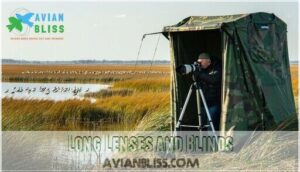
Your telephoto lens becomes your ethical compass in bird photography.
Telephoto lens options of 400-600mm provide essential lens reach while maintaining safe distances from migratory birds.
Bird blinds offer superior camouflage effectiveness, reducing detection rates by 60%.
Strategic blind placement near natural gathering spots maximizes shooting opportunities while minimizing footprint.
This distance approach guarantees ethical observation without disrupting feeding or resting behaviors, allowing you to capture authentic moments through minimal disturbance techniques.
For sharper images, consider using a sturdy tripod.
Tripods and Support
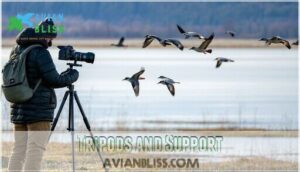
When shooting with telephoto lenses, tripod stability becomes your foundation for sharp migration shots.
Carbon fiber tripods offer lightweight portability while reducing vibration that can blur distant subjects. Many photographers find carbon fiber models offer the best balance of weight and stability.
Gimbal heads excel with heavy telephoto gear, providing smooth tracking as birds move across your frame. For quick repositioning, monopods provide adequate support while maintaining mobility.
Choose head types that match your lens weight for ideal vibration reduction.
Camera Settings and Techniques
Mastering your camera settings transforms challenging migration photography into successful, ethical documentation.
You’ll need to balance technical precision with respect for wildlife behavior to capture stunning images without disturbing these vulnerable travelers, which is crucial for ethical documentation.
Aperture Priority Mode
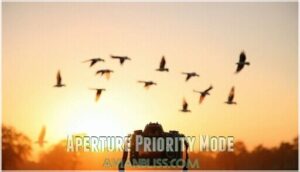
Set your camera to aperture priority mode for ideal depth of field control in ethical bird photography.
This setting lets you select the aperture while your camera chooses the appropriate shutter speed, ensuring sharp subjects with beautiful background blur.
Wider apertures (f/4-f/5.6) create stunning creative effects during bird migration shoots, while maintaining the light control needed for varying conditions and ethical considerations.
Many photographers find great camera deals online for this mode.
Shutter Speed Control
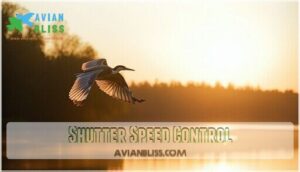
Fast shutter speeds freeze motion during bird migration, capturing sharp wing details at 1/1000s or higher.
For blur techniques and panning birds, use slower speeds around 1/250s to show movement while maintaining subject sharpness.
You can find various related products online.
In low light conditions, switch to shutter priority mode, balancing motion capture with ethical bird photography principles that prioritize minimizing disturbance over perfect shots.
ISO Sensitivity Adjustment
Your camera’s ISO sensitivity acts like a volume control for light, letting you capture sharp images when birds dart through shadowy dawn skies.
Modern cameras handle ISO 1600-3200 beautifully for bird migration photography, though noise increases at higher settings.
Balance ISO with shutter speed – you’d rather have slight grain than motion blur ruining that perfect shot.
Test your camera’s ISO invariance beforehand, as some sensors perform better when you underexpose slightly and brighten in post-processing for ethical bird photography with minimal disturbance.
Legal Considerations and Permits

Before you photograph migrating birds, you’ll need to understand the legal framework protecting these species.
The Migratory Bird Treaty Act and various permits govern when and where you can capture these remarkable journeys, which are protected under the Migratory Bird Treaty Act.
Migratory Bird Treaty Act
Everyone who photographs migratory birds must understand the Migratory Bird Treaty Act (MBTA), which protects over 1,000 species.
This 1918 legislation makes MBTA compliance essential for ethical bird photography, as violations can result in substantial fines and legal consequences.
- Treaty Enforcement: The U.S. Fish and Wildlife Service actively monitors and enforces MBTA violations, with fines reaching $15,000 for harassment or disturbance
- Conservation Impact: MBTA has considerably contributed to migratory bird population recovery and habitat preservation efforts across North America
- Permitting Process: Scientific or educational photography requires detailed applications with impact assessments and strict adherence to guidelines
- Legal Ramifications: Bird photography ethics violations can include imprisonment, making wildlife protection knowledge vital for responsible photographers
Protected Reserves and Permissions
Protected reserves serve as sanctuaries where photography permits control human impact on vulnerable bird populations.
You’ll need advance applications for most reserves, with requirements varying between national parks, wildlife refuges, and private property.
Access limitations include specified locations, time restrictions, and group sizes, and photography restrictions typically prohibit flash usage and drone regulations near nesting areas.
Permit acquisition requires detailed plans showing conservation impact awareness and ethical practices.
Endangered Species Regulations
Beyond permits, you’ll navigate strict ESA compliance when photographing endangered species.
The Endangered Species Act prohibits harassment or harm to protected birds, requiring careful habitat protection during shoots.
Critical habitat restrictions limit access to sensitive areas, while recovery plans guide conservation efforts.
Enforcement actions increase monitoring in protected zones.
Always maintain ethical considerations for species protection and bird migration conservation.
Many face threats from habitat loss and poaching.
Post Photography Best Practices

After capturing your bird migration photographs, your work isn’t finished—it’s time to process and share them ethically.
You’ll need to balance enhancing your images with maintaining their documentary value while using your photography to support conservation efforts.
Ethical Post Processing
Digital editing should enhance your migration photos without crossing ethical boundaries.
Reality representation means avoiding major manipulations that misrepresent what you actually witnessed.
Stay within manipulation limits by adjusting exposure, contrast, and sharpening while preserving the authentic moment.
Remove location data from images to prevent habitat overcrowding during sensitive migration periods.
Postprocessing ethics require honest representation of bird behavior and environmental conditions you documented.
Transparent Captioning
Your captions build viewer trust through honest representation of whether birds were photographed wild or captive.
Include species information, behavior details, and conservation challenges while maintaining image authenticity.
Remove location data to prevent habitat overcrowding.
Ethical photography practices prioritize bird wellbeing.
Transparent photo captioning supports ethical photography by providing context that helps viewers understand conservation messaging without compromising the integrity of your work.
Conservation Efforts and Sharing
Your photographs can become powerful tools for bird migration conservation through strategic sharing and collaboration.
Your lens captures more than images—it preserves the future of migration itself.
Transform your images into conservation advocacy by partnering with organizations and documenting biodiversity.
Here’s how to maximize your conservation impact:
- Remove location data from images to prevent habitat overcrowding and disturbance
- Donate photography proceeds to bird protection organizations supporting conservation efforts
- Collaborate with conservation groups to amplify your ethical photography reach
- Document biodiversity changes to support habitat protection research and policy
Frequently Asked Questions (FAQs)
What is the most ethical dilemma with street photography?
You’re walking a tightrope between capturing candid moments and respecting people’s privacy.
Street photography’s biggest ethical challenge involves obtaining consent while preserving authenticity—balancing documentary value with subjects’ dignity and rights, which is a delicate task that requires careful consideration of privacy.
What is a key ethical consideration in travel photography?
You’ll face cultural sensitivity challenges when photographing people, places, and traditions. Always ask permission before capturing locals, respect sacred sites, and understand how your presence affects communities you’re documenting.
What is the best ISO for birds in flight?
Start with ISO 800-1600 for birds in flight, then adjust based on lighting conditions.
You’ll need faster shutter speeds (1/1000s+) to freeze motion, so higher ISO compensates for reduced light reaching your sensor.
What are the ethical considerations of photography?
You’ll balance capturing stunning images with respecting birds’ welfare. Keep adequate distance, avoid disturbing nests, don’t use flash near roosting birds, and prioritize their natural behavior over your perfect shot.
How do weather conditions affect migration photography?
Cold weather reduces flight distances by 45% during migration, making birds more approachable for photography. You’ll find better opportunities during overcast conditions when birds conserve energy and stay lower.
What are optimal times for migration photography?
You’ll capture the best migration shots during early morning hours when birds are most active, feeding after overnight travel.
Late afternoon offers another prime window as flocks prepare for evening departures.
How do migration routes influence photography planning?
You don’t need to chase birds randomly—migration routes create predictable opportunities. Study flyways, timing, and stopover sites to position yourself where birds naturally concentrate, reducing disturbance while maximizing encounters.
What safety precautions should photographers take during migration?
Stay alert to weather changes, wear appropriate gear, and inform others of your location.
Maintain safe distances from cliffs and water edges.
Check local regulations and carry emergency supplies for remote areas.
How can photographers identify different migration patterns?
Males typically migrate before females and juveniles in most species.
You’ll identify patterns by observing four major flyways: Atlantic, Mississippi, Central, and Pacific.
Peak migration occurs 30-45 minutes after sunset during spring and fall seasons.
These routes are known as the North American Flyways.
Conclusion
Unlike those daguerreotype pioneers who couldn’t capture birds in flight, you’ve got incredible tools at your disposal.
Remember, ethical bird migration photography isn’t just about stunning shots—it’s about protecting the species you’re documenting.
You’ll create lasting memories while preserving habitats for future generations.
Follow legal guidelines, respect wildlife boundaries, and use proper equipment.
Your patience and ethical approach will reward you with breathtaking images that celebrate nature’s incredible journeys without compromising bird welfare.