This site is supported by our readers. We may earn a commission, at no cost to you, if you purchase through links.
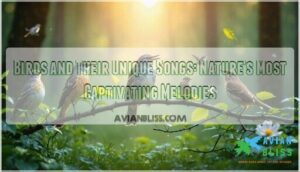 You’ll discover that birds and their unique songs create nature’s most diverse acoustic landscape.
Each species has evolved distinct vocalizations – from the Northern Mockingbird’s impressive mimicry of over 200 sounds to the Wood Thrush’s flute-like melodies that echo through forest canopies.
These aren’t just random notes; they’re sophisticated communication tools.
Birds sing to establish territory, attract mates, and coordinate with their flock.
The Lyrebird’s ability to replicate chainsaws and camera shutters shows how adaptable these vocal artists can be.
Your backyard becomes a concert hall where each performer brings centuries of evolutionary refinement to their craft.
There’s fascinating science behind what makes each song so perfectly tuned.
Table Of Contents
- Key Takeaways
- Birds Singing Behavior
- Unique Bird Songs
- Regional Bird Songs
- Birdsongs and Ecology
- Birdsong Mechanics
- Frequently Asked Questions (FAQs)
- Why are songbirds famous?
- Which birds have the most melodious songs?
- What birds mimic the songs of other birds?
- What does a bird song look like?
- What makes a bird song Beautiful?
- Are mythical birds related to singing birds?
- Which bird is known for its distinctive song?
- What bird has many different songs?
- What birds are known for their complex song?
- How do birds physically produce different sounds?
- Conclusion
Key Takeaways
- You’ll discover that birds use their songs for four main purposes: claiming territory through vocal boundaries, attracting mates during breeding season, coordinating with their flock, and sometimes expressing pure joy through spontaneous melodies.
- You can witness nature’s most impressive vocal mimics in your own backyard, from Northern Mockingbirds that replicate over 200 different sounds to Australian Lyrebirds that perfectly imitate chainsaws and camera shutters.
- You’ll find that birds create their complex sounds through a specialized organ called the syrinx, which functions differently from human vocal cords and allows them to produce dual-voice harmonies and learn new songs throughout their lives.
- You’ll notice that bird songs vary dramatically by region and season, creating unique acoustic landscapes where each species contributes its distinct voice to maintain ecological balance and reflect local habitat conditions.
Birds Singing Behavior
You’ve probably wondered why birds burst into song at dawn or why some species seem to have endless musical repertoires.
Birds sing for four primary reasons: claiming territory, attracting mates, communicating during specific times of day, and sometimes simply for the pleasure of vocal expression.
Claiming Territory
You’ll hear birds stake their claims through powerful territorial calls that mark their domain.
These vocal boundaries act like invisible fences, with each species defending its patch through song battles and border patrols.
Each bird’s song creates invisible property lines that rivals dare not cross.
- Territorial Marking – Birds use specific calls to establish ownership of feeding and nesting areas
- Border Patrols – Regular singing circuits help maintain vocal boundaries around their territory
- Song Battles – Competing males engage in vocal duels to resolve territorial disputes
- Territory Defense – Consistent vocalizations warn intruders and reinforce territorial behavior
Courtship and Mating
You’ll discover that male birds transform into vocal virtuosos during courtship displays, using their melodious songs as powerful tools for mate attraction.
Their vocal prowess becomes most evident during breeding season, when complex mating rituals unfold through intricate bird vocalizations.
These courtship performances showcase melody recognition abilities that help females identify the strongest partners for successful breeding habits.
The success of these courtship displays often depends on the male’s ability to establish a strong pair bond through breeding season behaviors, which is crucial for genetically fit partners and successful breeding.
Morning and Night Songs
You’ll notice bird songs shift dramatically between Dawn Choruses and Nighttime Serenades.
Morning Trills announce territory boundaries while Evening Songs serve different purposes.
Nocturnal birds like Eastern Whip-poor-will create haunting Nocturnal Melodies throughout darkness.
American Robin’s morning staple signals daybreak across neighborhoods.
These bird vocalizations follow circadian rhythms, with melodies perfectly timed for maximum acoustic impact.
Singing for The Joy of It
Beyond territorial and mating purposes, songbirds exhibit vocal freedom through spontaneous melodic expression.
Birds pour their hearts into song, transforming survival instincts into pure musical joy.
You’ll observe birds engaging in subsong—quiet, rambling vocalizations that lack the structured song patterns of territorial displays. This bird harmony represents pure joyful chirps, where avian music flows without specific behavioral triggers.
Consider these fascinating aspects of spontaneous bird vocalizations:
- Juvenile Practice Sessions: Young songbirds experiment with unique melodies during development
- Stress-Relief Singing: Birds vocalize softly when comfortable and relaxed
- Social Bonding: Flock members exchange gentle calls strengthening group cohesion
- Weather-Induced Songs: Pleasant conditions trigger spontaneous bird songs
- Individual Expression: Each bird develops personal vocal signatures beyond species-typical patterns
Unique Bird Songs
You’ll discover that some birds possess extraordinary vocal abilities that set them apart from typical songbirds.
These remarkable species showcase nature’s most impressive acoustic performances, from perfect mimicry to haunting nocturnal calls that echo across vast landscapes.
Lyrebird Mimicry
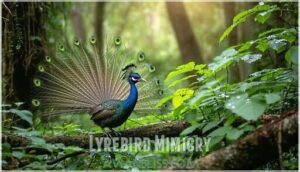
You’ll find superb lyrebirds mastering vocal imitation with remarkable precision.
These Australian birds demonstrate extraordinary mimicry skills, reproducing over twenty different species’ calls plus human-made sounds like chainsaws and camera shutters.
Their sophisticated syrinx enables complex sound reproduction, while enlarged brain regions dedicated to auditory memory support their lyrebird intelligence.
This adaptive calling helps males attract mates through elaborate displays showcasing their vocal prowess.
The ability of some birds to develop vocal learning abilities is a key factor in their capacity for mimicry and complex song production.
Mockingbird Repertoire
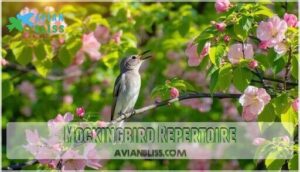
You’ll hear mockingbirds showcase their incredible vocal imitation abilities throughout North America.
These remarkable birds can replicate up to 200 different bird songs, creating an ever-changing repertoire that reflects their surroundings.
Their mimicry skills extend beyond bird vocalizations to include mechanical sounds like car alarms.
This learning behavior continues throughout their lives, with mockingbirds constantly adding new song patterns to demonstrate their impressive bird vocal agility.
The study of mockingbird songs is often preserved through music cd collections, which is a great way to experience their vocal imitation abilities.
Kakapo Booming Calls
While mockingbirds showcase vocal versatility, New Zealand’s kakapo produces something entirely different.
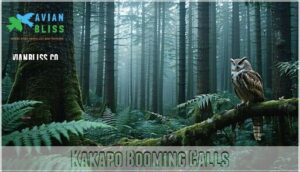
You’ll encounter deep, resonant booming calls that travel up to 5 kilometers through dense forest.
These endangered species use their nocturnal vocal displays during breeding season, creating omnidirectional sounds around 150-200 Hz that help conservationists track individual birds.
- Kakapo Conservation efforts rely on acoustic monitoring to track the 100+ remaining birds
- Booming Sounds can travel incredible distances through New Zealand’s forests at night
- Call Patterns consist of ~20 low-frequency booms followed by metallic chinging sequences
- Nocturnal Vocal displays occur primarily during full moon periods in breeding season
- Endangered Species status makes each recorded call valuable for population monitoring
Eastern Whip-Poor-Will Nocturnal Songs
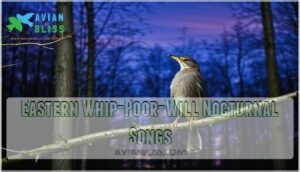
When darkness falls, you’ll discover the Eastern Whip-Poor-Will’s relentless nocturnal chants echoing through woodlands.
These secretive birds produce their signature "whip-poor-will" vocalizations repeatedly, creating distinctive birdcall patterns that can continue for hours.
Their nighttime serenades serve dual purposes: establishing territory and attracting mates during breeding season.
These persistent eastern songs make them unmistakable among nocturnal bird sounds, with their relentless chants being a key identifier.
Regional Bird Songs
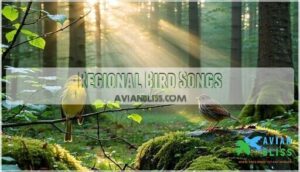
You’ll discover how geography shapes the songs that fill your backyard each season, from the Yellow Warbler’s summer announcement to the Hermit Thrush’s forest serenades.
These regional variations create distinct soundscapes that reflect local habitats and seasonal changes, making each area’s bird chorus as unique as its landscape.
Yellow Warbler Summer Arrival
Yellow Warbler migration signals summer’s arrival across North America, with males reaching breeding territories by May.
Their sweet "sweet-sweet-sweet-I’m so sweet" song accelerates over one second, repeated up to ten times per minute.
These bright yellow birds inhabit shrubby thickets near water, creating distinctive summer soundscapes.
Warbler migration patterns show earlier arrivals, with spring dates advancing four days since 1938, reflecting ongoing seasonal changes.
The Yellow Warblers’ habitat preferences include areas with dense vegetation types that support their breeding and foraging needs.
Hermit Thrush Ethereal Notes
Deep within North American forests, you’ll discover the Hermit Thrush’s ethereal sounds that seem to float through the woodland air.
These melodious vocalizations feature clear, bell-like note patterns that create enchanting forest acoustics. The Hermit Thrush produces bird songs with flute-like qualities, making their thrush habitat resonate with pure, spiritual tones.
Each phrase rises and falls gracefully, showcasing sophisticated bird vocalization techniques that captivate listeners with their otherworldly beauty. The study of thrush bird calls is essential to understanding the unique characteristics of these birds, which is a key aspect of bird vocalization techniques.
American Woodcock Spring Calls
During spring migration, you’ll hear the American Woodcock’s distinctive "peent" call echoing through twilight skies.
This chunky bird species performs elaborate courtship displays, spiraling skyward before diving earthward with whistling wing sounds.
Their bird vocalizations mark breeding patterns and habitat selection in eastern woodlands.
These unique bird calls signal woodcock mating season’s arrival, transforming quiet forests into acoustic theaters of romance.
Black-capped Chickadee Adaptable Songs
Throughout North America, you’ll discover how Black-capped Chickadees master the art of Adaptive Calls with remarkable precision.
These small songbirds demonstrate exceptional Vocal Learning abilities, adjusting their Chickadee Vocal patterns based on environmental conditions and social contexts.
Their Bird Communication system includes:
- Alarm calls – Intense "chick-a-dee-dee-dee" with more "dees" indicating greater threats
- Contact calls – Soft notes maintaining flock cohesion during foraging
- Territorial songs – Clear "fee-bee" whistles establishing breeding boundaries.
This Blackcapped Chickadee’s sophisticated bird vocalizations showcase how Song Patterns evolve for survival, making song recognition essential for successful bird communication.
Birdsongs and Ecology
You’ll discover how bird songs weave intricate patterns across ecosystems, creating acoustic landscapes that reflect the health and diversity of their environments.
These melodies serve as nature’s communication network, where each species contributes its unique voice to maintain ecological balance and support biodiversity conservation efforts.
Song Sparrow Regional Songs
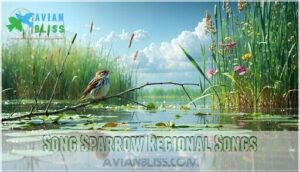
Song Sparrows showcase remarkable Song Variation across their Geographic Distribution, with each population developing distinct vocal dialects.
You’ll notice these bird vocalizations differ substantially between regions, influenced by Habitat Influence and local acoustic environments.
Their Vocal Learning abilities allow populations to adapt song recognition patterns during Migration Patterns, creating unique regional signatures.
These Song Sparrow vocalizations demonstrate how environmental factors shape bird songs across diverse landscapes.
Eastern Bluebird Happiness Symbol
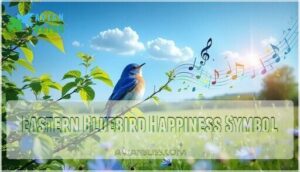
Watching Eastern Bluebirds brings instant joy to any birdwatcher’s heart. These vibrant songbirds don’t just captivate with their azure plumage—they’ve become powerful symbols of happiness and hope throughout Eastern ecosystems.
- Gentle warbles create soothing melodies that calm stressed minds
- Bright blue coloration contrasts beautifully against green countryside backdrops
- Peaceful demeanor reflects contentment, inspiring human emotional connections
- Conservation success stories demonstrate nature’s resilience through dedicated protection efforts
Their bird vocalizations embody pure avian emotions, transforming ordinary birdwatching into therapeutic experiences. Eastern Bluebird behavior exemplifies how bird songs transcend mere communication—they’re nature’s antidepressants, spreading happiness symbolism across rural landscapes.
Wood Thrush Communication Tool

You’ll discover the Wood Thrush’s syrinx creates haunting melodies that serve as sophisticated communication tools in forest ecosystems.
These avian songsters produce flute-like "ee-oh-lay" phrases using dual-voice capabilities, harmonizing with themselves while defending territories.
Their bird vocalizations carry frequencies perfectly adapted for forest acoustics, ensuring effective avian communication.
Through vocal mimicry and complex repertoires, Wood Thrush songs demonstrate remarkable thrush behavior patterns essential for survival.
The Wood Thrush’s ability to learn and reproduce bird song patterns is a key aspect of its communication strategy.
Western Meadowlark Grassland Presence
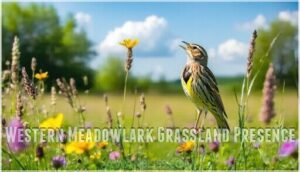
Western Meadowlark’s flute-like melodies carry across vast grassland ecosystems, serving as nature’s soundtrack for open prairies.
You’ll hear their rich song patterns during meadowlark migration seasons, when males establish territories through distinctive bird vocalizations.
These grassland habitat specialists rely on expansive bird habitats for survival, making grassland ecology conservation essential for maintaining their populations and preserving Western Meadowlark communities.
Birdsong Mechanics

You’ll discover that birds create their remarkable sounds through a specialized organ called the syrinx, which functions differently from human vocal cords.
This unique structure allows birds to produce complex melodies, learn new songs throughout their lives, and even mimic sounds from their environment with surprising accuracy.
Syrinx Structure and Function
You’ll find the syrinx acts as nature’s most sophisticated vocal organ, positioned where your trachea splits into bronchi.
This avian vocal organ controls airflow through specialized vocal muscles—up to six pairs in songbirds.
Sound production occurs when vibrating membranes create bird vocalizations without vocal cords.
The respiratory system pushes air through cartilages and membranes, enabling birds to use nearly all exhaled breath for bird sounds, making their vocalizations remarkably efficient compared to mammalian systems.
The unique anatomy of the bird syrinx allows for complex sound production mechanisms.
Northern Mockingbird Learning Process
Northern Mockingbird Learning Process represents a fascinating journey of vocal imitation that unfolds throughout their lives.
These remarkable birds don’t simply inherit their song patterns—they actively acquire mimicry skills through complex learning stages that showcase incredible neural adaptation.
Northern Mockingbird Learning Milestones:
- Juvenile Phase – Young birds absorb basic avian communication patterns from parents and nearby species during critical development periods
- Adult Expansion – Mature mockingbirds continuously add new bird vocalizations to their repertoire, sometimes learning hundreds of different sounds
- Lifelong Refinement – These vocal virtuosos perfect their mimicry throughout their entire lifespan, demonstrating remarkable cognitive flexibility
Brown Thrasher Complex Songs
You’ll find Brown Thrasher complex melodies showcase remarkable vocal learning abilities.
These songbirds create intricate song patterns by repeating short phrases twice before switching to new ones.
Their sophisticated bird vocalizations demonstrate exceptional bird intelligence, producing over 1,000 distinct complex melodies through combining innate and learned sounds.
This thrasher behavior reflects advanced vocal learning processes among songbirds, and showcases complex melodies.
Blackbird Melodious Tones
When you listen to a blackbird’s song, you’re hearing nature’s most sophisticated vocal instrument in action.
The blackbird’s syrinx produces those liquid, flute-like notes through precise airflow control, creating melodic structure that shifts from rich, low tones to crystalline highs.
These sonic patterns demonstrate remarkable tone variation, with each phrase flowing seamlessly into the next.
Male blackbirds craft these melodious vocalizations primarily at dawn and dusk, using their complex bird songs to establish territory and attract mates through masterful bird vocalization techniques to showcase their vocal instrument.
Frequently Asked Questions (FAQs)
Why are songbirds famous?
Like nature’s orchestra tuning before a grand performance, songbirds captivate you through their remarkable vocal abilities.
You’ll discover they’re famous for mimicking sounds, establishing territories, attracting mates, and creating complex melodies that inspire human culture and scientific study.
Which birds have the most melodious songs?
You’ll discover the most melodious singers include Wood Thrush with flute-like notes, Hermit Thrush’s bell-like phrases, Nightingale’s complex melodies, and Western Meadowlark’s rich tunes echoing across grasslands.
What birds mimic the songs of other birds?
You’ll find several master mimics among bird species. Northern mockingbirds replicate up to 200 different songs, while lyrebirds imitate chainsaws, camera shutters, and other birds with remarkable accuracy for mating displays.
What does a bird song look like?
Though you can’t see sound waves directly, bird songs create visual patterns called spectrograms that reveal pitch, duration, and frequency changes.
These scientific visualizations transform melodic phrases into colorful graphs, showing how each species’ unique vocal signature appears as distinctive shapes and patterns on acoustic analysis equipment.
What makes a bird song Beautiful?
You’ll find beauty in birdsong through complex melodies, varied tones, and intricate patterns. Songs captivate with their harmonic structures, rhythmic complexity, and emotional resonance that connects you to nature’s artistry.
Are mythical birds related to singing birds?
Mythical birds often embody extraordinary vocal abilities you’d find in real songbirds. Phoenix legends describe haunting calls, while sirens’ songs mirror nightingales’ complex melodies, reflecting humanity’s fascination with avian vocalizations.
Which bird is known for its distinctive song?
You’ll recognize the Northern Mockingbird’s remarkable ability to mimic over 200 different bird songs, plus mechanical sounds like car alarms and chainsaws, making it nature’s ultimate vocal copycat.
What bird has many different songs?
Picture a feathered virtuoso perched on your backyard fence, cycling through an impressive acoustic playlist.
You’ll hear Northern Mockingbirds mimicking up to 200 different bird songs, showcasing their remarkable vocal flexibility and learning abilities throughout their lives, with a talent for mimicking that is unparalleled.
What birds are known for their complex song?
You’ll find several birds renowned for their intricate vocalizations.
Brown Thrashers boast over 1,000 song types, while Wood Thrushes create flute-like melodies.
Nightingales produce complex whistles and trills that’ve inspired centuries of poetry and literature.
How do birds physically produce different sounds?
You’ll discover that birds produce sounds using their syrinx, a specialized vocal organ with muscles controlling airflow and sound flexibility, enabling them to create diverse melodies and mimic various sounds.
Conclusion
Walking through New York’s Central Park at dawn, you’d hear a symphony that rivals any orchestral performance.
A single Wood Thrush produces notes so pure they seem impossible from such a small creature.
Understanding birds and their unique songs reveals nature’s most sophisticated communication system. Each species has evolved distinct vocalizations shaped by millions of years of refinement.
You’re witnessing vocal artistry that combines territorial defense, mate attraction, and social coordination into melodies that transform any outdoor space into a living concert hall filled with evolutionary masterpieces.
- https://www.sciencedirect.com/sdfe/pdf/download/eid/3-s2.0-B9780124730700500128/first-page-pdf
- https://ornithology.com/the-science-of-the-syrinx/
- https://pmc.ncbi.nlm.nih.gov/articles/PMC2837734/
- https://ospublishers.com/The-gross-anatomy-of-the-syrinx-of-adult-male-domestic-fowl-gallus-gallus-domesticus.html
- https://www.youtube.com/watch?v=f_c_ytNDAXQ