This site is supported by our readers. We may earn a commission, at no cost to you, if you purchase through links.
 When you notice your bird tilting its head persistently, you’re likely witnessing a bird head tilting neurological issue that demands immediate attention. This isn’t just quirky behavior—it’s often a red flag for serious conditions affecting your feathered friend’s nervous system.
Head tilting typically signals problems with the inner ear, brain, or nervous system. Common culprits include viral infections, bacterial diseases, trauma from accidents, or even toxin exposure. You might also spot other troubling signs like circling, unsteady perching, or difficulty flying.
The vestibular system, which controls balance, gets disrupted when these issues strike. Your bird’s world literally turns sideways, making simple tasks like eating or perching challenging.
While some causes resolve with proper veterinary care, others require ongoing management. Quick action makes all the difference in your bird’s recovery prospects and quality of life moving forward.
Table Of Contents
- Key Takeaways
- Bird Head Tilting Causes
- Recognizing Balance Issues
- Diagnosing Neurological Issues
- Managing Neurological Conditions
- Treating Bird Head Tilting
- Frequently Asked Questions (FAQs)
- How to tell if a bird has neurological problems?
- Why does my bird keep twisting its head?
- What does a bird with ataxia look like?
- Can head tilting permanently damage birds?
- How long before head tilting becomes irreversible?
- Do all bird species show identical tilting?
- When should euthanasia be considered for tilting?
- Can head tilting spread between cage mates?
- Conclusion
Key Takeaways
- You need immediate veterinary attention when your bird tilts its head persistently – this isn’t quirky behavior, but a serious neurological emergency that can worsen rapidly without proper treatment.
- Multiple serious conditions cause head tilting, including viral infections like West Nile virus, bacterial diseases, heavy metal poisoning, trauma, and vitamin deficiencies that all affect your bird’s nervous system.
- Watch for additional warning signs like unsteady perching, difficulty walking, wing drooping, loss of flight control, and coordination problems that signal underlying neurological disorders.
- Swift action dramatically improves outcomes – neurological damage can become permanent within 24 hours, so you cannot wait to see if symptoms resolve on their own.
Bird Head Tilting Causes
When you notice your bird tilting its head persistently, you’re witnessing a potential neurological emergency that demands immediate attention.
This concerning behavior can stem from various underlying causes ranging from infections to toxicity, each requiring swift identification and treatment.
Neurological Disorders
Your bird’s spinal cord extends the entire vertebral column, making neurological disorders particularly complex.
Avian neurological disorders like PDD impact multiple systems, causing wasting and decline.
Hepatic encephalopathy creates unique symptoms from non-nitrogenous waste products, and hyperlipemia risks include fat accumulation in blood vessels, triggering seizure triggers from renal disease or hypocalcemia.
Heavy metal poisoning can also lead to neurological issues, and bird neurological disease requires immediate veterinary attention.
Infections and Diseases
Infectious diseases pose serious threats to your bird’s neurological health.
West Nile Virus can trigger devastating encephalitis, while Psittacosis Risk increases when combined with other conditions.
Paramyxovirus Impact includes tremors and paralysis in affected birds.
Hepatic Encephalopathy and Hyperlipemic Syndrome complicate recovery from bacterial infections like Salmonella.
These avian neurological diseases require immediate veterinary attention.
Trauma or Injury
Head trauma isn’t your bird’s friend – even minor bumps can trigger serious neurological issues including head tilt.
Spinal injuries from falls or collisions damage nerve pathways, causing balance problems and coordination loss.
Fracture complications near the skull affect brain function, while soft tissue damage creates swelling that pressures delicate neural structures.
Proper wound management prevents secondary infections that worsen bird concussions and related symptoms, which can lead to serious health issues if not addressed with proper care.
Toxicity and Poisoning
Toxins represent another sinister threat to your bird’s neurological health.
Even harmless-looking items in your home can become silent killers for your feathered friend’s delicate nervous system.
Lead poisoning from paint chips or metal objects can trigger severe bird head tilt, while zinc toxicity from galvanized materials causes similar symptoms.
Mercury toxicity and pesticide exposure create devastating neurological damage.
Birds are often exposed to lead after ingesting lead-containing objects.
- Your bird might suddenly lose balance after nibbling on that "harmless" costume jewelry
- Heavy metals accumulate silently until seizures and paralysis strike without warning
Mycotoxins from moldy food can cause irreversible brain damage within hours
Nutritional Deficiencies
Poor nutrition frequently triggers bird head tilt through vitamin deficiencies and calcium imbalance.
Seed-based diets lack essential nutrients, causing thiamine shortages and hypoglycemia causes.
Your feathered friend’s dietary needs include vitamin A, D, and proper calcium levels.
Calcium deficiency disrupts nerve function, while thiamine shortages affect brain activity, leading to neurological symptoms requiring immediate attention.
Recognizing Balance Issues
When your bird’s head starts tilting to one side, you’re witnessing a clear sign that something’s affecting their balance and coordination.
This symptom rarely appears alone—you’ll likely notice other telltale signs like unsteady perching, difficulty walking, wing drooping, or problems with flight control that signal underlying neurological issues requiring immediate attention.
Head Tilting Symptoms
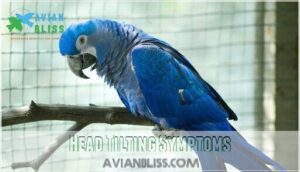
You’ll notice bird head tilting manifests as persistent sideways head positioning, often resembling a question mark.
Early signs include subtle neck deviation that worsens over time.
Bird neurological symptoms range from mild torticollis types to severe disorientation.
Watch for severity levels that increase with progression speed, especially when bird head tilt accompanies vision changes or coordination problems, which can indicate a serious neurological issue.
Unsteady Perching Signs
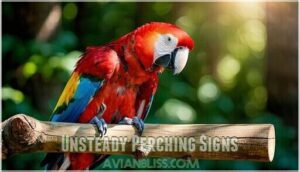
Your bird’s wobbly perching reveals serious balance reflex issues that shouldn’t be ignored.
Wobbly perching isn’t just clumsiness—it’s your bird’s nervous system crying for help.
Watch for perch gripping weakness where your feathered friend can’t maintain a steady grip.
Leg coordination loss causes frequent falling off perch episodes, while foot deformities may develop from repeated tumbles.
These unsteady perching signs often signal avian neurological disease requiring immediate veterinary attention, which is a serious issue that shouldn’t be ignored due to potential long-term effects on your bird’s balance reflex.
Walking Difficulties
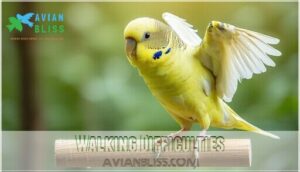
Walking difficulties reveal deeper neurological trouble brewing beneath your bird’s surface.
You’ll spot an uncoordinated gait as your feathered friend stumbles or weaves instead of walking straight. Leg paralysis makes normal movement impossible, while tremor signs create jerky, uncontrolled steps.
Bird ataxia transforms confident strides into uncertain shuffles. These coordination problems signal serious avian neurological disorders requiring immediate attention and thorough neurologic examination.
Wing Drooping
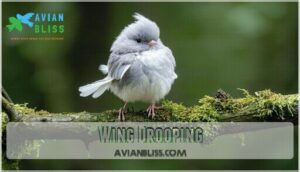
You’ll spot wing drooping when one or both wings hang lower than normal, creating an uneven silhouette.
This symptom often signals nerve damage, muscle weakness, or circulation issues affecting wing control.
Joint problems and feather damage can worsen the drooping appearance.
Bird neurological disorders frequently manifest through coordination problems and wing positioning changes, making this a key indicator of avian neurological disease requiring immediate veterinary attention.
Loss of Flight Control
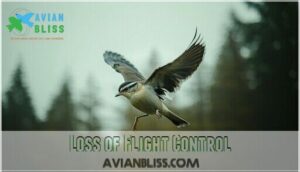
When your bird can’t maintain proper altitude or crashes during takeoff, flight anatomy disruptions signal serious neurological trouble.
Wing paralysis and muscle weakness prevent normal lift generation, while air sac rupture compromises breathing during flight.
Bird coordination problems manifest as bird clumsiness in the air.
- Feather damage from repeated crashes indicates deteriorating bird flight control
- Bird perching difficulties worsen as neurological function declines progressively
- Bird walking difficulties often precede complete loss of aerial mobility and can be a sign of underlying issues leading to neurological function decline and bird clumsiness.
Diagnosing Neurological Issues
When your bird shows head tilting, you’ll need a proper neurologic examination to pinpoint the exact cause.
A veterinarian will assess cranial nerve function, test pupillary responses, and evaluate your bird’s menace response to determine which parts of the nervous system aren’t working correctly.
Avian Neurologic Examination
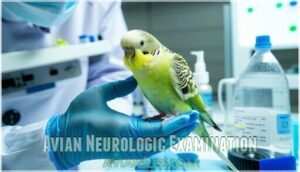
Performing an avian neurologic examination requires understanding unique anatomic variations that differ from mammals.
The spinal cord extends the entire vertebral column length, while cranial nerves follow specialized pathways.
Your vet will assess mental status, conduct PLR assessment, and evaluate the menace response to pinpoint neurologic disease locations.
These neurologic examination techniques form the foundation of avian veterinary medicine diagnostics.
Birds also lack a consensual response during pupillary light response.
Cranial Nerve Innervation
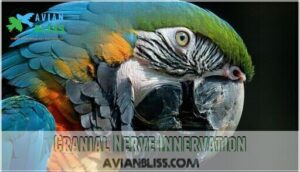
Understanding cranial nerve anatomy in birds requires recognizing key anatomic variations from mammals.
Unlike mammals, avian cranial nerve innervation follows unique pathways that affect neurologic examination techniques.
When you’re performing a cranial nerve exam, remember that birds lack consensual PLR due to these differences.
Their spinal nerves correlate directly with vertebrae number, and proper neurologic examination depends on understanding these variations, particularly for accurate PLR interpretation and menace response assessment during your diagnostic workup.
Optic and Oculomotor Nerve Function
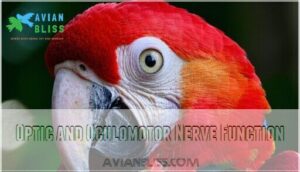
Your bird’s optic and oculomotor nerve functions control vision and eye movement.
These cranial nerves work together to process visual information and coordinate eye responses. When damaged, you’ll notice vision impairment and abnormal pupillary light response.
Key assessment areas include:
- Vision clarity – Watch for bumping into objects or missing food
- Eye movement coordination – Look for uneven or jerky movements
- Pupillary response – Check if pupils react to bright light
Avian pupillary response differs from mammals, making PLR assessment challenging but essential for diagnosis.
Menace Response Tests

Testing for avian menace response reveals nerve functionality through visual threat simulation.
You’ll gently move your hand toward the bird’s eye while watching for natural flinching or blinking reactions.
This neurologic examination technique helps detect early signs of avian neurologic disease affecting vision pathways.
| Test Component | Normal Response | Abnormal Response |
|---|---|---|
| Hand Movement | Quick blink/head pull | No reaction/delayed |
| Eye Tracking | Follows movement | Poor tracking ability |
| Protective Reflex | Immediate withdrawal | Absent or sluggish |
| Bilateral Testing | Equal responses | Uneven reactions |
Interpreting results requires understanding test limitations – some birds naturally show minimal responses.
The avian menace response connects optic nerve function with motor responses, making it valuable for neurologic assessment.
Early detection through this simple test can identify problems before severe symptoms develop, which is crucial for effective disease management.
Pupillary Light Response Evaluation
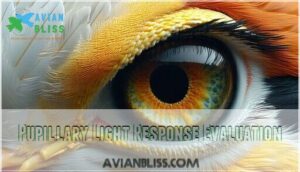
Your neurologic examination techniques advance when you evaluate pupillary light response early in the assessment. Birds present unique challenges because their striated iridal muscle can override normal PLR responses, making consensual PLR absence a normal finding.
Use sudden bright light directed at the medial canthus for accurate results during cranial nerve innervation testing. Recognizing early warning signs is essential for effective treatment.
- Light Source Impact: Direct bright light at the medial canthus rather than straight into the pupil for better PLR interpretation
- Iridal Muscle Override: Expect normal pupil constriction to be less predictable due to striated muscle control in avian eyes
- Serial PLR Monitoring: Track changes over time since single assessments can miss progressive avian neurologic disease patterns
- Early PLR Evaluation: Test within first 24 hours of symptoms for baseline measurements before neurological decline progresses
Managing Neurological Conditions
Once you’ve identified neurological symptoms in your bird, swift management becomes essential for preventing permanent damage.
You’ll need to address both immediate care needs and underlying causes while implementing preventive strategies to protect your bird’s long-term neurological health, which is crucial for its neurological well-being.
Preventing Neurological Disorders
You can’t just wing it when preventing neurological disorders in birds.
Vaccination strategies protect against paramyxovirus and other infectious diseases.
Provide proper UV light exposure for vitamin D synthesis.
Reduce gatherings during disease outbreaks to limit transmission.
Maintain hygiene practices with regular cage cleaning.
Schedule regular checkups for early detection.
Proper nutrition with vitamins A, D, and calcium supports brain health while creating a clean environment reduces contamination risks.
Regularly cleaning feeders can aid in preventing disease spread and is crucial for preventing disease and ensuring the health of birds, which relies on proper nutrition.
Reducing Stress and Enrichment
Stress reduction keeps your bird’s nervous system healthy and prevents head tilting episodes.
Create a stress-free environment with daily enrichment activities like puzzle feeders and foraging toys.
Social interaction with you provides mental stimulation, while calm, consistent care routines help maintain balance.
Consider using innovative feeding solutions to further enrich their environment.
Regular checkups catch stress-related issues early, and proper hygiene practices prevent infections that worsen neurological symptoms, ensuring a healthy and stress-free life.
Proper Nutrition and Hygiene
Balanced diet and hygiene practices form your bird’s foundation for neurological health.
Vitamin supplementation, especially vitamins A and D, supports nerve function while clean water access prevents infections.
Toxin avoidance means removing lead sources, zinc objects, and chemicals from their environment.
Consider essential bird supplements for peak health.
Daily cage cleaning and providing proper nutrition through fresh fruits, vegetables, and quality pellets strengthens their immune system against neurological disorders.
This comprehensive approach ensures your bird receives the care needed for optimal well-being, emphasizing the importance of a balanced diet.
Vaccination and Medication
You’ll find vaccination prevents many avian neurological disorders, with Newcastle disease vaccines showing 90% efficacy in poultry.
However, companion birds lack licensed vaccines for common causes like West Nile virus.
When treating bird head tilt treatment, antibiotics like enrofloxacin work well for bacterial infections, while antifungals tackle CNS aspergillosis.
Medication side-effects require monitoring—anticonvulsants need blood level checks to prevent toxicity.
Recognizing early warning signs is essential for effective treatment.
Supportive Care and Treatment
Thorough supportive care transforms your bird’s recovery journey from uncertain to hopeful.
When head tilting signals neurological trouble, your feathered friend needs more than basic treatment.
Essential bird head tilt treatment components include:
- Fluid therapy – maintains hydration during illness
- Nutritional support – prevents dangerous weight loss
- Intensive care – monitors vital signs continuously
- Serial monitoring – tracks improvement daily
Early intervention paired with proper nutrition and care dramatically improves outcomes for bird neurological treatment and rehabilitation.
Treating Bird Head Tilting
When your bird shows head tilting, swift treatment targeting the root cause can mean the difference between recovery and permanent damage.
You’ll need to work closely with an avian veterinarian who can identify whether infection, toxicity, or neurological disease is behind those concerning symptoms.
Addressing Underlying Causes
Several factors drive bird head shaking and neurological disorders in your feathered friend.
Infection etiologies like West Nile virus attack nerve pathways, while toxin exposure from lead paint damages brain tissue.
Nutritional balance matters too—vitamin deficiencies trigger seizures.
Genetic predispositions and metabolic disorders create vulnerability.
Identifying these bird head tilt causes helps veterinarians target bird neurological disease effectively.
Corticosteroid Therapy
Once you’ve identified the underlying cause, corticosteroid therapy can provide powerful inflammation reduction for your bird’s neurological symptoms. Dexamethasone at 1-2 mg/kg helps reduce brain swelling, but dosage considerations matter greatly.
Long-term use increases infection risks, so short courses work best.
- Side effects include immunosuppression and delayed feather regrowth in budgerigars
- Inhaled fluticasone offers alternative therapies with less systemic impact
- Tapering doses prevents withdrawal syndrome after treatment completion
- Contraindicated when fungal infections are suspected due to immune suppression
Antimicrobial and Antifungal Agents
While corticosteroids address inflammation, bacterial infections and fungal infections require targeted antimicrobials and antifungals.
Enrofloxacin demonstrates 85% agent efficacy against bacterial neurological cases, while itraconazole treats aspergillosis effectively.
Proper dosage considerations prevent resistance development – culture testing guides best antibiotic selection.
Administration routes include oral, injectable, and nebulized delivery. Monitor for side effects like nephrotoxicity with aminoglycosides in avian medicine applications.
Supportive Care and Fluid Therapy
Fluid therapy keeps your bird’s organs functioning during neurological episodes. You’ll need to provide subcutaneous or intravenous fluids to prevent dehydration, especially if your bird can’t drink normally.
Nutritional support through hand-feeding or tube feeding maintains energy levels. Monitor electrolyte balance carefully – sodium and potassium imbalances worsen neurological symptoms.
Consider specialized avian products to aid in treatment. Intensive care requires frequent hydration checks and supportive care adjustments.
Serial Evaluations and Monitoring
Your bird’s neurological recovery isn’t guesswork—it’s detective work requiring frequent assessment and serial examinations.
Watch for recovery signs like improved balance, reduced head tilting, and steadier perching.
Track symptom progression carefully, as neurological deficits can persist despite treatment.
These avian neurological exams guide treatment adjustments and reveal your bird’s long-term prognosis through systematic avian neurological diagnosis.
Frequently Asked Questions (FAQs)
How to tell if a bird has neurological problems?
Watch for wobbles, weakness, and weird walking patterns. You’ll spot head tilting, tremors, seizures, or trouble perching. Vision changes, paralysis, personality shifts signal serious neurological issues requiring immediate veterinary attention.
Why does my bird keep twisting its head?
Head tilting in your bird signals potential neurological problems requiring immediate veterinary attention.
This symptom often indicates serious conditions like West Nile virus, vitamin deficiencies, or lead poisoning that need swift diagnosis and treatment, which can be critical for the bird’s health and requires immediate action.
What does a bird with ataxia look like?
Like watching a drunk sailor navigate a ship’s deck, you’ll see your bird stumbling, losing balance, and struggling to coordinate movements. They’ll miss perches, walk unsteadily, and appear disoriented.
Can head tilting permanently damage birds?
Yes, prolonged head tilting can cause permanent damage if you don’t address the underlying neurological condition quickly.
The tilting itself isn’t harmful, but it signals serious issues like infections or toxicity that can worsen without treatment, including permanent damage.
How long before head tilting becomes irreversible?
Within 24 hours, delayed treatment dramatically reduces recovery chances. You’ve got a critical window—neurological damage becomes increasingly permanent as inflammation and tissue death progress, making swift veterinary intervention absolutely essential.
Do all bird species show identical tilting?
No, different bird species show varying head-tilting patterns. You’ll notice parrots display dramatic tilts while finches show subtle movements. Neurological anatomy differences between species affect symptom presentation and severity.
When should euthanasia be considered for tilting?
Approaching euthanasia like traversing a storm, you’ll consider it when your bird shows severe, unresponsive neurological decline with persistent seizures, complete paralysis, or inability to eat despite intensive treatment efforts.
Can head tilting spread between cage mates?
Head tilting itself isn’t contagious, but you’ll need to identify the underlying cause.
If it’s from infectious diseases like paramyxovirus or West Nile virus, those can spread between birds through direct contact or contaminated surfaces, which makes direct contact a key factor in disease transmission.
Conclusion
Sarah’s cockatiel, Buddy, started tilting his head one morning after flying into a window.
Within hours, he couldn’t perch properly and kept falling. This dramatic change illustrates how quickly a bird head tilting neurological issue can escalate from minor concern to emergency.
Your bird’s neurological health depends on recognizing warning signs early and acting fast. Don’t wait when you see persistent head tilting, balance problems, or coordination issues.
These symptoms rarely resolve without proper veterinary intervention and can worsen rapidly. Contact an avian veterinarian immediately for proper diagnosis and treatment planning to address the neurological issue.
- https://lafeber.com/vet/heavy-metal-poisoning-in-birds/
- https://www.merckvetmanual.com/exotic-and-laboratory-animals/pet-birds/toxicoses-of-pet-birds
- https://vcahospitals.com/know-your-pet/lead-poisoning-in-birds
- https://nilesanimalhospital.com/files/2012/05/Lead-and-Zinc-Toxicoses-in-Pet-Birds.pdf
- https://www.harrisonsbirdfoods.com/wp-content/uploads/2024/03/1030-152-Ch37-Toxins.pdf