This site is supported by our readers. We may earn a commission, at no cost to you, if you purchase through links.
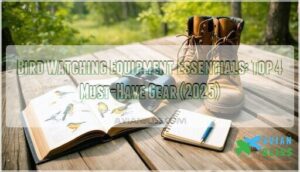 You’ll need four essential pieces of bird watching equipment to start your birding journey.
First, grab quality binoculars with 8×42 magnification – they’re your window into the avian world.
Second, carry a reliable field guide like Sibley’s for accurate species identification.
Third, pack a waterproof notebook to record your sightings, behaviors, and locations.
Fourth, wear comfortable hiking boots since you’ll cover various terrains chasing those elusive species.
Don’t forget basics like insect repellent and sunscreen, because nothing ruins a perfect birding moment like mosquito attacks or sunburn.
These bird watching equipment essentials form your foundation, but choosing the right binoculars involves understanding magnification ratios, lens coatings, and weight distribution factors that separate casual observers from serious birders.
Table Of Contents
- Key Takeaways
- Bird Watching Essentials
- Choosing Binoculars
- Spotting Scopes
- Top 4 Bird Watching Equipment
- Bird Watching Apps
- Safety and Comfort
- Bird Watching Locations
- Enhancing Bird Watching Experience
- Frequently Asked Questions (FAQs)
- What to look for in quality birdwatching equipment?
- What accessories do you need for birdwatching?
- What gear do you need to start birdwatching?
- What equipment does a bird watcher need?
- How to carry birdwatching gear?
- What is the interactive bird watching gear checklist?
- What equipment is needed for birdwatching?
- What equipment do you need to see birds?
- What is the best device for bird watching?
- What are the 5 S’s of birding?
- Conclusion
Key Takeaways
- Start with 8×42 binoculars – They’re your most crucial investment, offering the perfect balance of magnification and stability for tracking birds without breaking your budget.
- Carry a reliable field guide and waterproof notebook – You’ll need quick species identification and a way to record your sightings that won’t get ruined by weather.
- Don’t overlook comfort and safety gear – Proper hiking boots, weather-appropriate clothing, and insect repellent keep you comfortable during long birding sessions.
- Enhance your experience with technology – Bird identification apps like Merlin Bird ID transform your smartphone into a powerful field tool that works even offline.
Bird Watching Essentials
Starting your bird watching journey requires just three essential items that’ll transform you from a curious observer into a confident birder.
With a reliable field guide, quality binoculars, and a sturdy notebook, you’ll have everything needed to identify, observe, and document the fascinating birds around you.
Field Guides for Identification
Field guides serve as your roadmap to the fascinating world of bird species, helping you transform fleeting glimpses into confident identifications.
These essential resources contain detailed guide illustrations, habitat descriptions, and behavioral notes that make bird identification accessible to everyone. Bird songs identification can further refine your skills.
- Physical field guides offer durability and detailed regional guides perfect for expert usage in any weather
- Digital field guides and apps provide app portability with instant access to bird calls and digital checklists
- Specialized bird identification guides focus on specific regions, improving accuracy for local bird species identification
Binoculars for Observation
Nobody expects binoculars to transform your birdwatching experience, but they’re absolutely essential for spotting distant species.
Look for 8x magnification power with quality lens coatings for crisp images. A wide field of view helps track moving birds, while close focus capability reveals intricate feather details.
Consider exploring binoculars for birding to enhance your viewing experience. Choose waterproof models from trusted brands like Nikon or Celestron for reliable bird watching optics that enhance every birdwatching adventure.
Notebooks for Record Keeping
Beyond simple checklists, your bird watching journal becomes your personal field laboratory.
Sketching birds helps you notice subtle details you’d otherwise miss, while weather resistance protects months of observation details from unexpected downpours.
Data organization transforms random sightings into meaningful patterns, and personalization options let you track favorite species or seasonal behaviors.
A quality notebook with reliable pen and pencil creates lasting memories.
Choosing Binoculars
You’ll want to choose binoculars that match your birding style and budget, since they’re the most important upgrade you can make.
The right pair will transform distant specks into detailed birds, but with options ranging from under $100 to over $2,000, knowing what to look for saves both money and frustration.
This will help you make an informed decision, and budget will play a significant role in that decision.
Magnification and Objective Lens Size

When selecting binoculars, you’ll encounter numbers like 8×42 or 10×50. The first number represents magnification power, while the second indicates objective diameter in millimeters.
Here’s what matters:
- 8x magnification provides steady images with wider field of view
- 10x magnification offers closer detail but increases hand shake
- 42mm objective lens delivers excellent image brightness and exit pupil
- Larger objective diameter improves performance in low light conditions
Choose 8×42 binoculars for the best balance. For ideal viewing, consider binoculars with fully multi-coated lenses.
Waterproof and Lightweight Options
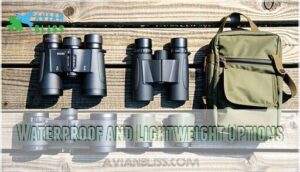
Waterproofing your bird watching equipment protects against sudden downpours, morning dew, and humid conditions.
Look for binoculars with O-ring seals and nitrogen purging to prevent internal fogging. Modern material innovation creates lightweight models under two pounds, while foldable binoculars offer portability.
Consider specialized birding binoculars for ideal viewing. Pack durable cases and packable rainwear as essential bird watching accessories for weather protection during your adventures.
Budget and Brand Considerations
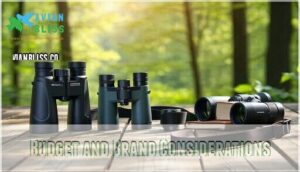
Your budget determines which bird watching equipment you can access, from entry-level binoculars under $150 to premium optics exceeding $1,000.
Smart shoppers find excellent affordable scopes and used equipment that deliver professional results without breaking the bank.
For ideal viewing, consider binoculars with fully multi-coated optics to improve light transmission.
- Entry-level binoculars ($100-300): Celestron Nature DX and Bushnell H2O offer solid performance for beginners
- Mid-range models ($300-700): Nikon Monarch M5 and Athlon Midas ED balance quality with bird watching affordability
- Premium options ($1,000+): Swarovski and Leica provide top-tier optics with lifetime warranties
- Money-saving tips: Consider previous-generation models from trusted bird watching binocular brands for significant savings
Spotting Scopes
When you’re watching birds in wide-open areas like wetlands or grasslands, you’ll quickly discover that binoculars aren’t always enough to get a clear view of distant species.
Spotting scopes bridge this gap by offering higher magnification power, typically ranging from 15x to 60x, which lets you observe fine details on birds that would otherwise appear as tiny specks through regular binoculars, allowing for a closer look at distant species and their fine details.
When to Use a Spotting Scope
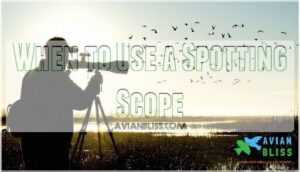
You’ll want spotting scopes when binoculars can’t bridge the gap for distance viewing.
Open habitats like wetlands, grasslands, and shorelines are perfect for scope magnification, where stationary birds appear as tiny specks through regular optics.
Detail observation becomes possible at ranges where even powerful binoculars fall short, making bird identification feasible for distant raptors, shorebirds, and waterfowl in their natural settings, allowing for a closer look at natural settings.
Types of Spotting Scopes
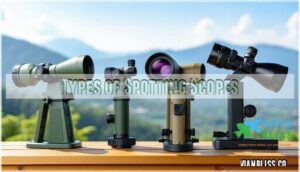
You’ll find five main types of spotting scopes for bird watching equipment.
Angled spotting scopes position eyepieces at 45 degrees, reducing neck strain during long sessions. Straight scopes align directly for quick target acquisition.
Compact models weigh under three pounds, offering excellent portability. Full-size versions feature larger objective lenses for superior magnification power and lens quality in open habitats.
For bird watching hikes, lightweight spotting scopes are ideal, and they can be considered lightweight and portable, making them perfect for bird watching with superior magnification.
Features to Look for in a Spotting Scope
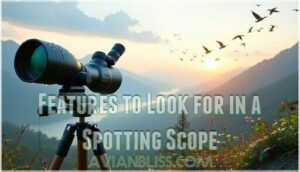
When choosing spotting scopes, prioritize magnification power between 20-60x for versatile bird watching.
Look for high-quality objective lenses, typically 60-80mm, which gather more light for clearer images. Understanding spotting scope magnification is vital for ideal viewing.
Weatherproofing protects your investment from rain and humidity. Confirm tripod stability through secure mounting systems.
Consider field of view specifications, as wider views help track moving birds more easily, and ensure a clearer image for better bird watching experiences.
Top 4 Bird Watching Equipment
After choosing your binoculars and field guide, you’ll want to examine these four top-rated pieces of equipment that experienced birders recommend.
These carefully selected items represent the best balance of quality, functionality, and value for both beginners and seasoned bird watchers, and are considered to be top-rated.
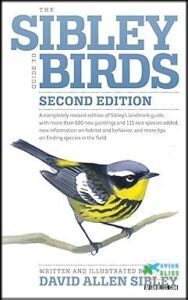
1. Sibley Guide to Birds Second Edition
 View On Amazon
Standing as the gold standard for bird identification, the Sibley Guide to Birds Second Edition transforms your field experience with 923 species coverage and nearly 7,000 digitally remastered paintings.
You’ll appreciate the 15-20% larger illustrations that reveal essential details for accurate identification.
This thorough guide includes over 600 new paintings, expanded habitat descriptions, and voice transliterations for 900+ species.
While it’s hefty for fieldwork, you’ll find it invaluable for home study and comparison work, making every birding adventure more rewarding with its accurate identification tools.
Best For: Serious birders and enthusiasts who want comprehensive, in-depth coverage of North American birds at home or for research.
- Nearly 7,000 remastered illustrations showing detailed plumage and angles for 923 species
- Expanded text with updated habitat, range maps, and voice descriptions for more precise identification
- Layout groups similar birds for easy comparison and offers new tips for tricky species
- Large, heavy book makes it impractical for field use or travel
- Small font size may be difficult for some readers, especially older users
- Minor color inaccuracies and occasional labeling errors in illustrations
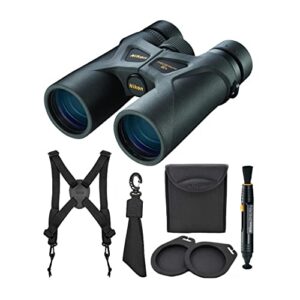
2. Nikon 8×42 ProStaff 3S Binoculars Bundle
 View On Amazon
At around $120, the Nikon 8×42 ProStaff 3S bundle delivers serious value for your birding adventures.
You’ll get crisp, bright images thanks to multi-coated lenses and silver-alloy prism coatings.
The 8x magnification hits that sweet spot for tracking fast-moving songbirds, while the 42mm objective lens gathers plenty of light for dawn and dusk observations.
Weighing just 20 ounces, these binoculars won’t strain your neck during long birding sessions, and the waterproof, fog-proof design handles morning dew and sudden downpours without missing a beat.
Best For: Birders and outdoor enthusiasts looking for lightweight, durable binoculars with bright, sharp optics at an affordable price.
- Crisp, bright images even in low light, thanks to quality coatings and eco-glass.
- Lightweight, ergonomic design reduces fatigue during long birdwatching outings.
- Waterproof and fog-proof construction ensures reliable use in any weather.
- Lens caps are not captive and may fall off during use.
- No compatibility with iPhone adapters for digiscoping.
- Some users may prefer higher magnification for detailed viewing.
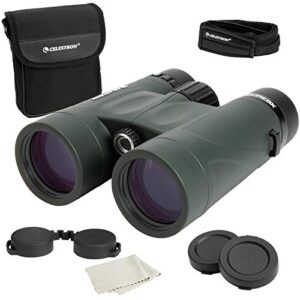
3. Celestron Nature DX 8×42 Binoculars
 View On Amazon
Budget-conscious birders often discover that stellar optics don’t require premium prices, and the Celestron Nature DX 8×42 proves this point beautifully.
You’ll appreciate its 8x magnification paired with 42mm objective lenses, which deliver bright, crisp images perfect for tracking fast-moving songbirds.
The fully multi-coated lenses and BaK-4 prisms guarantee excellent color accuracy, while the waterproof, nitrogen-purged housing handles morning dew and unexpected showers.
At under $200, you’re getting performance that rivals binoculars costing twice as much.
Best For: Birdwatchers and outdoor enthusiasts seeking quality optics at an affordable price.
- Moderate low-light performance compared to higher-end binoculars.
- Some discomfort reported with eyecups and basic accessories.
- Mild edge blur and reduced sharpness at field of view periphery.
- Bright, clear images with excellent color accuracy and a wide field of view.
- Durable, waterproof, and lightweight design ideal for field use.
- Highly rated value, rivaling more expensive models for performance.
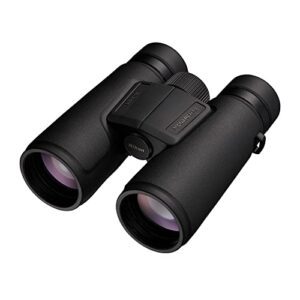
4. Nikon Monarch M5 8×42 Binocular
 View On Amazon
The Nikon Monarch M5 8×42 delivers premium optics that’ll make you feel like you’ve upgraded your eyes.
With ED glass lenses, you’ll spot crisp details without the color fringing that plagues cheaper binoculars.
The 19.5mm eye relief works perfectly with glasses, while twist-up eyecups lock securely in place.
At 22.2 ounces, they’re comfortable for all-day birding adventures.
The waterproof, nitrogen-filled design handles morning dew and sudden downpours without fogging up.
Though pricier at around $289, these binoculars offer exceptional clarity that transforms every birding session into a crystal-clear wildlife documentary.
Best For: Outdoor enthusiasts and birdwatchers who want sharp, clear views with premium comfort and reliable build quality.
- Excellent clarity and color fidelity thanks to ED glass and premium coatings
- Comfortable for eyeglass wearers with long eye relief and secure twist-up eyecups
- Durable, waterproof, and fog-free, making them suitable for all-weather use
- No built-in tripod mount, limiting hands-free use
- Slightly narrower field of view than some competitors
- Eyecups may loosen with frequent adjustment
Bird Watching Apps
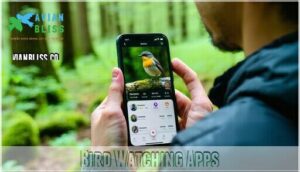
Modern bird watching apps transform your smartphone into a powerful identification tool that fits in your pocket.
You’ll access instant species information, bird calls, and real-time sighting data wherever your birding adventures take you.
Merlin Bird ID App
Merlin Bird ID revolutionizes smartphone bird identification through advanced AI technology.
You’ll access Photo Identification for visual matching, Sound Identification using real-time spectrogram analysis, and reliable Offline Functionality for remote locations.
This bird identification app covers 10,000+ species with Community Integration via eBird data, ensuring continuous Accuracy Improvement through machine learning algorithms and expert-verified content updates.
The app utilizes eBird data for location-specific identification.
Audubon Bird Guide App
The Audubon Bird Guide app covers over 800 North American species with 3,000+ photos and extensive audio clips.
You’ll love the similar bird ID feature for species comparison, plus nearby sightings alerts that show what’s been spotted locally.
The app’s offline access lets you identify birds without cell service, while automated life list updates track your discoveries.
These birding apps enhance your bird watching equipment arsenal perfectly. For a thorough experience, consider apps that offer bird song learning.
EBird App
The eBird app transforms your smartphone into a powerful research tool, connecting you with over a million birders worldwide.
This Cornell Lab creation supports conservation efforts through your everyday sightings, making every birding trip count.
Here’s what sets eBird apart:
- Offline functionality – Track sightings without cell service, then sync later
- Real-time species mapping – See what others spotted nearby today
- Data sharing for science – Your observations help researchers monitor bird populations
With support for 41 languages and GPS-based location tracking, eBird’s accuracy stems from millions of verified observations.
The app’s community features let you explore birding hotspots, receive rare species alerts, and contribute to the world’s largest biodiversity database while building your life list.
Benefits of Using Bird Watching Apps
Bird watching apps revolutionize your outdoor experience through instant identification features, audio recording capabilities, and seamless data sharing.
These smartphone tools offer portability advantages over traditional field guides, while real-time maps reveal nearby birding hotspots.
Whether you’re using birding apps for bird call identification or tracking species with bird identification apps, technology transforms every outing into an efficient, connected adventure, making it an ideal tool for instant identification.
Safety and Comfort

Proper clothing and safety gear protect you from harsh weather, insects, and terrain hazards during extended birding sessions.
Your comfort level directly affects how long you can observe and enjoy birds in the field.
Essential Clothing for Bird Watching
Your clothing choices can make or break your birding experience.
Weather-appropriate clothing with layering strategies keeps you comfortable as conditions change throughout the day.
Choose bird watching clothing in neutral earth tones—camouflage patterns work well in wooded areas.
Fabric technology like moisture-wicking synthetics beats cotton every time.
Comfort considerations matter during long hikes, so select breathable materials that won’t restrict movement while observing birds.
Footwear and Accessories
Your ground-game success depends on proper bird watching footwear and essential accessories that keep you comfortable during long observation sessions.
Waterproof hiking boots with ankle support prevent slips on uneven terrain, while thoughtful gear selection enhances your birding adventures.
- Comfortable hiking boots with boot waterproofing protect against wet grass, mud, and stream crossings
- Wide-brimmed bird watching hat in earth tones shields eyes from sun glare while identifying distant species
- Lightweight gloves provide warmth during early morning expeditions and protect hands from thorns
Insect Repellent and Sun Protection
Your gear is ready, but nature has other plans.
Proper bird watching protection shields you from sun damage and pesky insects that can ruin hours of observation.
Smart application of insect repellent and sunscreen keeps you comfortable during those perfect golden-hour sightings when birds are most active.
| Protection Type | Recommended Options | Application Tips |
|---|---|---|
| Insect Repellent | DEET alternatives like picaridin, lemon eucalyptus oil | Reapply every 4-6 hours, avoid face contact |
| Sunscreen Types | Broad-spectrum SPF 30+, zinc oxide formulas | Apply 30 minutes before exposure, reapply every 2 hours |
| Clothing Protection | Long sleeves, pants, wide-brimmed hats in light colors | Choose breathable fabrics, tuck pants into socks |
| Bird Watching Safety | Check for toxic reactions, carry first aid basics | Test products before trips, know allergy symptoms |
| Application Frequency | Morning application, midday refresh for extended trips | Set phone reminders, pack travel-size containers |
Check for toxic reactions, carry first aid basics.
Test products before trips, know allergy symptoms.
Morning application, midday refresh for extended trips.
Set phone reminders, pack travel-size containers.
Bird Watching Locations

You’ll discover amazing bird watching spots right in your own backyard, where common species like cardinals and robins provide excellent practice for beginners.
Local parks, nature reserves, and wildlife refuges offer diverse habitats that attract different bird species throughout the seasons, making them perfect destinations for expanding your birding skills.
Backyard Bird Watching
Transforming your yard into a thriving bird sanctuary starts with simple feeders filled with quality bird seed.
Place squirrelproof feeders near water sources like bird baths, creating natural feeding stations that attract diverse species.
Add bird houses and nesting boxes throughout your backyard habitats to encourage year-round residents and seasonal visitors to call your space home.
Local Parks and Nature Reserves
Local parks and nature reserves offer accessible bird watching opportunities right in your neighborhood.
Over 82% of Americans live within a 10-minute walk of public parks, making these locations perfect starting points for birders with essential equipment like binoculars and field guides.
- Park Accessibility: Most parks provide free or low-cost entry with designated bird-blind structures and observation decks
- Reserve Management: Many locations offer binocular lending libraries and maintain nesting boxes through partnerships with birding organizations
- Habitat Preservation: Urban reserves with 30% tree canopy cover support 50% higher bird species richness than low-canopy areas
- Local Species: City parks host up to 150 native and migratory species annually, with common sightings including American Goldfinch and Red-tailed Hawks
Bird Watching Etiquette and Ethics
Respecting wildlife while birdwatching guarantees you’ll minimize disturbance to delicate ecosystems.
Keep your distance from nests, especially during breeding seasons, since stressed parents may abandon their young. Avoid nesting areas entirely, stick to designated trails, and respect habitats by not trampling vegetation.
Practice ethical photography by using telephoto lenses instead of approaching closely. Always share sightings responsibly through apps like eBird to contribute valuable data while following proper birdwatching etiquette.
Always share sightings responsibly to contribute valuable data, and remember to respect habitats to ensure the well-being of the birds and their ecosystems.
Enhancing Bird Watching Experience
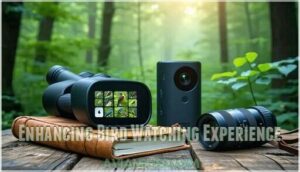
Once you’ve gathered your essential gear, you can take your bird watching to the next level with technology, proper record-keeping, and community connections.
These enhancements turn casual observations into meaningful discoveries, helping you identify more species and contribute to citizen science efforts.
Using Technology for Bird Identification
Modern bird identification apps leverage AI accuracy to transform your smartphone into a powerful field guide.
Photo analysis through apps like Merlin Bird ID instantly identifies species from your images, while sound identification tools recognize bird vocalizations in real-time.
Real-time data from these birding apps connects you to nearby sightings, making app comparison essential for choosing the right digital companion for your adventures.
Keeping a Bird Watching Journal
After each bird watching trip, your notebook becomes a treasure trove of discoveries and insights.
Recording detailed observations helps you track patterns, behaviors, and locations of different bird species. This practice transforms casual sightings into valuable data that enhances your field guide knowledge and sharpens your observation skills over time.
- Sketching birds helps you notice intricate details you’d otherwise miss, from wing patterns to beak shapes
- Memory enhancement occurs naturally as you write down sightings, creating lasting mental connections to each species
- Data analysis reveals seasonal migration patterns and feeding behaviors in your local area
- Observation skills improve dramatically when you record specific details like weather conditions and bird behavior
- Journaling benefits extend beyond birding, creating a personal nature diary filled with meaningful outdoor experiences
Joining Bird Watching Communities and Events
Connecting with fellow enthusiasts transforms solitary birding into shared discovery.
Local Birding Clubs offer weekly guided bird walks, while online birding forums provide year-round identification help.
Citizen science projects like Christmas Bird Count let you contribute meaningful data.
Birding festival tips from experienced members enhance your skills, and bird watching organizations host events that build lasting friendships around your passion.
Frequently Asked Questions (FAQs)
What to look for in quality birdwatching equipment?
Quality binoculars cost $200-2,000, so you’ll want 8×42 magnification for ideal field view and stability. Look for waterproof construction, lightweight design, and reputable brands like Nikon or Vortex for durability.
What accessories do you need for birdwatching?
You’ll need binoculars for distant observation, a field guide for identification, notebook for recording sightings, comfortable hiking boots, weather-appropriate clothing, backpack for gear, and smartphone with birding apps.
What gear do you need to start birdwatching?
Surprisingly, you don’t need much to start birdwatching effectively.
Essential gear includes binoculars with 8x magnification, a field guide for identification, notebook for observations, and comfortable walking shoes for outdoor exploration.
What equipment does a bird watcher need?
You’ll need binoculars (8×42 recommended), a field guide, notebook, and pen for observations. Add a backpack, comfortable hiking boots, weather-appropriate clothing, and your smartphone with birding apps.
How to carry birdwatching gear?
While lugging heavy gear seems counterproductive, you’ll find that organizing it smartly makes all the difference.
Use a comfortable backpack with compartments for binoculars, field guides, and snacks.
Consider birdwatching vests for quick access to essentials.
What is the interactive bird watching gear checklist?
You’ll want an interactive checklist covering binoculars, field guide, notebook, weather-appropriate clothing, backpack, first aid kit, insect repellent, water, snacks, and smartphone with birding apps for complete preparation.
What equipment is needed for birdwatching?
Don’t put all your eggs in one basket when starting out. You’ll need quality binoculars (8×42 recommended), a field guide, notebook, and smartphone with birding apps for successful identification adventures.
What equipment do you need to see birds?
You’ll need binoculars with 8x magnification for clear viewing, a field guide for identification, and a notebook for recording sightings.
These three essentials let you spot, identify, and track birds effectively.
What is the best device for bird watching?
Binoculars represent the single most important device for birdwatching, with 8×42 models offering the perfect balance of magnification, field of view, and portability for spotting distant species clearly.
What are the 5 S’s of birding?
Ever wonder what separates keen birders from casual observers?
You’ll use the five S’s of birding to identify birds: shape, shade, size, sound, and space.
Each category helps you notice specific details, allowing accurate identification in field guides.
Conclusion
Experienced birders understand that theory suggests expensive gear guarantees better sightings, but this isn’t always true.
Your bird watching equipment essentials don’t need to break the bank to deliver exceptional results.
Start with quality binoculars, a reliable field guide, waterproof notebook, and sturdy footwear.
These fundamentals will serve you well across diverse habitats and weather conditions.
Remember, the best equipment is what you’ll actually use consistently, and this leads to happy birding adventures await!
- https://www.nytimes.com/wirecutter/reviews/the-best-binoculars/
- https://www.bradtguides.com/the-best-birdwatching-equipment-kit-list/
- https://www.birdsandblooms.com/birding/birding-basics/birding-gadgets-gear/
- https://mdbirds.org/young-birders/birding-basics/field-guides/
- https://www.backyardecology.net/birding-tools-and-technology-to-help-you-be-a-better-birder/