This site is supported by our readers. We may earn a commission, at no cost to you, if you purchase through links.
 You’ll find bird population monitoring involves systematic tracking of bird species through field surveys, electronic tagging, and bioacoustic recordings.
Scientists use these methods to assess population trends, identify at-risk species, and evaluate conservation efforts.
Citizen science programs like eBird and the Great Backyard Bird Count engage volunteers in data collection, creating massive datasets that researchers couldn’t gather alone.
Modern monitoring combines traditional banding techniques with GPS trackers, automated sound recorders, and satellite imagery.
This thorough approach reveals how birds respond to habitat changes, climate shifts, and human activities.
The data collected becomes the foundation for targeted conservation strategies that can make or break species’ survival chances, ultimately informing species’ survival.
Table Of Contents
- Key Takeaways
- Bird Monitoring Methods
- Conservation Initiatives
- Citizen Science Programs
- Ecological Importance
- Tracking and Analysis
- Frequently Asked Questions (FAQs)
- How do scientists monitor bird populations in parks?
- What is bird monitoring & tracking?
- How does the Bird Conservancy monitor birds?
- How do we monitor neotropical migratory birds?
- What was the first statewide bird monitoring program?
- How accurate are bird population estimates?
- What causes bird monitoring data gaps?
- How much does bird monitoring cost?
- Which bird species are hardest to monitor?
- How do weather conditions affect monitoring results?
- Conclusion
Key Takeaways
- You’ll use multiple methods together for accurate monitoring—field surveys provide direct counts, electronic tracking reveals migration patterns, and bioacoustic systems capture 24/7 species data that traditional methods miss.
- You can contribute valuable data through citizen science programs like eBird and Great Backyard Bird Count, which create massive datasets that researchers couldn’t collect alone and require no special training.
- You’re tracking ecosystem health when monitoring birds—they’re early warning indicators that reveal environmental changes before they’re visible elsewhere, with 48% of species declining globally.
- You’ll find modern technology transforms monitoring through GPS trackers, AI systems identifying species with 87% accuracy, and satellite imagery detecting habitat changes across vast regions.
Bird Monitoring Methods
You’ll find that effective bird monitoring relies on four core methods that scientists use to track populations across different environments.
These techniques range from traditional field surveys where researchers count birds directly, to cutting-edge electronic tracking devices that follow individual birds across continents.
Field Surveys and Techniques

Precision guides every ornithological survey.
When you’re out conducting bird surveys, you’ll use bird census techniques like the Point Count method—standing still, noting every chirp and flutter.
Line Transects have you walking a set path, recording sightings along the way.
Area Searches mean covering a defined space, focusing on Species Identification and Habitat Assessment, offering a complete picture of bird populations.
Accurate data collection often relies on specialized survey tools.
Electronic Tracking Devices
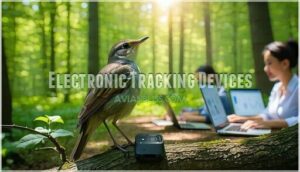
Electronic tracking devices revolutionize bird monitoring through advanced technology.
GPS tracking provides precise location data, while radio telemetry enables real-time movement studies.
The Motus Wildlife Tracking System connects researchers globally, tracking migrations across vast distances.
Device miniaturization reduces tagging impacts on birds, though battery life remains essential for long-term studies.
Data transmission capabilities and ethical considerations guide responsible remote sensing applications.
Researchers also use light-level geolocators on smaller birds, utilizing advanced technology for more accurate results.
Bioacoustic Monitoring Systems
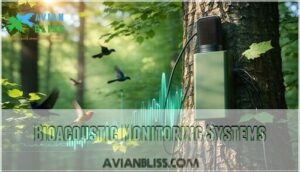
With modern recording equipment now affordable, you can capture bird vocalizations for species identification and habitat assessment.
Bioacoustic monitoring uses strategically placed microphones to collect acoustic data analysis around the clock, and artificial intelligence processes these recordings, identifying over 3,000 species while filtering out noise pollution.
This bird population monitoring method provides continuous bird data analysis, revealing behavioral patterns and population trends that traditional surveys might miss, making it invaluable for conservation applications.
These methods are also a cost effective solution for monitoring species diversity.
Remote Sensing Technologies
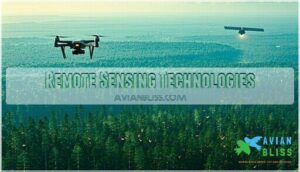
Remote sensing technology has changed the game for bird population monitoring.
With Satellite Imagery and Drone Applications, you can spot colonies and track migration without leaving your desk.
Habitat Monitoring is sharper than ever—thermal cameras and LiDAR reveal hidden nests and species.
Data Integration links remote sensing birds data with field surveys, making Species Identification and trend analysis faster and more reliable.
Conservation Initiatives
If you’re working to protect bird populations, you’ll find that major conservation organizations are your strongest allies in this critical mission.
These science-driven groups combine cutting-edge research with practical field programs to monitor species health and guide effective conservation strategies across North America and beyond, using cutting-edge research to inform their work.
Institute for Bird Populations

Science-based conservation drives the Institute for Bird Populations’ mission, connecting research with real-world habitat impact assessment.
You’ll find their peer-reviewed research spans global partnerships with agencies and universities.
Their flagship MAPS program tracks breeding productivity while MoSI program monitors winter survival rates.
Through rigorous bird population monitoring, IBP transforms data into actionable conservation strategies for threatened species.
Protecting habitats is essential for conserving migratory bird populations, which is crucial for migratory bird populations and supports bird population monitoring.
Bird Conservancy of The Rockies

Through the Great Plains to the Great Basin, Bird Conservancy of the Rockies coordinates IMBCR funding and partner networks for thorough landbird monitoring.
You’ll find their Rocky Mountain Avian Data Center houses population estimates for over 300 species, making it North America’s second-largest breeding bird program.
Their rigorous sampling design addresses large-scale avian population declines.
IMBCR Program

While Bird Conservancy of The Rockies establishes the foundation for large-scale avian monitoring, you’ll find their IMBCR program represents North America’s second-largest breeding bird monitoring initiative.
Through probabilistic sampling across private and public lands from the Great Plains to Great Basin, IMBCR delivers statistically rigorous landbird monitoring that addresses widespread population declines.
- Partner Network: Collaborates with diverse organizations for IMBCR funding and thorough data collection
- Species Coverage: Monitors over 300 bird species with population estimates accessible through Rocky Mountain Avian Data Center 2.0
- Data Accessibility: Provides researchers and conservationists with standardized, reliable datasets for decision-making
- Statistical Rigor: Uses probabilistic sampling methods that guarantee scientifically valid population assessments
- Geographic Scope: Covers vast terrain from grasslands to desert regions, capturing diverse habitat types
Regional Conservation Initiatives

You’ll find regional conservation initiatives coordinate multiple stakeholders across geographic areas to protect bird populations.
These programs integrate habitat preservation strategies with funding allocation from various sources.
Community involvement drives citizen science efforts that support regional monitoring networks.
Policy implementation guarantees species prioritization aligns with population trends data from bird population monitoring programs, creating thorough conservation initiatives.
Citizen Science Programs

You can contribute meaningful data to bird conservation efforts without being a professional scientist, joining thousands of volunteers worldwide who help track species populations through simple observation programs.
These citizen science initiatives provide researchers with vast datasets that would be impossible to collect through traditional scientific methods alone, creating a powerful network of community-based monitoring that spans continents and seasons, which is crucial for bird conservation efforts.
Community Science and Public Engagement
You’ll find that getting involved in citizen science birds opens doors to meaningful Volunteer Opportunities while boosting Data Accuracy through your observations.
Community science programs like eBird transform casual birdwatchers into valuable contributors, expanding Public Awareness about conservation needs.
These bird monitoring programs rely on Educational Outreach to train participants, ultimately supporting Conservation Funding through compelling data that demonstrates ecosystem health.
Great Backyard Bird Count
Each February, you can join over 384,000 participants worldwide in the Great Backyard Bird Count. This annual four-day GBBC participation event transforms casual birdwatchers into valuable citizen science birds contributors.
You’ll spend just 15 minutes counting species in your yard, park, or favorite birding spot. Count accuracy matters—your careful species identification helps scientists track bird populations across continents.
Future improvements in data collection depend on your observations, making bird population data collection more thorough than traditional surveys alone.
EBird and NestWatch Platforms
After counting birds in your backyard, you might want to join the eBird or NestWatch communities.
Both platforms let you record sightings and nesting activity, following strict NestWatch Protocols or eBird Data guidelines.
Their data validation systems guarantee accuracy, while public participation keeps bird data flowing.
Platform comparison? eBird tracks migration; NestWatch monitors breeding—together, they power global population monitoring in citizen science.
These efforts substantially aid bird conservation efforts.
Project FeederWatch
Ever wondered how your backyard observations help science?
Project FeederWatch lets you join a community science effort by reporting bird behavior and species at your feeders.
Your FeederWatch Participation supports:
- Data Accuracy through regular, simple counts
- Insights on Regional Variations in bird populations
- Comparison of Feeder Types and their visitors
- Population monitoring to track long-term trends
Citizen science, made easy, is a great way to contribute to bird research and conservation.
Ecological Importance

When you monitor bird populations, you’re basically taking the pulse of entire ecosystems since birds respond quickly to environmental changes and serve as reliable indicators of habitat health.
Their population trends reveal critical information about climate shifts, habitat loss, and ecosystem stability that helps scientists prioritize conservation efforts and predict broader environmental challenges, indicating the importance of birds as indicators of habitat health.
Ecosystem Health Indicators
Birds serve as nature’s early warning system, acting as Avian Bioindicators that reveal ecosystem health changes before they’re visible elsewhere.
Birds silently signal ecosystem collapse before scientists even notice the warning signs.
When you monitor bird population trends, you’re basically checking the planet’s vital signs.
These ecological indicators respond rapidly to Environmental Change, making bird population monitoring invaluable for detecting habitat quality shifts and Species Decline patterns that guide Conservation Strategies.
Monitoring these species provides insights into restoration efforts and overall ecosystem health.
Bird Population Trends
Your data on bird population trends reveals a sobering reality: 48% of species worldwide are declining while only 6% increase.
The birds are telling us something alarming: nature is losing its voice at an unprecedented pace.
North America lost 2.9 billion birds since 1970—a staggering 28-30% drop that shows Population Decline Causes ranging from habitat destruction to Climate Change Effects.
Three alarming trends emerge from population monitoring techniques:
- Grassland devastation – These ecosystems lost 53% of their birds, totaling 720 million individuals
- Migration Pattern Shifts – Climate disruption alters traditional routes and timing
- Breeding Success Rates – Reduced reproduction from Habitat Loss Impact and environmental stressors
This bird population monitoring data demonstrates how population trends serve as early warning systems for ecosystem collapse.
Habitat Preferences and Seasonal Variations
You’ll quickly notice how habitat preferences and seasonal variations shape where and when you spot birds.
Monitoring birds through nesting habitats, migration patterns, and foraging ecology helps track avian abundance year-round.
Breeding seasonality and winter habitats are key for habitat monitoring birds.
Here’s a quick table to break down these connections:
| Factor | Example Species |
|---|---|
| Nesting Habitats | Wood Thrush |
| Migration Patterns | Swainson’s Hawk |
| Foraging Ecology | American Robin |
| Winter Habitats | Dark-eyed Junco |
Conservation Impact and Priorities
Based on long-term monitoring data, you can see how bird population declines trigger targeted Conservation Strategies.
When Species Decline reaches critical thresholds, conservation priorities shift toward Habitat Prioritization and Ecosystem Resilience programs.
Bird population monitoring reveals which conservation efforts deliver the strongest conservation impact, helping agencies allocate resources effectively.
These population trends also highlight Economic Benefits from healthy bird communities, guiding future conservation priorities.
Tracking and Analysis
You’ll find that effective bird tracking combines traditional field methods with cutting-edge technology to create exhaustive population datasets.
Modern monitoring systems integrate GPS devices, satellite imagery, and AI-powered analysis tools to track species movements and habitat changes across vast geographic scales, utilizing cutting-edge technology.
Bird Population Monitoring Techniques
After grasping how birds shape ecosystems, let’s talk shop: bird population monitoring techniques are your toolkit for understanding what’s really happening out there.
You’ll rely on:
- Density Estimation for population counts
- Species Identification to track diversity
- Habitat Assessment to map bird hotspots
These population monitoring methods boost data accuracy and support smarter population monitoring strategies.
Data Collection and Analysis Methods
Since effective data collection forms the backbone of reliable population monitoring, you’ll need to master several key analytical approaches.
Point counts require statistical rigor to guarantee data accuracy, while distance sampling techniques help identify population trends through systematic bias mitigation.
Modern bird populations benefit from predictive modeling that transforms raw population data into actionable conservation insights.
Understanding how birds use satellite tracking and geolocators can further refine these models.
These data analysis methods enable researchers to distinguish between actual population changes and sampling variations, making population monitoring both scientifically sound and practically useful, which relies on reliable population monitoring and data accuracy.
Technological Advancements in Tracking
Modern tracking systems have revolutionized how you monitor bird populations through sophisticated telemetry innovations and AI identification tools.
GPS tracking devices now weigh just 2 grams, making them suitable for songbirds without affecting flight behavior.
Key technological advances include:
- Motus Wildlife Tracking System – Radio telemetry network spanning 1,800+ stations across 34 countries with nanotags weighing 0.22 grams
- BirdNET AI – Machine learning algorithms achieving 87% accuracy in species identification from acoustic monitoring birds recordings
- Miniaturized GPS units – Cost reductions of 60% since 2015, enabling remote monitoring of over 4,000 tracked species globally
- Automated bioacoustic sensors – Capturing 95% of local vocalizations while processing vast audio archives through geospatial analysis for bird population tracking technologies
These data integration advances streamline remote sensing workflows, transforming how researchers collect and analyze avian movement patterns.
Integration of Satellite and Remote Sensing Data
With remote sensing, you can spot Habitat Change Detection before it’s too late, track Migration Pattern Analysis as birds shift routes, and support Population Density Mapping across vast regions.
Conservation Area Monitoring gets a boost, too—satellite data feeds Predictive Modeling, species distribution modeling, and habitat mapping.
These tools make ecological monitoring and population monitoring programs more accurate, efficient, and far-reaching.
Frequently Asked Questions (FAQs)
How do scientists monitor bird populations in parks?
Think of scientists as detectives in the wild—they use point counts, line transects, and electronic tags to track birds in parks, gathering data on numbers, movement, and habitats.
They use these methods to help you understand how bird populations change over time.
What is bird monitoring & tracking?
Bird monitoring and tracking involves systematically observing and recording bird populations, movements, and behaviors.
This is achieved using field surveys, electronic tags, GPS devices, and citizen science programs.
The purpose is to assess species health and conservation needs.
How does the Bird Conservancy monitor birds?
You’ll use the IMBCR program to track birds across the Rocky Mountains and Great Plains.
Each year, Bird Conservancy conducts avian point count surveys using spatially balanced random sampling design to produce rigorous population estimates and trend data.
How do we monitor neotropical migratory birds?
You’ll track neotropical migratory birds by combining field surveys like point counts and banding with GPS tags, audio recorders, and community science reports.
This mix helps you map migration routes, survival rates, and changes in population trends, which is crucial for understanding the birds’ behavior and making informed decisions about conservation efforts, focusing on population trends.
What was the first statewide bird monitoring program?
Colorado launched the nation’s first thorough statewide effort in 1995, working with partners to "develop and implement a statewide all-bird monitoring plan."
You’ll find it revolutionized how states approach thorough avian conservation tracking.
How accurate are bird population estimates?
Like counting stars through shifting clouds, you’ll find estimates vary widely based on methodology.
Point counts and distance sampling provide decent snapshots, but habitat assumptions and detection rates create uncertainty ranges of 20-50% for most species, which can be considered a significant uncertainty.
What causes bird monitoring data gaps?
You’ll find data gaps pop up when surveys miss remote areas, seasons, or rare species.
Limited funding, tough terrain, and changing technology also play a part, leaving you with puzzle pieces instead of the full picture.
How much does bird monitoring cost?
Like comparing costs to catching lightning in a jar, you’ll find expenses vary dramatically—from $10,000 grant projects to $250,000 federal programs, depending on scale and technology requirements.
Which bird species are hardest to monitor?
You’ll struggle most with secretive species like rails and bitterns that hide in dense cover, nocturnal owls that avoid daylight detection, and rare migrants appearing unpredictably across vast landscapes.
How do weather conditions affect monitoring results?
Rain, wind, and fog become your biggest enemies when counting birds—they hide, stay quiet, or simply can’t be detected, skewing your data substantially.
Conclusion
Like ancient lighthouse keepers who understood that steady beacons prevented countless shipwrecks, today’s researchers recognize that consistent bird population monitoring serves as our early warning system for environmental change.
You’ve seen how field surveys, electronic tracking, and citizen science programs work together to create thorough datasets.
These monitoring efforts don’t just count birds—they reveal ecosystem health, guide conservation priorities, and help species adapt to changing conditions.
Your participation in citizen science projects directly supports this essential work, ensuring future generations inherit skies filled with diverse bird communities.
- https://research.fs.usda.gov/treesearch/3639
- https://www.birdpop.org/docs/pubs/Siegel_2009_Methods_for_Monitoring_Landbirds.pdf
- http://www.tidalmarshmonitoring.net/monitoring-methods-birds.php
- https://americanornithology.org/automated-bird-surveys-how-to-make-arus-and-ai-work-for-you/
- https://biodt.eu/use-cases/real-time-bird-monitoring-citizen-science-data