This site is supported by our readers. We may earn a commission, at no cost to you, if you purchase through links.
You spot a tuxedoed bird waddling along the shore, and your brain instantly shouts “penguin!” But wait—you’re standing on a rocky cliff in Iceland, thousands of miles from Antarctica. That striking black-and-white seabird you’re watching is actually a puffin, one of nature’s most delightful cases of convergent evolution.
Birds that look like penguins aren’t copycats—they’re northern cousins that evolved similar features to thrive in cold ocean waters. From the colorful beaks of puffins to the sleek diving skills of murres, these penguin doppelgangers share the same tuxedo dress code but tell completely different stories.
Understanding what makes these birds penguin-like reveals fascinating patterns in how nature solves the same survival challenges across different hemispheres.
Table Of Contents
- Key Takeaways
- What Makes a Bird Look Like a Penguin?
- Puffins: The Most Famous Penguin Lookalikes
- Auks and Murres: Northern Hemisphere Resemblances
- Extinct and Rare Penguin Doppelgangers
- Other Birds Mistaken for Penguins
- Habitats, Behavior, and Conservation of Penguin Lookalikes
- Frequently Asked Questions (FAQs)
- Are there any birds that look like penguins?
- Are penguins flightless birds?
- What bird looks like a baby penguin?
- Do Pelicans look like penguins?
- What avian species resemble a penguin?
- What do penguins look like?
- What bird looks similar to a penguin?
- What bird resembles a penguin?
- What is the bird that looks like a penguin but isn t?
- What North American bird looks like a penguin?
- Conclusion
Key Takeaways
- Puffins, auks, and murres evolved the same black-and-white “tuxedo” coloring as penguins through convergent evolution—nature solving identical survival challenges in cold ocean waters on opposite sides of the planet.
- The key difference separating these Northern Hemisphere lookalikes from true penguins is flight capability: puffins beat their wings 400 times per minute to fly at 50 mph, while penguins traded wings for flippers and lost flight completely.
- The Great Auk was the Northern Hemisphere’s only truly flightless penguin equivalent, but humans hunted this remarkable seabird to extinction in the mid-1800s—a permanent loss that underscores why protecting remaining species matters.
- These penguin doppelgangers face serious modern threats including habitat loss (20-40% reduction in foraging areas), climate change (10-30% decline in breeding success), and fishing bycatch, making accurate species identification by birdwatchers essential for conservation efforts.
What Makes a Bird Look Like a Penguin?
When you spot a bird that reminds you of a penguin, you’re probably noticing some pretty specific features that these birds share. From their classic black-and-white “tuxedo” look to the way they waddle around on land, certain traits make a bird look like it could be a penguin’s cousin.
Many of these penguin-like birds are actually types of birds found near water that have adapted similar coloring and body shapes for life along coastlines and wetlands.
Let’s break down the key characteristics that create this resemblance and help you understand what you’re really seeing.
For a deeper dive into spotting similar species in the field, check out how to identify birds with long tails and the features that matter most.
Distinctive Black-and-White Plumage
You’ll spot that classic tuxedo look right away! Many birds that resemble penguins share striking plumage patterns with dark backs and bright white bellies—remarkable coloration adaptations that work as camouflage strategies while hunting underwater.
This countershading helps them blend in from above and below, and you can explore more fascinating penguin adaptation facts to see how these features evolved for survival.
Here are three seabird characteristics that create this visual mimicry:
- Black dorsum paired with white underparts for counter-shading protection
- High-contrast feather structure visible from multiple angles
- Compact body silhouettes enhancing the penguin-like appearance at sea
Upright Posture and Waddling Walk
When you watch these birds on land, you’ll notice their upright balance and characteristic waddling gait—posture adaptation driven by short legs positioned far back on compact bodies.
Auks and murres showcase walking patterns nearly identical to penguin characteristics, with that adorable two-beat waddle and tail-supported balance techniques.
These seabird characteristics reveal how different bird species similar to penguins evolved comparable solutions for terrestrial movement!
Adaptations for Swimming and Diving
You’ll be amazed by how these seabirds transform underwater! Their wings function as powerful flippers with a high aspect ratio for propulsion, while dense feather adaptation creates waterproof insulation.
Dive physiology includes myoglobin-rich muscles for oxygen storage, enabling extended breath-holds. Buoyancy control comes from air trapped in plumage and controlled lung volume.
Webbed feet provide steering, and specialized underwater vision helps marine birds track fast-moving prey through murky depths!
These traits, along with buoyant plumage that doubles as insulation, make water bird species supremely adapted to their aquatic lifestyles.
Flight Capabilities Compared to Penguins
While penguins are completely flightless birds, their lookalikes tell a different story! Puffins and murres beat their wings up to 400 times per minute, reaching speeds near 50 miles per hour despite wing morphology built for diving mechanics. This dual performance comes at steep aerodynamic costs—their swimming efficiency underwater demands wings that make aerial flight exhausting, pushing some seabirds toward the flightless extreme. Understanding the distinct black white feathers of these birds can help in identification.
- Atlantic puffins sacrifice grace for grit, powering through air on wings meant for water
- Thick-billed murres dive 210 meters deep yet still soar between colonies and feeding grounds
- Great auks crossed the line penguins did, trading sky for sea and losing flight forever
Puffins: The Most Famous Penguin Lookalikes
If you’ve ever spotted a colorful bird waddling along the coast and wondered if penguins somehow flew north, you probably saw a puffin! These adorable seabirds are the most famous penguin lookalikes, with their upright stance, black-and-white coloring, and clumsy walk on land.
Let’s meet the three puffin species that cause all this delightful confusion.
Atlantic Puffin
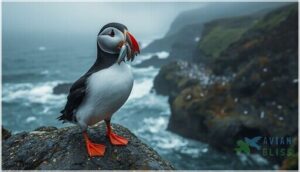
You’ll recognize the Atlantic Puffin by its bright orange beak and feet, which stand out like neon signs against its black-and-white tuxedo plumage. The Atlantic Puffin’s nesting habits are influenced by its preference for rocky island habitats.
These remarkable seabirds dive deep to catch small fish, and their colorful beak structure helps them grip multiple fish at once!
You’ll find them in bustling colonies along North Atlantic coastlines, where they nest in burrows during breeding season before their bird migration takes them out to sea for winter.
These seabirds represent just one example of the diverse types of birds and their habitats found across coastal ecosystems worldwide.
Horned Puffin
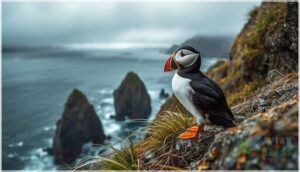
The Horned Puffin sports a sleek black cap and dramatic yellow plumes behind its eyes that look like tiny horns, making it one of the North Pacific’s most striking penguin mimics!
You’ll spot these astonishing seabirds along coastal cliffs from Alaska to Japan, where Horned Puffin habitat includes rocky islands and marine ecosystems.
During puffin migration, these feathered friends travel hundreds of miles across open ocean, showcasing the remarkable adaptations that make auks and seabirds such essential parts of our planet’s biodiversity!
Tufted Puffin
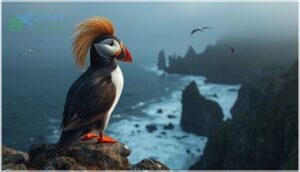
With its dramatic golden plumes sweeping backward like a rockstar’s wild mane, the Tufted Puffin stands out as the most flamboyant member of the puffin family! You’ll find these alcids along the North Pacific coast, where their bright orange beak structure and striking feather coloration make bird species identification easy.
During seabird migration, Tufted Puffins travel vast ocean distances, returning to rocky cliffs for their nesting habits each breeding season!
Key Differences Between Puffins and Penguins
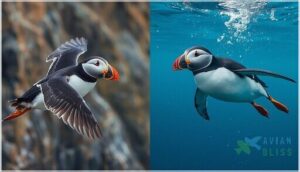
Despite their matching tuxedo look, puffins and penguins belong to completely different bird families separated by millions of years!
Flight patterns reveal the biggest split—puffins beat their wings 400 times per minute to soar at 50 mph, while penguins can’t fly at all.
Beak shapes differ too: puffins sport colorful triangular bills, whereas penguins have longer, curved beaks perfect for their diving techniques.
Auks and Murres: Northern Hemisphere Resemblances
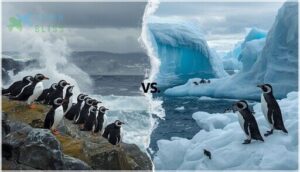
If you’ve ever spotted a black-and-white bird bobbing on ocean waves in the Northern Hemisphere, you’ve probably met one of the auk family members. These exceptional swimmers share the penguin’s tuxedo look and expert diving skills, but they live thousands of miles away in Arctic and sub-Arctic waters.
Let’s meet five impressive species that could fool you into thinking penguins took a vacation north!
Razorbill
If you’re scanning rocky North Atlantic cliffs, Razorbills are the black-and-white auks you’ll spot nesting in boulder crevices. These expert seabirds pack impressive underwater skills:
- They “fly” beneath the waves using wings as flippers, diving usually to 35–43 m
- Their distinctive hatchet-shaped bill features a bright white vertical stripe
- Breeding colonies cluster on sea cliffs from Iceland to Labrador
- Adults carry up to 8 fish crosswise in their bills
- Unlike penguins, Razorbills can actually fly between foraging sites
Common Murre
You’ll find Common Murre colonies packed wing-to-wing on northern sea cliffs, where these black-and-white seabirds create some of the densest nesting aggregations in the Auk family!
These remarkable divers plunge to 100 m, using their wings as underwater propellers, chasing capelin and herring.
Each adult in the colony lays one uniquely patterned egg on bare rock, and chicks leap from cliffs before they can truly fly!
Thick-billed Murre
You’ll recognize Thick-billed Murres by their stouter bills with a white gape line, making them stand out from their Common Murre cousins in the Auk family! These Arctic seabirds are absolute diving champions among auks, plunging beyond 150 m to catch fish and squid.
Colony dynamics shift with sea-ice changes, and their foraging strategies adapt when ocean temperatures climb—fascinating Arctic migration patterns follow the ice edge!
Little Auk (Dovekie)
Meet the Little Auk, or Dovekie—the smallest member of the auk family and one of the most adorable penguin lookalikes you’ll ever see! These tiny alcids weigh just 140-190 grams and sport black-and-white feather structure perfect for Arctic waters.
Their diet analysis reveals a preference for zooplankton, and their migration patterns take them south when winter ice expands.
Breeding habits include nesting behavior in rocky crevices across Greenland and Svalbard!
Japanese Murrelet
If you’re heading to Japan’s coasts, keep your eyes peeled for the Japanese Murrelet—one of the rarest seabirds and penguins lookalikes in the auk family! This bird species measures about 24 cm long and rocks striking black-and-white plumage with a white crescent behind each eye.
Breeding habits center on remote nesting sites in rocky crevices, while feeding patterns focus on small fish.
Conservation efforts are critical since only 2,500–10,000 individuals remain!
Extinct and Rare Penguin Doppelgangers

Some penguin lookalikes have vanished from the Earth entirely, while others are so rare that spotting one feels like finding hidden treasure. The Great Auk was hunted to extinction in the 1800s, and today you’ll find a few murrelet species teetering on the edge of survival.
Let’s meet these extinct and endangered birds that once ruled—or still cling to—the wild coasts of the Northern Hemisphere.
Great Auk
The Great Auk was once the most penguin-like bird in the Northern Hemisphere, but tragically, humans hunted this flightless seabird to extinction in the mid-1800s. This exceptional member of the Auk family showed us how bird evolution can create similar forms in different hemispheres!
Here’s what made it extraordinary:
- Stocky build with a short neck, perfect for diving deep
- Wings adapted for swimming underwater, not flying through air
- Black-and-white plumage that rivaled any penguin’s tuxedo look
Fossil records and historical accounts reveal these seabirds lived in colonies on rocky North Atlantic islands. The Auk extinction reminds us why protecting our feathered friends matters—once a bird species vanishes, we can’t bring it back.
The Great Auk’s extinction teaches us that once a species vanishes, we lose it forever—making protection of living birds essential
Guadalupe Murrelet
You’ll find one of the world’s rarest auks nesting on Mexican islands—the Guadalupe Murrelet, with fewer than 5,000 breeding pairs globally! This tiny seabird shows striking black-and-white plumage and pursues fish underwater using wing propulsion.
Island Conservation and Wildlife conservation efforts have tackled introduced predators, offering hope for Species Preservation.
Marine Ecology research reveals their nocturnal foraging underpins Bird Migration patterns, making Bird species identification vital for protecting these endangered ocean wanderers.
Marbled Murrelet
You can spot a Marbled Murrelet along the Pacific coast from Alaska to California, where these striking auks nest in old-growth forests far from shore! Their dark upperparts and pale chest create stunning contrast during Marine Foraging dives.
- Coastal Habitats include temperate rainforests with mature Nesting Platforms
- Wildlife conservation efforts target logging threats in breeding areas
- Seabird characteristics include compact bodies measuring 24–28 cm long
- Bird species identification relies on streaked juvenile plumage patterns
- Conservation Efforts focus on protecting old-growth conifer stands for survival
Other Birds Mistaken for Penguins
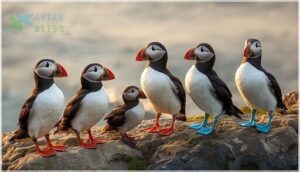
Not every penguin lookalike wears the classic black-and-white tuxedo or lives on icy shores. Some surprising birds get confused with penguins because of their upright stance, ocean-going lifestyle, or quirky appearance, even though they don’t fit the typical mold.
You’ll find these unusual suspects come in bright colors and unexpected shapes that might make you do a double-take.
Blue-Footed Booby
You might think those bright blue feet and upright stance scream penguin, but Blue-Footed Boobies are tropical seabirds with wings built for flight! Watch for their striking plunge-diving feeding habits from heights of 2-8 meters, targeting anchovies and sardines.
Their famous booby mating rituals feature a high-stepping “dance” showcasing those vibrant feet—brighter blues signal healthier birds, making them unforgettable penguin lookalikes along tropical nesting sites.
Nazca Booby
You’ll spot Nazca Boobies as striking Pacific seabirds with sharp black-and-white plumage reminiscent of penguins, but these penguin lookalikes soar and plunge-dive from heights up to 16 feet!
Found across the eastern tropical Pacific, especially the Galápagos, they’re birds mistaken for penguins until you watch their remarkable aerial hunting—a booby feeding spectacle no flightless bird could match.
Masked Booby
With their dazzling white bodies, jet-black wing tips, and piercing yellow eyes, Masked Boobies wear nature’s most dramatic tuxedo across tropical oceans worldwide—and you’ll often mistake them for penguins until they launch into their breathtaking 100-foot dives!
Five striking Masked Booby facts for your bird watching trips:
- Tropical distribution spans all warm oceans, from Caribbean reefs to Pacific atolls
- Nesting sites are established on remote coral islands and coastal cliffs
- Feeding patterns involve stunning plunge-diving for flying fish and squid
- Mating rituals include synchronized sky-pointing displays between partners
- Breeding habits usually produce two eggs, though only one chick survives
These striking seabirds prove that wildlife identification requires watching behavior, not just appearance!
Inca Tern
Along Peru’s rocky coastlines and northern Chile’s island chains, you’ll discover Inca Terns sporting slate-gray bodies and those unmistakable white mustache plumes—quite a departure from penguin plumage! Their black, recurved beaks and graceful aerial dives showcase remarkable seabird adaptations for marine ecology.
Though they’re listed as near threatened, these remarkable terns prove that bird identification requires observing flight behavior, not just tuxedo-like patterns. Wildlife conservation efforts continue protecting their breeding colonies!
Parakeet Auklet
You’ll spot Parakeet Auklets along Alaska’s rocky coasts, where their black upperparts and pale underparts create that penguin-like contrast you’ve been searching for! These remarkable Auk family members showcase unique beak shape and feather structure adaptations for their seabird habitat.
Here’s what makes their bird identification distinctive:
- Compact bodies with short necks and hooked bills for coastal foraging tactics
- Dense waterproof plumage enabling shallow-to-moderate diving depths
- Colonial nesting habits in cliff crevices across North Pacific breeding sites
Their migration patterns follow zooplankton abundance!
Habitats, Behavior, and Conservation of Penguin Lookalikes
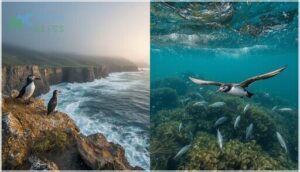
You’ve met the birds that wear nature’s tuxedos, but where do these penguin lookalikes actually live, and how are they doing?
These exceptional birds have carved out homes across oceans and coastlines worldwide, each adapting unique behaviors to survive in their marine worlds.
Let’s explore where you can find them, how they make their living, and what threats they’re facing today.
Typical Habitats and Global Distribution
You’ll find these penguin lookalikes scattered across the globe, from icy Arctic cliffs to tropical island shores, each species claiming its own slice of ocean real estate.
Puffins dominate the rocky shores of the North Atlantic, while murres patrol Arctic tundras and coastal ecosystems. Boobies prefer island habitats in warm marine environments.
These seabird habitats reveal fascinating patterns in marine biology and ecosystems—each species perfectly adapted to its wildlife habitat.
Foraging and Social Behaviors
Once these seabirds settle into their territories, their feeding habits and colony dynamics reveal remarkable wildlife adaptation strategies! Razorbills and murres showcase seabird behavior through coordinated group dives, where bird behavior and social structure combine with social learning to improve foraging strategies.
Their dive patterns and avian biology show remarkable precision:
- Puffins plunge 20–60 meters deep, targeting schooling fish near the surface
- Common Murres execute rapid, repeated dives exceeding 60 meters in prey-rich zones
- Razorbills coordinate feeding flights with synchronized diving to reduce search effort
- Little Auks concentrate feeding bouts during daylight hours near sea-ice edges
- Japanese Murrelets adjust dive depth based on tidal cycles and prey seasonality
Conservation Status and Threats
These remarkable seabirds face serious challenges that threaten their survival. Habitat fragmentation and climate shifts disrupt breeding colonies, while human impact from fishing bycatch and pollution adds further pressure. The conservation status of marine birds reveals troubling patterns—the Marbled Murrelet is endangered, and the Great Auk has suffered species extinction. Bird conservation efforts and wildlife conservation programs now target ecosystem disruption, but many colonies still lack protection.
| Threat Category | Impact on Populations |
|---|---|
| Habitat Loss | 20–40% reduction in foraging areas |
| Climate Change | 10–30% decline in breeding success |
| Fishing Bycatch | 1–8% adult mortality in affected regions |
| Disease Outbreaks | Localized mass mortality events |
Importance for Bird Watchers and Biodiversity
Accurate species recognition transforms your bird watching into meaningful citizen science. When you document penguin lookalikes, you’re mapping avian diversity and tracking ecosystem health across coastal habitats.
These observations inform conservation prioritization—protecting murres and puffins safeguards entire marine food webs! Your field notes contribute to ornithology databases that monitor avian biodiversity shifts, turning weekend outings into essential wildlife conservation work.
Frequently Asked Questions (FAQs)
Are there any birds that look like penguins?
Step outside and you might swear you’ve spotted a penguin—but hold on! Several seabird similarities fool even experienced birders.
Penguinlike birds with striking avian adaptations exist across oceans, mimicking these beloved flightless birds perfectly.
Are penguins flightless birds?
Yes, penguins are flightless birds! Their wings evolved into powerful flippers for underwater swimming.
Dense plumage and body fat help with buoyancy, making them skilled aquatic hunters but unable to fly.
What bird looks like a baby penguin?
The little auk (dovekie) is hands-down the world’s most convincing baby penguin mimics! This pint-sized seabird’s round body, stubby wings, and black-and-white juvenile plumage create common birding mistakes during wildlife identification adventures.
Do Pelicans look like penguins?
Pelicans sport a massive throat pouch and hooked beak that penguins lack entirely. Their feather patterns, diving techniques, and colony behavior differ dramatically—pelicans fly gracefully while penguins waddle and swim underwater using flipper-like wings.
What avian species resemble a penguin?
You’ll find auks, puffins, murres, and boobies among avian species with penguinlike characteristics.
These feathered friends showcase striking avian resemblance through bird evolution, developing similar seabird adaptations despite living in completely different ocean regions.
What do penguins look like?
Penguins sport striking tuxedo plumage—black backs and white bellies—that create perfect camouflage underwater.
These flightless birds stand upright on short legs, waddle confidently, and use their flipper-like wings to power through ocean depths with remarkable speed!
What bird looks similar to a penguin?
Several seabirds share penguins’ tuxedo look! Puffins, auks, and murres are classic penguin mimics with black-and-white plumage.
These feathered friends evolved similar colors for ocean life, though most can fly—unlike their flightless southern cousins.
What bird resembles a penguin?
Puffins reign as the most iconic penguin mimics you’ll encounter while birdwatching, sporting tuxedo-style plumage and upright stances.
Auks and murres—fellow seabirds—also mirror penguins through bird evolution’s fascinating convergence, though these feathered friends retain flight.
What is the bird that looks like a penguin but isn t?
The Atlantic Puffin is the most famous avian impostor you’ll encounter! These adorable feathered friends sport black-and-white plumage and upright postures, but unlike penguin species, puffins can actually fly.
What North American bird looks like a penguin?
You might wonder if those tuxedoed birds diving off northern coasts are penguins. They’re not! Atlantic Puffins, Common Murres, Razorbills, and other North American Auks share that striking black-and-white look through exceptional seabird adaptations.
Conclusion
You might think spotting birds that look like penguins is just a fun trivia game, but it’s actually a window into evolution’s creativity. These northern seabirds prove that nature doesn’t need a blueprint—it finds the same ingenious solutions on opposite ends of the Earth.
Next time you see a tuxedoed bird, take a closer look. You’re witnessing millions of years of adaptation, and that’s worth celebrating every single time.
- https://www.birdwatchingdaily.com/beginners/birding-faq/birds-that-look-like-penguins/
- https://timesofindia.indiatimes.com/etimes/trending/5-birds-that-look-just-like-penguins-natures-peculiar-lookalikes/articleshow/123698858.cms
- https://www.audubon.org/field-guide/bird/dovekie
- https://profile.google.com/cp/Cg0vZy8xMXRqcnoydzMx
- https://xeno-canto.org/809908/download