This site is supported by our readers. We may earn a commission, at no cost to you, if you purchase through links.
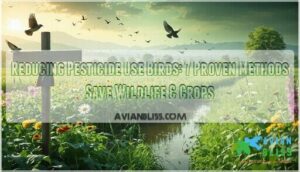 You’re killing birds needlessly with excessive pesticides, but targeted pest management can cut chemical use by 50-80% while boosting yields.
Every year, pesticides eliminate millions of birds through direct poisoning and habitat destruction.
Smart farmers now use integrated pest management, combining beneficial insects, precision spraying, and buffer strips around crops.
This approach doesn’t just save feathered friends—it creates natural pest control armies that work 24/7.
When birds return to your fields, they devour crop-damaging insects, reducing future pesticide needs.
Cover crops and organic practices further strengthen this cycle, turning your farm into a wildlife sanctuary that actually produces better harvests.
The transformation happens faster than you’d expect.
Table Of Contents
- Key Takeaways
- Pesticide Impact Birds
- Reducing Pesticide Use
- Bird Friendly Farming
- Alternatives to Pesticides
- Conservation Initiatives
- Frequently Asked Questions (FAQs)
- How are birds affected by the use of pesticides on crops?
- What is a solution to decrease pesticide use?
- How can birds be used as pest control?
- Will insecticide keep birds away?
- How do pesticides affect bird migration patterns?
- Which bird species are most vulnerable to pesticides?
- Do home garden pesticides harm backyard birds?
- How long do pesticides remain in soil?
- Can pesticide-exposed birds recover their health completely?
- Conclusion
Key Takeaways
- You’ll save 67 million birds annually by switching to integrated pest management, which cuts pesticide use by 50-80% while maintaining crop yields through natural predators and precision targeting
- Your farm becomes a self-sustaining ecosystem when you create buffer strips and use cover crops, attracting beneficial insects that provide 24/7 pest control and reduce future chemical needs
- You’ll boost profits with biological controls like predator insects and parasitoid wasps, which achieve 60-90% pest reduction rates while eliminating the cost and resistance issues of chemical pesticides
- Precision agriculture saves money and wildlife by using GPS and sensor technology to apply treatments only where needed, reducing chemical use by 30% while protecting bird habitats and food sources
Pesticide Impact Birds
You’ll discover that pesticides kill an estimated 67 million birds annually in the United States, while sublethal exposure weakens reproduction and reduces chick survival rates.
The widespread use of neonicotinoids and other insecticides eliminates essential insect prey for over half of farmland bird species, creating a domino effect that disrupts entire ecosystems.
Annual Bird Death Toll
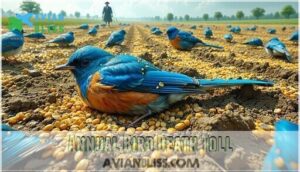
Pesticide exposure kills approximately 67 million birds annually in the United States alone, making it one of agriculture’s most devastating wildlife impacts.
Agriculture’s hidden toll: 67 million birds die from pesticides annually in America alone.
You’ll find that this conservative estimate only captures direct deaths, while countless more birds suffer from sublethal effects that researchers struggle to document thoroughly.
Key mortality causes affecting bird populations:
- Insecticide poisoning – Neonicotinoids and organophosphates cause immediate toxicity in 70% of cases
- Granular pesticide ingestion – Carbofuran applications kill 3-16 songbirds per hectare annually
- Secondary poisoning – Birds consume contaminated prey, spreading toxicity through food webs
- Habitat destruction – Herbicides eliminate nesting sites and insect food sources essential for survival
Sublethal Pesticide Exposure Effects
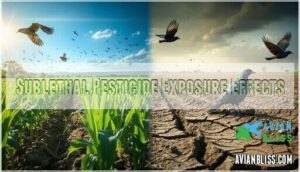
Even tiny doses of pesticides create devastating ripple effects throughout bird populations.
Sublethal pesticide exposure severely impacts bird reproduction, causing smaller chicks and reduced nest success rates.
Neonicotinoid effects birds experience include impaired navigation and 25% body weight loss.
These pesticide mixtures disrupt chick survival through hormonal imbalances and weakened immune systems, demonstrating clear pesticide toxicity birds face daily across agricultural landscapes.
Birds also suffer when pesticides reduce food, which has a significant impact on their overall well-being and survival, leading to reduced nest success.
Insecticide Use Consequences
When you’re dealing with insecticides, you’re witnessing a troubling ripple effect that spreads far beyond target pests.
These chemicals don’t just eliminate unwanted bugs—they’re creating a domino effect that’s reshaping entire ecosystems and threatening the birds we depend on for natural pest control.
Here’s what’s happening in your backyard and beyond:
- Prey Reduction Crisis: Neonicotinoid effects birds by eliminating over 50% of insect species that farmland birds rely on for survival
- Insecticide Toxicity: Direct poisoning weakens immune systems, disrupts reproduction, and reduces chick survival rates substantially
- Ecosystem Impacts: Pollinator decline creates food webs collapse, forcing bird populations to relocate or face starvation
- Resistance Development: Stronger pesticides become necessary as pests adapt, intensifying pesticide toxicity birds experience
Reducing Pesticide Use
You can dramatically reduce pesticide harm to bird populations by implementing targeted farming strategies that protect wildlife while maintaining crop yields.
These proven methods include integrated pest management, organic practices, and strategic buffer zones that create safer environments for birds while naturally controlling pests.
Integrated Pest Management Benefits
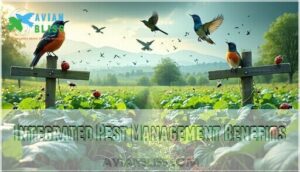
Integrated pest management transforms farming by cutting pesticide use up to 50% while maintaining yields.
You’ll see 30-60% higher bird abundance compared to conventional methods, as IPM creates diverse habitats supporting both beneficial insects and avian species.
Economic advantages include lower input costs and improved pest control efficacy, with 28% fewer damaging outbreaks, which highlights the economic advantages of using IPM and results in lower input costs.
Organic Farming Practices Advantages
Organic farming offers you a pesticide-free approach that supports up to 50% more wild bird species compared to conventional methods.
By eliminating synthetic chemicals, you’re promoting soil health and biodiversity boost while enabling natural water conservation.
These sustainable agriculture practices create reduced runoff, enhancing carbon sequestration.
Your pesticide alternatives benefit birds through healthier ecosystems that naturally control pests.
Consider using organic pesticide options for a safer approach.
Buffer Strips Importance
Buffer strips act like safety zones between farmland and sensitive areas, creating pesticide-free corridors where nesting birdlife thrives.
These wildlife corridors protect water quality while providing essential pollinator habitat and supporting soil conservation.
You’ll find these strips harbor twice as many nesting birds compared to treated croplands, demonstrating how strategic pesticide reduction enhances bird habitat preservation naturally.
This is vital, as the importance of bird habitats directly impacts their survival.
Bird Friendly Farming
You’ll discover that bird-friendly farming methods can increase wildlife abundance by 20-40% while maintaining crop productivity through natural pest control systems.
These sustainable practices create a win-win scenario where diverse bird populations help reduce insect pest outbreaks, cutting your reliance on chemical pesticides by up to 50%.
Increased Bird Abundance Methods
Several farming methods consistently increase bird abundance while reducing pesticide exposure.
You’ll see dramatic results when implementing habitat restoration projects that create nesting sites and food sources.
Here are three proven approaches:
- Habitat Restoration – Plant native vegetation strips along field edges
- Nesting Enhancement – Install bird boxes and preserve existing nest sites
- Food Supplementation – Maintain insect-rich areas through birdfriendly pest control
These pesticide alternatives birds thrive on boost populations 20-40% compared to conventional farming methods.
Natural Pest Control Benefits
When you embrace bird diversity on your farm, you’re basically hiring nature’s most efficient pest control team.
Birds are nature’s free workforce – they’ll slash your pest problems while you sleep.
These feathered workers provide ecosystem services worth billions annually, delivering economic benefits through natural predation that reduces crop damage and pesticide costs.
| Bird Species | Primary Pest Targets |
|---|---|
| Barn Owls | Rodents, small mammals |
| Swallows | Flying insects, mosquitoes |
| Woodpeckers | Bark beetles, wood borers |
| Chickadees | Aphids, caterpillars |
| Hawks | Larger rodents, rabbits |
Bird conservation through pesticide reduction strategies creates self-sustaining cycles where natural predators maintain pest populations below economic thresholds.
Supplementing their natural defenses, consider methods of natural parasite control to further support bird health.
Birdfriendly pest control methods and pesticide alternatives birds support generate measurable returns on investment while protecting wildlife.
Decreased Insect Pest Outbreaks
You’ll notice something remarkable when birds return to farmland: natural predators create a domino effect that reduces crop damage substantially.
Research shows greater bird diversity correlates with decreased insect pest outbreaks, providing sustainable agriculture with powerful allies.
This ecosystem resilience demonstrates how pesticide reduction strategies and bird conservation work together, creating biodiversity benefits that protect both wildlife and harvests naturally, showcasing the importance of ecosystem resilience.
Alternatives to Pesticides
You can protect birds while maintaining productive farms by adopting three science-backed alternatives that work with nature instead of against it.
These methods reduce the 67 million birds lost annually to pesticide exposure while often delivering better crop yields through enhanced natural pest control, which can lead to better crop yields.
Biological Pest Control Methods
You can harness nature’s own pest control army instead of relying solely on chemicals.
Biological pest control methods offer effective alternatives that protect birds while maintaining crop yields through natural enemies and targeted interventions.
Consider these powerful biological approaches:
- Predator introduction brings beneficial insects like lady beetles that reduce aphid populations by 90% in field trials
- Parasitoid wasps achieve 60% drops in whitefly outbreaks when released in commercial greenhouses
- Microbial pesticides using Bacillus thuringiensis show 70% effectiveness against pest caterpillars in organic fields
- Biopesticide efficacy reaches 80% mortality rates in crop-destroying beetles through fungal agents like Beauveria bassiana
- Natural pest control maintains equivalent crop yields while supporting pollinator populations and reducing pesticide impact birds
These birdfriendly practices demonstrate how reducing pesticide use through biological methods creates win-win scenarios for both agriculture and wildlife conservation.
You can find supplies for this online.
Precision Agriculture Techniques
Through GPS guidance and sensor technology, you’ll target pesticide applications with surgical precision, reducing chemical use by up to 30%.
Variable rate application systems analyze soil conditions and pest populations in real-time, while drone applications monitor crop health across vast fields.
This data analysis approach creates detailed pesticide maps, ensuring you apply chemicals only where needed, protecting bird habitats while maintaining crop yields.
Cover Crops Usage
You’ll transform your farm’s ecosystem when you plant cover crops between growing seasons, creating natural barriers against pests while boosting soil health.
These living mulches offer powerful pesticide alternatives through:
- Weed suppression – smothering unwanted plants naturally
- Erosion control – protecting topsoil from wind and water damage
- Water quality improvement – filtering runoff before it reaches waterways
- Crop yield enhancement – fixing nitrogen and adding organic matter
This sustainable agriculture practice reduces chemical reduction needs while strengthening your pest management strategy.
Many farmers source their cover crop seeds online for convenience.
Conservation Initiatives
You’re witnessing a global shift as governments implement conservation programs that protect birds while maintaining agricultural productivity.
Major initiatives like the EU’s Farm to Fork Strategy and the US Conservation Reserve Program demonstrate how policy frameworks can reduce pesticide dependency by 50% while supporting farmers through financial incentives and technical assistance, which is a key aspect of the global shift.
EU Farm to Fork Strategy
The EU’s Farm to Fork Strategy sets ambitious targets, requiring a 50% reduction in pesticide use by 2030.
You’ll see Policy Challenges emerging as current progress sits at only 14% reduction since 2015.
Strategy Implementation faces hurdles with binding legislation delays, while Environmental Impact assessments show promising avian health pesticides benefits where implemented effectively.
| Target Area | 2030 Goal |
|---|---|
| Total pesticide use | 50% reduction |
| Hazardous pesticides | 50% reduction |
| Organic farmland | 25% coverage |
| Progress status | 14% achieved |
Economic Effects include subsidies for farmers shifting to pesticide alternatives, though Future Outlook depends on stronger enforcement mechanisms to protect wildlife populations.
US Conservation Reserve Program
The US Conservation Reserve Program offers landowner incentives to convert 20 million acres of farmland into wildlife habitat, eliminating pesticide use on enrolled lands.
This habitat restoration supports 25 million additional breeding birds annually while reducing chemical inputs by 95%.
CRP enrollment creates buffer zones that block pesticide drift, enhancing environmental health and bird populations through effective conservation practices.
These initiatives align with habitat conservation efforts aimed at protecting bird populations.
National Bans on Pesticides
Beyond regional programs, you’ll find that national pesticide bans offer the most extensive protection for bird populations.
Countries worldwide have recognized that toxic substances require decisive action, with enforcement challenges often revealing the true test of political will against economic repercussions.
- The US DDT ban in 1972 rescued bald eagles from near-extinction – proving that bold policy moves can reverse decades of bird species decline
- EU neonicotinoid restrictions protect over 50% of farmland birds – directly addressing chemical exposure that destroys their insect food sources
- Vietnam’s total glyphosate ban demonstrates – how smaller nations can lead international policy comparison efforts despite political opposition
Frequently Asked Questions (FAQs)
How are birds affected by the use of pesticides on crops?
Like silent sentinels falling from the sky, you’ll find that pesticides kill an estimated 67 million birds annually in the US through direct poisoning, reproductive harm, and reduced insect prey availability for farmland species.
What is a solution to decrease pesticide use?
You can adopt integrated pest management (IPM) strategies, which combine biological controls, crop rotation, and precision application techniques to reduce chemical pesticide dependence by up to fifty percent.
How can birds be used as pest control?
Nature’s pest patrol arrives on wings—you’ll find birds naturally controlling agricultural pests by consuming insects, larvae, and small rodents that damage crops.
This provides eco-friendly protection that reduces your need for chemical interventions.
Will insecticide keep birds away?
Yes, insecticides will keep birds away from treated areas.
You’ll find birds avoid pesticide-sprayed zones because chemicals reduce their insect food sources and pose direct toxicity risks, forcing them to seek safer feeding grounds elsewhere, due to the reduction of their insect food sources.
How do pesticides affect bird migration patterns?
Pesticides disrupt your feathered friends’ migration by contaminating their food sources, weakening their immune systems, and impairing their navigation abilities, ultimately forcing them to alter traditional flight paths.
Which bird species are most vulnerable to pesticides?
While you might think all birds face equal risk, raptors and songbirds are most vulnerable to pesticide exposure.
You’ll find these species suffer reproductive failures, weakened immune systems, and direct poisoning more frequently than waterfowl or seabirds.
Do home garden pesticides harm backyard birds?
Your backyard spray bottle can spell trouble for birds. Common garden pesticides poison songbirds directly through contaminated seeds, water, or insects they eat, causing reproductive issues and death.
How long do pesticides remain in soil?
Soil chemistry affects how long you’ll find chemical residues lingering around.
Most pesticides persist for days to months, with some lasting over a year, depending on temperature and moisture conditions.
The duration of pesticide activity depends on its environmental half-life, which is a key factor in understanding how long pesticides will remain active, and this concept is closely related to the environmental conditions.
Can pesticide-exposed birds recover their health completely?
Studies show many birds recover from illness after sublethal exposure to insecticides, but complete recovery isn’t guaranteed.
You’ll find damaged brain chemistry can restore itself, though reproductive and behavioral effects might persist long-term in some species.
Conclusion
Tomorrow’s farms depend on today’s choices—and reducing pesticide use birds benefit from starts with your next planting decision.
These seven methods transform agricultural landscapes into thriving ecosystems where wildlife and crops coexist profitably.
You’ll discover that beneficial insects work harder than chemicals, buffer strips create natural fortresses, and precision targeting eliminates waste while preserving songbird populations.
Your fields become self-sustaining systems where reduced chemical inputs actually increase long-term productivity and biodiversity.