This site is supported by our readers. We may earn a commission, at no cost to you, if you purchase through links.
 You’ll discover over 700 documented North American bird species across diverse habitats, from Arctic-dwelling snowy owls to desert-loving cactus wrens.
These range from hummingbirds weighing less than a nickel to massive California condors with nearly 10-foot wingspans.
About 40% are year-round residents, while others migrate thousands of miles seasonally.
Whether you’re watching cardinals at your feeder or spotting warblers during spring migration, each species has evolved unique adaptations for survival, from distinctive field marks to behavioral quirks.
Mastering identification techniques transforms casual backyard watching into exciting detective work that reveals nature’s hidden patterns.
Table Of Contents
- Key Takeaways
- North American Bird Types
- Bird Species Classification
- Bird Identification Methods
- Bird Habitats and Ecosystems
- Conservation Status and Trends
- Frequently Asked Questions (FAQs)
- How many North American bird species are there?
- Which bird is only found in the USA?
- How do I identify a bird in my yard?
- What bird songs are easiest to learn?
- How do weather patterns affect bird behavior?
- Which birds visit feeders most frequently?
- What time of day are birds most active?
- How do birds navigate during long flights?
- Conclusion
Key Takeaways
- You’ll discover over 700 documented bird species across North America, ranging from tiny hummingbirds to massive California condors with 10-foot wingspans.
- You can master bird identification using four key methods: visual features like plumage patterns and beak shapes, audio cues from unique calls, range maps showing geographic distribution, and field guides or birding apps.
- You’ll find birds in four main habitat types—forests, wetlands, grasslands, and urban areas—with each species adapted to specific environments and ecological niches.
- You’re witnessing a conservation crisis with 3 billion birds lost since 1970, though targeted protection efforts have successfully recovered species like the California Condor from near extinction.
North American Bird Types
You’ll encounter four main types of birds across North America’s diverse landscapes, each adapted to specific lifestyles and habitats.
These categories include migratory species that travel thousands of miles seasonally, year-round residents, powerful birds of prey, and various waterfowl species.
Migratory Birds
You’ll encounter over 325 migratory bird species throughout North America, each following ancient flight routes that span thousands of miles.
These remarkable travelers showcase nature’s most incredible journeys, adapting their seasonal movements to survive changing climates and find essential resources.
Nature’s winged wanderers master epic journeys, chasing seasons across continents with remarkable precision.
Here are five awe-inspiring migration facts:
- Blackpoll Warblers fly 8,000km non-stop over the Atlantic Ocean
- Arctic Terns complete the longest migration on Earth annually
- Ruby-throated Hummingbirds cross the Gulf of Mexico in one flight
- Sandhill Cranes return to the same roosting sites for generations
- Boreal Chickadees can navigate using magnetic fields and star patterns
Bird tracking reveals these species use four major flyways—Atlantic, Mississippi, Central, and Pacific—as highways connecting breeding and wintering grounds.
Their habitat adaptation skills allow them to thrive in diverse ecosystems from Canadian boreal forests to Central American rainforests, making bird conservation efforts essential for protecting these incredible journeys.
Understanding the bird migration routes is essential for conservation efforts.
Resident Birds
While migratory species follow seasonal patterns, resident birds stay put year-round, becoming familiar faces in your backyard.
These north american birds include Northern Cardinals, Blue Jays, and Downy Woodpeckers that frequent bird feeding stations daily. You’ll observe their consistent nesting habits and flock behavior across different bird habitats.
Urban birds like House Sparrows adapt well to city life, making bird identification easier through regular observation, and allowing you to notice their habits in various bird habitats.
Birds of Prey
North American raptors showcase nature’s most skilled hunters, from soaring hawks to silent owls.
These apex predators play vital roles in ecosystem balance through their specialized hunting techniques and diverse prey preferences.
- Red-tailed Hawks dominate open landscapes with their distinctive rust-colored tails and keen eyesight
- Great Horned Owls hunt nocturally using asymmetrical ear placement for precise sound location
- Bald Eagles primarily target fish but adapt to various prey based on seasonal availability
- Peregrine Falcons achieve diving speeds exceeding 200 mph during hunting stoops
Waterfowl
Waterfowl encompass dozens of north american birds including mallards, geese, and diving ducks that inhabit pond habitat across the continent.
You’ll identify these waterfowl birds by their specialized beak structure adapted for filtering food and waterproof feathers requiring constant feather care.
Duck migration patterns and waterbird ecology make these bird species fascinating to observe, especially migratory birds during seasonal movements when waterfowls gather in massive flocks.
Bird Species Classification

You’ll encounter two main classification systems when studying North American birds: the ABA and AOU checklists.
These official references help you accurately identify and categorize the 700+ species found across the continent.
ABA Checklist
The ABA Checklist serves as your definitive guide to North American bird species, recognizing over 1,100 documented species across the continent.
This authoritative reference follows American Ornithological Society taxonomy updates and undergoes annual checklist revisions to maintain accuracy.
The checklist includes these key features:
- Species Classification with codes 1-6 indicating observation difficulty
- Bird Nomenclature using standardized English and scientific names
- ABA Guidelines for vagrant and introduced species inclusion
- Taxonomy Updates reflecting DNA research and genetic discoveries
- Cornell Birds of the World integration for detailed species accounts
AOU Checklist
The American Ornithological Society maintains the AOU Checklist as North America’s official taxonomy reference for bird nomenclature and species classification.
You’ll find taxonomy updates through committee proposals, with checklist revisions incorporating new research from Cornell Birds of the World.
This systematic system guarantees accurate identification standards for all North American bird species through systematic nomenclature changes.
The classification process relies on understanding the bird species classification system to accurately identify and categorize the various species, using official taxonomy reference and following a systematic system for accurate identification.
Bird Identification Methods
You’ll find success in bird identification by mastering four essential techniques that work together to confirm species.
Start with visual features like size, color patterns, and behavior, then use audio cues, range maps, and field guides to narrow down your options and achieve success.
Visual Identification
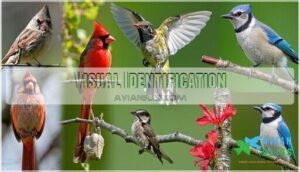
Beyond taxonomic classification systems, you’ll master visual identification through careful observation of key physical features.
Each bird species displays unique visual signatures that make field identification possible.
Your success depends on recognizing these distinctive characteristics:
- Plumage Patterns – Notice striped breasts on sparrows versus solid colors on cardinals
- Beak Shapes – Curved bills indicate nectar feeders while straight, pointed beaks suggest insect eaters
- Wing Spots – White patches on mockingbird wings flash during flight, unlike solid-winged robins
- Tail Markings – Red-tailed hawks show rusty tail feathers that separate them from other raptors
Developing a thorough bird identification guide is essential for improving your skills in recognizing various species.
Audio Identification

Listen closely to nature’s soundtrack—you’ll hear each species tells its story through unique bird calls and vocal patterns.
Machine learning models now recognize bird songs from over 700 North American species, transforming audio identification into a powerful tool.
Record their sounds with your smartphone, then use apps for instant sonic analysis and species confirmation.
The use of bird song apps has greatly enhanced the field of audio identification, making it easier to explore and understand the sounds of nature through unique bird calls.
Range Maps

Range maps reveal where you’ll find specific bird species throughout North and Central America, showing their geographic range and seasonal movements.
These visual tools display habitat distribution patterns, helping you understand migration patterns and species movement across different regions.
You can track bird range expansion and predict where certain species might appear during various seasons.
Understanding bird range maps requires studying bird migration patterns to make accurate predictions about species habitats and understand the importance of seasonal movements.
Birding Guides

Quality birding guides transform your field experience from guesswork into confident identification.
Field guides and birding apps provide instant species verification, while online resources connect you with local birding communities.
- Field guides become your trusted companion on every outdoor adventure
- Birding apps deliver real-time species lists and bird identification tips instantly
- Birding communities share prime bird watching locations and exclusive birding tours
Modern bird watching guides combine traditional field guide accuracy with digital convenience, helping you discover new species wherever you explore.
Effective birding requires reliable field guide resources to enhance your outdoor experience.
Bird Habitats and Ecosystems
Where your bird settles tells you everything about what it needs to survive.
You’ll find forest species like Barred Owls in wooded areas, while waterfowl such as Mallards prefer wetlands.
Adaptable birds like Blue Jays thrive in both natural and urban environments.
Forest Habitats

Forest birds rely on diverse woodland layers for survival.
You’ll find Northern Cardinals in dense understory shrubs, while Red-tailed Hawks patrol the tree canopy above.
Forest floors provide rich feeding grounds where American Robins hunt for insects among fallen leaves.
Habitat fragmentation threatens forest ecology, making intact woodlands critical for maintaining healthy bird populations and preserving woodland wildlife communities, which is essential for the overall forest ecology.
Wetland Habitats

Wetlands support over 30% of North America’s bird species during their life cycles.
You’ll find the continent’s highest bird species diversity in freshwater marshes, where aquatic invertebrates create rich feeding grounds.
Prairie potholes produce nearly 50% of all North American ducks, while coastal estuaries serve as critical migration stopover sites for millions of shorebirds annually.
Grassland Habitats

Grassland birds face mounting challenges as Habitat Loss transforms their open-country homes into farmland and developments.
You’ll find species like Red-tailed Hawks and Eastern Bluebirds adapting to fragmented landscapes where Grassland Fires once maintained natural Ecosystem Balance.
Bird Migration patterns shift as wild birds seek remaining prairie refuges, making Bird Conservation efforts essential for grassland bird species survival.
Urban Habitats

Urban birds have mastered the art of adapting to city life, turning skyscrapers into their personal apartment complexes.
You’ll spot Northern Cardinals at backyard feeders, Blue Jays claiming rooftop nesting sites, and House Sparrows thriving despite urban planning challenges.
These resilient species showcase remarkable bird adaptation skills, though urban wildlife faces ongoing habitat fragmentation and bird habitat loss concerns.
Effective urban bird habitats design, such as green space planning, is essential for supporting local bird populations and promoting biodiversity in cities.
Conservation Status and Trends

You’ll discover that North American bird populations face significant challenges, with over 3 billion birds lost since 1970 according to breeding surveys.
Understanding these conservation trends helps you identify which species need protection and recognize the success stories where targeted efforts have brought birds back from the brink of extinction.
Threatened Species
Beyond the diverse habitats you’ve explored, bird species across North America face mounting pressures that threaten their survival.
Human Impact has pushed numerous species toward extinction through Habitat Loss and Fragmentation Effects.
Climate Change compounds these challenges, creating perfect storms for population decline.
- Nearly 3 billion birds lost since 1970 (29% decline)
Three billion birds vanished in just five decades—a silent crisis unfolding across North America.
- Grassland birds dropped 53% over five decades
- Wetland species declined over 50% due to drainage
- Over 90 species classified as threatened by IUCN
- Partners in Flight identifies 70 species needing urgent attention
Endangered Species
North American bird conservation faces its toughest challenge with endangered species.
Habitat Loss drives many birds toward Species Extinction, including the California Condor and Whooping Crane.
You’ll find these critically endangered birds require intensive Conservation Plans and Wildlife Protection measures.
Biodiversity Preservation efforts focus on habitat restoration and captive breeding programs to prevent bird population decline through thorough bird conservation efforts.
Many organizations support endangered species protection through various initiatives.
Population Trends
Monitoring reveals a sobering reality: North America’s bird population trends show dramatic shifts across species and habitats.
You’ll find that habitat loss and climate change drive most declines, while conservation successes offer hope for recovery.
- Grassland birds face the steepest decline – populations dropped 53% since 1970, with species like Bobolink and Eastern Meadowlark losing over half their numbers
- Migratory species struggle most – long-distance migrants declined 40% overall, battling urbanization impacts and invasive species along flight paths
- Waterfowl show mixed results – duck populations increased 56% through targeted conservation, while coastal marsh birds declined 23% from habitat degradation
Conservation Efforts
Since 1986, wildlife conservation programs have protected over 22 million acres through strategic habitat preservation initiatives.
You’ll find bird conservation organizations implementing thorough strategies that reduce threats while boosting public awareness and securing vital funding initiatives for policy changes.
| Conservation Strategy | Key Achievement |
|---|---|
| Habitat Preservation | 95 million acres protected in National Wildlife Refuge System |
| Species Recovery | California Condor population grew from 27 to 560+ birds |
| Threat Reduction | 80% decrease in building collisions through Lights Out campaigns |
| Policy Changes | Migratory Bird Treaty Act protects 1,000+ native species |
| Public Engagement | 180,000+ volunteers participate in annual Christmas Bird Count |
The conservation efforts have led to significant achievements, including a notable increase in the California Condor population and a substantial decrease in building collisions, highlighting the importance of wildlife conservation programs and public awareness.
Frequently Asked Questions (FAQs)
How many North American bird species are there?
You’ll find over 800 documented bird species across North America’s diverse ecosystems. The continent’s rich habitats support everything from tiny hummingbirds to massive eagles, making it a birder’s paradise.
Which bird is only found in the USA?
Like searching for that needle in America’s haystack, you’ll find many birds share territories with Canada and Mexico.
However, several species remain exclusively within U.S. borders, including the Hawaiian Goose and various endemic island subspecies across different states.
How do I identify a bird in my yard?
Observe your bird’s size, colors, and behavior patterns to narrow down possibilities.
Note its beak shape, tail length, and feeding habits, then use field guides or apps like Merlin Bird ID for quick identification assistance.
Use these observations and tools to achieve quick identification assistance.
What bird songs are easiest to learn?
Start with clear, repetitive calls you’ll easily recognize.
American Robin’s cheerful "cheerily-cheerily-cheerio" and Northern Cardinal’s "birdy-birdy-birdy" whistles are perfect beginner songs.
Add Red-winged Blackbird’s distinctive "conk-la-ree" call for quick confidence-building success.
How do weather patterns affect bird behavior?
Weather becomes nature’s remote control, switching birds from lazy couch potatoes to frantic activity.
You’ll notice migration timing, feeding patterns, and singing behavior all shift with temperature, pressure, and precipitation changes affecting their survival strategies.
Which birds visit feeders most frequently?
Cardinals, blue jays, house sparrows, and chickadees dominate most feeders.
You’ll also spot woodpeckers, nuthatches, and finches regularly visiting.
These adaptable species quickly learn feeder locations and return consistently throughout seasons.
What time of day are birds most active?
You’ll spot most birds during early morning and late afternoon when they’re actively foraging.
Dawn brings peak activity as they search for food after fasting overnight, while evening offers another feeding window before roosting, which is a time of late afternoon foraging.
How do birds navigate during long flights?
Like a compass needle finding true north, you’ll discover that birds use multiple navigation systems during migration.
They rely on magnetic fields, star patterns, sun position, and even infrasound to stay on course across thousands of miles.
Conclusion
Discovering North American bird species transforms you into an unstoppable nature detective with endless mysteries to solve.
You’ve now got the tools to identify over 700 species across diverse habitats, from backyard cardinals to migrating warblers.
Whether you’re using field guides, range maps, or audio cues, each sighting builds your expertise.
Conservation awareness helps protect these remarkable creatures for future generations.
Start with common resident birds, then challenge yourself with seasonal migrants—you’ll be amazed how quickly your identification skills develop through consistent practice and observation.
This journey into the world of birds is a path to consistent practice and discovery.