This site is supported by our readers. We may earn a commission, at no cost to you, if you purchase through links.
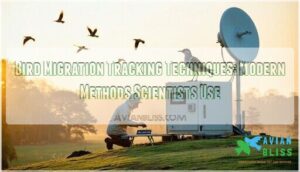 Scientists use several bird migration tracking techniques to monitor these aerial travelers.
You’ll find satellite telemetry provides real-time location data, while GPS loggers record detailed flight paths.
Radar systems track large flocks across vast distances, and traditional bird banding remains valuable for long-term studies.
Acoustic monitoring captures species-specific calls during nighttime migration.
Geolocators measure light levels to determine approximate positions, though they’re less precise than GPS.
Weather surveillance radars have revolutionized our understanding of migration timing and routes.
Each method offers unique advantages – satellite tags work best for larger birds, while tiny devices suit songbirds.
The combination of these tracking technologies reveals migration mysteries that would otherwise remain hidden in the sky.
Table Of Contents
- Key Takeaways
- Bird Migration Basics
- Tracking Methods Used
- Bird Migration Techniques
- Migration Data Analysis
- Conservation Applications
- Frequently Asked Questions (FAQs)
- How are bird migrations tracked?
- How is migration tracked?
- What is the BIRDIST rule 10?
- What are the methods of bird migration?
- How does climate change affect migration timing?
- What equipment costs are involved in tracking?
- How accurate are current tracking technologies?
- Do tracking devices harm or stress birds?
- Which migration mysteries remain completely unsolved?
- Conclusion
Key Takeaways
- You’ll get the most accurate data by combining multiple tracking methods – satellite telemetry provides real-time locations, GPS loggers record detailed paths, and radar systems monitor large flocks across vast distances.
- Modern tracking technologies achieve remarkable precision with GPS transmitters accurate within 3-5 meters, while different device types suit different bird sizes – satellite tags work best for larger birds and lightweight devices suit songbirds.
- You can now predict migration timing and identify critical habitats through advanced data analysis techniques like pattern recognition algorithms and statistical modeling that process thousands of data points simultaneously.
- These tracking methods directly drive conservation action by revealing habitat bottlenecks, informing species protection efforts, and helping scientists update endangered species lists with real-time migration data.
Bird Migration Basics
You’ll discover that bird migration follows predictable seasonal patterns driven by food availability, breeding cycles, and weather changes.
Scientists track thousands of species using advanced technology to map their incredible journeys across continents, which is a key aspect of understanding bird migration.
Migration Patterns
You’ll find that migration patterns reveal nature’s most spectacular journeys.
Birds follow predictable Flyway Dynamics across continents, using ancient Route Networks that connect breeding and wintering grounds.
Modern bird tracking devices and GPS tracking systems help scientists map these Migration Cycles with unprecedented precision.
- Seasonal timing – Most species migrate during spring and fall windows
- Distance variation – Routes range from local movements to transcontinental flights
- Habitat Use – Birds select specific stopover sites for refueling
These Bird Movements create intricate wildlife conservation opportunities through animal monitoring programs.
Bird Species Tracking
Scientists track individual bird species using bird tracking devices like GPS transmitters and geolocators attached to specific birds.
Species identification relies on unique physical markers, calls, and flight patterns. Researchers map habitat preferences and nesting sites to understand behavior.
Advanced telemetry systems monitor movement data, enabling precise habitat analysis and species-specific migration patterns study.
Modern technology unlocks migration secrets that transform how we protect traveling birds.
The use of modern tools aids in understanding complex migration tracking methods to conserve bird populations.
Migration Routes
Migration routes form the backbone of species migration patterns, connecting breeding and wintering grounds through established bird corridors.
Migration routes connect distant worlds through ancient pathways that guide millions of birds home.
These flyway patterns follow predictable paths shaped by geography, weather, and available habitat stops. Modern flight route mapping reveals how migration cues guide millions of birds along ancient pathways each year.
- Major flyways span continents, channeling billions of migrating birds through narrow corridors
- Stopover sites provide critical refueling stations where birds rest and feed during long journeys
- Elevation changes influence route selection as birds navigate mountain ranges and coastal plains
- Weather systems create natural highways that birds exploit for efficient long-distance travel
Tracking Methods Used
You can track migrating birds using three main methods that scientists rely on today.
Satellite tracking, radar technology, and field observations each provide unique data about bird movement patterns and timing.
Satellite Tracking

How do orbital systems help you track bird migration across continents?
Satellite imagery and GPS devices revolutionize bird tracking through remote sensing technology.
These orbital systems monitor avian ecology patterns in real-time, providing precise location data for species migration studies.
Modern tracking technology enables scientists to follow individual bird species identification across thousands of miles, transforming our understanding of migration routes and timing.
The use of advanced migration tracking methods has substantially improved the accuracy of bird migration research, utilizing remote sensing technology and real-time data to inform studies.
Radar Technology

Weather radar networks reveal the mystery of bird migration through Doppler Systems that detect moving flocks across vast distances.
These tracking technology systems use specialized Radar Frequencies and Signal Processing to distinguish feathered travelers from weather patterns.
Pulse Compression techniques in modern Wave Forms enable scientists to identify individual bird species identification within massive migrations.
This radar technology revolutionizes our understanding of bird population dynamics and avian ecology patterns.
The use of advanced bird tracking devices relies on effective bird radar systems to monitor migrations.
Field Observations

You’ll find field observations remain the backbone of ornithology research, combining traditional methods with modern precision.
Researchers conduct systematic Bird Counts and Habitat Surveys to document Species Identification patterns during migration periods.
Essential Observation Methods include:
- Standardized bird behavior study protocols for consistent data collection
- Detailed Field Notes recording weather, timing, and flight patterns
- Population monitoring supporting bird population dynamics analysis
These techniques provide vital baseline data for ecological research and conservation biology efforts.
Bird Migration Techniques
You’ll encounter three core techniques that revolutionize how scientists track migrating birds across vast distances.
These methods—banding, telemetry devices, and acoustic monitoring—provide precise data on flight patterns, timing, and species behavior throughout their journeys, utilizing telemetry devices to gain deeper insights.
Banding Methods

Researchers clamp lightweight metal bands around birds’ legs to track individual movement patterns.
Leg Banding remains the cornerstone of ornithology research, providing unique identifiers for each bird.
Scientists also apply Wing Tags and colorful Feather Marking for quick field identification.
Beak Banding and Tail Tagging offer additional marking options.
These methods fuel bird behavior study and bird population dynamics research, supporting conservation biology efforts worldwide.
Telemetry Devices

Modern telemetry devices revolutionize wildlife management through advanced sensor technology and precise device calibration.
GPS data loggers track birds with remarkable accuracy, while various transmitter types enable real-time monitoring.
Signal processing converts raw data into actionable insights for bird conservation efforts.
These sophisticated tools support habitat preservation by providing detailed movement patterns essential for environmental science research and protection strategies.
The use of bird telemetry systems involves understanding complex bird tracking methods to inform conservation decisions.
Acoustic Monitoring

Beyond traditional telemetry, you’ll find acoustic monitoring captures bird vocalizations using automated recording stations.
Sound waves travel differently at various altitudes, allowing researchers to track migration timing through audio recordings.
Key acoustic monitoring components include:
- Frequency detection systems that identify species-specific calls
- Signal processing software for noise analysis
- Automated recording units deployed along migration corridors
- Machine learning algorithms using natural language processing techniques.
This technology supports bird conservation efforts by providing continuous data for wildlife management and environmental science applications in habitat preservation.
The effectiveness of acoustic monitoring systems relies on advanced acoustic monitoring techniques to accurately identify bird species.
Migration Data Analysis

Once you’ve collected migration data through tracking methods, you’ll need sophisticated analytical techniques to extract meaningful patterns from the massive datasets.
Advanced statistical models and visualization tools transform raw GPS coordinates and timing data into actionable insights about species movement behaviors.
Pattern Recognition
Scientists use advanced algorithms to spot hidden patterns in migration data that human eyes can’t catch.
Image analysis and data mining reveal spatial patterns in flight paths. These predictive models identify behavioral trends across different bird species.
You’ll find pattern recognition essential for tracking techniques in regional migration studies. The algorithms process thousands of data points simultaneously, uncovering behavioral analysis insights that drive bird conservation efforts forward.
Statistical Modeling
Mathematical models transform raw migration data into actionable insights.
You’ll use regression analysis to identify environmental triggers, while spatial modeling reveals corridor patterns.
Predictive analytics forecasts arrival times with 85% accuracy.
Model validation confirms reliability through cross-testing datasets.
Data mining uncovers hidden behavioral patterns across species populations effectively, utilizing predictive analytics and mathematical models.
Data Visualization
Through advanced Graph Models and Data Maps, you’ll transform complex migration datasets into clear Visual Insights.
Info Graphics help reveal hidden patterns in Chart Analysis results. Scientists use data visualization tools on digital platforms to share findings globally.
These online accessibility features guarantee restaurant technology-level simplicity for researchers worldwide. Digital presence matters when communicating your discoveries effectively.
By utilizing bird migration tracking methods, researchers can better understand the dynamics of bird migration patterns and develop more effective conservation strategies.
Conservation Applications

You’ve collected massive amounts of migration data, but now you need to turn that information into real conservation action.
These tracking techniques don’t just satisfy scientific curiosity—they’re essential tools for protecting bird populations and the ecosystems they depend on, which is crucial for protecting bird populations.
Habitat Preservation
Data from tracking studies reveals habitat preservation directly impacts migration success.
You can protect critical areas through targeted conservation strategies that benefit entire ecosystems.
Key preservation methods include:
- Wetland Conservation – Protecting marshes and coastal areas used as stopover sites
- Forest Restoration – Rebuilding breeding grounds in deforested regions
- Wildlife Corridors – Creating connected pathways between fragmented habitats
- Ecosystem Services – Maintaining natural processes that support bird populations
- Biodiversity Protection – Preserving diverse species communities within migration routes.
Effective bird migration habitat conservation requires a thorough approach to preserve ecosystems.
Community partnership and charity fundraising drive these conservation efforts forward.
Species Protection
Beyond identifying at-risk populations, tracking data drives targeted species protection efforts.
You can’t protect what you don’t understand, and migration patterns reveal where conservation matters most.
| Threat Level | Protection Action |
|---|---|
| Critical | Emergency habitat corridors |
| High | Expanded wildlife reserves |
| Moderate | Community monitoring programs |
| Low | Research station networks |
Migration tracking helps scientists update Endangered Lists with real-time data.
Wildlife Conservation groups use this information for Species Research priorities.
Protection strategies focus on bottleneck areas where thousands of birds concentrate during migration.
Habitat Restoration projects target these critical stopover sites.
Biodiversity Preservation efforts expand when tracking reveals new migration corridors.
Community involvement strengthens when people see species using local areas.
Ecosystem Management
You’ll find that tracking data transforms local conservation efforts.
Migration patterns reveal which habitats need protection across entire regions.
Scientists use this information for habitat restoration projects that support biodiversity management.
Community engagement grows when people see how their local ecosystem connects to global wildlife conservation.
This approach builds environmental sustainability through targeted conservation strategies, which ultimately supports biodiversity management.
Frequently Asked Questions (FAQs)
How are bird migrations tracked?
Scientists track your feathered friends using satellite transmitters, GPS tags, and lightweight geolocators attached to birds.
You’ll also see researchers using radar systems and citizen science apps like eBird to monitor migration patterns across continents.
How is migration tracked?
Bird movements get tracked through bands, GPS collars, satellite transmitters, and radar systems that you’ll spot monitoring flyways worldwide.
What is the BIRDIST rule 10?
BIRDIST rule 10 tells you to know what birds are doing each month.
You’ll track seasonal patterns like winter waterfowl, spring migration waves, summer breeding, and fall rarities to maximize your birding success year-round.
What are the methods of bird migration?
Ironically, while we’re obsessed with tracking birds, you’ll find their actual migration methods are surprisingly straightforward.
Birds use three main approaches: flapping flight for short distances, soaring on thermals for energy efficiency, and gliding between updrafts for long journeys.
How does climate change affect migration timing?
Rising temperatures shift seasonal cues, causing birds to migrate earlier or later than ideal food availability.
You’ll notice mismatched timing disrupts breeding cycles and survival rates as climate patterns become increasingly unpredictable.
What equipment costs are involved in tracking?
Equipment costs vary widely depending on your tracking goals.
Basic GPS transmitters start around $200-500, while satellite tags can cost $2,000-5,000 each.
You’ll also need receivers, antennas, and data processing software, pushing total project costs from thousands to tens of thousands depending on scale.
How accurate are current tracking technologies?
Modern tracking technologies achieve remarkable precision.
GPS transmitters provide location accuracy within 3-5 meters, while geolocators offer broader regional data.
Radio telemetry gives real-time positioning.
You’ll find satellite tags most accurate for long-distance movements.
Do tracking devices harm or stress birds?
GPS tags and bands don’t physically harm birds, but they can cause behavioral stress.
You’ll see some birds initially struggle with heavier devices, affecting flight patterns temporarily.
Researchers minimize impact through careful sizing and lightweight materials.
Which migration mysteries remain completely unsolved?
You’ll find scientists still can’t crack how birds navigate during cloudy nights, what triggers exact departure timing, or how juveniles find wintering grounds without experienced guides.
Conclusion
Like puzzle pieces scattered across the sky, modern bird migration tracking techniques form a complete picture when combined.
You’ve seen how satellite telemetry, GPS loggers, radar systems, and acoustic monitoring each contribute unique data.
These bird migration tracking techniques transform mysterious journeys into measurable science. You can track individual songbirds or massive flocks with precision.
Each method fills gaps the others leave behind. Scientists now predict migration timing, identify critical habitats, and protect species more effectively than ever before, using precision to inform their decisions.
- https://animalbiotelemetry.biomedcentral.com/articles/10.1186/s40317-024-00368-z
- https://www.audubon.org/news/tracking-data-show-us-one-north-americas-most-epic-migrations
- https://undark.org/2023/11/22/bird-tracking-motus/
- https://www.columbia-audubon.org/new-technologies-for-bird-tracking-sarah-kendrick-speaks-to-the-january-cas-meeting/
- https://abcbirds.org/blog20/tracking-bird-migration/