This site is supported by our readers. We may earn a commission, at no cost to you, if you purchase through links.
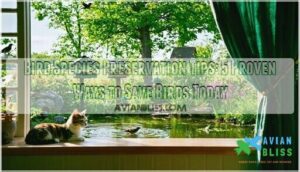 You can protect bird species by creating wildlife-friendly spaces in your yard.
Plant native trees and shrubs that provide natural food sources and nesting sites.
Install bird feeders with quality seeds and maintain clean water sources year-round.
Reduce window strikes by placing decals or screens on glass surfaces.
Keep cats indoors – they kill billions of birds annually.
Cut pesticide use to protect insects that birds need for food.
Support wetland conservation and join local bird counts to track populations.
These bird species preservation tips work because birds need safe corridors between habitats.
Small changes in your backyard can create surprising ripple effects across entire migration routes.
Table Of Contents
- Key Takeaways
- Create Bird Friendly Spaces
- Conservation Strategies
- Mitigate Human Impact
- Support Bird Habitats
- Engage in Bird Conservation
- Frequently Asked Questions (FAQs)
- How can we support bird conservation?
- How can we protect and reduce the death of birds?
- How can I Help Birds?
- How can you help endangered birds?
- How can a community contribute to bird conservation?
- How can I protect my garden from birds?
- What is the best way of protecting the endangered bird?
- How can you help protect bird biodiversity?
- What is the best way to save a bird?
- How do seasonal bird migration patterns affect conservation?
- Conclusion
Key Takeaways
- Transform your yard into a bird sanctuary by planting native trees and shrubs that provide natural food sources and nesting sites year-round.
- Keep cats indoors and reduce pesticide use – cats kill billions of birds annually while pesticides poison both birds and the insects they depend on for food.
- Prevent window strikes by installing decals or screens spaced 2 inches apart on glass surfaces, which can save up to 1 billion birds from fatal collisions each year.
- Support conservation efforts by participating in local bird counts, joining conservation organizations, and advocating for bird-friendly policies in your community.
Create Bird Friendly Spaces
You can transform your outdoor space into a thriving bird sanctuary by making simple yet effective changes.
Creating bird-friendly areas doesn’t require a massive overhaul—just thoughtful additions of native plants, water sources, and safe feeding stations can make your yard a magnet for local bird species.
Plant Native Vegetation
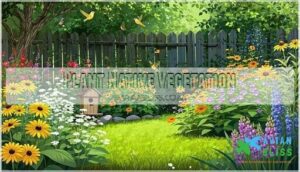
Planting native vegetation is like rolling out the welcome mat for birds.
Native planting supports soil conservation and boosts biodiversity enhancement. Choose native plant species for ecoregional planning and habitat restoration—these create birdfriendly habitats right in your yard.
You’ll notice more birds nesting and feeding, proving bird habitat preservation starts with simple, natural choices close to home.
Using native plant seed sources is essential for successful habitat restoration.
Provide Food and Water Sources
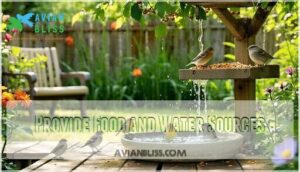
Beyond native plantings, you’ll want to consistently supply fresh water sources and diverse food options year-round.
Birds need reliable access to sustenance, especially during harsh weather or migration periods.
Consider these food and water essentials:
- Seed variety – Offer sunflower seeds, nyjer, and millet to attract different species
- Fresh water sources – Provide shallow dishes or dripping water features for drinking and bathing
- Natural food sources – Berry-producing shrubs and insect-attracting plants create sustainable bird feeding opportunities
Consistent availability transforms your space into dependable bird habitats that support bird conservation efforts effectively.
Install Bird Feeders and Baths
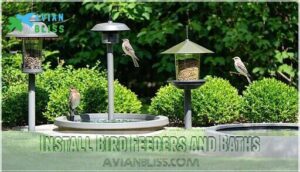
Every backyard can become a bird-friendly habitat with a few simple moves.
Place bird feeders where cats can’t reach, and keep them clean for superior bird nutrition. Bird baths need fresh water—change it often for good water quality.
Mix up feeder heights and bath styles to boost bird attraction and bird watching. Using proper bird feeder techniques is essential for their effectiveness.
Check out these Bird Feeder Tips:
| Feeder Placement | Bath Installation |
|---|---|
| Near shrubs | Shallow, sloped |
| Safe from cats | Easy to clean |
| Visible for birds | Partial shade |
| Away from windows | Fresh water daily |
Reduce Window Collisions
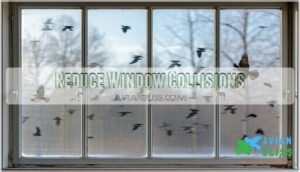
Annually, up to 1 billion birds die from window collisions across North America.
You can dramatically reduce these collision risks by installing window decals, bird screens, or window films spaced just 2 inches apart.
These glass treatments make windows visible to birds while maintaining your view, and simple birdsafe windows save countless lives daily.
Understanding effective window strike prevention methods is essential for reducing bird fatalities.
Conservation Strategies
You can help protect bird species by using smart conservation strategies like reducing pollution, supporting wetlands, and managing land wisely.
Even if you’re not a superhero, your everyday choices—like recycling or volunteering—make a real difference for birds and their habitats.
Sustainable Land Use Practices
Smart land management makes all the difference when you’re working to protect our feathered friends.
Sustainable agriculture and eco-friendly farming create healthier ecosystems where birds can thrive.
Key sustainable land use practices include:
- Soil conservation techniques that prevent erosion and maintain nutrient-rich environments for insects birds depend on
- Green infrastructure projects like riparian corridors that connect fragmented habitats and support migration routes
- Land restoration efforts that transform degraded areas into thriving bird sanctuaries through habitat restoration.
These wildlife preservation strategies maintain ecosystem balance while supporting both farming communities and bird conservation goals.
Reduce Pollution and Waste
You can’t fight pollution with a sword, but you can slash it with smart choices.
Eliminating single-use plastics reduces bird deaths by millions annually. Choose biodegradable alternatives and secure trash bins properly.
Composting diverts 30% of waste from landfills, protecting ground-feeding birds. Switch to non-toxic cleaners and recycle electronics to prevent toxic chemicals from contaminating bird habitats and food sources.
Protect Wetlands and Forests
Wetlands and forests serve as nature’s lifelines, providing critical ecosystem services that support countless bird species.
These habitats offer essential breeding grounds, food sources, and migration stopovers that birds desperately need for survival.
Here’s how you can make a difference:
- Support wetland restoration projects – Donate to or volunteer with organizations restoring degraded marshes and swamps
- Advocate for forest conservation policies – Contact representatives about protecting old-growth forests from logging
- Choose sustainable products – Buy certified wood and avoid products linked to habitat destruction
Support Conservation Organizations
Beyond preserving existing habitats, you can amplify conservation impact by supporting bird conservation organizations through strategic donations and volunteer work.
These wildlife conservation organizations depend on conservation funding and community engagement to protect species effectively.
Effective bird conservation requires understanding of conservation strategies to maximize the impact of donations and volunteer efforts.
| Support Type | Impact on Birds |
|---|---|
| Monthly Donations | Funds habitat restoration for 50+ species |
| Volunteer Hours | Directly saves 100+ birds annually |
| Corporate Partnerships | Protects millions of acres yearly |
| Local Fundraising | Creates safe migration corridors |
Your donation strategies and organization partnerships create measurable results.
Bird conservation efforts multiply when communities unite behind shared goals.
Mitigate Human Impact
You’re likely contributing to bird deaths without realizing it through everyday choices and habits.
Simple changes to how you manage your home, pets, and daily routines can dramatically reduce the human threats that kill billions of birds each year, making it a crucial step in conservation by addressing these everyday choices.
Reduce Pesticide Use and Pollution
Your garden doesn’t need toxic chemicals to thrive.
Pesticide alternatives like beneficial insects and crop rotation protect birds while controlling pests naturally.
These eco-friendly practices reduce your chemical footprint by up to 70%.
Choose organic products, create buffer zones with native plants, and practice pollution control through proper waste disposal.
Sustainable living means healthier birds and cleaner waterways for everyone.
Keep Cats Indoors and Control Feral Cats
In the context of feral cat management, keeping your pet indoors isn’t just about cat behavior—it’s essential bird conservation.
Cats kill over 2.4 billion birds annually in North America, with feral cats responsible for most deaths.
Indoor cat benefits include safety from diseases and predators.
Support trap-neuter-return programs and minimize cat predation through responsible pet management for effective feline conservation.
By promoting cat safety indoors, we can substantially reduce the number of birds killed by cats each year.
Reduce Collision Risks With Windows and Lights

Window collisions kill up to 1 billion birds annually across North America.
You can dramatically reduce these risks by installing window decals, frosted films, or screens spaced two inches apart.
Bird lights and reflective glass treatments help birds distinguish solid barriers from open flight paths.
Supporting urban planning initiatives for birdsafe windows and advocating for lights-out campaigns during migration seasons creates safer cityscapes for our feathered friends.
Promote Eco-Friendly Practices and Reduce Waste
Your everyday choices pack more punch than you might think.
Small changes in how you shop, consume, and dispose of items create ripples that benefit bird populations everywhere.
- Choose organic produce – supports farming without harmful pesticides that poison birds
- Buy reusable products – cuts down on plastic waste that birds often mistake for food
- Recycle properly – prevents glass and metal debris from harming birds in waterways
These sustainable practices reduce pollution while supporting conservation efforts that protect birdfriendly habitats.
Support Bird Habitats
Supporting bird habitats means creating spaces where our feathered friends can truly thrive.
When you preserve natural ecosystems and establish wildlife areas with native plants, you’re giving birds the homes they desperately need to survive and raise their young, which is crucial for their ability to thrive.
Preserve Natural Habitats and Ecosystems
After limiting harmful impacts, focus on habitat preservation to keep birds thriving.
Protecting natural habitats like forests and wetlands supports ecosystem balance and bird conservation. When you support habitat restoration, you’re backing biodiversity conservation and wildlife protection.
Even small changes help, such as promoting bird friendly practices in your community.
Check out this table for quick facts:
| Action | Benefit | Example |
|---|---|---|
| Preserve forests | Supports native flora | Local parks |
| Restore wetlands | Boosts wildlife | Community ponds |
| Create corridors | Aids migration | Hedgerows |
Create Wildlife Areas With Native Plants
Throughout parks and backyards, creating wildlife areas with native plants transforms ordinary spaces into thriving bird havens.
Native plantings support ecosystem restoration while establishing wildlife corridors that connect fragmented habitats. Your habitat enhancement efforts directly impact biodiversity conservation and bird species preservation.
Using native plant seed sources is essential for successful ecosystem restoration.
- Food security: Native plants produce seeds, berries, and attract insects that sustain birds year-round
- Nesting sanctuaries: Dense shrubs and trees provide safe breeding sites for raising young
- Migration rest stops: Wildlife corridors offer critical refueling stations during long journeys
- Climate resilience: Native species adapt naturally to local weather patterns and soil conditions
- Community impact: Your birdfriendly habitat inspires neighbors to create their own conservation spaces
Use Natural Pest Control Methods
Chemical pesticides harm birds directly and destroy their insect food sources.
Pesticides poison birds and wipe out the insects they depend on for survival.
You can protect feathered friends by embracing organic gardening and natural pest control methods. Try biological control using beneficial insects like ladybugs, or create natural barriers with companion planting.
These eco-friendly alternatives reduce chemical use while maintaining effective pest management, supporting healthier ecosystems for birds. By adopting methods that promote reducing pesticide use, individuals can substantially contribute to bird conservation efforts and help with reducing pesticide use for a healthier environment, which is key to natural pest control.
Support Bird Conservation Efforts and Policies
Supporting conservation efforts strengthens Wildlife Protection through coordinated action.
You can donate to organizations implementing Policy Reforms and Conservation Funding for critical habitats.
Contact representatives about Bird Legislation that protects migratory routes and nesting areas.
Join Eco Advocacy groups promoting birdfriendly practices in your community.
Your voice amplifies bird conservation awareness, creating lasting change for species survival.
Engage in Bird Conservation
You can make a real difference in bird conservation by getting involved in scientific research and community efforts.
Participating in bird counts, joining conservation groups, and supporting bird-friendly policies helps create data that scientists use to protect species and their habitats.
Participate in Bird Counts and Surveys
You can join millions of volunteers worldwide who contribute essential data through bird counts and surveys.
These citizen science programs help track over 10,500 bird species, with volunteers providing 60% of long-term population studies.
Your observations feed into research that’s detected the loss of 3 billion North American birds since 1970.
Apps like eBird make participation simple year-round, and this contributes to long-term population studies.
Join Conservation Groups and Volunteer
Beyond data collection, you’ll strengthen bird conservation efforts through hands-on community engagement.
Conservation groups need your help with habitat restoration, wildlife monitoring, and fundraising events. Your volunteer work amplifies environmental stewardship while connecting you with like-minded advocates.
Ways to get involved:
- Local Audubon chapters – Lead bird walks and habitat restoration projects
- Wildlife rehabilitation centers – Care for injured birds and maintain facilities
- Land trusts – Remove invasive species and plant native vegetation
- Citizen science programs – Monitor nesting sites and track population trends
- Conservation advocacy – Support bird-friendly policies through group participation
Raise Awareness and Educate Others
After rolling up your sleeves with hands-on volunteering, you can amplify your impact by spreading the word.
Chat with neighbors, share bird facts on Social Media, or organize Awareness Campaigns.
Public Outreach and Education Programs spark curiosity and foster Community Engagement.
Through bird conservation education, you help build wildlife awareness and inspire others to join bird conservation efforts—one conversation at a time.
Support Bird-Friendly Initiatives and Policies
Even if you’re not a policy wonk, you can still back bird conservation initiatives that matter.
Bird-friendly policies rely on your voice and action.
Try these steps:
- Advocate for bird conservation legislation and policy reforms.
- Support Conservation Funding and Bird Sanctuaries.
- Get involved in Community Engagement and advocacy.
- Encourage Legislative Support for bird conservation policies to ensure conservation efforts are successful.
Frequently Asked Questions (FAQs)
How can we support bird conservation?
Supporting bird conservation starts with a million tiny actions that create massive change.
You can plant native species, keep cats indoors, reduce pesticide use, and install window decals to prevent collisions, which are all part of the million tiny actions.
How can we protect and reduce the death of birds?
You can save birds by planting native plants, keeping cats indoors, and marking windows to prevent collisions.
Skip pesticides, recycle, and support conservation groups.
It’s like giving birds a safe neighborhood—just with fewer noisy neighbors, which is essentially providing them a better environment by following these conservation steps.
How can I Help Birds?
While billions of birds die from human-caused hazards annually, you can make a real difference.
Plant native species, keep cats indoors, mark windows, and reduce pesticide use to create safer environments.
How can you help endangered birds?
You can help endangered birds by planting native plants, keeping cats indoors, and avoiding pesticides.
Add birdhouses, support conservation groups, and use window decals.
Every small change in your yard or routine creates a safer world for birds, and by doing so, you support conservation.
How can a community contribute to bird conservation?
Communities can create powerful change by planting native vegetation, installing bird feeders, and participating in citizen science projects like eBird.
Keeping cats indoors, and supporting bird-friendly building policies that reduce window collisions, are also crucial actions.
How can I protect my garden from birds?
Like a gardener’s shield against winged thieves, you can protect your crops using bird netting, reflective tape, or decoy predators. Plant sacrificial crops nearby to redirect their attention naturally.
What is the best way of protecting the endangered bird?
Create native plant habitats, reduce window collisions with decals, keep cats indoors, eliminate pesticide use, support conservation organizations, and participate in citizen science projects like eBird to monitor populations effectively.
How can you help protect bird biodiversity?
Plant native species in your yard to provide birds with natural food and shelter. Keep cats indoors, reduce pesticide use, and install window decals to prevent collisions. Support conservation organizations.
What is the best way to save a bird?
Picture a feathered friend fluttering weakly on your doorstep.
If you’ve found an injured bird, don’t panic – you can help!
First, assess if it’s truly hurt or just a fledgling learning to fly.
For injured birds, gently place it in a ventilated box and contact a wildlife rehabilitator immediately.
Don’t give water or food – that’s their job.
How do seasonal bird migration patterns affect conservation?
Seasonal bird migration means you’ve got to think big—birds need safe stopovers and food along their routes.
If you plant native species and reduce hazards, you’ll help travelers find rest and refuel for their epic journeys.
Conclusion
Ready to transform your backyard into a bird sanctuary? These bird species preservation tips create lasting change when you take action.
Plant native species, reduce pesticides, and keep cats indoors to protect millions of birds.
Join local bird counts and support conservation groups to amplify your impact.
Every bird-friendly choice you make connects habitats across migration routes, proving that small changes create big results for bird populations worldwide, and that’s why it’s essential to take action to make a difference for the millions of birds.
- https://www.birds.cornell.edu/home/seven-simple-actions-to-help-birds/
- https://www.audubon.org/magazine/sweeping-new-report-shows-us-birds-declining-sharply-across-range-habitats
- https://www.thinkwildco.org/7-easy-tips-for-happy-birds-in-your-backyard/
- https://www.nps.gov/subjects/birds/conservation-at-home.htm
- https://www.invasive.org/101/birdwatcher.html