This site is supported by our readers. We may earn a commission, at no cost to you, if you purchase through links.
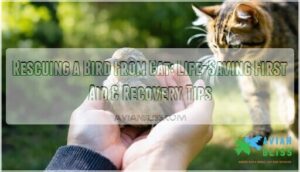 When rescuing a bird from cat attack, act fast but stay calm. Gently place the injured bird in a dark, well-ventilated box lined with soft cloth.
Don’t give food or water—this can cause more harm. Keep the environment quiet and warm.
Even if you can’t see wounds, cat saliva contains deadly bacteria that require antibiotic treatment within hours.
Contact a wildlife rehabilitator or avian vet immediately, as they’re equipped with proper antibiotics and care techniques. Handle minimally to reduce stress.
Time is critical—what looks like minor scratches can quickly become fatal infections. Professional intervention dramatically improves survival odds, and knowing the right steps can mean the difference between life and death for these vulnerable creatures.
Table Of Contents
- Key Takeaways
- Cat Attack First Aid
- Recognizing Bird Injuries
- Treating Bird Wounds
- Bird Shock Management
- Preventing Cat Attacks
- Handling Injured Birds
- Rehabilitation and Recovery
- Cat Behavior and Impact
- When to Seek Help
- Saving Bird Lives
- Frequently Asked Questions (FAQs)
- What to do if you save a bird from a cat?
- What should I do if my cat brings a live bird?
- Can birds recover from a cat attack?
- Should I just leave an injured bird?
- What diseases can cats transmit to birds?
- How long can birds survive without treatment?
- Can baby birds recover from cat attacks?
- Should I give rescued birds food or water?
- What happens if antibiotics arent given quickly?
- Conclusion
Key Takeaways
- Act fast but stay calm – Place the bird in a dark, ventilated box immediately and contact wildlife rehabilitators or avian vets within hours, as cat saliva contains deadly bacteria that require antibiotic treatment
- Don’t feed or give water – This can cause additional harm to injured birds in shock; instead, keep the environment quiet, warm, and minimize handling to reduce stress
- Even minor wounds are dangerous – Cat attacks pose serious infection risks from Pasteurella bacteria that can cause fatal septicemia within 48-72 hours, even from tiny puncture wounds you cannot see
- Professional help is essential – Time is critical since over 90% of cats carry deadly bacteria in their saliva, making immediate veterinary intervention the difference between life and death for attacked birds
Cat Attack First Aid
When you discover a bird in your cat’s mouth or claws, every second counts for the victim’s survival.
You’ll need to act fast and follow specific steps to give this injured bird the best chance of making it through what could be a life-threatening emergency.
When you discover a bird in your cat’s mouth or claws, every second counts for the victim’s survival.
You’ll need to act fast and follow specific steps to give this injured bird the best chance of making it through what could be a life-threatening emergency.
Immediate Actions for Injured Birds
When a bird falls victim to a cat attack, every second counts.
Time is your most precious ally when a bird’s life hangs in the balance.
Secure the Bird immediately by gently placing it in a ventilated cardboard box. Contact Rescue services or an experienced veterinarian within four hours.
Minimize Handling to reduce stress—birds can die from shock alone. Assess Quickly for bleeding wounds and use clean tissues to Stop Bleeding with gentle pressure.
Remember that cat attacks pose risks due to bacteria. Remember, injured bird survival depends on swift bird first aid and proper bird handling during this critical bird rescue moment.
Assessing Injuries and Shock
Quick assessment can mean the difference between life and death for an injured bird after a cat attack.
Look for visible injuries like bleeding wounds, broken wings, or missing feathers. Watch for bird shock symptoms including fluffed feathers, rapid breathing, and weakness.
Internal trauma isn’t always obvious, so observe overall condition and bird behavior carefully.
Professional bird rescue assessment remains essential regardless of what you initially see.
Minimizing Stress and Handling
After evaluating your bird’s condition, you’ll want to minimize handling since stress can kill injured birds quickly.
Think of yourself as creating a safe haven where the bird can focus on survival instead of fighting fear.
Here’s how to reduce stress during first aid:
- Use gentle handling with a towel or gloves when you must touch the bird
- Create a dark environment by covering the secure container with a cloth
- Find a quiet location away from pets, children, and household noise
- Minimize contact – resist checking on the bird every few minutes
Place the bird in a paper bag or ventilated box for transport.
Remember, less is more regarding bird stress reduction.
Recognizing Bird Injuries
When you rescue a bird from a cat, you’ll need to spot injuries quickly by checking for wounds, odd behavior, or signs of shock.
Even small problems, like a limp or missing feathers, can mean there’s more going on under those ruffled feathers.
Visible Wounds and Internal Trauma
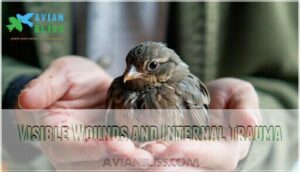
When examining a cat-attacked bird, look beyond obvious injuries.
Puncture wounds from claws often appear minor but hide dangerous Pasteurella multocida bacteria.
Internal bleeding may occur without external signs, while feather damage can mask deeper muscle trauma or bone fractures.
Small wounds don’t indicate minor injuries—internal trauma develops rapidly, making professional assessment critical for survival.
Birds instinctively hide their illnesses, so look for subtle signs, such as changes in droppings, but recognizing emergency signs is essential, as found in resources like recognizing emergency signs, to ensure timely intervention and proper care.
Signs of Shock and Distress
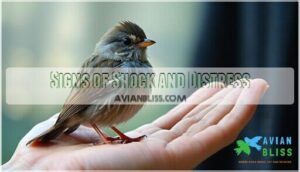
When shock grips a bird, you’ll notice fluffed feathers creating an oversized appearance, rapid shallow breathing patterns, and slow beak movements.
Their eye condition becomes glassy or unfocused, while alertness levels drop dramatically.
Bird shock symptoms include weakness and trembling, and these bird distress signals indicate the stress response has overwhelmed their small body’s systems completely.
Monitoring Bird Behavior
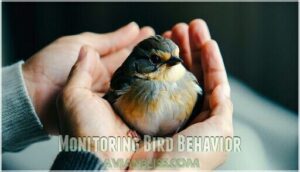
Observing bird behavior reveals critical clues about injury severity.
Watch for lethargy, unusual postures, or inability to perch normally.
Notice breathing patterns—rapid or labored breathing signals distress.
Check alertness levels and eye responsiveness.
Examine feather condition for fluffing or missing patches.
Monitor beak movements, which may indicate breathing difficulties or shock symptoms during your assessment.
A change in behavior, such as increased sleeping duration, may also indicate illness.
Treating Bird Wounds
Once you’ve secured the injured bird, you’ll need to address its wounds carefully to prevent infection and promote healing.
Proper wound care can mean the difference between recovery and a fatal outcome, especially since cat saliva contains deadly bacteria that require immediate attention.
Cleaning and Disinfecting Wounds
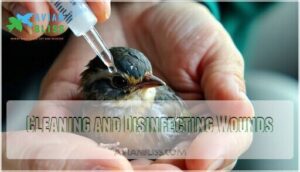
Clean bird wounds gently with saline solution to remove debris and cat saliva without damaging delicate feathers.
Avoid antiseptic creams or disinfectants like hydrogen peroxide, which can harm feather structure and delay healing. Pat wounds dry with clean tissues.
Some owners source specialized avian products for wound care.
Monitor for swelling or discharge that signals infection. Professional antibiotic treatment remains necessary for infection prevention, even after initial wound care, to ensure complete healing.
Applying Topical Treatments

After cleaning wounds, apply topical treatments carefully to promote skin repair.
Use triple antibiotic creams like Neosporin or silver sulfadiazine for wound cleaning and bird wound disinfection.
Apply thin layers directly to exposed skin, avoiding feathers during feather care.
Commercial products like ZYMOX or F10 antiseptic sprays work well for antibiotic treatment and bird wound care.
Proper bird wound treatment is essential for effective recovery and healing.
Managing Bleeding and Shock
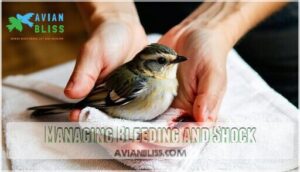
Blood loss can quickly kill a bird, so you’ll need to act fast with bleeding control and shock treatment.
Even small wounds require immediate wound care since birds have less blood than larger animals. Your emergency response should focus on bird stabilization through proper bird stress management.
Here’s your action plan for bird wound care:
- Apply gentle pressure to bleeding wounds using clean tissues or kitchen towels for bleeding control
- Create a warm environment at 25-30°C with humidity for effective shock treatment during bird wound healing
- Monitor breathing patterns – birds in shock breathe slowly in, quickly out, requiring careful bird injury assessment
Bird Shock Management
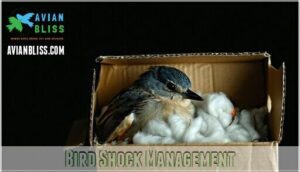
When a bird suffers from shock after a cat attack, it’ll appear weak, fluffed up, and breathe slowly in but quickly out.
You need to act fast by placing the bird in a warm, humid environment between 25-30°C and keeping it in complete darkness to reduce stress.
Identifying Shock Symptoms
Birds in shock appear fluffed up, weak, and breathe with slow inhalations followed by quick exhalations.
You’ll notice their eyes may seem dull or unfocused, and they might be unable to stand upright.
These shock signs indicate serious bird trauma requiring immediate emergency care.
Quick injury assessment helps determine if shock treatment is needed.
Proper stress management during bird shock recovery improves survival chances substantially.
Providing Warmth and Humidity
Once you’ve spotted shock symptoms, creating the right environment becomes your lifeline. Thermal care and humid environments work together like a healing sanctuary for your feathered patient.
Set up bird heating between 77-86°F using a heat pad on low or wrapped hot water bottle.
Essential warmth therapy setup:
- Cover half the cage with towels for avian comfort
- Use indirect heat sources to prevent burns
- Maintain 40-60% humidity with a vaporizer
- Monitor for panting or distress signs
Proper bird warmth conserves energy for healing rather than temperature regulation. This hydration-supporting environment reduces shock duration substantially.
Your bird emergency response improves dramatically with consistent bird treatment using these controlled conditions. Effective bird care often involves using a bird heat pad to maintain ideal temperatures.
Reducing Stress and Stimulation
Three key techniques reduce bird stress during recovery: create dark enclosures using towels to block visual stimuli, practice minimal handling by checking the bird only when necessary, and establish quiet spaces away from household activity.
These stress reduction methods prevent additional trauma.
Darkness naturally calms injured birds, while limiting human contact allows their nervous systems to stabilize during this critical healing period, utilizing minimal handling and quiet spaces to support recovery, and ultimately reducing bird stress.
Preventing Cat Attacks
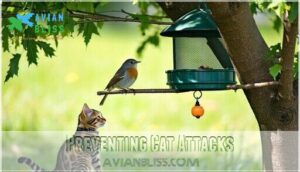
While you can’t always prevent cats from hunting, keeping your cat indoors eliminates most bird attacks entirely.
Using simple deterrents like bells on collars or creating barriers around bird feeding areas substantially reduces successful hunts.
Keeping Cats Indoors
The most effective way to prevent cat predation is keeping your indoor cat safely inside your home.
Indoor cats live longer, healthier lives while protecting local wildlife. If your cat craves outdoor time, consider cat enclosures or "catios" that provide fresh air without hunting opportunities.
Pet fencing systems can also create secure boundaries. This indoor safety approach eliminates bird attacks entirely, making it the gold standard for wildlife protection and responsible pet ownership.
Using Deterrents and Barriers
Physical barriers offer powerful protection for your feathered friends.
Cat Fencing around gardens creates safe zones, while Collar Bells reduce hunting success by 25%. Strategic Feeder Placement matters too.
- Ultrasonic Deterrents – High-frequency sounds cats hear but birds don’t
- Spike strips on fences – Uncomfortable footing that discourages climbing
- Motion-activated sprinklers – Startle cats away from Bird-Safe Gardens
Community Education and Awareness
Beyond physical barriers, Wildlife Awareness campaigns transform neighborhoods into bird-safe havens.
When you educate Cat Restraint practices and Bird Conservation benefits, entire communities embrace Responsible Ownership.
Community Action spreads through social media, local groups, and neighbor conversations about cat attack prevention.
| Education Strategy | Impact on Bird Safety |
|---|---|
| Neighborhood workshops | Increases responsible pet ownership awareness by 40% |
| Social media campaigns | Reaches 500+ households with protecting wildlife messages |
| School programs | Teaches children cat owners’ responsibilities early |
| Veterinary partnerships | Provides professional guidance on indoor cat benefits |
Handling Injured Birds
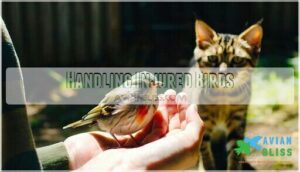
When you discover a cat has caught a bird, your immediate response can mean the difference between life and death.
You’ll need to act quickly but carefully to assess the bird’s condition and determine whether professional help is necessary.
Safe Handling Techniques
Handling caught birds requires a delicate touch to prevent further injury.
Your approach can mean the difference between life and death for these vulnerable creatures.
- Glove Use: Wear thick gloves to protect both you and the bird from scratches and bites
- Towel Restraint: Gently wrap the bird in a soft towel to secure grip without crushing delicate bones
- Gentle Approach: Move slowly and speak softly to avoid startling the already traumatized bird
- Minimizing Trauma: Handle only when necessary—excessive contact increases stress and shock risk
- Bird Box Transport: Immediately isolate the bird in a ventilated container for safe bird transport to professionals
For enhanced protection, consider using specialized bird handling equipment.
Assessing Bird Condition
Look closely at the bird’s overall condition by checking four key areas. Your bird injury assessment tips should focus on systematic observation from head to tail.
| Assessment Area | What to Check |
|---|---|
| Feather Condition | Missing patches, blood spots, matted areas |
| Breathing Patterns | Rapid, shallow, or labored breathing |
| Alertness Level | Eye response, head movement, awareness |
| Wound Inspection | Visible cuts, swelling, wing positioning |
Watch for bird injury symptoms like inability to stand or unusual postures. Behavior observation reveals pain through stillness or frantic movements. Birds mask discomfort well, making careful bird condition assessment vital for survival.
Deciding on Professional Help
Professional wildlife rescue becomes essential when you assess urgency beyond basic first aid.
Any cat-caught bird needs immediate antibiotic access – something only rehabilitators provide.
Internal injuries aren’t always visible, making expert bird injury assessment tips vital.
Don’t gamble with infection risk; contact animal rescue or bird rehabilitation centers within hours for proper care.
Rehabilitation and Recovery

Once your bird survives the initial crisis, professional rehabilitation becomes the key to a successful return to the wild.
Recovery isn’t just about healing wounds—it’s about rebuilding strength, regrowing feathers, and preparing for life outside captivity again.
Rehabilitation Centers and Vets
Finding rehabbers quickly saves bird lives.
Wildlife rescue centers and veterinarians with bird expertise understand rehab protocols that you can’t provide at home.
These rehabilitation facilities have specialized equipment, proper medications, and knowledge of release criteria.
They are equipped to provide the necessary care for injured birds.
Search online for "wildlife rehabilitation near me" or contact your local animal rescue for referrals.
Center resources include trained staff who know when birds are ready for freedom.
Recovery Time and Feather Regrowth
Recovery depends on injury severity and your bird’s overall health.
Minor wounds heal within weeks, while broken feathers won’t regrow until the next molt cycle—potentially taking up to 12 months.
During this bird recovery timeline, proper nutrition accelerates the bird wound healing process. Aviary acclimation helps birds regain flight strength before release preparation begins.
Preparing for Release
Once feather regrowth completes, your bird enters the final rehabilitation phase.
Aviary acclimation builds flight conditioning through spacious outdoor enclosures.
Natural foraging behaviors return as birds hunt insects and seeds independently.
Social integration with other recovering birds teaches predator avoidance skills.
Wildlife experts evaluate bird release criteria including sustained flight, self-feeding ability, and normal behavior patterns.
Meeting these rehabilitation timeline milestones means you’re ready to release back into the wild.
Cat Behavior and Impact

Your cat’s hunting instincts are completely natural, but they create a serious threat to local bird populations.
Understanding why cats hunt and taking preventive steps can save countless birds while keeping your pet safe and healthy.
Natural Hunting Instincts
Your cat’s prey drive isn’t learned behavior—it’s hardwired evolutionary programming.
Millions of years shaped these natural feline instincts, making hunting automatic regardless of domestication or training.
Well-fed cats still hunt because their predatory drive operates independently of hunger.
Even indoor cats display hunting behaviors through play, revealing powerful instincts that curbing hunting requires understanding, not punishment, and this is due to their strong natural feline instincts.
Preventable Causes of Bird Injuries
Pet cats cause millions of preventable bird injuries annually.
Indoor cats eliminate hunting risks completely, while outdoor cats with collar bells reduce bird deaths by up to 25%.
Strategic feeding locations—placing feeders 10+ feet from shrubs—minimize cat ambush opportunities.
Community awareness campaigns help neighbors understand how free-roaming cats impact local wildlife, promoting responsible ownership and bird injury prevention through simple deterrent methods.
Cat saliva introduces bacteria, and even minor puncture wounds can lead to serious infection, requiring immediate veterinary attention, especially given that cat attacks are deadly.
Responsible Pet Ownership
You hold the key to protecting countless birds through Indoor Cat Benefits like disease prevention and longer lifespans.
Collar Bells Effectiveness reduces hunting success by 25%, while Supervised Outdoor Time satisfies exploration needs safely.
Strategic Feeding Station Placement—at least 10 feet from shrubs—prevents cat ambushes, and Supporting Community Cat Programs addresses feral populations humanely, breaking the cycle of preventing attacks on vulnerable wildlife.
When to Seek Help
You’ll need professional help when a bird shows signs of serious injury, shock, or distress after a cat attack.
Don’t wait to see if the bird improves on its own—time is critical, and even minor-looking injuries can quickly become fatal without proper antibiotic treatment.
Urgent Care and Emergency Situations
During critical moments after a cat attack, your injured bird needs rapid response for survival.
First aid becomes a race against time when Pasteurella bacteria from cat saliva threatens septicemia within 48 hours.
Emergency priorities require immediate stabilization:
- Compress bleeding wounds with clean tissues to prevent fatal shock
- Place bird in dark, ventilated box away from pets and noise
- Contact wildlife rescue within 4 hours for antibiotic treatment
Even invisible puncture wounds demand triage urgency.
Don’t feed or water the bird—emergency care professionals handle that critical step.
Professional Assessment and Treatment
Professional veterinarians and wildlife rescue experts can provide the antibiotic administration your feathered patient desperately needs.
Avian vets understand internal trauma that’s invisible to untrained eyes, plus septicemia risks from cat bacteria.
Emergency vet clinics often work with wildlife rehabilitators who’ve specialized knowledge, and these rehab facilities offer veterinary expertise that transforms a grim prognosis into hope for recovery.
They can also provide guidance on avian broken wing treatment, which is crucial for a successful recovery process.
Signs of Serious Injury or Illness
When you’re evaluating a bird’s condition, certain red flags demand immediate professional attention.
Watch for these critical warning signs:
- Breathing Problems – labored breathing, open-mouth panting, or crackling sounds
- Lethargy Signs – inability to stand, head drooping, or unresponsive behavior
- Limb Function – visible limping, dragging wings, or inability to perch
Poor feather condition and cloudy eye condition also indicate serious bird injury signs requiring urgent care.
Saving Bird Lives
When you rescue a bird from a cat attack, your quick response can mean the difference between life and death.
Every minute counts because cat saliva contains deadly bacteria that can kill birds within 48-72 hours, even from tiny wounds you can’t see, and this rapid response is crucial for the bird’s survival.
Quick Action and Proper Care
If you spot an injured bird after a cat attack, Immediate Containment is your first step.
Use Gentle Handling, pop the bird in a dark box, and Contact Experts like wildlife rescue.
Avoid Feeding—birds in shock can’t digest food.
Minimize Stress by keeping noise and movement low.
Quick, precise bird care gives the little survivor its best shot.
Reducing Mortality Rates
Your quick response dramatically affects bird survival rates when cats attack.
Studies show that prompt vet care and antibiotic access can reduce the devastating 78% mortality rate seen in untreated cases. Early intervention within hours, not days, transforms outcomes.
- Antibiotic Access within 4 hours prevents cat saliva toxicity from causing fatal septicemia
- Rehab Capacity expansion helps more injured birds receive professional treatment
- Public Awareness campaigns teach owners about cat hunting instincts and prevention
- Early Intervention protocols save birds before shock and infection take hold
- Data Collection from wildlife centers tracks progress in bird survival improvements
Promoting Wildlife Conservation and Education
Your rescue efforts extend beyond individual birds.
By protecting one bird, you’re supporting wildlife conservation and educating others about cat impact on wildlife.
Share your experiences with neighbors to promote community involvement in bird protection.
Support habitat preservation projects and conservation funding initiatives.
Consider ethical considerations when discussing cat hunting instincts versus species protection needs.
Use bird deterrents effectively and advocate for responsible pet ownership in your community.
Frequently Asked Questions (FAQs)
What to do if you save a bird from a cat?
Carefully capture the compromised creature and contain it in a cardboard box with air holes. Contact wildlife rehabilitators immediately—birds need antibiotics within hours to survive cat bacteria.
What should I do if my cat brings a live bird?
Immediately remove the bird from your cat’s mouth and place it in a dark, ventilated box. Contact a wildlife rehabilitator or vet within hours for antibiotics.
Can birds recover from a cat attack?
Can birds bounce back from feline encounters?
Yes, but they need immediate professional care.
Even minor wounds can cause fatal infections from cat bacteria.
With quick antibiotic treatment, proper rehabilitation takes 3-6 weeks for recovery.
Should I just leave an injured bird?
Never leave an injured bird alone – it’ll likely die without help.
You must act fast to save its life.
Place it in a ventilated box and contact wildlife rescue immediately for proper treatment.
What diseases can cats transmit to birds?
Ever wonder what invisible threats lurk in your cat’s mouth?
Cats carry Pasteurella multocida bacteria in their saliva, which causes deadly septicaemia in birds within 48-72 hours, making even tiny puncture wounds potentially fatal.
How long can birds survive without treatment?
Cat-attacked birds have a narrow survival window.
You’ll see fatal septicemia develop within 48-72 hours without antibiotics, as over 90% of cats carry deadly Pasteurella multocida bacteria in their saliva and claws.
Can baby birds recover from cat attacks?
Yes, baby birds can recover from cat attacks with immediate veterinary care.
You’ll need antibiotics within hours since cat saliva carries deadly bacteria.
Success depends on quick action and professional treatment, with immediate veterinary care being crucial for recovery.
Should I give rescued birds food or water?
Studies show 62% of cat-attacked birds die even after admission to rehabilitation centers.
Don’t give rescued birds food or water—it can worsen injuries or cause choking.
Instead, place them in a dark, ventilated box and contact wildlife rehabilitators immediately for proper care.
What happens if antibiotics arent given quickly?
Without antibiotics, you’ll face a deadly 90% chance of septicaemia from Pasteurella multocida bacteria in cat saliva.
This "48-hour killer" causes fatal blood poisoning within 48-72 hours, making prompt antibiotic treatment absolutely critical for survival.
Conclusion
Every moment counts when rescuing a bird from cat attack.
You’ve learned the critical steps: secure containment, avoid food and water, seek immediate veterinary care.
Remember, invisible bacterial infections from cat saliva kill more birds than visible wounds.
Your quick thinking and proper handling techniques can transform a tragic encounter into a successful rescue story.
Professional help within hours isn’t optional—it’s essential for survival.
- https://forums.avianavenue.com/index.php?threads%2Fcat-attack.256339%2F
- https://spca.bc.ca/faqs/my-cat-caught-bird/
- https://www.greencrossvets.com.au/found-an-injured-bird-here-is-what-to-do/
- https://bestfriends.org/pet-care-resources/how-help-injured-wild-bird
- https://centaur.reading.ac.uk/78802/1/00.%20Baker%20et%20al.%20(2018)%20RSPCA%20cat%20predation%20paper%20Animal%20Welfare.pdf