This site is supported by our readers. We may earn a commission, at no cost to you, if you purchase through links.
 You’ll need a targeted approach for treating avian coccidiosis effectively.
Amprolium remains your go-to first-line treatment, while sulfonamides like sulfadimethoxine work well through drinking water systems.
Ionophores offer excellent prevention, but don’t mix them with treatment drugs.
Multivalent vaccines provide solid long-term protection, especially when maternal immunity wanes around 3-4 weeks.
Always follow proper withdrawal periods for meat birds – typically 5-7 days depending on the drug.
Monitor oocyst counts and weight gain to gauge treatment success.
Drug rotation prevents resistance, which has become a real headache for many operations.
The key lies in understanding when each tool works best.
Table Of Contents
- Key Takeaways
- Treating Avian Coccidiosis
- Coccidiosis Symptoms
- Avian Coccidiosis Control
- Treatment Efficacy Evaluation
- Preventing Coccidiosis Relapse
- Frequently Asked Questions (FAQs)
- What is the most effective treatment for coccidiosis?
- Can birds recover from coccidiosis?
- How long can a chicken survive with coccidiosis?
- What is the best antibiotic for coccidiosis in poultry?
- What housing conditions prevent coccidiosis outbreaks?
- How often should you clean waterers?
- Can stress worsen coccidiosis in chickens?
- Which feed additives boost natural immunity?
- Do probiotics help reduce oocyst shedding?
- Conclusion
Key Takeaways
- You’ll need to rotate anticoccidial drugs strategically before resistance develops – only 9.5%-54% of isolates remain susceptible to common treatments today
- Time your vaccination programs when maternal immunity wanes around 3-4 weeks, using multivalent vaccines that can achieve 75-90% disease control rates
- Monitor treatment success through concrete metrics like oocyst counts, weight gain, and lesion scores rather than guessing if your approach is working
- Always follow proper withdrawal periods (5-7 days for most drugs) and combine treatment with supportive care like probiotics to rebuild gut health
Treating Avian Coccidiosis
You’ll find treating avian coccidiosis requires a strategic approach combining anticoccidial drugs, vaccination programs, and resistance management to protect your flock’s health and productivity.
Modern treatment options include ionophores for ongoing control, multivalent vaccines for broad protection, and newer transmission-blocking vaccines that can substantially reduce oocyst shedding in commercial operations.
Effective Treatment Options
When treating avian coccidiosis, you’ll find success through a multi-pronged approach that targets both the parasite and supports your birds’ recovery.
Effective treatment combines strategic medication with supportive care to restore gut health and prevent reinfection.
Your primary treatment options include:
- Amprolium for coccidiosis – first-line anticoccidial drug
- Drug combinations with sulfonamides or toltrazuril
- Probiotics use to rebuild beneficial gut bacteria
- Natural remedies like apple cider vinegar for supportive care
Anticoccidial Drugs Usage
Feed-integrated anticoccidials dominate commercial poultry operations, with ionophores like monensin and lasalocid leading the charge against drug resistance.
You’ll need proper withdrawal periods (3-7 days) before slaughter, especially with sulfonamides requiring strict chemotherapeutic control.
Sensitivity testing reveals alarming trends—only 9.5% to 54% of isolates remain susceptible to common coccidiostats, making strategic rotation essential for maintaining ionophore efficacy in avian coccidiosis treatment.
Prevention often involves anticoccidial compounds, vaccination, or a combination of both.
Vaccination Methods
Modern coccidiosis vaccination revolutionizes poultry health through innovative delivery systems.
You’ll find three primary approaches transforming chick vaccination:
- Spray application – Automated platforms vaccinate up to 100,000 chicks hourly with live coccidiosis vaccines
- In-ovo injection – Achieved 80% vaccine efficacy in recent Belgian trials using attenuated vaccines
- Water administration – Practical for large flocks, though maternal immunity from breeder vaccination enhances protection
Studies show in-ovo vaccines are quite effective.
Managing Drug Resistance
You’ll want to stay ahead of coccidiosis drug resistance by using Drug Rotation and Monitoring Resistance.
Resistance Mechanisms can trip up even seasoned farmers, so consider Alternative Strategies like probiotics or improved litter management.
Early vaccination can help birds build protective immunity to combat coccidiosis.
Novel Therapies are on the horizon, promising better coccidiosis control.
Here’s a quick comparison table to make things stick:
| Challenge | Solution |
|---|---|
| Drug Failure | Rotate anticoccidial drugs |
| Resistance Spread | Monitor resistance |
| Poor Efficacy | Try alternative strategies |
| Costs Rising | Seek novel therapies |
Coccidiosis Symptoms
You’ll recognize coccidiosis symptoms through four key indicators that directly impact your flock’s health and productivity.
These clinical signs, lesion scores, oocyst counts, and weight gain measurements provide the diagnostic framework you need to assess infection severity and treatment effectiveness.
Clinical Signs
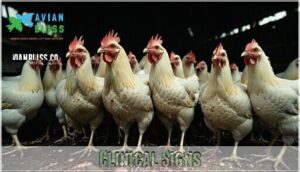
Recognizing coccidiosis symptoms chickens display helps you act quickly before losses mount.
Watch for these key warning signs that signal infection:
- Mortality Rates climbing unexpectedly in your flock
- Reduced Appetite causing birds to ignore feed
- Plumage Changes with feathers appearing ruffled or dull
- Dehydration Signs including sunken eyes and lethargy
- Droppings Analysis revealing bloody or watery stools
Early coccidiosis diagnosis through careful observation prevents devastating outbreaks in poultry operations.
Lesion Scores
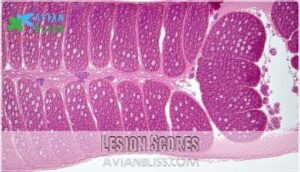
When examining intestinal damage, lesion severity scoring systems provide diagnostic accuracy that’s essential for your avian coccidiosis treatment success.
You’ll assess tissue damage using standardized coccidiosis lesion scoring methods that range from zero (healthy) to four (severe hemorrhaging).
This coccidiosis pathology evaluation guides your treatment guidelines and enables proper post-treatment analysis to monitor recovery progress effectively, which is crucial for overall treatment success.
Oocyst Count
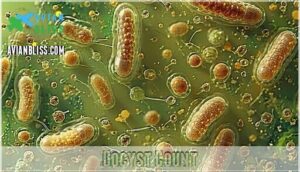
Although oocyst quantification might seem like counting microscopic enemies, you’ll find this diagnostic indicator reveals vital infection severity data.
Count correlation with clinical symptoms helps determine your avian coccidiosis treatment effectiveness and guides coccidiosis management strategies.
- Baseline counts – Establish pre-treatment oocyst levels for accurate progress tracking
- Environmental impact – Monitor facility contamination through regular sampling protocols
- Treatment protocols – Adjust coccidiosis control measures based on declining counts
- Severity assessment – Use quantification data to evaluate coccidiosis treatment options
Weight Gain Effects
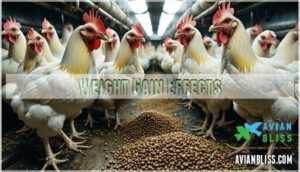
Beyond oocyst counts, you’ll notice weight gain serves as your primary economic indicator when treating coccidiosis in poultry.
Growth performance directly correlates with feed conversion efficiency, impacting your bottom line substantially.
Infected birds rarely reach market weight on schedule, creating substantial economic impact across commercial operations requiring ideal dosage strategies.
| Severity Level | Weight Loss (%) | Feed Conversion Impact |
|---|---|---|
| Mild | 5-10% | 10-15% decrease |
| Moderate | 15-25% | 25-35% decrease |
| Severe | 30-50% | 50-70% decrease |
| Subclinical | 2-8% | 5-12% decrease |
The severity levels of coccidiosis, including mild, moderate, severe, and subclinical cases, have distinct effects on weight loss and feed conversion impact, which are crucial for commercial poultry operations.
Avian Coccidiosis Control
You’ll need a thorough control strategy that combines multiple approaches to effectively manage avian coccidiosis in your flock.
Modern treatment protocols integrate ionophore applications, multivalent vaccines, transmission-blocking vaccines, and proper drug withdrawal periods to combat increasing resistance while maintaining production efficiency, which is crucial for production.
Ionophores Application
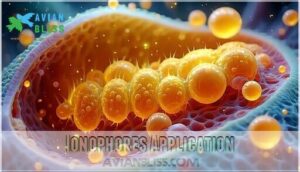
Within commercial poultry operations, you’ll find ionophores serve as your primary defense against coccidiosis in poultry.
These compounds disrupt parasite cell membranes, making treating coccidiosis more manageable than traditional methods.
- Dosage Optimization: Calculate precise ionophore concentrations based on flock age, weight, and infection severity
- Ionophore Resistance: Monitor field isolates regularly since only 9.5%-54% remain fully susceptible to common drugs
- Alternative Ionophores: Rotate between monensin, salinomycin, and maduramicin to combat resistance development
- Ionophore Synergies: Combine with management practices like litter treatment for enhanced effectiveness
- Environmental Impact: Consider withdrawal periods and residue prevention in meat production systems
Multivalent Vaccines
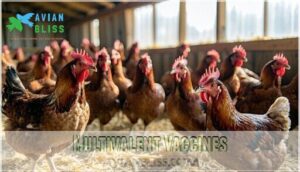
Multivalent vaccine-platforms revolutionize coccidiosis prevention by targeting 3-7 Eimeria species simultaneously, delivering species protection through single administrations.
You’ll achieve 75-90% disease control rates while boosting labor efficiency with automated systems processing 100,000 chicks hourly.
These formulations enhance immunity improvement and streamline vaccine administration for thorough avian coccidiosis management.
A key element is to maintain clean environments to prevent oocyst buildup.
| Vaccine Feature | Performance Metrics |
|---|---|
| Species Coverage | 3-7 Eimeria strains |
| Disease Reduction | 75-90% effectiveness |
| Weight Gain Boost | Up to 8% improvement |
| Oocyst Reduction | >90% decrease |
| Processing Speed | 100,000 chicks/hour |
Transmission-Blocking Vaccines
You’ll access next-level protection with transmission-blocking vaccines that target oocyst formation directly.
CoxAbic leads this breakthrough approach, generating maternal antibodies in breeders that provide passive immunity to chicks.
These vaccine targets focus on gametocyte antigens, achieving significant shedding reduction while supporting thorough coccidiosis prevention strategies.
Further resources explore products for these vaccines.
Advanced poultry disease management now incorporates these specialized coccidiosis vaccines alongside traditional vaccination programs for enhanced breeder immunity and superior coccidiosis in birds control.
Proper Drug Withdrawal
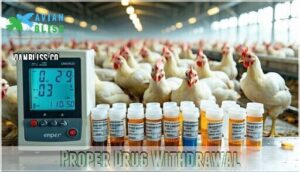
Time your coccidiosis treatment withdrawals carefully to avoid residue contamination in meat production.
Sulfonamide concerns and chemotherapeutic risks demand strict withdrawal timeline adherence—you can’t cut corners here.
Your veterinary medicine protocols for poultry disease management must prioritize consumer safety.
Proper coccidiosis medication scheduling prevents costly recalls and regulatory violations during processing.
Treatment Efficacy Evaluation

You’ll need reliable metrics to measure how well your treatment program works against coccidiosis in your flock.
The anticoccidial index (ACI) combines weight gain, lesion scores, survival rates, and oocyst counts into a single number that tells you if your birds are truly protected.
Composite Indices
When treating coccidiosis, you’ll rely on composite indices that combine multiple measurements into one thorough score.
These Index Components include weight gain, lesion scores, survival rates, and oocyst counts.
Data Integration creates Statistical Significance by weaving together clinical observations.
Your Index Interpretation determines treatment success, while Predictive Value helps forecast medication effectiveness for future coccidiosis outbreaks.
Anticoccidial Index
When evaluating coccidiosis treatment effectiveness, you’ll rely on the Anticoccidial Index (ACI) as your go-to metric.
This composite score combines weight gain, lesion scores, survival rates, and oocyst counts into a single number.
ACI standardization helps compare different treatments, though ACI limitations include varying calculation methods between studies.
Improving ACI accuracy requires consistent protocols across poultry health evaluations for reliable coccidiosis control strategies assessment.
Weight Gain Analysis
Beyond the anticoccidial index, you’ll need precise Growth Performance metrics to gauge treatment success.
Weight gain analysis reveals three critical indicators:
- Feed Conversion ratios comparing input costs to output gains
- Market Weight targets achieved within standard timeframes
- Economic Impact calculations factoring Optimal Dosage expenses against productivity
Coccidiosis treatment effectiveness directly correlates with poultry health outcomes, making weight tracking essential for poultry farming profitability and animal health optimization.
Survival Rate Assessment
Monitoring survival rates reveals the harsh reality of coccidiosis treatment efficacy in your flock.
You’ll track mortality factors including treatment timing, breed susceptibility, and immune response variations.
Effective coccidiosis management requires documenting death rates before, during, and after intervention.
Supportive care substantially impacts survival outcomes, especially in young chickens where coccidiosis mortality rate peaks without prompt action.
Implementing strict hygiene practices can also reduce transmission risks, which is crucial for the overall health of your flock, emphasizing the importance of prompt action.
Preventing Coccidiosis Relapse
You’ll need to establish long-term protection strategies to prevent coccidiosis from returning after initial treatment success.
Breeder vaccination programs that create maternal immunity, combined with automated vaccination platforms capable of processing up to 100,000 chicks per hour, offer the most reliable defense against recurring outbreaks in commercial flocks, utilizing vaccination programs.
Maternal Immunity
Maternal immunity acts like nature’s insurance policy against coccidiosis in chickens.
When breeder hens receive proper vaccination, they pass protective antibodies to their chicks through passive transfer.
This chick protection depends on several factors:
- Breeder health status during vaccination
- Antibody persistence levels in breeding stock
- Vaccine timing coordination with laying cycles
- Proper storage of hatching eggs.
This natural defense system provides early-life protection while chicks develop their own immunity against poultry diseases, which is influenced by the breeder health and vaccine timing.
The result is a protective mechanism that supports the chicks until they can fend for themselves.
Breeder Vaccination
You’ll strengthen your flock’s defense by vaccinating breeders with transmission-blocking vaccines like CoxAbic.
These vaccines target oocyst formation, creating maternal antibodies that protect commercial chicks through early weeks when they’re most vulnerable to coccidiosis in chickens.
| Vaccine Component | Immunity Duration | Oocyst Reduction |
|---|---|---|
| CoxAbic Subunit | 3-4 weeks | 60-80% decrease |
| Live Attenuated | 2-3 weeks | 45-65% decrease |
| Killed Vaccine | 1-2 weeks | 30-50% decrease |
Proper vaccine timing guarantees breeder health translates into robust coccidiosis prevention for offspring, making this strategy essential for thorough coccidiosis treatment programs in commercial poultry diseases management.
Automated Vaccination Platforms
Revolution’s here—automated vaccination platforms transform poultry coccidiosis prevention through precision technology.
These systems deliver three game-changing benefits:
- Vaccine Delivery Speed: Processing 60,000+ chicks hourly cuts downtime by 30%
- Chick Welfare Impact: Consistent dosing reduces adverse reactions by 65%
- Cost-Benefit Analysis: Labor savings of $0.03-$0.08 per bird offset Platform Maintenance costs
Despite Scalability Challenges requiring $450,000-$900,000 investment, vaccine efficacy improvements justify adoption for serious poultry management operations prioritizing disease prevention.
Modern systems allow for consistent vaccine application.
Disease Control Strategies
Beyond automated systems lies thorough disease control that protects your flock year-round.
Implement strong biosecurity measures, including proper footwear disinfection and visitor protocols.
Enhance gut health through strategic probiotic use, which strengthens natural immunity against chicken coccidiosis.
Combine traditional coccidiosis treatment with alternative therapies like herbal supplements.
Early detection remains your best defense—monitor droppings daily and maintain consistent poultry management practices for effective coccidiosis prevention.
Maintaining clean, dry environments is also vital to prevent oocyst buildup.
Frequently Asked Questions (FAQs)
What is the most effective treatment for coccidiosis?
Only 5%-54% of Eimeria isolates remain fully susceptible to common drugs today.
You’ll find ionophores most effective for controlling coccidiosis, as they develop resistance slowly compared to other anticoccidials and remain the primary treatment choice.
Can birds recover from coccidiosis?
Yes, you can expect birds to recover from coccidiosis with proper treatment.
Early intervention using anticoccidials or supportive care typically leads to full recovery, though severe cases may cause lasting intestinal damage affecting long-term health.
How long can a chicken survive with coccidiosis?
A backyard flock owner watched helplessly as her prize hen, Cookie, went from energetic to lethargic in days.
Without treatment, chickens typically survive 7-10 days with severe coccidiosis before succumbing to dehydration and blood loss from intestinal damage.
What is the best antibiotic for coccidiosis in poultry?
Coccidiosis isn’t bacterial, so antibiotics won’t cure it. You’ll need anticoccidial drugs like amprolium, sulfadimethoxine, or toltrazuril instead. These target the parasitic protozoa causing the infection effectively.
What housing conditions prevent coccidiosis outbreaks?
Like building a fortress against invasion, you’ll want dry, well-ventilated housing with proper drainage, clean water systems, and adequate spacing between birds to prevent overcrowding and stress.
How often should you clean waterers?
Clean waterers every 2-3 days to prevent bacterial buildup and biofilm formation.
Daily cleaning works best during hot weather when contamination accelerates.
Fresh water keeps birds healthy and reduces disease transmission risks substantially.
Can stress worsen coccidiosis in chickens?
Yes, stress absolutely worsens coccidiosis in chickens.
You’ll find stressed birds develop more severe infections because stress compromises their immune systems, making them vulnerable to parasites they’d normally fight off effectively.
Which feed additives boost natural immunity?
Several key feed additives work behind the scenes to strengthen your birds’ natural defenses against parasitic threats.
You’ll find probiotics, prebiotics, essential oils, and organic acids effectively boost immunity while supporting gut health for resilient flocks, which includes using essential oils.
Do probiotics help reduce oocyst shedding?
Probiotics can substantially reduce oocyst shedding by strengthening gut health and competitive exclusion.
They help your birds develop better intestinal microbiomes that naturally resist Eimeria parasites, creating an environment less favorable for coccidial reproduction, which is achieved through competitive exclusion.
Conclusion
Success with treating avian coccidiosis effectively requires strategic thinking, not just throwing drugs at the problem.
You’ll maximize results by rotating anticoccidials before resistance develops, timing vaccines when maternal immunity drops off, and monitoring oocyst counts religiously.
Don’t forget those withdrawal periods – nobody wants residues in meat.
Smart producers combine prevention tools with targeted treatment, understanding that each drug has its sweet spot for maximum impact.
- https://my.elanco.com/en_gb/product-support/poultry/htsi-news-what-are-the-treatment-options-for-coccidiosis-in-poultry
- https://pmc.ncbi.nlm.nih.gov/articles/PMC9284840/
- https://etd.ohiolink.edu/acprod/odb_etd/ws/send_file/send?accession=osu1713211172100996&disposition=inline
- https://extension.psu.edu/avian-coccidiosis/
- https://www.wattagnet.com/poultry-future/new-technologies/article/15536270/new-technologies-advance-poultry-coccidiosis-control