This site is supported by our readers. We may earn a commission, at no cost to you, if you purchase through links.
 You can dramatically improve bird identification by combining habitat clues with physical features.
A bird identification guide habitat location approach works because species stick to specific environments based on food sources and nesting needs.
Forest birds like woodpeckers won’t appear in grasslands, while wetland species avoid urban areas.
Start by noting your location – creek bed, oak forest, or suburban yard – then match size, shape, and behavior patterns.
This habitat-first method eliminates unlikely candidates and narrows possibilities by up to 70%.
Even similar-looking birds separate cleanly when you factor in their preferred environments.
Master birders know that where matters as much as what you’re seeing, and by considering the location and environment, you can become more proficient in bird identification.
Table Of Contents
- Key Takeaways
- Bird Identification Basics
- Choosing Field Guides
- Habitat Location Factors
- Regional Bird Distribution
- Advanced Identification Techniques
- Frequently Asked Questions (FAQs)
- What is the best field guide for birds?
- How do I find out what birds are in my area?
- What equipment enhances bird identification accuracy?
- How do weather conditions affect identification?
- When are birds most active daily?
- Which bird features change seasonally?
- How do juveniles differ from adults?
- What binoculars work best for bird identification?
- How do weather conditions affect bird visibility?
- What time of day offers optimal birding?
- Conclusion
Key Takeaways
- Start with habitat to eliminate 70% of possibilities – You will narrow your search dramatically by noting whether you are in a forest, wetland, grassland, or urban area, since species stick to specific environments based on their food sources and nesting needs.
- Use the four-element identification system – You will master bird ID by focusing on size and shape first, then examining color patterns, observing behaviors, and confirming the habitat where you spotted the bird.
- Combine multiple resources for best results – You will improve accuracy by using both printed field guides and digital apps, with experts recommending The Sibley Guide for detailed illustrations and apps like Merlin Bird ID for real-time identification help.
- Time your observations for peak activity – You will spot more birds and see clearer identifying behaviors during dawn and dusk, when they are actively feeding, with early morning offering the best window for territorial songs and natural behaviors.
Bird Identification Basics
You’ll master bird identification by focusing on four essential elements that separate one species from another.
Start with size and shape to narrow your options, then examine color patterns, observe behaviors, and note the specific habitat where you spotted the bird.
Size and Shape Considerations
You’ll quickly discover that relative size serves as your first identification clue.
Size becomes your instant sorting system—compare that mystery bird to a familiar robin or crow to narrow the field fast.
Compare the mystery bird to familiar species like robins or crows for reference. Notice body proportions – does it have long legs like a heron or a compact frame like a chickadee?
Body language speaks louder than colors—notice those legs, that frame, that telltale posture
Silhouette shapes and flight profiles reveal key characteristics even at distance, though size deception can trick you when birds fluff feathers or crouch low.
Some birds, like herons, eagles, and swans, are considered largest birds due to their size.
Color Pattern Recognition
Looking at color patterns helps you distinguish between similar bird species quickly.
Pay attention to these key features:
- Plumage variation across sexes and ages
- Seasonal changes in breeding versus winter feathers
- Color morphs within the same species
Regional differences affect identification too.
Hybrid identification requires noting unusual color combinations that don’t match field guides perfectly.
Behavioral Traits Analysis
Beyond recognizing color patterns, you’ll want to observe how birds actually behave in their environment. Bird behavior patterns reveal species identity through distinct actions and movements.
| Behavior Type | What to Watch | Example Species |
|---|---|---|
| Feeding Habits | Ground scratching vs. aerial hunting | Blue Jay vs. Red-tailed Hawk |
| Flight Patterns | Straight flight vs. undulating motion | Northern Cardinal vs. Woodpecker |
| Social Behavior | Flocking vs. solitary habits | Crows vs. Great Horned Owl |
| Vocalizations | Dawn songs vs. territorial calls | Various songbirds vs. raptors |
Watch feeding strategies closely. Some birds scratch through leaf litter while others dive for fish. Mating rituals also provide identification clues during breeding season. These bird behavior studies help separate similar-looking species through their unique actions.
Habitat Association
When identifying birds, you need to connect species with their specific habitats since habitat association provides essential identification clues.
Different bird species prefer distinct environments due to food sources and nesting requirements. Forest birds like woodpeckers rarely appear in grasslands, while wetland species such as herons avoid urban areas.
Birds choose homes based on what’s on the menu and where they can safely nest
Understanding species distribution patterns helps narrow identification possibilities substantially.
Climate change and habitat loss increasingly affect where you’ll find certain birds, making habitat knowledge essential for successful bird identification.
Choosing Field Guides

You’ll find that selecting the right field guide substantially improves your bird identification success in the field.
Whether you prefer traditional printed guides or modern digital applications, each option offers unique advantages for recognizing species based on habitat and location.
Printed Guide Options
When selecting a bird field guide, you’ll want printed options that balance portability factors with thorough species coverage.
Quality illustration detail helps distinguish similar species while clear guide organization speeds up identification.
Consider guides with regular updates that cover your region’s birds, as well as field guides with range maps and habitat information to support accurate bird identification in various locations.
Many birders find value in purchasing field guides for easy reference, which can be a key factor in accurate bird identification and overall birding experience.
Digital Guide Applications
While physical field guides serve their purpose, digital bird identification apps offer real-time advantages for today’s birders.
Modern bird identification websites and apps provide instant access to vast species databases with enhanced features:
- App accuracy improves through machine learning algorithms that analyze your photos
- Species sounds play instantly to confirm auditory identification in the field
- Offline access guarantees your bird identification guide works without cell service
- Community sharing connects you with local birders for habitat location tips
These digital tools transform your smartphone into a thorough bird identification resource.
You can find products related to birding app features online.
Expert Recommendations
Professional birders recommend combining multiple resources for reliable identification success.
The Sibley Guide provides detailed artwork highlighting key field marks across all North American regions.
Crossley ID Guide offers photographic approaches in realistic habitat contexts.
Expert gear includes quality binoculars and field-appropriate clothing following ethical birding practices that support conservation efforts.
For thorough coverage, consider using a guide that offers detailed plumage variations to ensure the best results in bird identification with the right field guide.
Habitat Location Factors
Understanding where different bird species live helps you narrow down your identification options before you even lift your binoculars.
Each habitat type hosts specific bird communities, so knowing whether you’re in a forest, wetland, or backyard dramatically reduces the number of species you need to examine when making your identification, which is based on understanding the habitat.
Forest and Woodland Habitats

You’ll find that forest birds inhabit different vertical layers from canopy to understory.
Each layer hosts unique species adapted to specific conditions.
Canopy structure determines light penetration and food availability.
Dense forests support different birds than open woodlands.
Habitat loss threatens woodland conservation efforts.
Look for Northern Cardinals in forest edges and Blue Jays throughout wooded areas.
Identifying birds requires a reliable field guide, which is essential for bird identification.
Wetland and Grassland Habitats
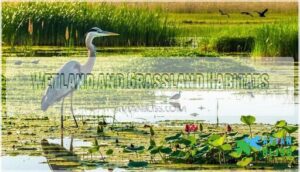
Wade through wetlands where Great Blue Herons hunt or explore grasslands where Bobolinks nest.
These habitats face severe habitat loss threats, making grassland conservation critical.
Wetland birds like Red-winged Blackbirds depend on marsh edges, while grassland birds require open spaces.
Protecting native grasslands is essential for biodiversity.
Restoration efforts help these specialized species survive, and your bird identification guide improves when you understand each habitat’s unique bird preferences.
Urban and Suburban Environments

Urban environments transform bird identification into a fascinating challenge. You’ll discover species that thrive alongside humans in these bustling habitats.
Urban birds adapt to city life through specific traits:
- Smaller body sizes – fit better in crowded spaces
- Flexible diets – eat seeds, insects, and food scraps
- Enhanced mobility – fly frequently to avoid disturbances
- Bold behavior – explore new areas confidently
- Higher reproduction – produce more offspring to offset urban risks
Suburban birdsong differs from rural calls as birds adjust to noise pollution. Backyard birding reveals common species like Blue Jays and Cardinals that excel in human-modified landscapes.
City migration routes funnel diverse species through urban corridors during seasonal movements. Human impact creates both challenges and opportunities for urban habitats identification. These environments support fewer total species but often harbor surprising biodiversity in parks and green spaces.
A recent study highlights how smaller body sizes are frequently observed in urban birds.
Regional Bird Distribution
Understanding where different bird species live helps you know what to expect in your area.
North American birds follow four major flyways during migration and show distinct regional patterns based on habitat and season.
North American Flyways

North American migration follows four major flyways: Atlantic, Mississippi, Central, and Pacific routes.
These natural highways guide millions of birds annually along coastlines and river systems.
Flyway management requires international cooperation to address migration challenges like habitat loss and climate impacts.
Understanding these bird migration routes helps you locate species during peak travel times and supports habitat connectivity conservation efforts.
State-Level Breeding Populations

When tracking state-level breeding populations, you’ll discover that each state hosts different percentages of species’ total populations.
Colorado supports nearly 7.5% of all Olive-sided Flycatchers during breeding season, ranking 9th among 19 states.
This population trends data helps create habitat mapping for conservation status assessments.
Regional variations in species distribution guide targeted protection efforts across bird habitats, making your bird identification website searches more focused on local breeding densities.
Birding apps can greatly aid accurate identification to enhance bird identification and provide conservation status insights, ultimately supporting targeted protection efforts.
Migration Patterns and Hotspots
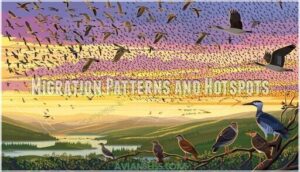
Migration patterns reveal critical pathways for bird identification and habitat location studies.
North America’s four major flyways—Atlantic, Mississippi, Central, and Pacific—channel millions of migrants annually.
Understanding these bird migration patterns helps predict species presence during specific seasons.
Citizen Science projects track Migratory Challenges while documenting Stopover Ecology and Climate Impacts on traditional routes, supporting essential Flyway Conservation efforts.
Advanced Identification Techniques

Once you’ve mastered basic identification skills, advanced techniques will help you distinguish between similar species and tackle challenging birds.
These methods combine visual details with sound recognition and scientific data collection to sharpen your birding expertise.
Visual Identification Guides
Beyond field guides and apps lies a world where image clarity becomes your best ally.
High-resolution photos in bird guides reveal markings detail that separates similar species like Sharp-shinned and Cooper’s Hawks.
Guide accuracy trumps artistic license—choose resources showing real birds over stylized illustrations.
Species comparison pages help you distinguish confusing pairs, and practice with multiple visual references to sharpen your bird identification skills across different habitat locations.
Auditory Identification Methods
You’ll recognize birds by their unique sounds just as much as their looks.
Bird vocalizations include songs calls and alarm notes that vary between species. Sound spectrograms help analyze these patterns visually.
Regional dialects exist within species so a cardinal’s song differs between states.
Learning call types and song variation improves your bird identification skills substantially.
Many resources, like a specialized song guide, can aid in this process.
Participation in Citizen Science Projects
You’ll connect with fellow enthusiasts through citizen science projects like eBird and the Great Backyard Bird Count.
These platforms let you contribute sightings while improving your bird identification skills through data collection.
Community engagement builds confidence as you participate in conservation benefits alongside 600,000 other participants.
Your observations support real scientific research and species tracking efforts, contributing to a larger citizen science project.
Frequently Asked Questions (FAQs)
What is the best field guide for birds?
You’ll find The Sibley Guide to Birds remains the industry standard, praised for its thoroughness and detailed illustrations.
National Geographic Field Guide to Birds of North America also ranks highly among experts.
For accurate bird identification, consulting a reliable birding field guide is essential.
How do I find out what birds are in my area?
Staring at the sky like you’re waiting for feathered fortune tellers to appear?
Download Merlin Bird ID or Audubon Bird Guide apps to identify local species by answering simple questions about what you’ve seen.
For accurate bird identification, utilize the bird identification tools and resources available to help you make the most of your birdwatching experience with local species.
What equipment enhances bird identification accuracy?
Binoculars boost your bird-watching game substantially.
Choose 8×42 models for crisp detail and steady viewing.
Field guides help confirm species features.
Smartphone apps provide instant sound identification and range maps for accurate field confirmation.
How do weather conditions affect identification?
Like a chameleon changes colors with its surroundings, weather transforms bird visibility dramatically.
Rain obscures field marks and muffles calls. Bright sunlight creates harsh shadows that hide details.
Overcast skies provide even lighting for clearer identification, making it easier to see complete concepts and understand the impact of weather on bird visibility.
When are birds most active daily?
You’ll spot most birds during dawn and dusk when they’re actively feeding.
Early morning offers peak activity as birds search for food after fasting overnight.
Evening brings another feeding surge before roosting.
Which bird features change seasonally?
Birds undergo dramatic transformations that’ll blow your mind.
You’ll notice plumage changes most clearly – breeding seasons bring vibrant colors and ornate feathers that fade to duller winter coats for camouflage and energy conservation.
These transformations are crucial for the birds’ survival, but the text only mentions the change in appearance.
How do juveniles differ from adults?
You’ll notice juvenile birds often lack the bright colors and distinct patterns of adults. Their plumage appears duller with streaky or mottled markings that provide camouflage while they’re vulnerable.
What binoculars work best for bird identification?
Choose 8×42 binoculars for bird identification.
Most birders prefer 7- or 8-power binoculars because they’re bright and have a wide field of view, making it easier to spot and track moving birds in various habitats.
How do weather conditions affect bird visibility?
Weather works wonders in determining your birding success.
Rain reduces visibility and sends most species seeking shelter.
Clear skies offer ideal conditions for spotting birds actively foraging and displaying natural behaviors throughout their habitats, with clear skies and natural behaviors being key to a successful birding experience.
What time of day offers optimal birding?
Dawn’s first light brings peak activity as you’ll hear territorial songs and witness feeding behaviors.
Evening offers another excellent window when birds return to roosts and engage in social calls before darkness settles.
Conclusion
Mastering methods for successful species spotting starts with understanding your bird identification guide habitat location strategy.
You’ll find that habitat-focused approaches cut identification time in half while boosting accuracy rates substantially.
Forest dwellers rarely venture into open grasslands and wetland species avoid desert regions.
Your success depends on matching physical features with environmental clues rather than relying solely on color patterns.
Practice this habitat location technique consistently and you’ll develop expert-level identification skills within months of dedicated field observation.