This site is supported by our readers. We may earn a commission, at no cost to you, if you purchase through links.
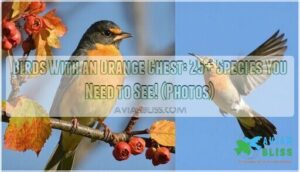 You’ll find birds with an orange chest throughout North America, each one like a flying sunset bringing warmth to your backyard.
The Baltimore Oriole’s brilliant orange breast makes it a spring favorite, while the American Robin’s rusty-orange chest signals earthworm hunting season.
Eastern Bluebirds sport soft orange washes that complement their blue wings, and tiny Rufous Hummingbirds glow like embers at your feeder.
These orange markings aren’t just for show—they’re nature’s billboards for attracting mates and claiming territory.
Males typically display the brightest colors during breeding season, while females keep things more subtle for safety.
Each species has its own orange story to tell.
Table Of Contents
- Key Takeaways
- Bluebirds With Orange
- Orioles With Orange
- Hummingbirds Orange
- Songbirds Orange Chest
- Other Orange Birds
- Frequently Asked Questions (FAQs)
- What bird has an orange chest?
- What is an orange-breasted bird that looks like a robin?
- What is the orange breasted bird of prey?
- What does a blue bird with orange chest mean?
- What bird has a rust chest?
- What kind of bird is brown with an orange belly?
- Do Bluebirds have an orange chest?
- What eats birds with orange chests?
- How long do orange-chested birds live?
- Where do orange-chested birds nest?
- Conclusion
Key Takeaways
- You’ll spot orange-chested birds across multiple families including bluebirds, orioles, hummingbirds, and songbirds, with males typically displaying the brightest colors during breeding season while females keep more subtle tones for safety.
- You can easily identify Eastern and Western Bluebirds by their striking blue upperparts combined with rust-orange breasts, and they’re cavity-nesters that depend on nest boxes and tree holes for breeding.
- You’ll find Baltimore and Bullock’s Orioles building incredible hanging nests from plant fibers while displaying brilliant orange plumage, and they’re skilled weavers that create nature’s own works of art.
- You can attract these orange-chested birds to your backyard by providing native trees, shrubs, and appropriate feeders, turning your yard into a wildlife theater where patient observation reveals their unique behaviors and seasonal movements.
Bluebirds With Orange
You’ll find bluebirds among the most recognizable orange-chested birds in North America, with their striking combination of bright blue upperparts and warm rusty-orange breasts creating a stunning contrast.
These azure beauties with fiery chests transform any backyard into a living canvas of nature’s most perfect color palette.
The Eastern and Western Bluebird species both display this classic color pattern, making them favorites among birdwatchers who enjoy spotting these cavity-nesting birds in open woodlands and farmlands.
Eastern Bluebird

You’ll spot the Eastern Bluebird’s rust-orange chest glowing like a sunset across farmlands and open woodlands throughout eastern North America.
These cavity-nesting beauties depend on nest boxes and tree holes for breeding.
Their insect diet makes them valuable allies in your garden, controlling beetles and grasshoppers while serving as indicators of ecosystem health in agricultural landscapes.
To attract them, consider providing native trees and shrubs.
Western Bluebird
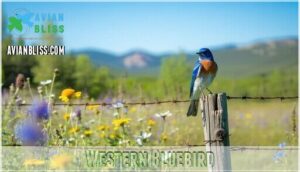
Western Bluebirds share similar orange chested birds characteristics with their eastern cousins but call the western states home.
You’ll recognize males by their deeper blue heads and darker orange chests, while females display subtle gray plumage with orange highlights.
Their habitat preference includes open woodlands and meadows across their geographic range from Mexico to southwestern Canada, maintaining stable conservation status.
Orioles With Orange
You’ll spot orioles hanging upside down from tree branches, their bright orange feathers catching sunlight as they search for insects and nectar.
These skilled weavers build incredible hanging nests that look like nature’s own work of art, making them some of the most fascinating orange-chested birds you can observe.
Baltimore Oriole
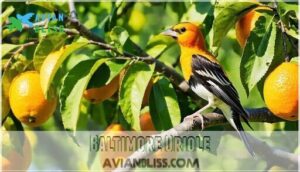
Moving from those stunning bluebirds, you’ll discover the Baltimore Oriole’s brilliant orange chest that’ll stop you in your tracks.
These orange breasted birds showcase nature’s artistry with their fiery plumage.
- Oriole Diet: Nectar, insects, and fruit fuel their energy
- Nest Construction: Hanging pouches woven from plant fibers
- Plumage Variation: Males sport deep orange, females show paler tones
- Migration Patterns: Winter journeys to Central America
- Conservation Status: Stable populations across eastern regions
Bullock’s Oriole
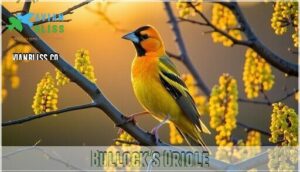
You’ll find Bullock’s Oriole throughout western North America, where males sport brilliant orange plumage with striking black throats and crowns.
These North American bird species prefer open woodlands and riparian areas for their habitat preference. Their diet details include insects, nectar, and fruits.
Oriole identification becomes easier during breeding season when males display their vibrant orange breasted bird coloring while building pendant nests.
Hooded Oriole
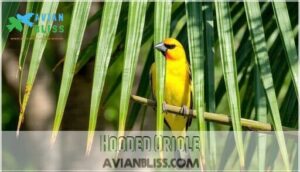
You’ll recognize the Hooded Oriole by its brilliant deep orange plumage contrasting with its distinctive black throat and crown.
Their diet includes nectar, insects, and fruits.
Males weave intricate hanging nests from palm fibers.
These orioles prefer palm trees and riparian woodlands across the southwestern United States, and their conservation status remains stable, unlike the more widespread American Robin, with a diet that also includes various types of fruits.
Orchard Oriole
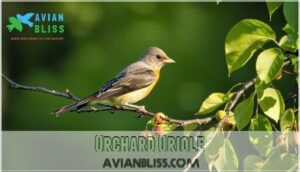
You’ll spot the Orchard Oriole by its unique chestnut-orange plumage variation among birds with orange chests.
This smaller oriole species prefers open woodlands and orchards for its habitat preferences. Males display rich burnt-orange coloring with black heads, while females show olive-green tones.
Their diet composition includes insects and nectar. They’re known to migrate to Central America for the winter.
This bird identification challenge rewards patient observers with stunning views of North America’s smallest oriole.
Altamira Oriole
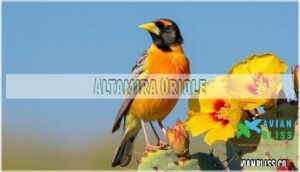
Brilliance defines the Altamira Oriole (Icterus gularis), Texas’s largest oriole species.
You’ll find this stunning member of birds with orange chests along the Rio Grande Valley, where riparian habitat provides perfect nesting conditions.
- Texas Range: Limited to southernmost Texas counties near Mexican border
- Riparian Habitat: Prefers dense woodland areas along rivers and streams
- Feeding Habits: Consumes insects, fruits, and nectar from various sources
- Conservation Status: Currently listed as least concern despite restricted range
- Bird Identification: Distinguished by size and distinctive hanging basket nests
Hummingbirds Orange
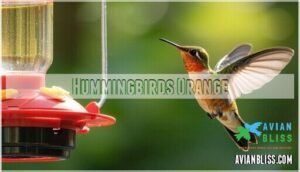
You’ll spot some truly remarkable hummingbirds that showcase brilliant orange plumage, making them stand out from their emerald-green relatives.
These tiny aerial acrobats, like the Rufous and Allen’s Hummingbirds, display fiery orange chests and sides that catch sunlight beautifully as they hover at your feeders.
Rufous Hummingbird
With fiery orange plumage that rivals autumn leaves, the Rufous Hummingbird stands out among birds with orange chests.
Nature’s tiniest flames, these aerial jewels transform backyards into living galleries of orange brilliance.
You’ll witness spectacular courtship displays during their remarkable Rufous Migration from Canada to Mexico.
These tiny pollinators play a vital pollination role while maintaining their nectar diet.
Bird identification guides note their conservation status remains stable across their extensive bird ranges.
Allen’s Hummingbird
Allen’s Hummingbird (Selasphorus sasin) brings incredible orange plumage to California’s coastal chaparral.
You’ll spot males with fiery copper throats during hummingbird migration seasons.
These tiny birds with orange chests maintain their nectar diet while defending territories aggressively.
Bird identification guides highlight their rapid wing beats, making them favorites for bird photography enthusiasts seeking dynamic shots of hummingbirds in action.
They’re known to perform elaborate courtship displays to attract mates.
Songbirds Orange Chest
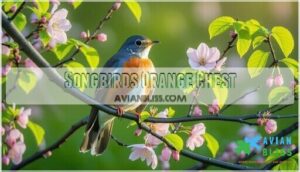
You’ll find some of North America’s most melodious birds sport brilliant orange chest feathers that catch sunlight like tiny flames in the forest.
These songbirds, from the cheerful American Robin to the striking Black-headed Grosbeak, combine beautiful music with eye-catching plumage that makes them favorites among birdwatchers.
American Redstart
The American Redstart’s orange patches flash like tiny flames as males dart through forest canopies.
These active warblers showcase striking black and orange plumage that makes bird identification straightforward.
You’ll find these energetic songbirds in deciduous woodlands during breeding season.
Here’s what makes Redstart identification easy:
- Male plumage: Jet-black body with bright orange patches on wings, sides, and tail
- Female coloration: Gray-brown upperparts with yellow patches instead of orange
- Redstart behavior: Fan-shaped tail spreading and constant movement while foraging
- Redstart habitat: Mature forests with dense canopy cover for nesting
These insect-eating birds with orange chests actively hunt by flashing their colorful patches to startle prey.
Redstart diet consists mainly of flies, moths, and beetles.
Bird coloration serves both identification and hunting purposes.
Conservation efforts focus on protecting their woodland breeding grounds.
Bird identification resources often highlight their distinctive tail-fanning behavior and orange wing patches.
American Robin
Spotting an American robin brings instant recognition to your backyard birding adventures.
These birds with orange chests showcase rusty-red breasts that make robin bird identification effortless.
Robin habitat spans lawns and woodlands, while their robin diet includes worms and berries.
For supplemental feeding, consider chewy robin food.
Robin migration patterns vary by region, and their cheerful robin song signals spring’s arrival through established bird behavior patterns.
Red-breasted Nuthatch
Don’t let the name fool you—Red-breasted Nuthatches sport beautiful rust-orange underparts that make them stand out among birds with orange chests.
These compact acrobats navigate tree trunks headfirst, their nasal "yank-yank" Nuthatch Sounds echoing through coniferous forests.
Their Nuthatch Diet includes seeds and insects, while their quirky Nuthatch Behavior involves storing food in bark crevices for winter survival.
They thrive on a specific seed mix designed for their needs.
Blackburnian Warbler
You’ll find the Blackburnian Warbler stands out with its fiery orange throat that practically glows against dark forest canopies.
This stunning bird species showcases remarkable orange plumage during breeding season, creating one of nature’s most striking displays.
These birds play a vital role in insect control efforts.
Key Features:
- Males develop brilliant orange throats and faces during breeding behavior peak
- Habitat preferences include mature coniferous and mixed forests
- Diet analysis reveals they primarily consume insects and spiders
Black-headed Grosbeak
You’ll recognize the Black-headed Grosbeak by its striking contrast—males sport jet-black heads against brilliant orange-rust bodies, while females show warm orange washes across their chests.
These chunky songbirds inhabit western woodlands and mountain forests, where Grosbeak Diet includes seeds, insects, and fruit.
During Grosbeak Migration, they travel to Mexico each winter, making them special treats for birders using bird identification guides resources.
Other Orange Birds
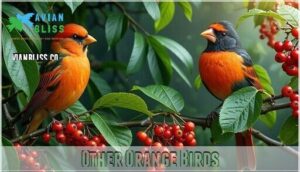
You’ll find orange-chested birds in many other bird families beyond the ones we’ve covered so far.
These additional species include colorful tanagers, cardinals, and exotic weavers that showcase stunning orange plumage across their chests and bodies.
Northern Red Bishop
Moving from North American songbirds to African species, you’ll discover the Northern Red Bishop’s stunning transformation. During breeding season, males develop brilliant orange-red Bishop Plumage that makes them unmistakable among orange birds.
These weaver bird species thrive in grassland Bishop Habitat across southern Africa. Their related products are available online.
Key identification features include:
- Vibrant orange-red breeding plumage in males
- Black facial mask and wing markings
- Compact 10-12 centimeter body size
- Brown-gray coloration in females and non-breeding males
Their Bishop Behavior involves elaborate courtship displays, while Bishop Diet consists of seeds and insects. Bishop Conservation status remains stable, making them excellent subjects for bird identification guides resources and bird field guides resources covering African bird plumage variations.
Western Tanager
Male Western Tanagers sport flaming orange-red heads that make them stand out among North American birds.
You’ll spot these orange birds in coniferous forests across the West, where their tanager song resembles a hurried robin’s call.
Their tanager migration takes them from breeding grounds to Central America, while tanager conservation efforts focus on habitat protection.
They’re often found in open coniferous forests during breeding season.
| Aspect | Description | Details |
|---|---|---|
| Tanager Habitat | Coniferous forests | Juniper-pine to spruce-fir zones |
| Bird Plumage | Orange-red head, yellow body | Males have black wings and tail |
| Tanager Diet | Insects and fruits | Forages in upper canopy levels |
| Tanager Migration | Long-distance traveler | Winters Mexico to Costa Rica |
| Tanager Conservation | Least Concern status | Habitat preservation key |
Scarlet Tanager
The Scarlet Tanager shows dramatic plumage variation between sexes.
You’ll spot males with bright red bodies and black wings, while females display olive-yellow tones with orange-tinged underparts.
Their diet includes insects and fruits during migration patterns from Central America to northern forests each spring.
These North American birds face habitat loss concerns, though their conservation status remains stable.
Flame-colored Tanager
You’ll spot this stunning Flame-colored Tanager showing off vibrant orange-red plumage with contrasting black wings and tail.
These orange birds inhabit pine-oak forests from Mexico to Central America, where they feed on fruits and insects.
Their brilliant bird colors make identification straightforward – males display more intense coloration than females.
Conservation status remains stable throughout their mountainous range.
Varied Thrush
You’ll find the Varied Thrush deep in the Pacific Northwest’s coniferous forests, where this striking bird species displays its burnt-orange chest against dark plumage.
Unlike its cousin the American Robin, this forest-dweller prefers shadowy bird habitats and delivers haunting, flute-like calls.
- Thrush Habitat: Dense old-growth forests from Alaska to California
- Thrush Diet: Ground-foraging for insects, berries, and acorns
- Thrush Migration: Northern populations move south during harsh winters
- Thrush Conservation: Vulnerable to logging and habitat fragmentation
Northern Cardinal
While Northern Cardinals are famous for their brilliant red plumage, you’ll occasionally spot females and juveniles displaying subtle orange-tinged chests that distinguish them from other orange birds.
Their Cardinal Diet includes seeds, fruits, and insects, and they inhabit woodlands and backyards across eastern North America.
Their distinctive Cardinal Song and bold Cardinal Behavior make them easily recognizable among bird species sharing similar orange chest markings.
Summer Tanager
Unlike the American robin’s bright orange chest, the Summer Tanager displays subtle orange-red plumage that’s pure poetry in motion.
These birds with orange chests prefer:
- Dense forest canopies for nesting
- Open woodlands near water sources
- Insect-rich environments for feeding
- Warm southern climates year-round
Their diet composition includes wasps and bees, while their conservation status remains stable.
Painted Bunting
During breeding season, you’ll witness nature’s masterpiece in the Painted Bunting.
Male plumage showcases vibrant blue heads, red underparts, and green backs, while female colors display subtle green-brown tones with orange-buff chest hints.
These orange birds thrive in bunting habitat including dense thickets and woodland edges.
Their bunting diet consists of seeds and insects, with conservation status currently stable across their range.
Chestnut Weaver
You’ll spot the Chestnut Weaver’s vibrant orange plumage across East African grasslands and savannas.
This remarkable bird species showcases expert Weaver Nesting skills, constructing intricate hanging nests from grass fibers.
Their Weaver Diet consists mainly of seeds and insects, while their Weaver Habitat spans Tanzania, Kenya, and Uganda.
Weaver Taxonomy places them in the Ploceidae family, with stable Weaver Conservation status making them accessible through bird identification resources.
Western Spindalis
Deep within Mexico’s tropical forests, you’ll discover the Western Spindalis, a striking tanager with vibrant orange-rufous chest plumage.
This medium-sized bird showcases remarkable sexual dimorphism, with males displaying bold black, white, and orange coloration.
Found in mountainous woodland edges between 900-1,800 meters elevation, Western Spindalis feeds on insects and berries while maintaining stable conservation status despite limited Caribbean distribution.
Frequently Asked Questions (FAQs)
What bird has an orange chest?
Like nature’s autumn leaves come to life, you’ll spot Eastern Bluebirds with their vibrant orange chests perched on fence posts.
These beautiful songbirds wear rusty-orange plumage across their throats and bellies, especially males during breeding season.
What is an orange-breasted bird that looks like a robin?
You’re likely seeing an Eastern Bluebird! These gorgeous birds share the robin’s size and orange breast, but they’ve got brilliant blue wings and backs instead of the robin’s brownish-gray coloring.
What is the orange breasted bird of prey?
You’ll be absolutely amazed by the Sharp-shinned Hawk!
This incredible raptor sports stunning grey upperparts with a distinctive orange chest featuring fine barring patterns.
You’ll find them hunting smaller birds in forests nationwide.
What does a blue bird with orange chest mean?
You’ve spotted an Eastern or Western Bluebird!
These stunning birds symbolize happiness, renewal, and hope in many cultures.
Their vibrant blue backs paired with rusty-orange chests make them nature’s perfect messengers of joy.
What bird has a rust chest?
Absolutely stunning Eastern Bluebirds sport that distinctive rust-colored chest you’re looking for.
You’ll spot males displaying light orange-rust coloration across their chest area, making them incredibly easy to identify in open woodlands and farmlands, with their appearance being a key factor in identification.
What kind of bird is brown with an orange belly?
You’re likely seeing a female Eastern or Western Bluebird. These brown-backed beauties sport vibrant orange bellies that’ll catch your eye in open fields and woodlands across North America.
Do Bluebirds have an orange chest?
A picture’s worth a thousand words, and yes, bluebirds do sport orange chests.
You’ll spot Eastern and Western Bluebird males displaying vibrant orange-rust coloration across their chests, creating a stunning contrast with their brilliant blue upperparts.
What eats birds with orange chests?
Hawks, owls, and other raptors hunt orange-chested birds like bluebirds and orioles.
You’ll also find snakes, cats, and weasels targeting these colorful species.
Their bright plumage makes them visible to predators.
How long do orange-chested birds live?
Orange-chested birds live varying lifespans depending on species. You’ll find bluebirds living 7-9 years, orioles reaching 5-9 years, hummingbirds surviving 3-5 years, and hawks extending 10-15 years in wild conditions.
Where do orange-chested birds nest?
You’ll find these colorful birds nesting in diverse spots.
Bluebirds prefer cavity homes like tree holes and nest boxes, while orioles weave hanging pouches in tree branches, and hawks build stick platforms high in forest canopies.
Conclusion
Picture yourself as a backyard birdwatcher, binoculars ready, scanning for these orange-chested gems.
From the Baltimore Oriole’s blazing breast to the Robin’s rusty vest, these birds with an orange chest transform ordinary yards into wildlife theaters.
You’ll discover that patient observation reveals their unique behaviors, feeding patterns, and seasonal movements.
Keep your field guide handy and camera charged—each sighting offers fresh insights into nature’s colorful palette.
Your dedication to watching will reward you with unforgettable avian encounters year-round.