This site is supported by our readers. We may earn a commission, at no cost to you, if you purchase through links.
 You’ll hear four main ohio owl sounds throughout the state’s forests and neighborhoods.
The Barred Owl delivers its famous "**Who cooks for you?
**" call in two rhythmic phrases, while Great Horned Owls produce deep, gravelly hoots that sound like distant foghorns.
Eastern Screech-Owls offer variety with their descending whinny and monotonic trills, and Barn Owls contribute spine-chilling shrieks that’ll make your hair stand on end.
These nocturnal hunters use their distinctive calls for territory marking, mate attraction, and communication. Each species has unique vocal patterns that make identification straightforward once you know what to listen for during those quiet evening hours.
Table Of Contents
- Key Takeaways
- Common Owls Found in Ohio
- Barred Owl
- Great Horned Owl
- Eastern Screech-Owl
- Barn Owl
- Optimal Time and Conditions for Hearing Owl Calls
- Cultural and Historical Significance of Owl Calls
- Frequently Asked Questions (FAQs)
- How many types of owls are there in Ohio?
- Where can I find owls in Ohio?
- What does a horned owl sound like?
- Do owls call at a lower pitch?
- Are horned owls common in Ohio?
- What does a barn owl sound like?
- What’s the most common owl in Ohio?
- What are the six sounds of an owl?
- What do owls hoot at night?
- What owl hoots three times?
- Conclusion
Key Takeaways
- You’ll recognize four main Ohio owl sounds: Barred Owls’ rhythmic "Who cooks for you?" call, Great Horned Owls‘ deep foghorn-like hoots, Eastern Screech-Owls’ descending whinnies and trills, and Barn Owls’ high-pitched screams that’ll make your hair stand on end.
- You’ll hear these owls most clearly during dawn and dusk hours, especially in January and February when they’re establishing territories and attracting mates during breeding season.
- You can identify each species by their unique vocal patterns: Barred Owls often call in pairs with their famous phrase, Great Horned Owls produce the shortest hoots in their second and third calls, Eastern Screech-Owls use different pitches between males and females, and Barn Owls create piercing territorial advertisements.
- You’ll find these owls in different Ohio habitats – Barred Owls prefer dense woodlands near water, Great Horned Owls adapt to mixed environments, Eastern Screech-Owls favor suburban areas with mature trees, and Barn Owls hunt over farmland and grasslands.
Common Owls Found in Ohio
When you step outside on a quiet Ohio evening, you’ll likely hear the calls of four common owl species that call the Buckeye State home.
Step into Ohio’s twilight symphony where four mysterious voices call through the darkness.
The Barred Owl’s rhythmic "Who cooks for you?" echoes through forests, while the Eastern Screech-Owl produces its signature descending whinny. Great Horned Owls deliver deep, gravelly hoots that carry across open fields, and Barn Owls pierce the night with high-pitched screams.
These ohio owls have adapted to diverse habitats across the state. Barred Owls prefer dense woodlands, Great Horned Owls thrive in mixed environments, Eastern Screech-Owls favor suburban areas with mature trees, and Barn Owls hunt over farmland and grasslands.
Their hunting behavior varies from nocturnal rodent specialists to opportunistic predators. Identifying owls by their distinct owl calls becomes easier once you understand each species’ unique vocal signature and habitat preferences throughout Ohio’s varied landscape.
Barred Owl
You’ll recognize the Barred Owl’s distinctive call as a rhythmic "Who cooks for you? Who cooks for you?" with the last syllable drawn out for emphasis.
These medium-sized owls with deep brown eyes and horizontally striped feathers communicate through paired hooting sessions that carry clearly through Ohio’s wooded areas, which is a key aspect of their behavior, particularly notable for their distinctive call.
Who Cooks for You? Who Cooks for You?

You’ll instantly recognize the Barred Owl call when you hear it—this rhythmic phrase sounds exactly like someone asking "Who cooks for you? Who cooks for you?"
These hooting owls use this distinctive vocal communication to claim territory and attract mates.
Listen for owl pair hooting in Ohio’s wooded areas, where Barred Owls thrive in dense forests near water sources.
Two Rhythmic Phrases, Last Syllable Drawn Out
Barred Owl calls feature distinct rhythmic patterns you’ll recognize instantly. These ohio owls produce two clear phrases with dramatically drawn-out final syllables, creating memorable owl vocalizations.
Listen for these characteristics:
- First phrase rises in pitch like a question
- Second phrase drops lower with extended ending
- Phrase repetition occurs every 10-15 seconds
These drawn-out syllables serve specific vocalization purposes in barred owl duets. To improve identification skills, remember to analyze vocalization nuances, such as tone and pitch.
Found in Eastern US, Pacific Northwest, Canada

When you’re listening for barred owl sounds in Ohio, you’re hearing a species that spans an impressive range.
These common owls Ohio residents know well have expanded far beyond their original eastern territories.
| Region | Owl Habitats | Population Density |
|---|---|---|
| Eastern US | Dense forests, swamps | High established |
| Pacific Northwest | Old-growth forests | Expanding rapidly |
| Canada | Boreal woodlands | Moderate stable |
| Ohio | Mixed woodlands | Consistent presence |
Conservation efforts track their westward expansion carefully.
Barred owls, with their distinctive hooting call, are widespread in North America, and have a consistent presence in certain regions, making them a notable species for conservation efforts.
Vocalizations Used for Communication
You’ll discover that barred owl vocalizations serve multiple communication purposes beyond their famous "Who cooks for you?" call.
These owl sounds function as territorial calls to defend hunting grounds, mate attraction signals during breeding season, and contact calls to maintain family bonds.
- Deep hoots echoing through misty forests at dawn
- Sharp calls cutting through silence to claim territory
- Gentle contact calls between parent and offspring
- Rhythmic duets strengthening pair bonds during courtship
Hooting Often Occurs in Pairs
Most Barred Owls engage in duet hooting with their mates, creating synchronized call and response patterns that echo through Ohio’s forests.
These breeding pair communications strengthen mate synchronicity while defending paired territories from intruders.
You’ll often hear these owl vocalizations as coordinated exchanges, where one partner initiates the classic "**Who cooks for you?
**" and the other responds immediately, reinforcing their territorial claims.
Great Horned Owl
You’ll recognize the Great Horned Owl‘s deep, gravelly hoots that sound like a muffled foghorn echoing through Ohio’s woodlands.
When pairs call together, the female typically hoots first, followed by the male’s response with shorter second and third hoots creating their distinctive duet.
The female typically initiates the call, showcasing the unique vocal interaction between the pair.
Gravelly Hoots
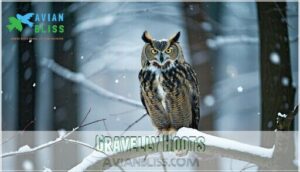
The Great Horned Owl is famous for its gravelly hoots, often compared to a muffled sound.
These calls, essential for territory defense and mate attraction, showcase their role as a top predator.
Listen for their distinct hoots duration at dawn or dusk.
Among Ohio owls, their vocalizations stand out, helping you identify this fascinating owl species Ohio proudly hosts.
Sound Like Muffled Foghorn
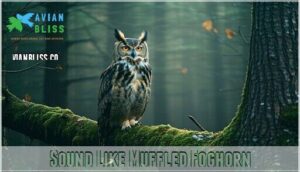
The Great Horned Owl’s call, often compared to a muffled foghorn, echoes through Ohio’s woods.
Its vocalization range adapts to regions, making it a signature of ohio owls.
This sonic territory marker serves specific purposes:
- Defending territory from rivals.
- Attracting mates with its deep, resonant tones.
- Hooting duets between pairs, amplifying their bond.
These owl sounds are unforgettable.
Pairs Chant Together, Female First
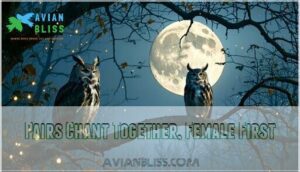
When you hear Great Horned Owls calling at night, you’ll notice the female dominance in their duet function.
She initiates the chant synchronicity while her mate responds with complementary Ohio owl sounds.
These mating rituals showcase intricate owl communication patterns, with call variations that strengthen pair bonds.
Mutual preening also reinforces their bonds.
Their coordinated owl calls demonstrate sophisticated vocal teamwork essential for successful breeding seasons, highlighting the importance of owl communication and pair bonds in their mating rituals.
Shortest Hoots Are Second and Third

Recognizing Great Horned Owl calls becomes easier when you focus on hoot length ranking. Their distinctive pattern features the shortest sounds in positions two and three, creating a unique rhythm that sets them apart from other Ohio owls.
Here’s how to identify this acoustic adaptation:
- Listen for the classic five-hoot sequence with varying durations
- Count the beats – the middle hoots are noticeably briefer
- Compare timing patterns against other owl sounds you’ve heard
Found in Continental US, Alaska, Canada

You’ll find Great Horned Owls across the entire continental United States, Alaska, and Canada – making them North America’s most widespread owl species.
Their remarkable range expansion demonstrates incredible adaptability to diverse owl habitats, from Ohio’s forests to Arctic tundra.
Snowy Owls, for instance, exhibit strong philopatry to wintering sites in central North America.
| Region | Population Status |
|---|---|
| Continental US | Stable populations |
| Alaska | Breeding resident |
| Canada | Year-round presence |
| Ohio | Common resident |
Eastern Screech-Owl
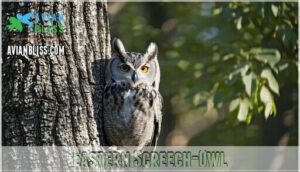
You’ll recognize the Eastern Screech-Owl’s call as a distinctive descending whinny that sounds like a horse’s neigh with a trembling quality, often described as a trill that starts high and drops in pitch.
This small owl produces two main vocalizations: the whinny call for territorial purposes and a monotonic trill for communication between pairs, with males calling at noticeably lower pitches than females.
Descending Whinny, Trill
You’ll recognize the Eastern Screech-Owl’s signature descending whinny and trill – it sounds like a horse on helium.
These Ohio owl sounds showcase remarkable Screech-Owl Communication through distinct Trill Variations:
- Whinny call – drops in pitch like a miniature horse
- Monotonic Trill – steady vibrato for territory claims
- Vibrato Significance – creates haunting woodland melodies
These owl screeches help identify this common Ohio species.
Males Call at Lower Pitch Than Females
You’ll discover that male Eastern Screech-Owls produce deeper, more resonant owl calls than their female counterparts.
This acoustic dimorphism in Ohio owls serves essential evolutionary reasons, helping pairs coordinate during courtship and territorial disputes.
The pitch variation between sexes enhances mating success by allowing clear identification of partners, making species comparison easier for birdwatchers identifying owl mating calls with distinctive ohio wildlife sounds that facilitate species comparison.
Monotonic Trill for Communication
Beyond pitch differences, Eastern Screech-Owls use monotonic trills for essential communication.
This steady, unchanging call helps establish territories and coordinate with mates.
You’ll hear these owl calls throughout Ohio’s woodlands as birds maintain acoustic range with their neighbors.
Trill function includes:
- Territory establishment: Marking boundaries through consistent vocalizations
- Mate coordination: Maintaining contact between breeding pairs
- Species identification: Distinguishing from other Ohio wildlife sounds
Vibrato Master
Among Ohio’s owl sounds, the Eastern Screech-Owl‘s vibrato frequency range sets it apart as nature’s vocal virtuoso.
This owl vibrato creates distinctive pitch fluctuations spanning 5-8 Hz, making vibrato acoustic analysis reveal complex territorial calls.
Unlike other bird sounds Ohio offers, this species vibrato comparison shows evolutionary purpose—each vibrational signature helps identify individual owls through sophisticated communication strategies.
These owls are related to the Western Screech-Owl, found in western North America, and exhibit a unique vibrato acoustic analysis and sophisticated communication strategies with their vibrational signature.
Western Screech-owls Have a Bouncy Ball Call
The Western Screech-owl’s distinctive "bouncing ball" call sets it apart from Ohio’s Eastern Screech-owl.
This accelerating rhythm resembles a ping-pong ball dropping faster and faster.
While uncommon in Ohio, understanding call variations helps you identify regional dialects in screech-owl acoustics.
- Tempo increases: Notes speed up like a bouncing ball losing height
- Frequency range: Call mimicry occurs between 1-3 kHz for hunting vocalizations
- Geographic distinction: Western screechowl sounds differ from Ohio owl sounds you’ll typically hear
Barn Owl

You’ll recognize the Barn Owl by its distinctive high-pitched screams and harsh "k-r-r-r-r-ick" calls that cut through Ohio’s night air.
These pale, heart-faced owls use their piercing vocalizations for self-advertisement and territorial communication across the 48 lower states where they’re found.
High-pitched Screams
Barn Owls produce spine-chilling high-pitched screams that echo through Ohio’s night air.
These haunting scream variations serve as powerful distress signals and territorial calls.
Their acoustic range spans frequencies that carry across open farmland, making owl communication unmistakable.
- Sharp shriek: Piercing alarm when threatened
- Extended wail: Long territorial announcement
- Rapid sequence: Multiple screams during conflicts
K-r-r-r-r-ick: Self-advertisement
Barn Owl shrieks aren’t just noise—they’re strategic.
Their high-pitched “K-r-r-r-r-ick” serves as a self-advertisement, broadcasting their presence to rivals and potential mates.
This sharp call doubles as an owl territorial call, helping them claim space in Ohio’s quieter habitats.
If you’re listening for Ohio owl sounds at dusk, this vocalization is your cue to spot these pale-faced hunters in action.
Shriek: Distress or Warning
When you hear a barn owl’s piercing shriek, it’s sounding the alarm.
This distress call warns of danger and can startle predators away from nests.
Shriek variations serve multiple purposes:
- Predator alerts – Sharp screams deter threats
- Contextual meanings – Intensity varies by situation
- Species differences – Unlike screech owl trills
- Acoustic analysis – Higher pitch than territorial calls
- Owl vocalizations – Distinct from normal hunting sounds
Found in Lower 48 States (except Some Northern)
You’ll find barn owls throughout most of America’s lower 48 states, though some northern regions see fewer populations.
Their habitat diversity allows them to thrive in:
- Agricultural farmlands with open hunting grounds
- Grassland prairies supporting abundant prey
- Desert edges where rodents flourish
- Suburban areas with suitable nesting sites
Regional variations affect population stability across different climates, making habitat diversity a crucial factor.
Five Other Continents
Beyond North America’s borders, you can hear owl sounds across every inhabited continent.
These ghostly hunters thrive from African savannas to Australian outback, producing distinctive owl vocalizations worldwide.
Their owl territorial calls echo through European forests and Asian mountains, while South American Owls add unique hoots to rainforest symphonies.
| Continent | Common Species | Distinctive Calls | Habitat |
|---|---|---|---|
| Africa | African Wood Owl | Deep hooting sequences | Dense forests |
| Asia | Brown Wood Owl | Hollow whistling notes | Mountain regions |
| Europe | Tawny Owl | Classic "tu-whit tu-whoo" | Deciduous woodlands |
| Australia | Powerful Owl | Double hooting pattern | Eucalyptus groves |
Optimal Time and Conditions for Hearing Owl Calls
You’ve learned to recognize Ohio’s owl sounds, but timing makes all the difference for successful owl watching.
These nocturnal birds ohio call most actively during specific periods when conditions align perfectly.
Optimal listening conditions include:
- Dawn and Dusk – Peak activity occurs during these twilight hours when owls begin hunting
- Seasonal Variations – January and February offer the best owl territorial calls as breeding season approaches
- Weather Conditions – Clear, calm nights without wind or precipitation amplify owl hoots across distances
- Habitat Influence – Position yourself near wooded edges, open fields, or wetlands where owls hunt
The Lunar Cycle affects visibility but doesn’t substantially impact owl sounds.
Understanding owl call products can further enhance your owl watching experience.
Patient observers will discover these timing secrets reveal memorable encounters with Ohio’s remarkable nocturnal hunters.
Cultural and Historical Significance of Owl Calls

Throughout history, owl sounds have carried profound meaning beyond their biological purpose.
Indigenous beliefs often interpret owl hoots as messages from ancestral spirits, with different species representing various spiritual guardians.
You’ll recognize owl symbolism woven into countless folklore connections, where these nocturnal calls signal wisdom or foretell important events.
Halloween associations link owl sounds to mysterious supernatural domains, while literary references use their haunting vocalizations to create atmospheric tension in stories.
Native American cultures particularly revered horned owl calls as protective night guardians.
These cultural interpretations transform simple biological communication into something deeper—owl folklore that connects you to generations of human fascination with these enigmatic nocturnal creatures and their evocative sounds.
Owls are also seen as symbols of transformation, representing death and rebirth in some cultures.
Frequently Asked Questions (FAQs)
How many types of owls are there in Ohio?
Ohio’s nighttime hunters include eight distinct owl species that you’ll encounter across the state.
Great Horned, Barred, Eastern Screech, Barn, Short-eared, Long-eared, Northern Saw-whet, and Snowy Owls call Ohio home seasonally.
Where can I find owls in Ohio?
You’ll find owls in Ohio’s dense woodlands, open grasslands, marshes, and farmland edges.
Check state parks, nature preserves, and wooded areas near fields at dawn or dusk when they’re most active.
What does a horned owl sound like?
Great Horned Owls produce deep, gravelly hoots that carry far distances, resembling a muffled foghorn.
You’ll hear their distinctive "hoo-hoo-hoo, hoo-hoo" calls echoing through wooded areas, especially during dawn and dusk hours.
Do owls call at a lower pitch?
Owl calls vary dramatically in pitch depending on the species.
You’ll hear deep, gravelly hoots from Great Horned Owls that sound like muffled foghorns, while Barn Owls produce high-pitched screams and shrieks instead.
Are horned owls common in Ohio?
You’ll find Great Horned Owls are quite common throughout Ohio year-round.
They’re highly adaptable and thrive in the state’s mixed woodlands, farmlands, and even suburban areas with their distinctive deep hooting calls.
What does a barn owl sound like?
You’ll hear barn owls produce high-pitched screams rather than typical hoots. Their calls sound like harsh "k-r-r-r-r-ick" sounds or longer shrieks that cut through the night air with surprising intensity.
What’s the most common owl in Ohio?
Barred owls are Ohio’s most common species, easily recognized by their distinctive "Who cooks for you?" call. You’ll find them year-round in forests throughout the state, especially near water sources.
What are the six sounds of an owl?
Surprisingly, you’ll only hear about five main owl sounds, not six.
You’ll recognize hoots, screams, trills, whinnies, and territorial calls.
Each species uses different vocalizations to communicate with mates and claim territory.
What do owls hoot at night?
You’ll discover owls hoot at night primarily to claim territories and attract mates during breeding season.
They’re also communicating with family members, warning off intruders, and maintaining contact across their hunting grounds.
What owl hoots three times?
Great horned owls commonly produce three-hoot sequences, especially males establishing territory.
You’ll recognize their deep, resonant "hoo-hoo-hoo" pattern during breeding season, typically delivered in sets of three to five hoots with distinctive pauses between each call.
Conclusion
Tonight, you’ll step outside and hear one of these four distinctive ohio owl sounds echoing through your neighborhood.
Whether it’s the Barred Owl’s rhythmic "Who cooks for you?" or the Great Horned Owl’s deep foghorn hoots, you now possess the knowledge to identify each species by their unique vocalizations.
Eastern Screech-Owls’ trills and Barn Owls’ spine-chilling shrieks will no longer remain mysterious.
Listen carefully during evening hours, and you’ll discover Ohio’s nocturnal hunters communicating all around you.
- https://www.allaboutbirds.org/guide/Great_Horned_Owl/overview
- https://birdsoftheworld.org/bow/species/easowl1/cur/sounds
- https://onlinelibrary.wiley.com/doi/full/10.1002/jmor.70020
- https://www.nature.org/en-us/about-us/where-we-work/united-states/ohio/stories-in-ohio/ohio-endangered-species/
- https://dam.assets.ohio.gov/image/upload/ohiodnr.gov/documents/wildlife/backyard-wildlife/Pub%205423%20-%20Common%20Owls%20of%20Ohio%20R0123_WEB.pdf