This site is supported by our readers. We may earn a commission, at no cost to you, if you purchase through links.
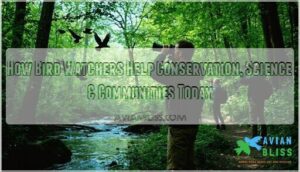 When you grab your binoculars, you’re joining
Table Of Contents
Key Takeaways
- You’re contributing vital data to global conservation by recording your bird sightings through eBird and citizen science programs—your observations become part of a 2-billion-record database that guides habitat protection and species recovery efforts.
- You’re creating bird-friendly environments that serve as wildlife corridors by installing native plants, providing water sources, and maintaining feeders in your yard—these spaces help birds navigate urban landscapes and find safe nesting sites.
- You’re driving significant economic impact through your birding activities, pumping $107 billion annually into local economies while supporting 1.4 million jobs nationwide through equipment purchases, travel, and tourism.
- You’re building the next generation of conservationists by participating in educational programs, birding clubs, and public events—your involvement creates informed communities that understand why birds matter to our ecosystems.
How Bird Watchers Support Conservation
When you watch birds, you’re doing more than enjoying nature—you’re actively supporting conservation efforts that protect habitats and save endangered species.
Your observations help scientists track population changes and identify areas where birds need protection most, which is crucial for understanding and addressing the needs of endangered species.
Every bird sighting you record becomes vital data for protecting endangered species and their habitats
Habitat Protection and Restoration
When you protect wetlands and restore forests, you’re creating lifelines for countless bird species.
Your efforts in establishing wildlife corridors connect fragmented habitats, allowing birds to safely migrate and breed.
Through supporting ecosystem services and biodiversity preservation, you directly impact bird habitat conservation and wildlife preservation initiatives.
By promoting bird conservation efforts, individuals can make a significant difference in protecting local bird populations.
- Watching a Wood Duck family navigate restored wetlands you helped fund
- Seeing native songbirds return to forests you planted saplings in
- Witnessing successful falcon nesting on green rooftops you advocated for
- Discovering rare warblers using wildlife corridors you helped establish
- Celebrating increased biodiversity in conservation areas you supported
Endangered Species Advocacy
When fourteen Maryland bird species face extinction, you become their voice in the halls of power.
Your observations fuel Environmental Policy changes that create Bird Safeguards and strengthen the Endangered List protections.
Through Wildlife Protection advocacy, you’re helping species like the Bald Eagle bounce back from near-extinction, proving that grassroots Conservation efforts drive meaningful Wildlife Preservation and Endangered Species Protection nationwide.
Citizen Science and Data Collection
When you submit your bird observations to eBird or participate in annual bird counts, you’re contributing to the world’s largest biodiversity database with over 2 billion recorded sightings.
Every bird you count becomes data that guides conservation decisions worldwide
Your simple checklist becomes valuable scientific data that researchers use to track migration patterns, population trends, and climate change impacts on bird species.
EBird and Bird Count Contributions
When you submit your Bird Surveys to eBird, you’re joining over 680,000 observers who’ve logged 2 billion bird sightings worldwide.
Your Species Tracking and Bird Identification efforts fuel Data Analysis that directly supports Conservation Efforts.
Every Bird Count you complete—whether at Maryland Birding Locations or beyond—strengthens this massive Citizen Science database that researchers rely on for critical Birdwatching insights.
By participating in bird citizen science, individuals can substantially contribute to the understanding and protection of bird populations.
Impact on Ornithological Research

Your observations fuel groundbreaking discoveries that reshape our understanding of avian life.
When you spot that rare warbler or track migration patterns, you’re contributing to a scientific revolution that’s rewriting textbooks.
Here’s how your field notes become scientific breakthroughs:
- Research Methods evolve as scientists analyze your 2 billion eBird observations across 253 countries
- Data Analysis powers over 1,250 peer-reviewed publications using citizen-contributed datasets
- Species Tracking through your checklists enables population trend models for 852 species worldwide
- Habitat Studies benefit from your location data, improving distribution maps and conservation planning
- Bird Behavior research advances through Macaulay Library recordings you’ve shared from field encounters
This Ornithological Research directly influences federal habitat policies and guides Conservation decisions nationwide.
The eBird program relies on bird sighting data to inform its conservation efforts.
Youth Involvement in Data Gathering
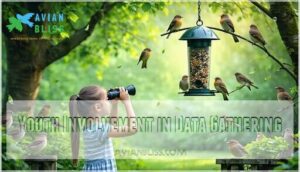
Through Young Birders programs, you’ll help gather essential data while mastering Bird Identification techniques.
Project FeederWatch and NestWatch turn your Backyard Birding into valuable Citizen Science contributions.
You’ll conduct Bird Surveys using proven Bird Watching Techniques, transforming casual observations into Youth Research that shapes conservation decisions.
Your Data Collection efforts fuel discoveries that protect the birds you love studying, contributing to Citizen Science.
Promoting Bird-Friendly Communities
You can transform your backyard into a thriving bird habitat by providing proper food sources, clean water, and native plants that offer shelter and nesting sites.
Your bird-friendly choices create stepping stones that help birds navigate urban landscapes while contributing to community-wide conservation efforts.
Creating Bird-Friendly Yards and Homes

Your backyard can become a wildlife sanctuary through thoughtful design choices.
Native Plants host twice as many bird species as conventional yards, providing essential food sources throughout the seasons.
Transform your space with:
- Dense shrub layers for nesting cover and winter shelter
- Chemical-free practices to protect vulnerable nestlings
- Fresh water sources that increase local bird diversity.
Bird Friendly Homes incorporate Nest Boxes and strategic Wildlife Gardening techniques.
Yard Habitat improvements support Backyard Birding while Bird Feeders complement natural food sources from native vegetation.
Effective bird feeding strategies often rely on proper bird feeder placement and maintenance.
Bird Feeding and Nest Monitoring
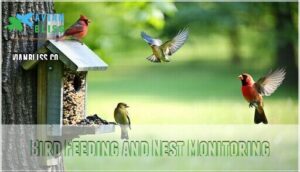
You’ll find bird feeders become magnets for backyard birds when you choose the right bird seeds and feeder types.
Sunflower seeds attract cardinals and chickadees, while nyjer draws goldfinches. Regular feeder maintenance prevents disease spread among visiting species.
Installing nest boxes creates safe nesting habits opportunities, and monitoring these structures helps you understand local bird behavior patterns throughout breeding seasons.
By following proper bird feeding strategies, individuals can substantially contribute to the well-being of local bird populations, and make a positive impact on backyard birds, by using the right bird seeds, and creating a safe environment through nest boxes.
Urban Initiatives Like Lights Out Baltimore

When darkness falls, Urban Conservation advocates launch Lights Out Baltimore to tackle a deadly problem.
This Wildlife Protection initiative dims City Lighting that disorients migrating birds, reducing fatal collisions by thousands annually.
Maryland Ornithological Society champions these Dark Skies efforts through their Wildlife Action Plan, proving Bird Watching in Maryland drives meaningful Conservation beyond backyard feeders.
Educating and Engaging The Public

You don’t just watch birds—you create the next generation of conservationists through hands-on education and community engagement.
When you lead school programs or host public birding events, you’re building a network of informed citizens who understand why birds matter to our ecosystems.
Youth and School Programs
Maryland schools tap into conservation through hands-on Student Projects that connect classrooms to real science.
The Maryland Ornithological Society provides Education Resources and Bird Camps that transform kids into conservation champions through School Outreach programs.
Here’s how Youth Mentors make Bird Watching in Maryland educational:
- eBird Explorers – 11-hour lessons for ages 8-15 using participatory science
- Bird Identification Guide training through point counts and species exercises
- Online Bird Courses connecting theory to outdoor experience
- Conservation grants up to $3,000 for youth-led endangered species research
- Habitat-building activities like installing feeders and monitoring nest boxes
These programs create environmental stewards who contribute meaningful data to ornithological research.
Many participants utilize bird watching kits to enhance their learning experience.
Public Events and Birding Clubs
Throughout the year, birding clubs like the Maryland Ornithological Society and Baltimore Bird Club host Field Trips and Bird Counts that welcome everyone.
These Club Meetings feature expert speakers sharing insights about Bird Watching in Maryland.
Bird Fairs showcase equipment and techniques, while Membership Drives expand participation.
Bird Club Membership opens doors to guided Bird Watching Activities, connecting novices with seasoned birders who share their passion freely.
By participating in these events, individuals can learn about and support local bird conservation efforts in their communities.
Economic and Social Benefits of Bird Watching

You’re contributing more than just birding observations when you watch birds—you’re driving a massive economic engine.
Your passion for birding pumps billions into local economies through equipment purchases, travel expenses, and tourism activities that create jobs and support communities nationwide.
Boosting Local and State Economies
Bird watchers pump serious cash into local economies.
Your birding trips generate $107 billion annually, supporting 1.4 million jobs nationwide.
When you visit Maryland Ornithological Society events or join the Baltimore Bird Club, you’re boosting local businesses.
Birding revenue creates $38 billion in tax funding for states and counties, proving bird club membership drives real economic growth beyond conservation.
In addition, bird watching supports citizen science projects that contribute to global biodiversity monitoring and conservation efforts.
Birding Tourism and Festivals
When your local spending power extends beyond state borders, you’re contributing to a $62.73 billion global market that’s projected to reach $95.22 billion by 2030.
Bird Festivals and Birding Events like Ohio’s Biggest Week draw 90,000 attendees annually, pumping $40 million into local economies.
These Wildlife Conservation Tourist Attractions create jobs while supporting the Maryland Ornithological Society’s mission through Eco Tourism partnerships.
The growth of birding tourism relies on organized birding tour operations that cater to enthusiasts.
Community Building Through Bird Clubs
You’ll discover that club membership creates lasting friendships through shared birding adventures and social events.
Local chapters like the Maryland Ornithological Society and Baltimore Bird Club host bird meetings where you’ll learn bird identification techniques and access ornithology resources.
These volunteer work opportunities strengthen community bonds while advancing conservation goals together.
Frequently Asked Questions (FAQs)
What equipment do beginning bird watchers need?
Like telegraph operators of old, you’ll need binoculars (8×42 are perfect), a field guide, and a notebook.
Start with these basics—your smartphone’s birding app can identify calls while you’re learning the ropes in the field.
How do weather conditions affect birding success?
Weather conditions dramatically impact your birding success, determining bird activity levels, visibility, and behavior patterns.
Overcast skies reduce glare while light rain can trigger feeding frenzies, but strong winds and storms limit observations substantially, affecting your overall birding success.
What are the best birding times daily?
You’ll find birds most active during dawn and dusk when they’re feeding and singing.
Early morning, starting an hour before sunrise, offers peak activity.
Evening hours also provide excellent opportunities as birds prepare for nighttime roosting.
How do bird watchers identify rare species?
You’ll spot rarities by noting unusual size, color patterns, or behavior that doesn’t match common species. Use field guides, birding apps, and experienced birders’ expertise to confirm identification.
What safety precautions should birders take outdoors?
Carry proper gear including water, snacks, first aid kit, and weather-appropriate clothing.
Tell someone your birding location and expected return time.
Stay on designated trails, watch for wildlife, and bring a charged phone for emergencies.
Conclusion
Through observation, documentation, and advocacy, you’re contributing to conservation efforts that protect both common and endangered species.
By participating in citizen science programs, creating bird-friendly spaces, and educating others, you help researchers gather vital data while building stronger communities.
Your binoculars become tools for scientific discovery and environmental stewardship.
Understanding how bird watchers help reveals the profound impact of this accessible hobby on our natural world and society.
- https://ebird.org/news/ebird-passes-2-billion-bird-observations
- https://www.audubon.org/magazine/birding-booming-hobby-and-big-business
- https://www.grandviewresearch.com/industry-analysis/birdwatching-tourism-market-report
- https://pacificbirds.org/2025/03/birding-benefits-economy
- https://dnr.maryland.gov/wildlife/Documents/rte_Animal_List.pdf