This site is supported by our readers. We may earn a commission, at no cost to you, if you purchase through links.
 You’ll find that birds that migrate over water are some of nature’s most impressive athletes. Arctic Terns hold the record with 55,250-mile annual journeys between Arctic and Antarctic waters. Pacific Golden-Plovers fly 9,700 kilometers nonstop from Alaska to Hawaii without landing once.
Shearwaters and albatrosses lock their wings for hours of effortless ocean flight. Even surprising songbirds double their body weight in fat reserves before attempting sea crossings. These species use magnetic compasses in their beaks, celestial navigation, and strategic wind patterns to cross vast oceans.
They spend up to 78% of migration time floating on waves between flights. The secrets behind their remarkable oceanic survival strategies reveal fascinating adaptations you never knew existed.
Table Of Contents
Key Takeaways
- You’ll witness nature’s most extreme athletes when Arctic Terns complete 55,250-mile annual journeys and Pacific Golden-Plovers fly 9,700 kilometers nonstop without landing once.
- You can recognize these oceanic migrants by their streamlined bodies, pointed wings, and ability to lock their wings for hours while riding wind currents and floating on waves between flights.
- You’re seeing birds that’ve evolved incredible navigation systems using magnetic compasses in their beaks, celestial navigation, and strategic timing to cross vast oceans where there’s zero room for error.
- You’ll help protect these remarkable species by supporting conservation of critical island stopovers and coastal wetlands where exhausted birds double their body weight before continuing their epic journeys.
Iconic Birds That Migrate Over Water
You’ll discover remarkable species that complete journeys spanning thousands of miles across open ocean.
These birds have evolved incredible adaptations that allow them to navigate vast stretches of water without rest stops.
Arctic Tern and Its Epic Journey
You’ll witness nature’s most incredible marathon when you observe Arctic Terns. These remarkable birds complete the longest migration on Earth. Their epic flight spans from Arctic breeding grounds to Antarctic waters.
- Arctic Terns travel 55,250 miles annually in their Tern Migration Patterns
- Their Sea Crossing Strategies include using wind currents over open ocean
- Specialized Feather Adaptations provide waterproofing and insulation during flight
- Arctic Breeding Habits involve nesting in colonies on rocky coastlines
- Small Flocking Behaviors help them navigate vast oceanic distances together
Pacific Golden-Plover’s Ocean Crossing
Pacific Golden-Plovers break free from Alaska’s grip each fall. They launch themselves across 9,700 kilometers of open Pacific Ocean toward Hawaii. No rest stops exist during this nonstop flight. These Birds rely on massive Energy Reserves built up before departure.
These tiny warriors launch into 9,700 kilometers of open ocean with zero room for error
Their flight muscles power streamlined wings through changing wind patterns. Bird Physiology adapts perfectly for these Oceanic Routes. Migration Timing matches favorable weather windows.
Flight Patterns stay remarkably straight despite Pacific Loon distractions below. Waterproof feathers protect against ocean spray during the incredible journey. The pacific golden plover’s annual migration is influenced by its migratory journey patterns.
Shearwaters and Albatrosses
Shearwaters and albatrosses rule the open seas with unmatched skill. These seabird masters spend months gliding over waves without touching land.
Here’s what makes these ocean wanderers extraordinary:
- Laysan Albatross can lock their wings for hours of effortless flight
- Shearwater Migration covers thousands of miles following fish schools
- Oceanic Feeding happens through precise surface dives and skimming
- Pelagic Conservation protects their vast ocean habitats
- Albatross Habitat spans entire ocean basins year-round
These birds transform Seabird Foraging into art, riding wind currents with wings designed for endless ocean travel.
Icelandic Whimbrel’s Nonstop Flights
Across vast Atlantic waters, Icelandic whimbrels undertake extraordinary nonstop flights spanning 3,900–5,500 kilometers to West Africa in just five days. These birds maximize their energy reserves through strategic fat storage before departure.
Their flight physiology includes specialized air sac systems and powerful wings that enable sustained migration patterns. Wind assistance becomes essential during these oceanic crossings, helping reduce energy demands. Their nonstop strategies represent remarkable feathers-to-freedom journeys across open seas.
Songbirds Surprising Sea Crossings
Songbirds defy expectations with remarkable sea crossing abilities. Research reveals migration routes spanning hundreds of kilometers over open water. These small birds challenge previous assumptions about land bird limitations.
Three surprising songbird sea crossing strategies:
- Timing flights with favorable wind patterns – Songbirds exploit atmospheric uplift to reduce energy demands during oceanic journeys
- Building extra fat reserves – Species double their body weight at staging sites before attempting water crossings
- Using islands as stepping stones – Birds navigate between remote atolls and coastal refuges for rest and refueling
Migration physiology allows these tiny travelers remarkable oceanic habitat use despite lacking waterbird adaptations.
Unique Adaptations for Oceanic Migration
When you watch birds soar effortlessly across vast oceans, you’re witnessing millions of years of evolutionary perfection in action. These incredible migrants have developed specialized adaptations that transform their bodies into living aircraft capable of surviving journeys that would challenge even modern technology.
They have developed these adaptations to transform their bodies into living aircraft.
Flight Muscles and Energy Storage

You’ll find that migratory birds pack incredible power into their flight muscles. These birds develop larger pectoral muscles with more blood vessels and mitochondria than non-migrating species. Their muscle physiology supports extended aerodynamic efficiency through enhanced fat metabolism.
Birds store energy reserves as fat – sometimes over 50% of body weight. This fat provides twice the power output of other fuels during ocean crossings. The physiological adjustments of migratory birds are influenced by factors such as muscle growth regulators that control flight muscle size.
Navigational Skills and Orientation

Over open water, birds rely on multiple navigation systems for precise orientation. Your magnetic compass detects Earth’s magnetic field through specialized cells in the beak.
Celestial navigation uses sun position during day and star patterns at night. Visual cues from coastlines help when available.
These orientation strategies combine with spatial memory to create detailed mental maps. Understanding bird anatomy reveals how these navigation systems work together for successful ocean crossings. Birds utilize magnetic field detection mechanisms to navigate across vast distances, using their navigation systems for precise orientation.
Resting and Feeding Strategies at Sea
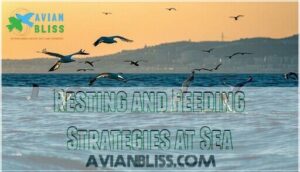
Ocean Resting becomes essential when birds face endless water. Many seabirds spend up to 78% of migration time floating on waves.
They’ve mastered three key strategies:
- Sea Food Sources – Diving for fish and plankton during rest stops
- Seabird Foraging – Skimming surface prey while floating
- Marine Habitat adaptation – Using ocean currents for easier movement
These Feeding Behaviors help Birds of the World survive impossible journeys across open seas.
Use of Wind and Atmospheric Uplift

You’ll find that migratory birds become masters of reading Wind Patterns and exploiting Atmospheric Lift during ocean crossings. These species adjust their Flight Optimization techniques by riding Air Currents that reduce energy demands.
Soaring birds maximize Uplift Strategies by timing departures with favorable conditions. Their powerful flight muscles of the shoulder and specialized wings give them the ability to fly efficiently across vast waters.
Challenges Faced During Water Crossings

When you think about birds crossing vast oceans, you’re witnessing one of nature’s most demanding challenges. Open water creates deadly obstacles that push these incredible travelers to their absolute limits.
Lack of Resting Sites and Safe Landings
When you’re crossing vast oceans, there’s no room for error. Unlike terrestrial routes, oceanic migration strips away safety nets that land-based species rely on.
- Sea Crossing Barriers create impossible landing zones where exhausted birds face certain death
- Oceanic Resting becomes a luxury most species can’t afford during nonstop flights
- Fatigue Management demands precise energy calculations before departure from staging areas
- Landing Strategies must account for zero margin of error over endless water
- Habitat Preservation of coastal stopover sites becomes critical for species survival
Understanding the complex migration timing factors is essential to grasping the challenges birds face during these journeys.
Weather Hazards and Exhaustion
Bad weather turns ocean crossings deadly for migrating birds. Storm fatigue overwhelms even strong fliers like the Red-tailed Hawk. Wind resistance increases energy demands threefold during atmospheric stress. Ocean turbulence creates downdrafts that exhaust flight endurance rapidly.
When storms hit you’ll notice fewer Bird ID opportunities as species like American Goldfinch avoid risky flights while hardy Eurasian Wrens push through dangerous conditions despite hearing distressed sounds songs from struggling flocks, which can be related to atmospheric stress.
Human Impacts: Wind Turbines and Habitat Loss
Wind Turbines pose serious threats to water-crossing migrants. Collision Rates reach 680,000 annual bird deaths across U.S. wind farms.
Offshore migrants fly lower than land birds, increasing Wind Turbine Risks substantially. Habitat Destruction from turbine placement creates functional habitat loss.
Birds avoid entire corridors, reducing migration routes. Renewable Energy development fragments critical over-water pathways.
Conservation Policies must balance energy needs with Bird Species Information protection requirements.
Climate Change and Migratory Success
Climate change disrupts migration timing for water-crossing birds. Sea Level Rise floods coastal stopover sites. Migration Timing shifts as springs arrive 14 days earlier.
Atmospheric Shifts alter wind patterns that birds depend on. Climate Modeling shows 73% of North American Bird species can’t adapt fast enough. Ecological Resilience varies by species.
Use Bird ID guides to Explore Species affected by these changes in Birds of the World databases.
Critical Stopover Sites and Conservation Needs
You’ll discover that migrating birds depend on specific islands and wetlands as essential rest stops during their ocean journeys. These critical refueling stations allow birds to double their body fat and recover from exhausting flights across open water.
Importance of Islands and Atolls

Over 30% of ocean-crossing birds depend on Island Refugia during epic journeys. These Atoll Ecosystems provide essential rest stops where exhausted travelers double their body fat reserves.
Pacific atolls support Seabird Habitats across 4,000-kilometer stretches. These Oceanic Corridors reduce mortality by 40%. Coastal Conservation protects these lifelines. Bird ID guides help you Explore Species using these stepping stones. Birds of the World rely on these sanctuaries for survival.
Managed Wetlands as Refueling Stations
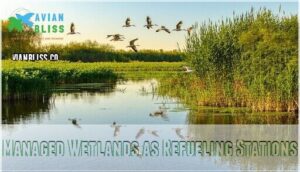
Managed wetlands serve as essential pitstops for ocean-crossing birds. These restored habitats support diverse species during their epic journeys.
Key refueling strategies include:
- Energy replenishment – Marbled Godwit and Sandhill Crane double their body fat reserves
- Strategic timing – Birds synchronize arrival with peak food availability
- Species diversity – Heermanns Gull joins countless migratory patterns in these sanctuaries
Wetland restoration creates important bird habitat where feeding birds can recover before continuing their transcontinental adventures. Effective wetland management often involves installing bird feeding systems to support the local ecosystem.
Conservation Efforts and Citizen Science

Your efforts create real change through citizen science programs that track species like European Starling and Red-tailed Hawk migrations. Community engagement drives habitat restoration projects protecting Sandhill Crane and Marbled Godwit stopover sites.
Bird monitoring data from volunteer programs supports research funding for Heermanns Gull conservation. Together we’re building networks that safeguard tomorrow’s migrations, through community engagement.
How to Identify Migratory Water-Crossing Birds

Spotting these ocean-crossing migrants requires knowing their key features and behaviors during peak migration seasons.
You can identify them by their streamlined bodies, pointed wings, and distinctive flight patterns that help them tackle vast water crossings, characterized by their streamlined bodies.
Visual Identification Tips
Spotting these oceanic travelers requires sharp observation skills. Each species displays unique characteristics that set them apart from resident birds.
Key Visual Identification Features:
- Bird Plumage – Arctic Terns show clean white bodies with black caps during breeding season
- Beak Shapes – Pacific Golden-Plovers have short black bills perfect for picking invertebrates
- Wing Morphology – Shearwaters possess long narrow wings built for dynamic soaring
- Tail Features – American Robin migrants display rusty-red breasts unlike water-crossing specialists
- Feather Patterns – Whimbrels show distinctive curved bills and streaked brown plumage year-round
Developing strong Bird ID Skills means studying Birds of the World guides and practicing with local Bird species information to Explore birds effectively. Understanding migration patterns is essential for identifying migratory birds.
Recognizing Flight Patterns
During migration seasons, watch for birds that fly in distinctive V-formations or long lines.
Flight Path Analysis reveals these patterns reduce energy costs.
Bird Tracking Methods show migrating flocks maintain steady altitudes and speeds.
Migration Route Mapping indicates water-crossers like American Robin and Bald Eagle follow specific corridors.
Aerodynamic Studies prove their streamlined flight differs from local birds’ erratic movements.
Observing these patterns requires proper bird watching tools to accurately identify species, which is crucial for Migration Route Mapping and understanding Flight Path Analysis.
Distinctive Calls and Songs
Listening for distinctive Bird Vocalizations helps identify ocean-crossing migrants. Arctic Terns produce sharp "kee-ah" calls while Pacific Golden-Plovers whistle clear "tu-lee" notes. The Mourning Dove’s soft cooing contrasts with shearwater’s harsh cries.
These Acoustic Signals and Call Recognition techniques from All About Birds reveal species identity. Song Patterns differ between migrants – some stay silent during flight while others maintain contact calls throughout their journey.
Frequently Asked Questions (FAQs)
How do birds navigate over featureless oceans?
Like stars guiding ancient sailors, you’ll rely on magnetic fields, sun positions, and polarized light patterns invisible to human eyes for oceanic navigation.
What happens when birds get lost at sea?
When you’re lost at sea, exhaustion sets in quickly. You’ll desperately search for land or floating debris.
Without rest stops, your energy reserves deplete rapidly, often leading to fatal crashes into ocean waters.
Do birds sleep while flying over water?
You’re cruising over endless ocean when exhaustion hits.
Birds can’t truly sleep while flying, but they’ve mastered a clever trick called unihemispheric slow-wave sleep.
One brain hemisphere rests while the other stays alert for navigation and danger.
How long can birds survive without landing?
You can survive weeks without landing during migration. Some birds like Arctic Terns fly nonstop for months over oceans. They rest by floating on water between flight sessions.
Why dont more birds migrate over water?
Open water kills birds through exhaustion since they can’t find thermal updrafts or landing spots.
You’re looking at flapping flight that drains energy fast, plus weather risks that cause mass deaths along coastlines.
Conclusion
Witnessing these remarkable ocean crossers reminds you that birds that migrate over water represent nature’s ultimate endurance athletes. You’ve discovered how Arctic Terns complete 55,250-mile journeys while Pacific Golden-Plovers fly nonstop for days. These species rely on magnetic navigation and strategic wind patterns to survive their oceanic adventures.
You can help protect their migration routes by supporting conservation efforts. Next time you spot seabirds along coastlines, you’ll appreciate the incredible journeys they undertake across Earth’s vast waters.
- https://nationalzoo.si.edu/migratory-birds/news/have-wings-will-travel-avian-adaptations-migration
- https://northernwoodlands.org/outside_story/article/autumn-migration
- https://journals.biologists.com/jeb/article/214/17/2823/10483/Migration-and-exercise-induced-changes-to-flight
- https://www.frontiersin.org/journals/ecology-and-evolution/articles/10.3389/fevo.2022.787623/full
- https://www.sciencedirect.com/science/article/pii/S1534580721001647