This site is supported by our readers. We may earn a commission, at no cost to you, if you purchase through links.
 You’ll discover that bird migration patterns in Western Europe follow two main flyways split by the Alps – westward routes toward Britain and southeastward paths to the Mediterranean. Over 500 species make these journeys annually, including Whooper Swans from Iceland, Bean Geese from Scandinavia, and European Honey Buzzards heading to tropical Africa.
Migration timing depends on daylight changes and weather patterns, with spring movements from March-May and autumn flights from August-November.
Scientists track these movements using GPS technology and ringing programs that reveal fascinating navigation secrets most birdwatchers never realize exist.
Table Of Contents
Key Takeaways
- You’ll find over 500 bird species following two main flyways through Western Europe – westward routes toward Britain and southeastward paths to the Mediterranean, with the Alps acting as a natural divider that splits these ancient migration corridors.
- You can expect predictable seasonal timing with spring migrations from March to May and autumn flights from August to November, triggered by daylight changes, temperature shifts, and food availability rather than random weather patterns.
- You’re witnessing remarkable navigation abilities as birds use GPS-like systems combining magnetic fields, star patterns, and geographical landmarks to travel thousands of miles between Arctic breeding grounds and African wintering areas with pinpoint accuracy.
- You’ll discover that climate change and human activities create serious threats along migration routes, with 25 million birds dying annually from illegal hunting, power line collisions, and habitat destruction at critical stopover sites like Gibraltar.
Key Bird Species Migrating in Western Europe
You’ll encounter diverse bird species crossing Western Europe’s skies, from massive swans and geese to agile raptors and tiny warblers. These migrants follow ancient routes shaped by geography, food availability, and seasonal triggers that have guided their journeys for thousands of years.
Common Swans and Geese
Three swan species dominate Western Europe’s waterfowl migration landscape. You’ll encounter distinct migratory patterns across different populations, with northern birds traveling further than their southern counterparts.
- Mute Swan populations exhibit partial migration, with Scandinavian birds moving to ice-free waters while British swans remain resident
- Whooper Swan follows predictable routes from Iceland and northern Europe to wintering grounds in Britain and Ireland
- Bean Goose demonstrates complex subspecies variation, with taiga populations migrating through established flyways to agricultural areas
- Greylag Goose shows notable adaptability in swan habitat selection, utilizing both natural wetlands and urban park environments
Iconic Birds of Prey
Western Europe’s raptors showcase notable diversity in their migration strategies. European Honey Buzzards navigate long distances to tropical Africa, while Red Kites demonstrate expanding populations through successful conservation efforts. White-tailed Eagles, Europe’s largest raptor, undertake impressive journeys across continental flyways. Sparrowhawks exhibit partial migration patterns, with northern populations moving south while southern birds remain resident year-round.
Notable Insectivorous Migrants
Insectivorous migrants like warblers and flycatchers undertake remarkable journeys to tropical Africa each autumn. These tiny powerhouses navigate thousands of miles using advanced adaptations for long-distance travel.
These tiny powerhouses navigate thousands of miles using remarkable long-distance adaptations
- Warbler migration targets specific African wintering grounds, primarily Sierra Leone and Tanzania
- Flycatcher habits include strategic stopover timing to coincide with peak insect availability
- Insectivore adaptations feature energy-efficient flight patterns and fat storage mechanisms
Resident Vs. Migratory Populations
Many bird species in Western Europe display flexible migration strategies. You’ll find some populations stay put year-round while others migrate seasonally. This phenomenon, called partial migration, creates complex population dynamics within single species. Understanding the migratory bird species list is vital for conservation efforts, as it involves protected bird species.
| Species | Resident Behavior | Migratory Pattern |
|---|---|---|
| Blackbirds | Urban populations stay | Rural birds migrate south |
| Robins | Western populations remain | Eastern populations move |
| Starlings | Coastal areas resident | Inland flocks migrate |
Northern and eastern European bird migration patterns show stronger migratory tendencies compared to western populations that often remain resident.
Seasonal Timing and Triggers of Migration

You’ll discover that bird migration timing follows predictable seasonal windows driven by environmental changes and internal biological rhythms. These patterns vary substantially between species, with some birds showing complete migration while others exhibit partial movement or nomadic behaviors based on local conditions.
Spring and Autumn Migration Windows
Spring Migration peaks from March to late May across Western Europe as birds escape harsh northern winters. You’ll witness barn swallows arriving in April, while white storks cross Gibraltar in late March. Autumn Migration extends from July through October, with cuckoos departing early and finches peaking in November.
These Seasonal Patterns reflect precise Migration Timing evolved over millennia, creating predictable Flyway Dynamics that birders can follow. Understanding bird migration patterns involves recognizing the role of migration navigation methods in shaping these seasonal movements.
Environmental and Biological Cues
Bird migration reacts to precise environmental and biological cues that trigger seasonal movements. Temperature fluctuations, daylight cues, and food availability create powerful signals for migratory connectivity across Western Europe.
Key environmental triggers include:
- Photoperiodism – changing day length activates hormonal responses
- Humidity signals – atmospheric moisture indicates weather pattern shifts
- Ecological conditions – habitat quality determines departure timing
These migration patterns rely on birds detecting subtle environmental changes that forecast ideal travel conditions ahead. The use of sophisticated environmental sensors helps researchers better understand these complex interactions.
Partial Migration and Nomadism
Two distinct patterns challenge traditional migration concepts. Partial Migration occurs when populations split—some individuals migrate while others stay put, maximizing Energy Conservation through Ecological Flexibility. Nomadic Behavior involves unpredictable movements responding to resource availability.
Western Europe’s Partial Migrants include robins and blackbirds, demonstrating notable Metabolic Adaptations. These Nomadic flights augment Migratory connectivity, showcasing nature’s adaptive strategies for survival.
Major Migration Routes and Geographic Influences
You’ll discover that Western Europe’s bird migration routes follow predictable patterns shaped by geography and seasonal food availability. The towering Alps create a natural divide that splits migration flows into distinct westward and southeastward pathways.
Westward and Southwestward Flyways

Western flyways guide millions of birds along predictable corridors each autumn. Weather patterns shape their migration strategies, while habitat connectivity guarantees safe passage. You’ll find Western Marsh Harriers and Eurasian Teal following these routes, using celestial navigation and magnetic fields for guidance. Northern Pintail, Brent Goose, and Eurasian Hobby rely on this flyway ecology for successful journeys southward.
Barriers: The Alps and Mediterranean
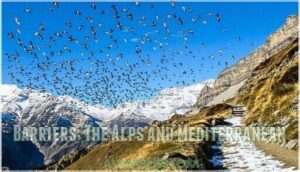
Mountains create formidable terrain obstacles for migrating birds across Western Europe. The Alps force species through specific mountain passes, splitting flyways westward and southeastward. Mediterranean crossing presents a 550-kilometer sea barrier requiring substantial energy reserves. These geographic challenges funnel birds into concentrated migration patterns, making Alps migration routes predictable yet perilous for countless species traveling between breeding and wintering grounds.
The changing climate affects bird migration patterns due to climate change effects.
Stopover Sites and Bottleneck Areas
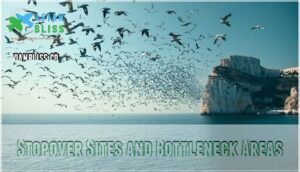
Critical funnel-zones like Gibraltar concentrate thousands of migrating birds into narrow passages, creating outstanding viewing opportunities but also conservation challenges. You’ll find these bottleneck areas where geographic barriers force migration corridors to compress. Site fidelity drives birds to return to proven stopover sites for refueling strategies. Habitat restoration becomes essential at these vulnerable points where bottleneck ecology amplifies human threats to Western Europe’s migration patterns.
Understanding bird migration patterns requires studying migration map data to inform conservation efforts.
Research Methods and Data Visualization
You’ll discover how scientists track millions of migrating birds through sophisticated ringing programs and satellite technology that reveal precise movement patterns across Western Europe.
Modern interactive atlases now transform over 24 million bird encounter records into interactive visualizations that help researchers identify critical migration corridors and timing shifts.
Bird Ringing and Tracking Studies

Scientists have ringed over 13 million birds across Western Europe since 1950, creating massive datasets for Migration Modeling. These efforts have been instrumental in understanding bird behavior and movement patterns.
You’ll find Bird Ringing programs using lightweight GPS devices and RFID tags for precise Species Monitoring. These Tracking Devices weigh under 3 grams yet deliver tracking data within 10 meters accuracy, providing valuable insights into bird migration.
Recovery rates from Ringing schemes usually reach 2-10%, providing vital information for researchers analyzing migration patterns and building detailed databases. The use of sophisticated bird tracking systems has substantially improved the accuracy of migration pattern research.
Interactive Maps and Migration Atlases

You’ll find Migration Data comes alive through Interactive map platforms like the Bird Migration Atlas. These Atlas Visualization tools transform millions of bird tracking records into stunning Map Visualization displays. Route Modeling algorithms process Geographic Analysis data across European Geographic regions, letting you explore migration patterns with a simple click.
The Migration Atlas reveals complex flyways through intuitive interfaces. Understanding the migration patterns is essential for conservation efforts and researching bird species.
Data Validation, Filtering, and Animation Techniques

Beyond basic bird tracking, you’ll encounter advanced data validation systems that guarantee accurate migration patterns. Researchers apply multiple filtering methods to eliminate erroneous records and refine data quality.
Key validation techniques include:
- Statistical modeling to identify outliers in tracking data
- Geographic information systems filtering impossible location sequences
- Animation tools that visualize movement across geographic regions
These animation techniques transform raw data into compelling visual stories, helping scientists spot behavioral patterns that spreadsheets can’t reveal.
Conservation Challenges and Future Trends

You’re witnessing remarkable changes in bird migration as climate shifts alter traditional patterns across Western Europe.
Human activities create deadly bottlenecks where millions of birds face power lines, illegal hunting, and habitat loss during their ancient journeys.
Impact of Climate and Environmental Change
Climate change disrupts bird migration patterns across Western Europe through rising temperatures and shifting weather patterns. Habitat loss forces species northward, with 40% showing range shifts over three decades.
Sea level rise threatens coastal stopover sites, while ecosystem disruption creates food mismatches. Environmental change alters migration timing, affecting survival rates substantially.
Human Threats Along Migration Routes
Migratory birds face deadly obstacles during their epic journeys across Western Europe. Around 25 million birds die annually from illegal hunting practices, power line collisions, and habitat destruction along critical migration routes.
- Shotgun pellets scattered across Mediterranean stopover sites where exhausted warblers seek refuge
- High-voltage power lines creating invisible death traps for soaring raptors and large waterbirds
- Concrete developments replacing traditional wetland rest stops that species depend on for survival
- Light pollution from cities disrupting nocturnal migrants’ natural navigation systems and causing fatal collisions
Human disturbance at bottleneck sites like Gibraltar intensifies these threats, making bird conservation efforts essential for protecting vulnerable migratory bird species during their most perilous moments.
Ongoing Research and Conservation Efforts
Scientists utilize state-of-the-art Wildlife Protection technologies to safeguard Europe’s migrating birds. Habitat Preservation projects restore 4,000 hectares, while Species Monitoring tracks 380 GPS-tagged godwits. Climate Modeling predicts route changes, and Ecological Restoration connects breeding grounds.
Migration Atlas data fuels Ornithology Research, helping Wildlife Conservation efforts protect vulnerable populations through targeted Bird Conservation strategies and Avian Ecology studies. The conservation of migratory birds relies on understanding flyway network dynamics to inform protection policies.
Frequently Asked Questions (FAQs)
How do urbanization effects alter migration patterns?
I’ll search for current information about how urbanization affects bird migration patterns to provide you with a thorough answer.
Let me search for more specific information about urbanization effects on bird migration patterns.
You’ll notice cities force migrating birds to skip natural stopover sites, causing them to arrive earlier due to urban heat islands. Habitat destruction and light pollution disrupt traditional routes, while noise interference affects navigation and communication systems.
What navigation methods do migrating birds use?
Birds possess an absolutely mind-blowing navigation toolkit that’d make GPS jealous. You’re witnessing creatures using magnetic fields, star patterns, sun positioning, and geographical feature recognition.
They’ve got built-in compasses detecting Earth’s magnetic field through specialized proteins in their eyes and beaks.
Which weather conditions delay or accelerate migration?
Strong headwinds and cold fronts delay your feathered travelers, while warm tailwinds and high-pressure systems speed them along. Temperature drops can trigger early departures, but storms force emergency stops.
How do bird migrations affect local ecosystems?
Picture a massive truck convoy suddenly stopping at your town’s gas station – that’s what happens when millions of migrating birds arrive.
You’ll see ecosystems transform as birds redistribute nutrients through droppings, control insect populations, pollinate plants, and create cascading effects throughout food webs during their seasonal journeys.
Conclusion
Who knew that watching birds could turn into such a logistical nightmare? You’d think they’d just fly south when it’s cold, but bird migration patterns western europe reveal a complex network of routes that’d make airline schedulers weep.
**Your understanding of these flyways helps conservation efforts succeed.
** Scientists continue tracking over 500 species using GPS technology and ringing programs.
You’re witnessing one of nature’s most precise navigation systems that connects Arctic breeding grounds to African wintering areas across thousands of miles.
- https://www.euronatur.org/en/what-we-do/bird-conservation-in-europe/our-migratory-bird-projects
- https://www.biology.ox.ac.uk/article/seasonal-migration-patterns-in-eurasian-blackcaps
- https://www.weforum.org/stories/2022/03/climate-change-transforming-europe-birds-nature/
- https://pmc.ncbi.nlm.nih.gov/articles/PMC2614143/
- https://ajpojournals.org/journals/index.php/AJCS/article/download/1989/2366/7492