This site is supported by our readers. We may earn a commission, at no cost to you, if you purchase through links.
 You can identify birds through their unique songs and calls, which work like vocal fingerprints specific to each species. Bird identification by song and region becomes even more powerful when you factor in geographic variations—the same species often develops distinct "dialects" across different areas.
Start by downloading apps like Merlin Bird ID or BirdNET, which analyze audio recordings and filter results by your location. These tools use machine learning to match vocalizations with species that actually occur in your region. Focus on common local birds first, then gradually tackle more challenging species.
Regional song patterns create fascinating differences even within the same species, making location-specific identification essential for accuracy. The combination of species-specific vocal signatures and regional filtering dramatically improves your identification success rate.
Table Of Contents
Key Takeaways
- You’ll identify birds faster by ear than by sight – Bird songs act like vocal fingerprints that reveal species identity even in dense cover where visual identification fails, making sound recognition your most reliable field tool.
- Regional dialects dramatically change identification accuracy – The same species develops distinct "accents" across different areas, so you’ll need location-specific filtering in apps like Merlin Bird ID to match vocalizations with birds that actually occur in your region.
- Start with common local species before tackling challenging ones – You’ll build confidence faster by mastering familiar backyard birds like American Robins and Northern Cardinals, whose consistent songs create a foundation for recognizing more complex vocalizations.
- Dawn hours provide optimal recording conditions – You’ll capture the clearest bird sounds during early morning when territorial singing peaks and background noise is minimal, making this the best time for both learning and using identification apps.
How Bird Songs Aid Species Identification
You’ll hear birds before you see them, especially in dense cover where even experienced birders rely on sound for quick identification. Bird vocalizations reveal species identity faster than visual cues, with each species producing unique patterns in frequency, rhythm, and tone that distinguish them from similar-looking relatives.
Importance of Vocalizations in Bird ID
Hearing bird songs reveals nature’s acoustic signatures better than sight alone. Vocalizations carry species-specific patterns that reveal identity even in dense cover. These sonic diversifications evolved for territory defense and mate attraction, creating unique acoustic fingerprints.
Identifying birds by ear becomes essential when visual cues fail, making vocalization patterns your most reliable field tool. Mastering bird identification requires understanding bird sound recognition techniques to improve skills.
Differences Between Bird Calls and Songs
You’ll quickly notice that birds make two distinct types of vocalizations. Bird calls are short, simple sounds used for basic communication like warning of danger or staying in contact with flockmates.
Bird songs are longer, more complex patterns usually sung by males during breeding season. Songs showcase intricate syllable variation and frequency analysis reveals their elaborate call structure, while calls remain brief and functional.
Role of Regional Song Variation
Regional song patterns create a fascinating acoustic map across bird populations. You’ll discover that Geographic Song Patterns vary dramatically even within the same species. A White-crowned Sparrow in California sounds distinctly different from one in Alaska.
Bird songs create nature’s GPS – each species carries its own acoustic address that changes with geography
Regional Dialects influence bird sound identification through:
- Acoustic Adaptation to local environments
- Learned variations passed between generations
- Geographic barriers shaping Localized Bird Calls
Song Variation Analysis reveals these differences help US Bird Species maintain territorial boundaries while adapting to their specific habitats.
Common North American Species and Their Songs
You’ll recognize these North American species by their distinctive vocal signatures. Learning bird songs becomes easier when you start with common backyard species. Each bird’s song patterns reveal important clues about species distribution and habitat acoustics throughout different regions.
| Eastern Species | Western Species | Widespread Species |
|---|---|---|
| Northern Cardinal: "birdy-birdy-birdy" | Western Meadowlark: bubbling melody | American Robin: "cheerily-cheer-up" |
| Black-capped Chickadee: "fee-bee" | Spotted Towhee: "drink-your-tea" | White-throated Sparrow: "Oh-sweet-Canada" |
| Tufted Titmouse: "peter-peter" | Anna’s Hummingbird: rapid squeaks | Yellow Warbler: "sweet-sweet-sweet" |
Recording and Analyzing Bird Sounds
You’ll need quality recording equipment and proper technique to capture bird sounds that technology can accurately analyze. Clear audio recordings reveal specific frequency patterns, syllable durations, and spectral features that help distinguish between similar species.
Choosing The Right Recording Equipment
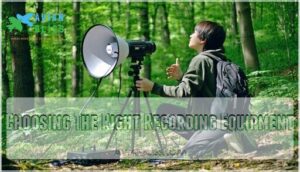
For successful bird sound recording, choose equipment matching your field conditions and target species. Parabolic microphones excel at isolating distant calls with high-quality sound, while shotgun mics offer easier handling for mobile surveys. Digital recorders like MixPre-3 II provide clean, low-noise audio processing essential for machine learning applications.
Match your microphone selection to deployment needs—omnidirectional for soundscapes, directional for specific identification. To achieve high-quality recordings, consider using the right recording setup for your birding needs.
Tips for Capturing Clear Bird Audio

How can you guarantee crystal-clear bird sound recordings that apps will accurately identify? Position your microphone within 30 feet of singing birds, avoiding windy conditions that create noise interference. Use directional microphones for audio improvement and noise reduction during field recording sessions. Calibrate your equipment beforehand, testing audio levels to prevent distortion. Record bird sound during dawn hours when vocalizations are strongest and background noise is minimal.
Understanding microphone types is vital for achieving high-quality recordings in various environments.
Submitting Recordings for Identification

How do you get your recordings into the hands of bird identification experts? Successfully submitting audio files requires following specific protocols for ideal species verification.
Here’s your step-by-step process:
- Audio File Upload – Select WAV or MP3 formats under 10MB for best compatibility with BirdNET and similar platforms.
- Recording Tips – Include 30-60 seconds of clear audio with minimal background noise for accurate sound wave analysis.
- Bird Call Patterns – Note the time, location, and behavior when you record bird sound for context.
- Species Verification – Most bird sound identification platforms delete your data after processing to protect privacy.
These bird sound recognition systems analyze your recordings within seconds, making bird identification by sound guide technology incredibly accessible for field researchers and casual birders alike.
Audio Features Used in Species Analysis

Once you’ve submitted your recording, complex algorithms analyze multiple acoustic features to identify the species. Spectral analysis examines frequency patterns across different pitches, while syllable duration measurements capture timing variations. Machine learning neural networks process spectrograms—visual representations of sound—to classify bird calls. These acoustic features work together, enabling accurate bird sound recognition and species identification.
To achieve high-quality recordings, researchers often rely on high-end portable sound recorders that can capture a wide range of frequencies and variations.
Using Technology for Bird Song Recognition

Modern technology has transformed bird identification from requiring years of field experience to instant recognition through your smartphone. Apps like Merlin Bird ID and BirdNET can now analyze recordings or live audio and match bird vocalizations to species within seconds, making this once-specialized skill accessible to anyone with curiosity about their feathered neighbors.
Top Free Bird Identification Apps
Merlin Bird ID dominates the free bird identification apps landscape with over 8,000 species in its database. BirdNET App excels at audio analysis, identifying 5,000+ species through song recognition technology. ChirpOMatic specializes in European birds with regional tuning. Smart Bird ID offers multilingual support for mobile users.
These species database platforms use machine learning for accurate field identification. The use of bird identification tools improves the overall birding experience.
BirdNET and Its Conservation Impact
BirdNET stands out among research platforms as a powerhouse for citizen science and conservation efforts. This free app facilitates species monitoring through sophisticated audio analysis, helping researchers track bird populations worldwide.
You’re contributing to conservation bioacoustics simply by uploading recordings. The BirdNET App transforms your smartphone into a research tool, supporting global bird identification by sound initiatives.
Real-time Vs. Uploaded Audio Analysis
When choosing between live recording and uploaded audio analysis, you’ll notice distinct differences in performance and flexibility. Real-time processing captures sounds as they happen, while uploaded files allow for better noise reduction and sound filtering techniques.
Here are 5 key differences that’ll shape your birding experience:
- Live Recording – Instant species identification but limited by background noise and audio quality
- Uploaded Audio Analysis – Enhanced bird sound analysis through sophisticated noise reduction algorithms
- Realtime Processing – Immediate results for active birding sessions using BirdNET technology
- Sound Filtering – Pre-processed files enable cleaner bird call classification than live feeds
- Audio Quality – Uploaded recordings maintain consistent quality standards for accurate identification
How Machine Learning Improves Accuracy
Machine learning transforms bird sound identification through sophisticated neural network training that analyzes complex acoustic patterns. CNNs achieve 75-91% accuracy by processing spectral features like frequency and syllable duration. Data quality directly impacts model performance, while addressing algorithmic bias ensures reliable real-time species identification across diverse environments. Understanding bird song patterns is vital for developing effective machine learning models.
| Model Type | Accuracy Rate | Best Use Case |
|---|---|---|
| XGBoost | 75% | North American species classification |
| CNN (Convolutional Neural Networks) | 91% | Australian species with hybrid features |
| CNN-LSTM | 85% | Noisy field conditions with background sounds |
These machine learning models continuously improve through transfer learning, adapting to regional dialects and expanding detection capabilities for both common and rare species in bird call classification systems.
Identifying Birds by Region and Season
You’ll discover that bird songs vary dramatically across regions, with local dialects creating unique identification challenges even within the same species. Seasonal timing also plays a vital role, as migration patterns and breeding behaviors determine which species you’ll hear in your area throughout the year.
Filtering Species by Location

Your bird identification app becomes incredibly powerful when you filter by location. Location Based Filtering narrows thousands of possibilities to species actually found in your area. Geographic Species Distribution data helps apps focus on Regional Bird Patterns and Habitat Specific Identification.
This Spatial Audio Analysis approach makes Location Based Identification faster and more accurate, especially for Bird Species Identification across diverse US Bird Wildlife regions throughout North America.
Regional Dialects and Song Differences

Looking for current information about regional song variations in birds to provide accurate content about dialects and song differences.
You’ll notice that location-specific song patterns vary dramatically. White-crowned Sparrows and Bewick’s Wrens showcase distinct song variation between regions, with populations just 30 miles apart displaying recognizable dialect differences. Geographic isolation creates these acoustic adaptations through cultural transmission.
Young birds learn from local tutors, developing region-specific patterns that become standardized within populations. Spectral analysis reveals how environmental pressures shape these adaptations—urban birds sing higher-pitched songs to overcome traffic noise while rural populations maintain more complex, leisurely melodies. This dialect formation process makes bird sound recognition highly location-dependent for accurate identification.
Spring Bird Song Highlights in North America

Spring transforms North America into a symphony of returning migrants and breeding birds. Migration patterns bring species north, creating peak vocal activity as males establish territories and attract mates. Song variation intensifies during the breeding season, with habitat effects shaping distinct regional choruses across diverse landscapes.
- Dawn chorus peaks: Early morning hours (4-7 AM) offer the richest bird sound identification opportunities when territorial songs overlap.
- Species distribution shifts: Warblers, thrushes, and flycatchers return to specific breeding ranges, creating location-based birding by ear challenges.
- Breeding behavior intensifies: Males sing more frequently and with greater complexity, making spring bird song identification easier for beginners.
Using EBird for Local Birding Insights

eBird transforms local birding through Location Filtering and Species Mapping across North America. You’ll access Regional Checklists showing which birds frequent your area, while Habitat Analysis reveals prime spots for bird sound identification.
These Birding Communities share real-time sightings, making birding by ear more strategic and successful in your region.
Building Skills for Birding by Ear

You’ll build stronger birding skills by starting with familiar species like American Robin before tackling challenging groups.
Focus on repeated listening patterns and create personal memory tricks to lock in each bird’s unique vocal signature.
Learning Techniques and Mnemonics
Master birding by ear through mnemonics—catchy phrases that mirror bird songs. Create memory aids like "Who cooks for you?" for Barred Owls or "Wichity-wichity" for Common Yellowthroats.
Develop personal sound patterns and vocalization maps by tapping syllables while listening. Practice ear training with spectrograms to visualize calls.
Repetition builds mastering bird sounds naturally over time.
Starting With Familiar Species
Building your birding by ear skills starts with species you already know. You’ll recognize these birds faster and build confidence before tackling trickier vocalizations.
- Northern cardinal – Learn this clear "birdy-birdy-birdy" whistle first since it’s consistent year-round.
- American robin – Master their liquid warbling song that sounds like cheerful chatter.
- Blue jay – Practice identifying their harsh "jay-jay" calls and softer warbling notes.
- House sparrow – Focus on their simple chirping patterns around your neighborhood.
- Crow family – Start with basic "caw-caw" sounds before advancing to complex variations.
Choose local birds you see daily at feeders or parks. These familiar bird sounds create your foundation for species recognition. This beginner tips approach builds vocalization patterns recognition systematically, making bird sound identification and bird identification much easier as you advance your birding by ear abilities.
By utilizing sound identification tools, you can improve your skills in recognizing different bird species.
Practicing With Common Calls
Now you’ll focus on Call Patterns and Sound Variation that make ear training effective. Common species like American Robin and Northern Cardinal offer consistent vocal learning opportunities. Their predictable bird calls help develop bird sound recognition skills. Start with these reliable singers before tackling Bird Mimicry challenges.
| Species | Primary Call | Learning Tip |
|---|---|---|
| American Robin | Clear "cheerily-cheer-up" | Listen for liquid quality |
| Northern Cardinal | Sharp "birdy-birdy-birdy" | Note metallic tone |
| Blue Jay | Harsh "jay-jay-jay" | Unmistakable volume |
Practice birding by ear daily with these foundation species. Their distinct bird songs build confidence for identifying similar-sounding variations later.
Advancing to Rare or Similar-sounding Birds
Once you’ve conquered common calls, challenging yourself with rare species and similar-sounding birds sharpens your birding by ear skills dramatically. Focus on subtle sonic patterns that distinguish species like Eastern versus Western Meadowlarks.
Study bird acoustics through detailed analysis of vocal mimicry and frequency variations. Practice with similar calls using bird sound identification apps for immediate feedback.
Frequently Asked Questions (FAQs)
What time of day do birds sing most actively?
Like a morning coffee kickstarting your day, dawn chorus hits peak volume around sunrise when birds establish territories and attract mates. You’ll hear maximum vocal activity during the first few hours after daybreak, when testosterone levels surge and competition peaks.
How does weather affect bird song identification accuracy?
Weather substantially impacts bird song identification accuracy. Rain muffles sounds, wind creates background noise, and temperature affects bird vocal activity. You’ll get best results during calm, clear conditions when birds sing most clearly and consistently.
Can juvenile birds be identified by their vocalizations?
Here’s the mystery: you’d think young birds would sound just like their parents, but they don’t. Juvenile vocalizations are often incomplete, scratchy versions of adult songs, making identification challenging until they develop full vocal repertoires.
Do migrating birds change their songs during travel?
Most migrating birds don’t change their songs during travel. They’ll maintain their core song structure throughout migration, though you might notice slight variations in call frequency or intensity based on their energy levels and immediate needs.
Which bird songs are easiest for beginners to learn?
American Robins offer the perfect starting point—their cheerful "cheerily-cheer-up" song is unmistakable. You’ll quickly master Northern Cardinals‘ "birdy-birdy-birdy" and House Wrens’ bubbly cascading notes, building confidence for trickier species.
Conclusion
Surprisingly, you’ve probably heard hundreds of bird songs without realizing their identification potential. Mastering bird identification by song and region transforms casual nature walks into scientific discoveries.
You’ll develop an ear for species-specific vocalizations while understanding how geography shapes vocal patterns. Start with common local species, then gradually tackle challenging identifications. Regional dialects make location filtering essential for accurate results.
With consistent practice using recording apps and field techniques, you’ll soon identify birds by sound alone, opening up year-round birding opportunities regardless of visibility conditions.
- https://www.birdwatchingdaily.com/birds/field-guides-and-apps/best-birdsong-apps/
- https://pmc.ncbi.nlm.nih.gov/articles/PMC10890763/
- https://www.audubon.org/magazine/these-smart-devices-can-identify-birds-outside-your-window
- https://birdfact.com/bird-behavior/communication/dialects-in-bird-songs
- https://www.nature.com/articles/s41598-023-33825-5