
This site is supported by our readers. We may earn a commission, at no cost to you, if you purchase through links.
 You can access bird species migration maps through interactive platforms like eBird’s migration dashboard and BirdCast’s real-time forecasts. These tools use GPS tracking data, weather radar, and citizen science observations to map migration patterns across North America’s four major flyways.
The Pacific Flyway guides over 350 species from Alaska to South America, while the Mississippi Flyway accommodates 40% of waterfowl populations. Arctic Terns’ 44,000-mile journeys and warbler spring routes become visible through these mapping technologies.
Conservation groups use this data to protect critical habitat corridors and reduce collision risks. The combination of satellite tracking and community reporting creates surprisingly detailed migration stories.
Table Of Contents
Key Takeaways
- You can track bird migrations through interactive platforms like eBird’s migration dashboard and BirdCast’s real-time forecasts, which combine GPS data, weather radar, and citizen science observations to show detailed movement patterns across North America’s four major flyways.
- Migration tracking technology uses GPS collars, radio telemetry networks, weather radar detection, and citizen science data to create accurate maps—with some systems achieving over 90% accuracy in predicting migration patterns up to seven days ahead.
- You’ll find that different species follow distinct seasonal patterns, from Arctic Terns’ record-breaking 44,000-mile annual journeys between poles to warblers following predictable spring routes through specific flyway corridors.
- Conservation teams use migration data to identify critical habitat corridors, assess collision risks from buildings and power lines, and coordinate international protection efforts across the breeding and wintering grounds that birds depend on.
Interactive Bird Migration Map Platforms
You can explore bird migration patterns through several interactive platforms that combine real-time data with GPS tracking technology.
These digital tools let you follow specific species like Arctic Terns and warblers as they travel thousands of miles along major flyways.
EBird Migration Dashboard Features

You’ll discover eBird’s migration dashboard transforms complex bird migration data into accessible visualizations. The user interface lets you navigate through historical data from 2012 forward, tracking migration patterns across seasons and years.
- Species Filtering: Search specific bird species and view their migratory routes across habitats
- Data Visualization: Interactive maps reveal abundance trends through color-coded real-time updates
- Historical Data: Compare current migration patterns with previous years’ data
BirdCast Real-Time Migration Forecasts

BirdCast delivers three-day migration forecasts using 23 years of weather radar data and machine learning algorithms. You’ll receive real-time updates every six hours, tracking migration intensity measured in birds per kilometer per hour.
The platform’s alert systems notify you when peak migration nights approach, helping reduce building collision risks. Orange directional arrows show nightly flight paths across interactive maps, while precipitation overlays reveal how weather affects bird migration patterns and timing.
The forecasts are based on data from a network of weather radars managed by the U.S. government.
Movebank Global Tracking Database

Accessing Movebank’s global tracking database provides access to massive datasets from Bird Species worldwide. You’ll find standardized Bird Migration records from GPS collars, satellite tags, and other Tagging Technologies tracking movements across diverse Bird Habitats.
The platform’s Data Accessibility lets researchers analyze migration patterns using powerful Analytical Tools. Data Standardization ensures consistent formats across studies, while Future Developments promise enhanced visualization capabilities for understanding complex habitat connectivity and species movements.
Audubon Migration Explorer Tools

The Audubon Migration Explorer transforms how you’ll view bird migration through its extensive data visualization platform. This cutting-edge data visualization platform animates the amazing transcontinental journeys of migratory birds using the latest available data on migratory connectivity for hundreds of species.
The platform offers visualizations for 19 selected conservation challenges that migratory birds face.
- Track over 450 bird species across their heroic annual journeys
- View colorful maps of more than 9,300 birds captured by tracking devices
- Access species vulnerability assessments for conservation planning
- Engage with citizen science data that enhances future development
- Connect breeding locations in the north to wintering locations in the south
Major North American Migration Flyways
You’ll discover four major flyways that guide millions of birds across North America each year: the Pacific, Central, Mississippi, and Atlantic corridors.
These aerial highways connect breeding grounds in the Arctic with wintering areas as far south as South America, creating predictable migration routes that scientists can now track and map with great precision.
Pacific Flyway Route Mapping
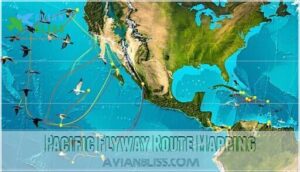
You’ll find the Pacific Flyway stretches from Alaska to South America, guiding over 350 North American bird species along coastal habitats annually. GPS tracking reveals species distribution patterns across flyway stopovers, where conservation challenges emerge from habitat loss.
Future projections show shifting migration routes as conservation status deteriorates for vulnerable species, requiring targeted bird migration protection strategies throughout these critical habitats.
Central Flyway Corridor Analysis

Moving eastward from the Pacific, you’ll find North American bird species traversing the Great Plains through America’s heartland migration superhighway. Almost 400 bird species use the Central Flyway, creating critical habitat connectivity challenges. Agricultural impacts and wind energy developments create conservation gaps that affect millions of birds annually.
- Platte River and Missouri River valleys serve as major bottlenecks concentrating diverse species
- Over 50 percent of North America’s migratory waterfowl depend on this corridor
- More than 70 percent of America’s mallards begin their lives in this flyway
- Stopover ecology research reveals critical refueling sites across prairie landscapes
- Conservation status assessments show declining grassland habitats threaten corridor integrity
Mississippi Flyway Species Tracking

You’ll discover North American Bird Species along the Mississippi River’s natural highway, where Tracking Technology monitors over 325 species annually.
Data Analysis reveals 40% of waterfowl use these Flyway Stopovers, though Species Decline creates Conservation Challenges.
Explore Species distribution through Bird Migration patterns as researchers document Conservation Status across key Bird Habitats.
Atlantic Flyway Seasonal Patterns
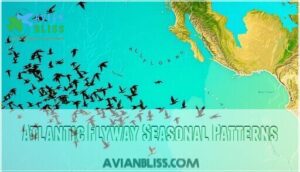
Throughout spring and fall, you’ll witness millions of Species moving along Eastern States coastlines, using Coastal Stopovers and Freshwater Wetlands as fuel stations. Bird Migration peaks March through May northbound, with fall movements spanning June to December.
These Habitats connect Arctic Breeding Grounds to tropical Winter Habitats, though Flyway Threats require urgent Conservation Needs.
Technology Behind Migration Tracking Maps

You’ll discover how scientists use four main technologies to create accurate migration maps that track millions of birds across continents.
These systems combine GPS tags, radio networks, weather radar, and citizen observations to provide real-time data on species movements and flyway patterns.
GPS Collar and Tag Data
GPS collars and tags transform bird migration tracking by providing precise location data. These devices record coordinates every few minutes, creating detailed movement patterns. Tag Data Accuracy depends on satellite connectivity and device quality. Battery Life Impact determines study duration, generally lasting months to years. Collar Weight Effects must stay under 5% of bird body weight to avoid behavioral changes. Data Transmission Rates vary from real-time to scheduled uploads. Ethical Tagging Practices help guarantee minimal stress during capture and attachment.
This technology helps scientists understand Bird Migration routes, identify critical Bird Habitats, and assess Conservation Status across Species.
Motus Radio Telemetry Networks
Motus radio-telemetry towers create a powerful tracking network across continents. You’ll find over 1,500 receiver stations monitoring nanotags weighing less than one gram.
Tag deployment logistics involve careful timing during bird migration windows. Network infrastructure costs remain minimal through volunteer collaborations.
Data transmission range extends up to 15 kilometers per station. Tagging ethical concerns require permits and weight restrictions.
Public data access promotes conservation of endangered species and their habitats.
Weather Radar Migration Detection
While radio telemetry tracks individual birds, weather radar captures massive migration events across entire regions. You’ll see radar systems detecting bird density at different altitudes, revealing migration patterns invisible to ground observers.
Weather interference can obscure readings, and radar limitations prevent precise species identification. However, these systems excel at mapping flying birds through major bird habitats, showing real-time bird migration intensity and altitude detection across flyways.
Citizen Science Data Integration
Beyond traditional tracking methods, you can contribute to Bird Migration research through citizen science platforms like eBird. Volunteers submit Bird ID observations, creating massive datasets that scientists use for Species analysis.
Data Quality Control ensures accurate Bird Identification while promoting Public Awareness. These Educational Opportunities connect communities to Habitats, making Data Accessibility possible for migration studies worldwide.
Seasonal Migration Patterns by Species

You’ll discover that each bird species follows distinct seasonal migration patterns tracked by sophisticated GPS and radar technology.
These data-driven maps reveal how Arctic Terns complete 44,000-mile global journeys while warblers follow predictable spring routes through North America’s flyway corridors.
Arctic Tern Global Journey Maps
Arctic terns complete the most exceptional pole-to-pole journeys of any species, covering up to 44,000 miles annually between Arctic and Antarctic regions. Their tern migration distance showcases striking breeding ground fidelity despite facing arctic tern threats from climate change.
Arctic terns travel up to 44,000 miles annually on the world’s longest pole-to-pole migration journey
- Summer breeding grounds span Arctic tundra across Alaska, Canada, and Greenland
- Winter feeding areas concentrate around Antarctic ice edges and southern oceans
- Flight paths follow coastlines through Atlantic and Pacific flyways
- Stopover sites include productive marine habitats for refueling during migration
These waterbirds and waterfowl demonstrate how flying birds adapt to seasonal resource availability, with conservation implications extending across multiple continents as habitats face increasing pressure.
Warbler Spring Migration Routes
You’ll find warbler species follow predictable spring migration routes from wintering grounds in Central America to breeding grounds across North America. These passerines rely on specific warbler stopovers where habitats provide essential insects and nectar.
Migration timing varies between species, with some arriving weeks before others. Route variations depend on habitat preferences, weather patterns, and geographic barriers that shape their ancient pathways northward.
Raptor Fall Migration Corridors
Autumn brings striking hawk migrations through North America’s mountain corridors. Raptors use thermals and updrafts along ridges to soar between 700-3,000 feet altitude, traveling up to 480 kilometers daily.
Wind patterns funnel these birds of prey through narrow mountain passes where prey availability remains high. Their navigation strategies rely heavily on thermal use across open country habitat.
These hunting birds conserve energy by riding deflected winds and spiraling in thermal "kettles" during fall migration.
Waterfowl Winter Distribution Charts
Waterfowl winter distribution charts reveal where ducks, geese, and swans concentrate during winter days. You’ll find these Waterbirds and Waterfowl species clustering in Freshwater Wetlands and coastal Habitats where Food Resource Availability remains high.
Winter Habitat Loss, Climate Change Impacts, Disease Outbreaks, and Hunting Pressure all influence these Bird Migration patterns, making accurate winter tracking essential for conservation.
Conservation Applications of Migration Data

You’ll find that migration data transforms bird conservation by revealing critical habitat corridors and timing windows that need protection.
Scientists use this tracking information to identify collision hotspots along flyways and coordinate international conservation efforts across multiple countries.
Climate Change Impact Visualization
Climate change dramatically reshapes where and when birds migrate. Interactive maps reveal how species respond to warming temperatures through Range Contraction Models and Habitat Shift Mapping.
- Phenological Mismatch occurs when migration timing falls out of sync with food availability
- Extreme Weather Effects force birds to alter traditional routes and stopover sites
- Conservation Prioritization uses data to identify vulnerable corridors needing protection
These visualization tools help scientists track Habitat Loss and guide bird migration conservation efforts.
Habitat Corridor Protection Planning
You can protect critical bird migration pathways by mapping habitat corridors that connect fragmented landscapes. Conservation teams use migration data to identify where habitat loss threatens species movement between breeding and wintering grounds.
Land acquisition programs target these bottleneck areas, while habitat restoration projects fill gaps in corridor connectivity.
Community engagement helps expand protected areas through partnerships.
Collision Risk Assessment Maps
You’ll find collision risk assessment maps reveal where Power Line Collisions and Building Strike Risks threaten migrating birds most. These tools analyze flight paths against infrastructure, highlighting deadly corridors where Habitat Fragmentation and Light Pollution Impact create hazardous conditions.
Scientists use GPS data to identify high-risk zones, enabling targeted Mitigation Strategies that protect vulnerable Species during critical migration periods.
International Flyway Conservation Strategies
International collaboration creates the backbone for protecting bird migration routes. The Americas Flyways Initiative launched in 2025 to protect critical ecosystems through Nature-Based Solutions , while coordinated global responses address habitat destruction, climate change, and infrastructure threats that affect migratory species.
- Flyway habitat protection through cross-border agreements between nations
- Climate resilience planning integrating sustainable development goals
- Community involvement in wetland restoration and monitoring programs
- Habitat corridor conservation linking breeding and wintering grounds
- Conservation status assessments tracking Bird Migration patterns across species
Frequently Asked Questions (FAQs)
How accurate are bird migration prediction models?
Models trained on twenty-three years of radar data achieve ninety percent-plus accuracy.
BirdCast forecasts predict migration intensities up to seven days ahead, while newer neural network approaches consistently exceed 9 accuracy rates.
Which bird species migrate the longest distances annually?
You’ll find Arctic Terns rule this category, flying up to 80,000 km annually , traveling from Arctic breeding grounds to Antarctica. American Golden-Plovers also impress with their 20,000 mile journey between continents.
How do weather patterns affect migration timing?
Ever wonder why you see certain birds earlier than expected? Above-average temperatures cause birds to migrate earlier in spring.
Meanwhile, storms divert birds hundreds of miles off course or force them to hunker down for days longer than usual.
What causes some birds to stop migrating?
You’ll find birds abandoning migration when climate change makes their current territories habitable year-round.
Rising temperatures, reduced energy costs, and habitat shifts convince some species that the risky journey isn’t worth it anymore.
How do urban areas impact migration routes?
Urban areas increase the likelihood that birds remain year-round in their ranges, avoiding migration. Cities create "heat islands" with higher temperatures that alter breeding timing and food availability.
Habitat loss disrupts natural migratory routes and stopover sites. Light pollution and building collisions pose additional hazards for migrating birds.
Conclusion
Absolutely revolutionizing how folks perceive avian movement, bird species migration maps transform countless data points into accessible visual stories. These interactive platforms are essential for tracking species across continental flyways.
Whether you’re monitoring Arctic Terns’ epic journeys or local warbler populations, these tools combine satellite technology with citizen science observations. Conservation efforts rely heavily on this mapping data to protect critical habitat corridors and reduce collision risks during peak migration periods.