This site is supported by our readers. We may earn a commission, at no cost to you, if you purchase through links.
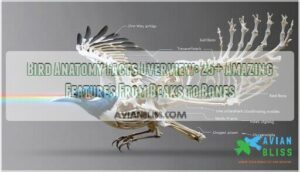 You’ll find that bird anatomy facts overview reveals nature’s most ingenious design solutions. Birds possess hollow pneumatic bones that reduce body weight by 20% while maintaining strength, and their wishbone stabilizes powerful wing beats during flight. The keel bone anchors massive flight muscles, while contour feathers create waterproof surfaces and down feathers trap warm air for insulation.
Their respiratory system features one-way airflow through rigid lungs connected to air sacs, maximizing oxygen efficiency for sustained flight. Birds can see ultraviolet light with tetrachromatic vision, and their beaks mirror perfect engineering for specialized feeding strategies.
From webbed feet for swimming to razor-sharp talons for hunting, every anatomical feature has a specific survival purpose that’s been refined over millions of years of evolution.
Table Of Contents
Key Takeaways
- You’ll discover that birds’ hollow bones reduce their body weight by 20% while maintaining strength, making flight possible through this perfect engineering solution.
- You can observe three distinct feather types working together – contour feathers create waterproof surfaces, down feathers trap warm air for insulation, and specialized flight feathers enable precise aerial maneuvers.
- You’ll find that birds possess tetrachromatic vision, allowing them to see ultraviolet light and detect colors beyond human perception, while their one-way respiratory system maximizes oxygen efficiency during flight.
- You can see how every bird feature serves a specific survival purpose – from webbed feet for swimming and razor-sharp talons for hunting to specialized beak shapes that mirror perfect tools for different feeding strategies.
Essential Bird Anatomy Facts
You’ll discover that birds possess three fundamental anatomical features that make flight possible: a unique fused skeleton structure, a powerful four-chambered heart, and hollow bones connected to specialized air sacs.
This biological engineering puts human aviation to shame – what took us centuries to figure out with metal and engines, birds mastered through millions of years of evolution.
What took humans centuries to master with metal and engines, birds perfected through millions of years of evolutionary engineering
Unique Skeleton Structure
Bird skeletons are engineering marvels that balance strength with weight efficiency. You’ll discover hollow bones filled with air, creating pneumatic structures that reduce body mass while maintaining durability.
- Pneumatic bones – Air-filled cavities make bones lighter without sacrificing strength
- Keel function – Extended breastbone anchors powerful flight muscles for wing movement
- Wishbone purpose – Fused collarbone provides structural stability during wing beats
- Lightweight adaptation – Hollow bone design reduces overall body weight by 20%
- Tail vertebrae – Fewer vertebrae than mammals, with some fused for aerodynamic flight
Four-Chambered Heart
Birds have four-chambered hearts, just like mammals do, which keeps blood pumping efficiently through their bodies. This setup maintains the right blood pressure and heart rate when they’re flying and need lots of oxygen.
This circulation system supports the intense demands of bird life and keeps their organs working properly. Unlike reptiles with their three-chambered hearts, birds can keep up high-energy activities that help them survive.
Hollow Bones and Air Sacs
You’ll discover that pneumatic bones contain internal air spaces, making them incredibly lightweight yet remarkably strong. These hollow bones connect directly to your bird’s respiratory system through air sacs, creating outstanding respiratory efficiency.
Birds can breathe continuously thanks to their hollow bones connecting to air sacs, creating a one-way airflow that keeps oxygen moving even when they exhale.
These lightweight yet strong bones make flight possible by cutting body weight dramatically while still providing the structural support needed for those powerful wingbeats.
All About Feathers: Types and Functions
You’ll discover that bird feathers aren’t just pretty decorations, but complex engineering marvels with distinct types serving specific functions.
From waterproof contour feathers that improve flight to fluffy down feathers that trap body heat, each feather type contributes to a bird’s survival through insulation, aerodynamics, and protection.
Contour, Down, and Semiplume Feathers

You’ll discover three distinct feather types that work like nature’s greatest layering system. Contour feathers form your bird’s sleek outer shell, providing waterproofing and aerodynamic surfaces. Down feathers create the perfect insulation layer underneath, trapping warm air like tiny fluffy pillows. Semiplume feathers bridge the gap between these two, offering flexible give and additional thermal regulation.
- Contour feathers overlap like roof shingles for maximum protection
- Down feathers multiply a bird’s warmth by creating air pockets
- Semiplume function includes structural give during preening
- Feather development follows precise genetic programming for peak performance
Remiges and Rectrices in Flight
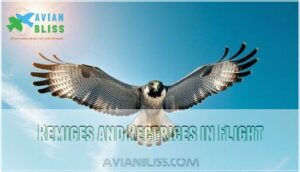
The primary flight feathers called remiges give birds their aerial mastery through precise feather aerodynamics. These stiff wing feathers create lift and enable complex flight maneuvers, while rectrices (tail feathers) provide essential tail steering during turns and landings.
These flight feathers work hand in hand, ramping up how efficiently birds beat their wings while supporting flight through their intricate design and regular upkeep.
Plumage Coloration and Patterns

You’ll notice that feathers aren’t just brown or gray – they showcase nature’s most stunning color production methods. Melanin variation creates blacks and browns, while carotenoids produce vivid reds and yellows. Feather structure itself generates feather iridescence through microscopic layers that bend light.
These bird feathers serve dual purposes: sexual selection drives flashy displays, while camouflage strategies keep birds hidden from predators. Some species even owe their vibrant hues to porphyrin-based pigments, which can fluoresce under UV light.
Specialized Bird Beaks and Feet
You’ll discover that bird beaks function as specialized tools, with curved raptor beaks designed for tearing flesh, while thin probing bills extract nectar from flowers.
Their feet serve equally important roles, featuring sharp talons for grasping prey, webbed toes for swimming, and strong claws for perching on branches.
Beak Shapes and Feeding Adaptations
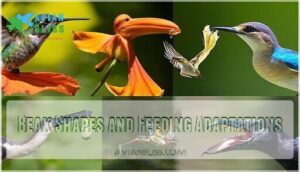
You’ll notice bird bill variations mirror nature’s engineering brilliance. Beak morphology reflects specialized feeding strategies: needle-like beaks allow hummingbirds to reach deep into flowers for nectar feeding, while cone-shaped beaks provide seed cracking power for finches and sparrows.
Ducks employ filter feeding mechanisms, woodpeckers use insect probing techniques, and hawks wield sharp beak adaptations for tearing prey. The beak’s strength comes from its keratin composition.
Talons and Feet Functions
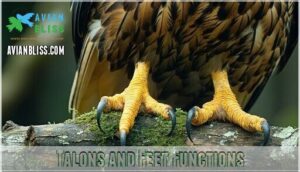
Bird feet aren’t just for walking—they’re specialized tools adapted for survival. Talons function as razor-sharp weapons for raptors, while perching adaptations help songbirds grip branches effortlessly.
Foot morphology varies dramatically: webbed for swimming, scaled for scratching, or needle-pointed for precision. Grasping mechanisms and leg strength determine whether you’re watching a hawk snatch prey or a woodpecker climb bark.
Claw sharpness reflects each species’ lifestyle perfectly.
Unique Examples: Pelican Bill, Ostrich Legs

You’ll find some of nature’s most extreme Bird physical attributes in surprising places. Consider these striking examples that showcase just how specialized Bird Anatomy Facts can become:
- The Australian Pelican holds the record with its 40-50cm bill – the longest of any bird
- Ostrich Legs propel these flightless giants at speeds reaching 43 mph across African landscapes
- Sarus Crane Height reaches nearly 6 feet, making them the world’s tallest flying birds
Evolution crafted these beak and leg adaptations as perfect answers to survival challenges.
How Birds Breathe, Digest, and Move
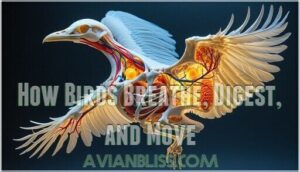
Birds pack some incredible machinery inside their bodies, all engineered for flight and staying alive.
Take their breathing setup – air sacs work with rigid lungs to create a one-way flow that keeps oxygen pumping constantly.
Specialized digestive organs like the crop and gizzard efficiently process food, while powerful flight muscles anchored to the keel bone generate the force needed for sustained flight.
Avian Respiratory System
Unlike mammalian systems, you’ll discover that avian anatomy features pneumatic bones connected to air sacs. The respiratory system creates one-way airflow through rigid lungs. Each respiratory cycle requires two inhales and two exhales, maximizing oxygen intake efficiency through continuous fresh air circulation.
| Component | Function |
|---|---|
| Air Sacs | Act as bellows, directing airflow |
| Pneumatic Bones | Provide lightweight structure, store air |
| Rigid Lungs | Allow continuous gas exchange |
| Parabronchi | Enable unidirectional airflow pathways |
Digestive Tract: Crop to Gizzard
Your bird’s digestive system works like a multi-stage factory, breaking down food efficiently. The crop stores food temporarily, while the proventriculus releases digestive enzymes. Here’s how rapid digestion happens:
- Crop Function: Acts as your bird’s personal pantry, storing meals for gradual release
- Proventriculus Enzymes: Chemical breakdown begins here with acid and digestive juices
- Gizzard (Ventriculus) Grinding: Muscular grinding chamber pulverizes food for nutrient absorption in the small intestine
Flight Muscles and Keel
You’ll discover that flight muscles represent nature’s most efficient power systems. The pectoralis muscles provide the downstroke force, while the supracoracoideus muscles enable the upstroke lift through a unique pulley mechanism.
These muscle adaptations anchor to the keel, a blade-like bone structure extending from the sternum. Keel size directly correlates with flight efficiency – larger keels furnish more powerful flight muscles, enabling everything from hummingbird hovering to albatross soaring across oceans.
Bird Senses and Extraordinary Adaptations

You’ll discover that birds possess tetrachromatic vision, allowing them to see ultraviolet light and detect colors beyond human perception, while some species use echolocation to navigate dark environments.
These sensory adaptations, combined with behaviors like vocal mimicry and tool use, demonstrate the striking evolutionary solutions that enable birds to thrive in diverse ecological niches.
Vision, Hearing, and Smell
Your feathered friends possess remarkable sensory perception that puts human abilities to shame. Birds have tetrachromatic vision, allowing them to see UV light and detect colors invisible to you. Their sound localization skills help pinpoint prey or predators with pinpoint accuracy.
While most birds have limited olfactory abilities compared to mammals, species like vultures use smell to locate carrion from miles away.
Mimicry, Tool Use, and Social Behaviors
Several avian species showcase impressive cognitive abilities through vocal mimicry and tool innovation. Your avian brain encounters these fascinating social learning capabilities:
- Vocal Mimicry – Grey parrots demonstrate largest mimicry repertoires, while corvids imitate environmental sounds
- Tool Innovation – New Caledonian crows craft compound tools from multiple materials
- Cooperative Breeding – Helper birds assist with raising offspring in structured family units
- Flock Dynamics – Complex social hierarchies influence resource access and reproductive success
All this shows just how sophisticated bird intelligence really is.
Strange Features: Hoatzin Claws, Kiwi Feathers
You’ll find some truly bizarre evolutionary oddities when examining certain primitive features. Hoatzin chicks sport functional wing claws that help them climb branches, while Kiwi adaptations include hair-like feathers that lack barbules.
These unique bird traits showcase how avian adaptations evolved from ancient reptilian ancestors. Both species retain bird characteristics that most modern birds have abandoned through millions of years of evolution.
Frequently Asked Questions (FAQs)
How do birds sleep without falling off branches?
Birds use specialized tendons that automatically lock their toes around branches when they perch. You’ll notice they don’t need conscious effort to grip – the tendons tighten naturally as they bend their legs, creating a secure hold even during sleep.
Why dont birds get electrocuted on power lines?
Electricity always follows the easiest path, which keeps us safe in many situations.
When touching only one wire, birds don’t create a circuit to ground. As a result, current stays in the wire, not flowing through their bodies.
Can birds taste spicy foods like peppers?
You’ll experience no spicy heat when you eat peppers. Birds lack the molecular receptors that detect capsaicin, so they can’t taste the "burn" like mammals do.
How do migrating birds navigate without getting lost?
Migratory birds navigate using several different methods working together. They rely on Earth’s magnetic field, sun compasses, star patterns, and landmarks to find their way.
Birds that fly during the day use a "sun compass," which combines birds’ view of where the sun is in the sky with their internal perception of what time of day it is.
Why do some birds have different colored eggs?
You’ll notice egg colors vary because of two main pigments: biliverdin creates blue and green shades while protoporphyrin produces brownish reds. These pigments combine in different amounts, creating nature’s colorful protection system for developing chicks through camouflage and temperature regulation.
Conclusion
Think you’ve learned everything about birds? You haven’t scratched the surface. This bird anatomy facts overview reveals how every feature is for survival – from hollow bones that make flight possible to beaks perfectly shaped for specific diets.
You’ve discovered that birds aren’t just flying animals; they’re living examples of evolutionary engineering. Each anatomical adaptation tells a story of millions of years spent perfecting the art of survival in diverse environments.
- https://poultry.extension.org/articles/poultry-anatomy/avian-skeletal-system/
- https://www.britannica.com/animal/bird-animal/Form-and-function
- https://en.wikipedia.org/wiki/Bird_anatomy
- https://www.ebsco.com/research-starters/anatomy-and-physiology/respiration-birds
- https://pmc.ncbi.nlm.nih.gov/articles/PMC2141920/