This site is supported by our readers. We may earn a commission, at no cost to you, if you purchase through links.
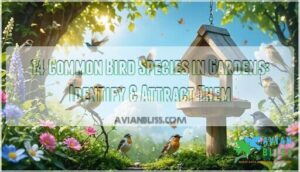 Your garden is already a bird sanctuary—you just need to know who’s visiting. Every chirp at dawn, every flash of color at your feeder, and every nest tucked into your hedges belongs to species with distinct personalities, habits, and needs.
Yet most of us recognize only a handful of the regulars, missing out on the fuller picture of avian life unfolding right outside our windows. Learning to identify common bird species in gardens transforms casual observation into genuine connection, revealing which visitors prefer sunflower seeds over suet, who’s nesting in April versus July, and why that persistent tapping isn’t random at all.
Whether you’re stocking feeders for the first time or you’ve been watching birds for years, recognizing the fourteen species that frequent gardens most often gives you the foundation to care for them better—and enjoy their company more fully.
Table Of Contents
Key Takeaways
- Fourteen common bird species regularly visit North American gardens year-round, each with distinctive physical features, calls, and behaviors that make identification straightforward once you know what to look for.
- Successful bird attraction requires matching specific feeders and foods to species preferences—tube feeders with sunflower seeds for finches and cardinals, platform feeders with peanuts for jays, and nectar feeders for hummingbirds—while maintaining clean water sources and native plant cover.
- North America has lost 2.9 billion breeding birds since 1970 due to habitat loss, climate change, and urbanization, though most common garden species like robins, cardinals, and doves maintain stable populations with Least Concern conservation status.
- Homeowners directly support bird conservation by planting native species, avoiding pesticides, preventing window collisions, maintaining feeder hygiene, and participating in citizen science programs that track population trends and inform protection efforts.
Most Common Garden Birds to Spot
If you spend any time in your backyard, you’ve probably noticed a handful of familiar faces showing up again and again. These common garden birds visit yards across North America, each with its own colors, calls, and quirks.
Here are the species you’ll spot most often—and what makes them stand out.
American Robin
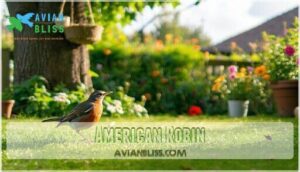
If you’ve ever watched a bird run upright across your lawn with purpose, as if it’s on a mission to unearth hidden treasure, you’ve likely spotted the American Robin—one of the most recognizable thrushes in North America. This backyard bird features a distinctive orange breast and is a year-round resident in most areas, making bird identification easy.
Keep an eye out for these key features:
- Bird diet: Primarily insects, especially earthworms pulled from soil
- Nesting habits: Cup-shaped mud nests in trees or shrubs
- Robin migration: Northern populations shift southward in winter
Northern Cardinal
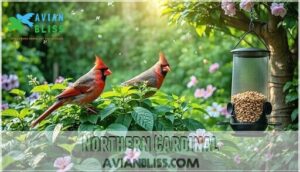
While robins hunt earthworms on your lawn, Northern Cardinals add year-round color to your garden with their striking red feathers and jaunty crests. Spot males by their black eye masks and listen for their signature ‘what-cheer’ song echoing through the backyard. These garden favorites often travel in pairs, making them easy to identify.
| Aspect | Details |
|---|---|
| Cardinal Diet | Black oil sunflower seeds, berries, insects |
| Nesting Habits | Dense shrubs, 3-4 eggs per clutch |
| Feather Care | Regular preening, dust bathing |
| Mating Rituals | Males feed females during courtship |
Want to keep your birds well-fed? Stock your feeders with their favorite seeds and berries, and you’ll have cardinals visiting your yard all year long.
Mourning Dove
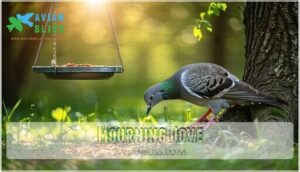
You’ll often hear Mourning Doves before you see them—their soft, melancholy cooing drifts through gardens and open spaces like a gentle conversation with the morning itself. These ground feeders startle easily, launching into flight with a distinctive whistle from their wings.
You’ll find them foraging for seeds in open habitats, from woodlands to cities, making them reliable backyard birds year-round. Watch for their taupe-gray plumage and long, tapered tails as they visit your bird feeders or peck at scattered seed below.
Blue Jay
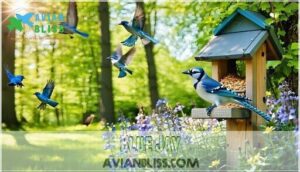
Blue Jays command attention with their bold blue, black, and white markings and jaunty pointed crest—a flash of color that announces their presence long before their raucous calls echo through your yard. You’ll spot these intelligent backyard birds in small family groups, often dominating feeders with surprising assertiveness.
They’ve got a few tricks that set them apart:
- Diet versatility – They eat acorns, insects, and even raid other birds’ nests
- Feather care – Watch them "anting," rubbing insects on feathers for maintenance
- Food storage – They cache thousands of seeds each fall
- Mimicry skills – They can imitate hawk calls to scare off competitors
Unlike the gentler American Robin or Northern Cardinal, Blue Jays don’t hesitate to assert themselves at your feeder.
American Goldfinch
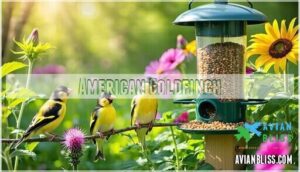
The American Goldfinch looks like a drop of sunshine with wings—bright yellow plumage and a neat black cap that make this seed specialist impossible to miss at your feeder. You’ll notice their bouncy flight pattern and hear their cheerful "po-ta-to-chip" call as they work through thistle and nyjer seeds.
Unlike many backyard birds, these finches delay nesting until late summer when seed-producing plants peak—smart timing for raising chicks. Their feather molting transforms males to olive-drab in winter, making bird identification trickier during goldfinch migration season.
White-breasted Nuthatch
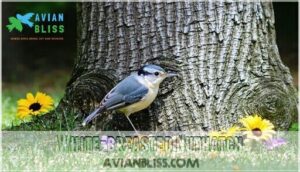
Watch a White-breasted Nuthatch walk headfirst down a tree trunk, and you’ll wonder how this upside-down acrobat defies gravity with such ease—a nasal "yank-yank" call often announces its presence before you spot that crisp white face and belly against blue-gray wings.
These backyard favorites depend on:
- Nuthatch diet of insects, seeds, and nuts wedged into bark crevices
- Tree climbing technique using specialized toe structure for inverted movement
- Beak structure perfect for hammering open sunflower seeds
- Nesting habits in tree cavities lined with soft materials
- Feather maintenance through frequent preening for efficient flight
Plant the right trees and shrubs, and white-breasted nuthatches will become regular visitors to your yard—a simple way to sharpen your identification skills while supporting local wildlife.
Tufted Titmouse
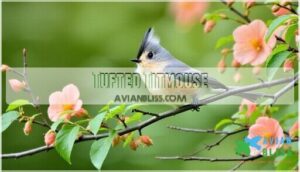
Sporting a jaunty crest and soft gray plumage, the Tufted Titmouse brings acrobatic charm to your backyard feeders while announcing itself with a clear, whistled "peter-peter-peter" song. You’ll find this backyard bird foraging upside-down alongside chickadees, showing minimal migration since most populations stay year-round.
Keep these energetic performers happy with the right setup, and they’ll put on a show all year long. Want to attract them? Focus on these essentials:
| Feature | Details |
|---|---|
| Bird Identification | Gray body, pointed crest, black forehead patch, peach-colored flanks |
| Bird Seed Preferences | Sunflower seeds, suet, peanuts at platform or hopper feeders |
| Garden Nesting | Tree cavities, nest boxes 5–15 feet high with 1.25" entrance holes |
| Feeding Behavior | Caches seeds, hangs upside-down, visits feeders in small flocks |
| Conservation Status | Stable populations benefiting from bird feeding practices |
Ruby-throated Hummingbird
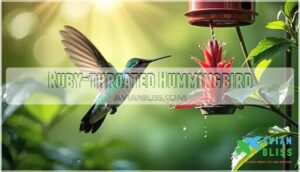
With wings beating up to 80 times per second, the Ruby-throated Hummingbird transforms your garden into a high-speed aerial theater. These tiny birds hover at feeders with jewel-toned precision, seemingly defying the laws of physics. Their migration spans thousands of miles, making your feeder placement and nectar recipes key for garden wildlife conservation.
Here’s what these tiny speedsters need:
- Red tubular flowers like bee balm and cardinal flower in garden plantings
- Sugar-water feeders (1:4 ratio) hung in shaded spots
- Perches near water features for preening between flights
- Hummingbird cameras capturing iridescent throat feathers during bird identification sessions
Carolina Wren
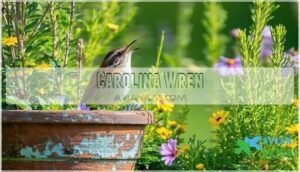
You might hear a Carolina Wren before you spot one—this rust-colored bundle of energy belts out a loud "teakettle-teakettle-teakettle" song that echoes through gardens year-round, rain or shine. Unlike many backyard birds following bird migration patterns, Carolina Wrens stay put through winter, adding reliable garden bird diversity to your yard.
Watch for their habit of nesting in quirky spots—mailboxes, flowerpots, even old boots. Their bold personality and distinctive calls make Carolina Wren bird watching a joy for garden bird identification newcomers.
| Feature | Description | Identification Tip |
|---|---|---|
| Plumage | Rust-cinnamon upperparts, buff underparts | White eyebrow stripe stands out |
| Size | 5-6 inches long | Tail often held upright |
| Habitat | Dense shrubs, brush piles, woodlands | Check low vegetation |
| Diet | Insects, spiders, occasional seeds | Prefers ground foraging |
House Finch
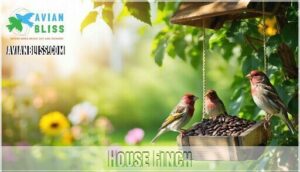
House Finches arrive like colorful party crashers—the males sport a raspberry-red splash across their heads and chests, while their cheerful, warbling songs fill suburban yards and city parks from coast to coast. Originally western natives, these adaptable backyard birds now thrive wherever feeders offer sunflower seeds.
Watch for their undulating flight pattern and listen for that bubbly song—perfect bird identification clues for bird watching beginners.
Quick House Finch Facts:
- Feather coloration varies—some males show orange or yellow instead of red, depending on diet
- Seed preferences lean heavily toward black oil sunflower and nyjer at feeders
- Flock behavior means you’ll rarely see just one; they travel in chatty groups
- Nesting habits include building cups in hanging plants, wreaths, or building ledges
- Garden wildlife regulars year-round in most regions, unlike migratory finch species
Song Sparrow
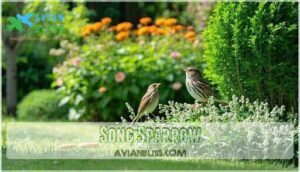
Song Sparrows might lack flashy colors, but their voices more than make up for it—these brown-streaked birds deliver one of the most melodic performances in any backyard, a rich tune that sounds like they’re saying "Maids, maids, maids, put on your tea kettle-ettle-ettle." Their sweet song rings out from shrubby edges and garden thickets, though their distinctive "chimp" call often gives them away first during birdwatching sessions.
These urban songbirds stay close to cover, hopping through undergrowth while searching for insects and seeds—perfect backyard birds for those learning bird identification.
| Feature | What to Look For | Garden Wildlife Notes |
|---|---|---|
| Plumage | Brown streaks converging into chest spot | Excellent camouflage in dense vegetation |
| Song Sparrow Habitat | Shrubs, wetland edges, garden borders | Thrives where cover meets open ground |
| Bird Seed Preferences | Millet, cracked corn on ground feeders | Prefers foraging beneath feeders |
| Garden Nesting | Low shrubs, dense grasses | Builds cup nests close to ground |
| Sparrow Migration | Year-round in much of range | Northern populations move south in winter |
Dark-eyed Junco
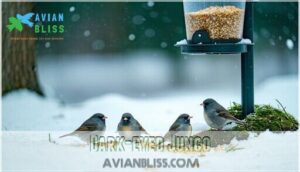
When winter arrives and Song Sparrows retreat to thickets, the Dark-eyed Junco becomes your garden’s most reliable cold-weather companion—a slate-gray visitor with a white belly that appears like clockwork when the first frost settles in. These popular winter feeding birds travel in small flocks, foraging beneath feeders where they scratch for millet and cracked corn you’ve scattered.
You’ll spot these telltale features when dark-eyed juncos visit your yard:
- Slate head and back contrasting sharply with bright white belly
- Pink bill perfect for cracking seed preference staples
- White outer tail feathers flashing like little flags during flock behavior
- Ground-feeding habit in habitat selection near coniferous and mixed woods
Their junco migration patterns bring them south from northern breeding grounds each fall, making them one of the most common North American birds for winter bird identification.
Black-billed Magpie
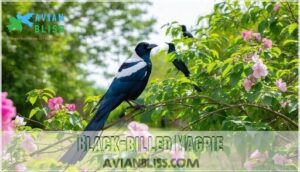
If you’re used to the subdued grays and browns of winter visitors, the Black-billed Magpie will catch your eye with its bold tuxedo pattern and tail that stretches nearly as long as its entire body. This striking urban bird thrives in both rural and city habitats across the western states, where you’ll spot its social structure in small, chatty flocks. Their intelligence shines during foraging behavior—these backyard birds remember cache locations and even recognize individual humans.
If you’re into gardening or just love watching wildlife, you won’t mistake these magpies for anything else in your yard.
| Feature | What to Look For |
|---|---|
| Plumage | Black head, back; white breast; iridescent wings |
| Size | Large black-billed magpie with 18-24" tail |
| Habitat | Open woodlands, parks, suburban yards |
| Behavior | Bold, curious, ground and aerial foraging |
| Call | Harsh, rattling "mag-mag-mag" sound |
House Wren
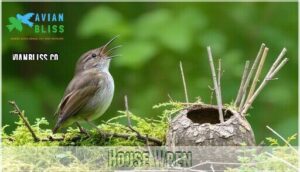
Small enough to slip inside an old work glove or an empty flowerpot, the House Wren claims nesting spots with a tenacity that belies its five-inch frame and plain brown plumage. You’ll hear these garden dwellers before you see them—their bubbly, cascading wren songs announce territorial claims across suburban spaces where urban adaptation has made them thrive year-round. Unlike many backyard birds that follow strict migration patterns, this common wren species stays close to home, weaving elaborate stick nests in cavities that other wildlife might overlook.
Spotting them is easy once you know what to look for: that signature tail pointing skyward and their constant, fidgety movements as they dart through the foliage.
- Size: Compact 4.5-5" body with slightly upturned tail
- Plumage: Warm brown upperparts with fine barring on wings and tail
- Nesting habits: Fills cavities with stick foundations, often in unexpected garden spots
- Song: Energetic, bubbling trill lasting 2-3 seconds
- Behavior: Acrobatic foraging through dense vegetation and brush piles
How to Identify Backyard Bird Species
Learning to identify the birds in your backyard doesn’t have to be complicated. Once you know what to look for—from field marks and songs to feeding habits—you’ll start recognizing your feathered visitors with confidence.
When you spot an unfamiliar bird at your feeder, a few key details will help you narrow down the ID.
Key Physical Features (plumage, Size, Markings)
Learning to spot a bird by sight starts with three essentials: the colors and patterns of its plumage, its overall size compared to familiar species, and the distinctive markings that set it apart from similar lookalikes. Take the American Robin’s rusty-orange breast or the Northern Cardinal’s jet-black mask—these feather colors and marking types become instant clues.
You’ll notice beak shapes vary too: the Ruby-throated Hummingbird’s needlelike bill differs dramatically from the White-breasted Nuthatch’s chisel-shaped one, revealing how each species feeds.
Distinctive Bird Calls and Songs
Once you tune into the sounds of your backyard, you’ll discover that bird calls and songs work like audio fingerprints—each species broadcasting its own unmistakable signature across the garden.
The Northern Mockingbird’s repertoire of 200+ melody types contrasts sharply with the Northern Cardinal’s crisp "what-cheer" song and chip call.
Once you learn the White-breasted Nuthatch’s nasal "yank-yank" or the Carolina Wren’s cheerful bubbling, spotting different species by ear gets much easier—these signature sounds become your personal field guide to backyard birds.
Behavior and Feeding Habits
Watching birds move through your garden reveals as much about their identity as their plumage—the American Robin’s upright sprint across your lawn while hunting earthworms looks nothing like the White-breasted Nuthatch’s signature head-down creep along tree bark.
Feeding strategies vary dramatically among backyard birds: Blue Jays dominate feeders with aggressive displays, while Mourning Doves prefer ground-level foraging beneath them. Northern Cardinals crack seeds with powerful beaks, but Ruby-throated Hummingbirds hover at nectar sources with rapid wingbeats.
These bird behavior patterns help you nail identification even from a distance.
Seasonal Changes in Appearance
Many backyard birds swap their bright breeding colors for more subdued winter plumage. American Goldfinches change from vivid yellow to muted olive-brown, while male Scarlet Tanagers trade their scarlet feathers for yellowish-green, sometimes confusing even experienced birders. Knowing these changes helps you follow feather molting patterns throughout the year.
A few examples:
Northern Cardinals keep their red feathers year-round, though males look slightly duller after molting. Ruby-throated Hummingbirds lose their iridescent throat patches before migrating. Mourning Doves show minimal color changes but have worn feather edges by late summer.
Using Field Guides and Apps
You don’t need a degree in ornithology to identify the birds visiting your yard—just the right tools and a bit of practice. Field guides offer detailed illustrations and range maps, while apps like Merlin use bird identification techniques, including digital journaling and species tracking.
Here’s a quick comparison:
| Tool Type | Best For | Key Feature |
|---|---|---|
| Paper Field Guides | Learning anatomy and markings | Detailed illustrations with comparative plates |
| Merlin App | Instant identification | Sound and photo recognition for identifying common backyard birds |
| eBird Mobile | Species tracking and citizen science | Records sightings and shares data with researchers |
Start with one bird identification guide, then explore app reviews to find what suits your style.
Bird Behaviors and Habitats in Gardens
Once you’ve figured out which birds are stopping by, it’s time to see what they’re actually doing in your space.
Different species have different rhythms—some forage on the ground while others hunt from branches, and their nesting spots and seasonal patterns vary just as much.
Now we can dig into the key behaviors and habitat needs that define who shows up and why.
Feeding Patterns and Preferences
Garden birds don’t just eat whatever lands in front of them—each species has carved out its own niche at the buffet, complete with preferred menus and distinctive dining styles.
You’ll notice American Robins skulking across your lawn hunting earthworms, while goldfinches hang acrobatically from thistle feeders. Cardinals crack sunflower seeds with powerful beaks, and nuthatches forage upside-down along tree bark for hidden insects.
Once you grasp these feeding habits, you can position food sources to attract the birds you want to see.
Nesting and Breeding in Urban Areas
Beyond the feeder, your backyard becomes a surprisingly effective nursery where even city birds build nests, raise young, and manage the challenges of reproduction in human environments.
City birds have become masters of adaptation when it comes to nesting. Watch for:
- Cardinals placing nests in thick shrubs near porches, unfazed by foot traffic that might scare their forest cousins
- Wrens taking over birdboxes and using hanging baskets as instant nurseries
- Robins building mud-cup nests on porch ledges, eaves, or rooftop gardens
When birds successfully nest and raise their young in backyards—even compact urban ones—they’re proving that city spaces genuinely support wildlife reproduction.
Your birdwatching isn’t just a hobby; it’s part of a larger conservation effort happening right where you live.
Migration and Seasonal Movements
As the seasons shift, so does the cast of characters visiting your yard—some species stick around year-round while others vanish overnight, driven by ancient migratory rhythms you can track right from your window. Seasonal patterns reveal striking habitat shifts: Ruby-throated Hummingbirds disappear southward by October, while Black-capped Chickadees remain through brutal winters. Mourning Doves adjust their range with climate effects, pushing north earlier each spring.
Your bird tracking captures these migratory patterns in real time—migration routes literally pass overhead.
| Species | Migration Pattern | Peak Garden Presence |
|---|---|---|
| Ruby-throated Hummingbird | Long-distance migrant | May–September |
| Mourning Dove | Partial migrant | Year-round (variable) |
| Black-capped Chickadee | Year-round resident | All seasons |
Adaptation to Urban Environments
Birds that thrive in your backyard aren’t just lucky—they’ve evolved specific traits that let them flourish alongside humans, from tolerating noise and traffic to nesting in gutters and feeding on whatever you accidentally provide.
Urban bird adaptation shows up in fascinating ways: larger-bodied species like pigeons benefit from green space expansion, while colorful birds increasingly dominate urban spaces over brown-plumaged relatives.
Protecting urban wildlife begins in your own backyard once you understand the daily obstacles birds face as cities expand into their habitat.
Attracting and Supporting Garden Birds
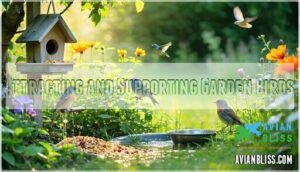
Now that you know who’s dropping by, it’s time to give them a reason to stay. Think food, water, shelter, and safety—the basics that transform your yard from a quick pass-through into a regular hangout.
Ready to make your feathered neighbors feel at home?
Choosing The Right Bird Feeders and Food
Want to turn your backyard into a bird hotspot? It starts with pairing the right feeders and food with the species in your area. Here’s what works:
- Tube feeders with black oil sunflower seed attract Northern Cardinals and American Goldfinches
- Platform feeders with peanuts draw Blue Jays and nuthatches
- Nectar feeders bring Ruby-throated Hummingbirds to your garden
Keeping feeders clean stops disease from spreading between visiting birds.
And when you place food thoughtfully, you’ll see birds acting more naturally—which makes your backyard habitat that much more rewarding to watch.
Providing Water Sources and Shelter
Fresh water and shelter are just as vital as food for keeping birds healthy and returning season after season. You’ll attract more backyard birds by offering shallow bird baths (1–2 inches deep) and layered vegetation that creates safe garden habitats.
| Water Features | Shelter Designs | Wildlife Gardening Benefit |
|---|---|---|
| Bird baths | Dense shrubs | Nesting sites |
| Pond installation | Brush piles | Predator protection |
| Drippers | Evergreen trees | Year-round cover |
| Shallow basins | Birdhouses | Breeding support |
| Moving water | Hedgerows | Roosting spaces |
By adding these elements to your yard, you’ll support natural bird behaviors and help protect local species.
Planting Native Plants for Wildlife
Native plants form the backbone of any thriving wildlife garden because they’ve evolved alongside local birds for thousands of years, providing exactly the seeds, berries, insects, and shelter that visiting species need to survive. Choosing native plants for your yard supports local ecosystems and creates bird-friendly gardens that require less water and maintenance.
Beyond sustainability, this style of landscaping becomes a real-world tool for bird conservation—turning your backyard into something like a field study site where habitat restoration happens naturally.
Creating Safe Spaces From Predators
Even the most bird-friendly garden won’t reach its full potential if local predators—from neighborhood cats to sharp-shinned hawks—turn your feeders into hunting grounds.
You can create garden sanctuaries by positioning feeders near dense native plants for quick escape cover, installing bird-friendly fencing, and using predator deterrents like motion-activated sprinklers.
When you put these safeguards in place, you’re doing more than keeping predators at bay—you’re creating spaces where birds can nest safely and a wider variety of species can thrive.
Citizen Science and Backyard Bird Counts
Tracking the birds in your own backyard connects you to a global network of observers documenting real-time changes in avian populations. Programs like the UK’s Big Garden Birdwatch engage nearly 600,000 volunteers annually, turning casual birding into meaningful ornithological research that shapes conservation efforts worldwide.
Ways you can contribute:
- Join organized bird surveys – Annual counts provide data analysis that reveals population trends and threats to backyard birds
- Learn bird identification basics – Volunteer training and backyard birding tips help you accurately report species you observe
- Share your sightings – Community engagement through apps and platforms strengthens citizen science networks tracking migration patterns
Trends and Conservation of Garden Birds
Garden bird populations are changing in ways that show both challenges and opportunities for conservation. Some species are declining sharply, while others are adapting well to city life.
Understanding these shifts can shape smarter decisions in your own backyard. Here’s the current picture for garden birds and what you can do to support them.
Population Changes and Threats
North America has lost nearly 2.9 billion breeding birds since 1970—a stark 29% decline driven by habitat loss, climate shift, and pesticide use. Grassland species like the Eastern Meadowlark have dropped over 53% collectively, while threats to backyard birds include collisions (killing up to 1 billion annually), avian diseases, and free-roaming cats.
Since 1970, North America has lost nearly 2.9 billion breeding birds—a 29% decline driven by habitat loss, climate change, and pesticides
These conservation efforts now target 229 species facing high concern as bird decline accelerates across familiar garden visitors. The decline of bird populations is largely attributed to climate change effects.
Effects of Urbanization on Bird Diversity
Urbanization acts like a sieve for bird species—cities usually host only 112 bird species on average, while some areas lose up to 75% of their original avian diversity. As you look around your backyard, you’re seeing the winners of urban adaptation: granivorous and terrestrial birds thrive, while insectivorous species vanish.
Urban spaces shape bird communities through three main pathways:
- Green space conservation—cities investing in parks and urban woodland patches maintain higher diversity than concrete-dominated landscapes
- Habitat loss gradients—bird richness peaks at forest edges and plummets toward city centers, with ground-nesters hit hardest
- City planning strategies—retaining vegetation corridors and reducing paved surfaces helps migratory birds navigate suburban habitats despite fragmentation
Urban spaces filter for generalists, creating functional homogenization where different cities end up hosting similar avian species rather than unique communities. Understanding urban planning strategies is key for conserving biodiversity in urban areas.
Conservation Status of Key Species
While urban winners dominate your feeders, you’ll be reassured to know most common garden species remain secure. American Robin, Northern Cardinal, and Mourning Dove all hold Least Concern status with stable populations—robins number around 380 million globally, cardinals 130 million, and doves approximately 337 million across North America.
Yes, climate shifts and regional pressures pose real challenges to bird populations, but organizations like the American Bird Conservancy and federal wildlife agencies track these species closely—and right now, your backyard regulars aren’t disappearing.
Keeping their habitats intact and protected remains essential to hold this ground.
How Gardeners Can Help Bird Conservation
Your backyard can become a lifeline for birds—both common species and those in decline. Start with the basics: swap out ornamental plants for native varieties like sunflowers and serviceberry that actually feed and shelter local birds.
Join citizen science programs; your backyard bird observations contribute valuable data on urban wildlife trends.
Try sustainable gardening—skip the pesticides and let those seed heads stay through winter. Your choices add up, building stronger bird populations right in your own neighborhood.
Frequently Asked Questions (FAQs)
What time of year do most garden birds nest?
Most backyard birds nest between early spring and midsummer, usually from March through July.
You’ll notice peak nesting activity in May and June, when temperatures warm and insects become abundant for feeding hungry chicks.
How can I prevent window collisions in my backyard?
Window Decals and Bird-Friendly Glass help stop collisions by making windows visible. Apply Window Film or patterns spaced two inches apart.
Using these simple collision prevention strategies can make urban yards much safer for birds.
Track results using a bird guide app while birding.
Which garden birds are considered invasive species?
House Sparrows and European Starlings top the list of invasive bird species in North American gardens. These non-native birds outcompete native species for nesting sites and food, disrupting garden ecosystems and requiring thoughtful exotic bird management strategies.
Do garden birds recognize individual humans who feed them?
Some species show impressive individual recognition skills. Studies reveal that corvids, such as crows and jays, can recall specific faces for years.
American Robins and Northern Cardinals may also tell regular feeders apart from strangers, growing bolder and approaching closer over time.
What diseases can spread through shared bird feeders?
Shared feeders can become contamination hotspots. One study found Salmonella, H5N1 avian influenza, and various bird parasites like feather mites clustering where birds gather.
You’ll notice beak deformities in backyards when hygiene slips, so regular cleaning is key to keeping the birds you’re trying to help at your feeders healthy.
Conclusion
Once you’ve cracked the code of identifying common bird species in gardens, you’ll never look at your backyard the same way again. These fourteen regulars aren’t just visitors—they’re neighbors with preferences, quirks, and patterns you can learn to anticipate.
By offering the right food, water, and shelter, you’re enjoying better birdwatching while also supporting species that increasingly depend on gardens as urban habitats expand. Your efforts matter more than you might think.