This site is supported by our readers. We may earn a commission, at no cost to you, if you purchase through links.
 A single bird species slipping toward extinction rarely makes headlines, but when an entire habitat collapses, dozens of rare species can vanish before we notice. Rare bird habitat protection efforts now focus on stopping this cascade before it starts, blending scientific research with community action to preserve the forests, wetlands, and grasslands these vulnerable species need to survive.
Local leaders are stepping into roles once held exclusively by government agencies, monitoring populations and restoring degraded land with knowledge passed down through generations. The challenges are real—habitat loss continues at alarming rates, climate shifts are pushing species into corners, and pollution threatens even protected areas.
But proven strategies exist, from wetland restoration projects that rebuild connectivity to legislative protections that shield migratory corridors, and communities worldwide are putting them to work with measurable results.
Table Of Contents
Key Takeaways
- Community-led conservation approaches—where local leaders monitor populations, restore degraded land using traditional knowledge, and integrate sustainable livelihoods with habitat protection—have proven more effective and lasting than top-down government initiatives alone.
- Habitat loss and fragmentation pose the greatest immediate threat to rare birds, with pesticides causing a 2.2% decline in grassland birds per 100 kilograms applied and chemical contamination driving steeper population losses than habitat destruction itself.
- Legislative programs like BirdLife’s Preventing Extinctions Programme (which has moved 25 species out of Critically Endangered status) and the North American Wetlands Conservation Act (which invested $102.9 million in 2025 to protect 548,242 acres) demonstrate that targeted funding and legal protection deliver measurable recovery results.
- Restoration success depends on engineering habitat connectivity through wildlife corridors, bridges, and wetland networks—because even well-restored habitat patches fail when isolated populations can’t safely move between protected areas to breed, feed, and maintain genetic diversity.
Community-Led Approaches to Rare Bird Conservation
When saving rare birds, people at the local level hold a surprising amount of power. From village leaders to everyday neighbors, communities often spark the most lasting change.
Here’s a look at some of the ways folks come together to protect these fragile habitats.
Empowering Local Leaders and Communities
When you give people who know their land best a real voice in conservation, you discover solutions that last far longer than any quick fix.
Our Community-led Approach brings together Indigenous knowledge and conservation education through collaborative governance, with community-based monitoring helping guide habitat protection.
Supporting local leaders means bird conservation and sustainable livelihoods go hand in hand, rooted firmly in community engagement.
Community Engagement in Conservation Initiatives
Getting neighbors together to shape conservation plans can turn local knowledge into powerful action for both people and birds. Collaborative monitoring through education programs lets you spot habitat changes early.
When conservation is community-led, everyone’s invested in the outcome. It’s about blending real benefits for residents with protecting habitats and creating ways to make a living that last.
When people genuinely participate, conservation stops being some distant policy and becomes part of how they live.
Case Studies of Grassroots Success
You see real change when Our Community-led Approach takes root—like island restorations turning the tide for rare species, or urban forests growing richer with each passing year.
In Illinois, vireo recovery soared thanks to dedicated grassroots monitoring, while focused action protected the Pale-headed Brushfinch. These conservation success stories show habitat preservation is strongest with community-led conservation at heart.
The Acteon and Gambier Archipelago saw rare bird recovery after restoration efforts.
Threats Facing Rare Bird Habitats

Rare birds face trouble from many sides, and the dangers are real for their habitats. Before solutions can work, it’s important to see where the main threats are coming from.
Let’s take a closer look at the key challenges these birds are up against.
Impact of Habitat Loss and Fragmentation
What makes a single patch of forest so critical to a rare bird’s survival? When we talk about habitat loss and fragmentation, we’re looking at a crisis with real teeth:
- Habitat degradation drives sharp population decline and higher extinction risk.
- Edge effects bump up predation, squeezing out nesting spots.
- Genetic consequences make recovery tough in isolated patches.
Habitat protection and restoration truly matter; common species decline is a major factor.
Effects of Climate Change on Bird Populations
Although climate change may sound like a distant storm, it’s already forcing dramatic range shifts and pushing tropical and specialist species to the brink.
Birds now migrate earlier, nest less successfully in heat, and morph their bodies to adapt.
For many, especially those tied to shrinking habitats, these subtle changes spell steeper risks of extinction rather than resilience.
Pollution and Pesticide Challenges
When it comes to chemical contamination, pesticides hit rare birds hard. Just one treated corn kernel is enough to kill a songbird, and chronic pesticide exposure causes steeper population declines than even habitat loss.
Neonicotinoids alone cause a 2.2% decline in grassland birds per 100 kilograms applied, while bioaccumulation effects ripple through food webs, reducing invertebrate prey and breeding success.
Air pollutants like ozone compound the ecological damage, though stricter regulations have prevented an estimated 1.5 billion bird deaths since 1980.
Human Activities Driving Extinction
Beyond pesticides and pollution, direct human interference has wiped out more than 150 bird species since the 1500s. Hunting, habitat conversion, and invasive species rank as the deadliest threats.
These pressures hit hardest where deforestation meets agricultural expansion.
- Ancient forests razed for cropland, erasing nesting sites overnight
- Urban development fragmenting migration corridors into isolated patches
- Hunting pressure decimating seabird colonies for feathers and eggs
- Invasive species like rats and cats devouring ground-nesting chicks
- Wetland drainage for development eliminating critical stopover habitat
These conservation challenges compound habitat loss faster than restoration efforts can keep pace.
Key Programs and Legislative Actions

Saving rare birds takes more than good intentions—it requires real programs backed by laws and funding. Over the past few decades, governments and conservation groups have launched initiatives that protect critical habitats and hold people accountable for the survival of threatened species.
Here’s a look at the key efforts making a difference right now.
BirdLife’s Preventing Extinctions Programme
BirdLife’s Preventing Extinctions Programme, launched in 2008, aims to save the world’s most endangered birds. Since its inception, the programme has helped 25 species move out of the Critically Endangered category.
The initiative supports over 140 threatened bird species across 50 countries, collaborating with more than 100 partner organizations. Species Guardians work on the ground in priority projects, with local communities contributing 60% of field data.
From captive breeding to invasive predator removal on islands, these recovery strategies directly combat extinction. Despite these efforts, over 500 species still require urgent assistance.
U.S. Foundation for International Conservation Authorization
Here’s something most people don’t realize: the U.S. puts $100 million a year into restoring bird habitats worldwide through the Foundation for International Conservation Authorization.
For many rare and migratory species, this program has become essential to their survival.
USFICA’s funding allocation funds community-led conservation projects that protect wetlands, forests, and grasslands where threatened birds breed and migrate.
Through conservation partnerships, habitat restoration efforts have already benefited dozens of species facing extinction, proving that targeted investment in habitat protection strategies can make a real difference for birds on the brink.
Migratory Bird Protection and Wetland Incentive Acts
The Migratory Bird Treaty Act shields over 1,100 bird species from harm, but regulatory shifts have weakened enforcement since 2017.
In 2025, the North American Wetlands Conservation Act channeled $102.9 million into wetland restoration, safeguarding 548,242 acres of migratory bird habitat.
While these conservation efforts deliver real results, industrial operations continue killing up to 1.1 billion birds each year—underscoring why steady enforcement and reliable funding remain essential for meaningful population recovery.
Role of Multinational and Federal Partnerships
Federal partnerships like Migratory Bird Joint Ventures don’t just review grant applications—they rank projects based on habitat value, connecting dollars to the wetlands and flyways where birds need help most.
International treaties and legislative influence shape conservation funding, while the grant review process ensures your tax dollars support endangered species conservation where joint venture impact matters.
BirdLife’s conservation programs and similar conservation initiatives prove that smart funding allocation and coordinated conservation strategy deliver measurable results for rare birds.
Habitat Restoration and Protection Strategies
Bringing rare bird habitats back to life takes more than good intentions—it requires careful planning and proven methods.
These efforts hinge on four practical strategies—things like restoring wetlands and linking up isolated wildlife zones.
Let’s look at the strategies that are making a real difference for threatened species right now.
Wetland and Forest Restoration Projects
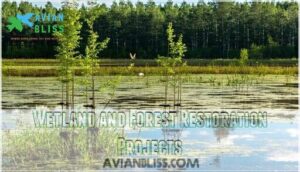
When wetlands disappear and forests shrink, rare birds lose the very ground beneath their wings—but restoration projects are giving these species a fighting chance at survival.
You’ll find conservation efforts working to reverse habitat loss and recovery through wetland creation and reforestation benefits. These projects rebuild habitat connectivity, allowing bird species to move safely between areas. Sustainable management practices support species reintroduction, helping populations bounce back from the edge.
Protected Areas and GIS Mapping
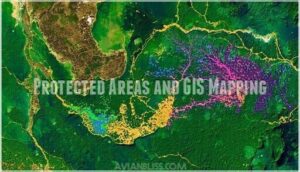
Protected areas act as crucial refuges for rare birds, yet the real power lies in knowing where to focus efforts. Tools like GIS habitat modeling and spatial prioritization help conservationists identify the exact locations that matter most.
Research on protected area effectiveness reveals these zones boost conservation outcomes by 15%—particularly for specialist species losing ground to habitat destruction.
Meanwhile, modern monitoring systems track population shifts as they happen.
- GIS maps active nesting sites, home ranges, and migration corridors with precision
- Protected areas reduce extinction rates and boost breeding success for declining species
- Spatial data layers reveal threats like invasive plants and hazardous fences
- Network Impacts multiply when reserves connect, buffering environmental shifts
- Crowd-sourced observations update range maps, guiding land acquisition decisions
Species Population Management Techniques

Once you know where rare birds live and breed, you can step in with hands-on tactics—like captive breeding, translocation, and nest-box programs—to give struggling populations the boost they need to survive. Captive breeding programs maintain genetic diversity while reintroduction programs return birds to restored habitats. Population monitoring tracks survival rates, and invasive species removal clears space for natives to thrive.
| Technique | Purpose |
|---|---|
| Captive breeding | Safeguard genetic diversity and boost numbers |
| Translocation strategies | Move birds to safer, healthier sites |
| Nest-box installation | Provide secure breeding spaces |
| Population monitoring | Measure success and adjust conservation efforts |
Engineering Solutions for Habitat Connectivity

If birds can’t travel safely between the pockets of habitat you’ve worked so hard to restore, even the best conservation plans fall short—and that’s where bridges, tunnels, and wildlife corridors come in. Ecological engineering addresses habitat fragmentation by reconnecting isolated areas. Here’s what you can build:
- Wildlife corridors using corridor design principles and reforestation techniques
- Bridge construction over roads to link forest patches
- Artificial stream channels with fish passages for aquatic connectivity
- Wetland restoration zones that weave habitat together
Frequently Asked Questions (FAQs)
How do invasive species affect rare bird survival?
Invasive species threaten rare birds through predation pressures, competition dynamics, and habitat alteration. Black Rats, for example, devastate island populations by eating eggs and chicks, while invasive plants change nesting areas and food availability, accelerating population decline and endangering species.
What role do ecotourism activities play in conservation?
Think of ecotourism as a bridge connecting conservation needs with community prosperity. When you visit rare bird habitats responsibly, your presence creates economic incentives that make habitat preservation worthwhile for local communities.
Our community-led approach shows that sustainable tourism strengthens both BirdLife’s conservation programs and bird species recovery efforts.
How can individuals support rare bird habitat funding?
You can make a real difference by supporting conservation funding through individual donations to BirdLife’s conservation programs, volunteering at local sites, or advocating for protective policies.
Corporate sponsorship and legacy giving options also strengthen our community-led approach to bird conservation efforts—donate now to help protect vulnerable species.
What are emerging technologies for monitoring bird populations?
It might sound counterintuitive, but older technology is making a real difference in conservation work.
Researchers now rely on acoustic monitoring, drone surveillance, and satellite tracking to keep tabs on bird populations.
AI identification and bioacoustics analysis assist in species population management, while GIS mapping tracks population size across habitats.
How do agricultural practices impact rare bird habitats?
Agricultural methods like monoculture farming and pesticide use seriously harm rare bird habitats. These practices lead to habitat conversion, water depletion, and soil degradation, all contributing to bird population decline.
Community-led conservation efforts can help reverse this impact.
Conclusion
What happens when the safety net disappears completely? Rare bird habitat protection efforts depend on you taking action now, whether that means supporting local restoration projects, advocating for stronger legislation, or simply spreading awareness in your community.
The tools exist, the science is proven, and communities worldwide are already seeing results. Every wetland restored, every corridor protected, and every partnership formed brings vulnerable species one step back from the edge.
Your voice and involvement can tip the balance between extinction and recovery.