This site is supported by our readers. We may earn a commission, at no cost to you, if you purchase through links.
 Every fall, billions of birds abandon their breeding territories and streak across continents toward distant wintering grounds—a feat demanding navigation across thousands of miles without GPS or maps. These journeys aren’t random wanderings but highly evolved migration patterns shaped by environmental triggers, genetic programming, and millions of years of adaptation.
Daylight shifts and dropping temperatures set off hormonal changes that transform sedentary residents into long-distance travelers, while some species stay put year-round thanks to different evolutionary strategies.
Understanding what drives these movements, how birds navigate with stunning precision, and why certain routes and stopover sites matter reveals both the complexity of avian life and the conservation challenges threatening these ancient pathways.
Table Of Contents
Key Takeaways
- Birds migrate in response to hardwired environmental cues like shifting daylight and temperature, which trigger hormonal changes that drive them to abandon breeding grounds—these aren’t random wanderings but highly evolved patterns shaped by millions of years of adaptation and genetic programming.
- Navigation relies on a sophisticated multi-modal toolkit including sun compass orientation, star pattern recognition, and magnetic field detection, with birds switching between these systems based on weather and migration stage to achieve remarkable precision across thousands of miles.
- The four major North American flyways funnel billions of birds between breeding and wintering grounds, but stopover sites—where migrants spend more cumulative time than actual flight—are declining at 4.2% annually due to habitat loss, wetland destruction, and urbanization that’s already erased nearly 3 billion birds since 1970.
- Migratory birds deliver substantial economic value through $41 billion in annual U.S. tourism revenue and critical ecosystem services like pest control and pollination, making habitat preservation and conservation funding essential investments that protect both biodiversity and human prosperity.
What Drives Bird Migration?
You might wonder why some birds leave home each year while others never do. Migration isn’t random—it’s driven by specific environmental cues, survival needs, and millions of years of evolutionary fine-tuning.
Let’s break down the four key forces that send birds on their extraordinary journeys.
Environmental Triggers and Seasonal Movements
You might think birds just wing it when fall arrives, but the truth is far more precise—migration is triggered by a hardwired response to environmental cues like shifting daylight, dropping temperatures, and the sudden scarcity of food. These seasonal cues set off hormonal changes that drive birds to abandon their breeding grounds and seek milder climates where resources remain abundant.
Climate change is now disrupting migration timing, causing mismatches between avian migration patterns and the ecological balance they depend on for survival.
Differences Between Migrants and Residents
Not every bird you see in winter has braved thousands of miles to get there—some species stay put year-round, while others vanish with the first frost. Understanding what separates migrants from residents reveals a fundamental survival strategy shaped by millions of years of evolution.
Migrant traits include physiological adaptations like enlarged flight muscles and fat storage capacity, while resident behaviors favor year-round territoriality and dietary flexibility. These adaptive strategies aren’t random—migration genetics hardwire directional preferences into species like Arctic Terns.
Meanwhile, chickadees and cardinals exemplify species comparison through local resource exploitation, demonstrating how avian migration patterns diverge based on ecological niche and evolutionary pressure.
Breeding and Wintering Ground Selection
Once a species commits to migration, choosing where to breed and where to winter becomes a matter of life or death—governed by resource availability, competition, and climate stability. Breeding grounds offer abundant nesting sites and food availability during spring’s insect surge, while wintering grounds provide climate adaptation refuge when northern habitats freeze.
Habitat quality dictates species distribution: warblers claim dense forests for concealed nests, shorebirds stake mudflat territories rich in invertebrates. These bird migration patterns reflect millions of years of fine-tuning, making habitat preservation essential to sustaining migration patterns worldwide.
Evolutionary Origins of Migration
Understanding how migration first arose requires looking millions of years into the past. Phylogenetic analysis of over 750 passerine species reveals that most migratory ancestors originated in North America, not the tropics—contradicting older assumptions. These lineages evolved migration by shifting wintering grounds southward, with genetic adaptation locking in distance and direction.
Fossil records show sandhill cranes migrated 2.5 million years ago, while bird migration patterns trace back to the late Cretaceous. Evolutionary triggers like seasonal food booms drove migration syndromes—suites of traits enabling long journeys.
Ornithological research confirms migration ecology is flexible: tropical residents often descended from migrants who lost the trait, and migration can re-emerge under ecological pressure, maintaining ecological connectivity across continents. The study of bird migration patterns is vital for understanding the complex relationships between species and their environments.
Major Global Migration Routes and Flyways
Birds don’t just wander aimlessly—they follow ancient highways carved through the sky over millennia.
These flyways connect breeding grounds to wintering habitats, guiding billions of migrants across continents and oceans each year. Let’s trace the world’s major routes and discover which species claim them as their own.
Atlantic, Mississippi, Central, and Pacific Flyways
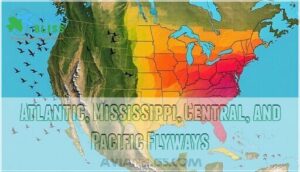
If you’ve ever glanced up in autumn and wondered where all those honking geese are headed, you’re witnessing one of North America’s four great aerial highways—flyways that channel billions of birds between their breeding and wintering grounds each year. These corridors shape bird migration patterns across the continent.
- Atlantic Flyway: Traces the eastern seaboard from Arctic Canada to Caribbean wintering grounds
- Mississippi Flyway: Funnels waterfowl down the continent’s midsection toward Gulf Coast marshes
- Pacific Flyway: Guides shorebirds along western mountains from Alaska to Latin America
Conservation efforts and bird tracking reveal how habitat preservation along these routes sustains flyway ecology for countless species.
East Asian-Australasian and African-Eurasian Flyways

Beyond North America’s familiar flyways, the East Asian-Australasian corridor stretches across half the planet—funneling shorebirds from Siberian tundra through tidal mudflats in China and Korea all the way to Australian wetlands, while the African-Eurasian route weaves together three continents in one of nature’s longest commutes.
You’ll find the East Asian-Australasian Flyway supporting millions of Asian waterbirds whose survival depends on ecological connectivity across 22 countries, while conservation of migratory birds along Eurasian landscapes faces mounting pressure from wetland drainage and coastal development.
Key Stopover Sites and Their Importance

When you’re watching warblers drop into a Gulf Coast forest or sandpipers settle on a mudflat, you’re witnessing stopover habitat in action—those essential refueling stations where migration success depends on finding food, cover, and rest. Over 2.4 million hectares across the eastern U.S. serve as stopover sites for landbirds, with radar data showing that 44% of autumn migrants pause at Gulf Coast forests while hardwood patches in fragmented Midwest farmland become lifelines for exhausted travelers.
The cumulative time birds spend at these stopovers often exceeds actual flight time, making habitat preservation and ecological restoration urgent priorities for the conservation of migratory birds. These birds face a 4.2% annual decline in stopover use and mounting threats from artificial light and land conversion. Understanding the importance of stopover sites is essential for developing effective conservation strategies.
Notable Species and Their Signature Routes

From the Arctic Tern’s pole-to-pole odyssey covering 44,000 miles annually to the Bar-tailed Godwit‘s nonstop 7,000-mile Pacific crossing, certain species have become legends in the migration world—each with signature routes that push the boundaries of endurance and navigation.
BirdCast species tracking reveals Sandhill Cranes funneling through the Central and Mississippi Flyways, while Swainson’s Hawks trace a narrow corridor along the Pacific Flyway from Alaska to Argentina.
Your understanding of these bird migration patterns bolsters flyway conservation and habitat preservation efforts that protect these extraordinary journeys.
Navigation Strategies and Flight Formations

When you watch birds crossing continents, you’re witnessing one of nature’s most intricate navigation systems in action. These travelers rely on an intricate toolkit—celestial cues, magnetic sensing, and social flight strategies—that scientists are still working to fully understand.
Here’s how birds find their way and why the journey itself shapes their survival.
Use of Sun, Stars, and Magnetic Fields
You navigate the world using a refined toolkit of avian navigation techniques that rival any GPS. Migratory birds rely on three primary celestial mapping systems:
- Sun Compass: During daylight, you track the sun’s arc across the sky, adjusting your internal clock to compensate for its movement—experiments show this time-compensated system guides routes with striking precision, especially at high latitudes where courses shift about 1° per degree of longitude.
- Starry Navigation: At night, species like Indigo Buntings orient using learned rotational patterns of stars around the celestial pole, acquired during development through observation of the night sky’s movement.
- Magnetic Fields: Your magnetic sense detects Earth’s inclination and declination angles, enabling both compass orientation and positional mapping—studies with Eurasian reed warblers revealed that altered magnetic cues trigger compensatory directional adjustments, with this magnetoclinic mechanism explaining up to 73% of tracked migration pathways.
These bird migration patterns demonstrate striking redundancy in animal navigation, as you switch between sun, starry navigation, and magnetic fields depending on weather, light conditions, and migration stage—a multi-modal strategy perfected through millions of years of avian orientation evolution.
Inherited Instincts Vs. Learned Routes
When a juvenile cuckoo hatches alone and flies thousands of miles to Africa without a guide, you witness instinct at work—but when a seasoned crane adjusts her route to avoid a new wind farm, you’re seeing learned adaptation in action. Genetic predisposition hardwires instinctual navigation and migration cues into first-time fliers, while experienced birds improve migration routes through adaptive learning.
Field studies confirm that older individuals enhance bird navigation strategies annually, blending inherited avian navigation techniques with real-world feedback to master their journeys.
V-Formation and Energy Conservation
That inherited compass and learned savvy work together beautifully, but the real innovation for long-distance travelers like geese and pelicans is the V-formation—a flight pattern that can slash energy costs by up to 70% through precise aerodynamic cooperation. Each bird arranges itself to ride updrafts from wingtip vortices created by the flier ahead, transforming wind resistance into lift.
Aerodynamic benefits of V-formation include:
- Reduced drag: Trailing birds exploit vortex currents, cutting individual effort markedly
- Shared leadership: Flock members rotate to the front, distributing the taxing lead position
- Energy savings: Formation dynamics allow extended range without additional fuel reserves
You’ll notice these flight formations most during fall and spring, when flocking behavior reaches peak efficiency.
Nighttime Vs. Daytime Migration
While formation flying dominates daytime skies, roughly 80% of migratory songbirds choose darkness for their journeys—a strategic shift that reduces predation risk and leverages cooler air that holds more moisture and oxygen.
Nocturnal migration allows birds to feed during daylight hours, while moonlight navigation and starlight orientation guide their routes. Bird tracking technology reveals how altitude adjustment differs between these strategies:
| Factor | Nocturnal Flight | Diurnal Migration |
|---|---|---|
| Predation Risk | Lower—hawks inactive | Higher—raptors hunt actively |
| Temperature | Cooler, energy-efficient | Warmer, increases water loss |
| Navigation Cues | Stars, magnetic fields | Sun compass, landmarks |
| Typical Species | Warblers, thrushes | Raptors, cranes, swallows |
Understanding these bird migration patterns helps you appreciate why different species evolved distinct timing strategies for their migration routes.
Conservation Challenges for Migratory Birds

Migratory birds face mounting pressures that threaten their survival across every leg of their journey. Understanding these challenges is the first step toward meaningful conservation action.
Here’s what puts these amazing travelers at risk.
Habitat Loss and Fragmentation
As you walk through what was once a thriving wetland now carved into shopping centers and subdivisions, you’re witnessing the single greatest threat to migratory birds—habitat loss that has already erased nearly 3 billion birds from North America since 1970. Deforestation and wetland destruction fragment flyways into disconnected patches, forcing migrants into perilous detours. The urbanization threat compounds these conservation challenges, leaving species stranded without safe stopover sites.
What habitat fragmentation effects mean for you:
- Breeding grounds vanish – Forest-nesting warblers return to find parking lots where they once raised chicks
- Stopover sites disappear – Exhausted shorebirds can’t refuel along coastlines now hardened with seawalls and marinas
- Flyways fracture – Once-continuous migration corridors break into isolated islands of habitat
- Species decline accelerates – Forty percent of migratory birds worldwide face population drops
- Conservation efforts struggle – Wildlife conservation and habitat preservation strategies can’t keep pace with development
Environmental impact on bird migration demands immediate conservation strategies.
Impacts of Climate Change on Migration Patterns
Climate change is disrupting migration patterns like never before. North American songbirds now arrive one to two days earlier per decade, yet spring green-up advances by 14 days, creating Timing Mismatches that leave chicks starving.
You’ll also see Range Shifts: European species have moved 70 km northeast, while some, like American Redstarts, shifted 500 km south due to Caribbean drying.
These Route Changes and Morphological Adaptations—smaller bodies, longer wings—can’t fully compensate, driving down Survival Rates and threatening flyways worldwide.
Research, Monitoring, and Citizen Science Initiatives
You’ll track migration success using Tracking Technologies like satellite tags and geolocators—over 458 species monitored across North America. Meanwhile, eBird from Cornell Lab of Ornithology has logged 1 billion observations, proving Citizen Contributions drive wildlife research and monitoring.
Here’s how conservation efforts leverage these tools:
- Motus Wildlife Tracking System spans 1,100 stations in 34 countries
- Data Analysis merges GPS and citizen reports for real-time mapping
- Funding Networks raised $125,000 for Egypt’s raptor observatory
- Impact Assessment identifies peak mortality periods and critical habitats
This collaboration powers smarter protection strategies worldwide.
Economic and Ecological Importance of Migration

Bird migration isn’t just a breathtaking natural spectacle—it’s an economic powerhouse and ecological lifeline you mightn’t have considered.
From fueling billion-dollar tourism industries to providing free pest control services that keep your food affordable, these seasonal travelers deliver benefits that ripple through entire ecosystems and economies.
Let’s break down exactly how migratory birds earn their keep and why protecting their journeys matters to your wallet and your world.
Birdwatching and Migration Tourism
Every autumn, you can witness one of nature’s most lucrative spectacles—migratory birds traveling thousands of miles along ancient flyways. This phenomenon generates roughly $41 billion annually for the U.S. economy alone while supporting over 660,000 jobs in birdwatching and migration tourism.
Tourism revenue flows directly into conservation funding, creating a self-reinforcing cycle where ecotourism impacts drive community engagement and protection of critical flyways.
In Alaska’s rural regions, bird migration patterns attract visitors who fuel local economies while strengthening conservation efforts that safeguard these extraordinary journeys.
Ecosystem Services: Pest Control, Pollination, Seed Dispersal
Because migratory birds link ecosystems across continents, they deliver considerable economic value through avian pest control, bird pollination value, and seed dispersal distance—services totaling billions annually. Over 50% of bird species regulate agricultural pests, while hummingbirds pollinate 1,000+ plant species, often traveling seed dispersal distances exceeding 293 km.
Yet ecosystem service decline threatens this ecological balance, undermining conservation efforts protecting wetlands and the environmental impact of migration itself.
Wetlands and Habitat Preservation Strategies
You can’t protect what you don’t preserve—and wetlands represent the front line of migratory bird conservation, serving as irreplaceable stopover sites where exhausted travelers refuel before crossing continents. Strategic wetland restoration and habitat corridors secure protected areas essential for migratory bird species along flyways:
- Restore degraded wetlands through hydrological management
- Establish habitat corridors connecting fragmented landscapes
- Expand protected areas encompassing critical stopover sites
- Promote sustainable agriculture reducing pesticide runoff
- Foster community engagement in local habitat preservation efforts
How to Support Migratory Bird Conservation
Supporting migratory bird conservation starts closer to home than most people realize—simple actions in your backyard, community, and daily choices can ripple across entire flyways. You can reduce pesticides in your garden, support legislation protecting critical stopover sites, and participate in citizen science projects tracking migration patterns. Responsible birding practices and habitat restoration efforts strengthen species preservation across all major flyways.
| Action | Impact | How to Start |
|---|---|---|
| Reduce pesticides | Protects food sources along migration routes | Switch to native plants, natural pest control |
| Support legislation | Safeguards stopover sites and breeding grounds | Contact representatives about Wildlife Preservation Efforts |
| Join citizen science | Tracks population trends, informs conservation efforts | Contribute to eBird, Journey North monitoring programs |
| Restore habitat | Creates corridors connecting fragmented landscapes | Plant native species, preserve backyard wildlife areas |
Frequently Asked Questions (FAQs)
How do birds know when to start migrating?
Birds don’t wait for a calendar—they respond to environmental cues like changing daylight and temperature.
Internal clocks and hormonal changes, shaped by genetic factors, trigger seasonal bird movements.
Navigation instincts kick in when conditions signal it’s time to follow ancient flyways toward breeding or wintering grounds.
What happens if birds miss their migration window?
Ironically, missing migration can be a death sentence wrapped in good weather. Delayed breeding shrinks your nesting window, while reduced resources at stopover sites increase mortality.
Climate change disrupts timing—mismatched arrival means prey peaks before you land, forcing altered flyways that demand urgent conservation efforts.
Do all members of a species migrate together?
Not always—Partial Migration Patterns mean some individuals stay put while others travel. Age-Related Migration and Individual Migration Decisions create staggered departures.
Species-Specific Variation and Social Migration Factors shape who leaves, when, and with whom along Flyways.
How far can migratory birds fly without stopping?
Flight Endurance varies dramatically among species—some record holders complete long-distance flights exceeding 7,000 miles nonstop, relying on fuel reserves and favorable environmental factors.
Others require frequent stopover sites along flyways to sustain their bird migration journeys.
Can birds change their migration routes over time?
Like reading a map in shifting winds, birds can indeed alter their Migration Routes over time. Route Flexibility allows populations to respond to Climate Change, habitat shifts, and Human Impact through both Genetic Influence and Learning Migration, ensuring continued success along evolving Flyways despite mounting Conservation Efforts challenges.
Conclusion
You might think tracking bird species migration patterns is only for academics, but understanding these ancient rhythms makes you a guardian of something special. Every time you protect a wetland, plant native vegetation, or support conservation funding, you’re defending evolutionary routes millions of years in the making.
These journeys aren’t just biological marvels—they’re lifelines connecting continents, ecosystems, and biodiversity’s prospects. The birds won’t wait for perfect conditions to return; they’ll navigate by starlight and instinct, trusting the landscape below remains intact. Your choices determine whether those pathways stay open.
- https://www.birdlife.org/news/2018/06/27/migration-marathons-7-unbelievable-bird-journeys/
- https://www.birds.cornell.edu/home/bring-birds-back/
- https://unu.edu/ehs/series/5-key-findings-about-current-state-worlds-migratory-species
- https://explorer.audubon.org/en/home
- https://abcbirds.org/program/birds-at-risk/