This site is supported by our readers. We may earn a commission, at no cost to you, if you purchase through links.
 You’ve found a feather on the trail—striped, mottled, perfectly intact. But what bird dropped it? Without the right bird feather identification techniques, that feather remains a mystery.
Most people rely on color alone, which leads to misidentification when lighting shifts or seasonal plumage changes. Size, shape, barb structure, and molt patterns reveal far more.
Once you understand what to measure and where to look, feathers transform from random finds into precise clues. The methods that follow will sharpen your eye and turn guesswork into confident identification.
Table Of Contents
Key Takeaways
- Accurate feather identification relies on systematic examination of anatomy (shaft structure, barb density, vane asymmetry) and dimensions rather than color alone, since lighting and seasonal molt cycles alter appearance.
- The Migratory Bird Treaty Act prohibits possessing feathers from over 800 protected species in the United States, making legal knowledge essential before collecting any wild bird feathers.
- Online databases like The Feather Atlas combined with field documentation (measurements, habitat notes, photographs with scale references) transform identification from guesswork into verifiable species matching.
- Regional species knowledge and understanding of molt patterns, habitat relationships, and seasonal plumage changes sharpen identification skills more effectively than memorizing individual feather appearances.
Essential Feather Anatomy and Types
Before you can identify a feather, you need to understand what you’re looking at. Feathers aren’t just simple structures—they come in distinct types, each built for a specific purpose.
Let’s break down the anatomy and categories that form the foundation of accurate identification.
The Seven Types of Feathers and Their Functions

You might think feathers are just feathers, but birds carry seven distinct types on their bodies—each one engineered for a specific job that keeps them alive. Contour feathers shape the body and smooth flight dynamics. Down feathers trap air for insulation types that regulate temperature. Flight feathers—primaries, secondaries, and tertials—power movement through the sky.
Understanding feather morphology and plumage variations unlocks better feather identification skills you’ll use in the field.
Key Parts of a Feather (Shaft, Barbs, Barbules)

Each feather you examine has three architectural elements that hold its shape together: the shaft runs down the center like a spine, barbs branch off like rows of teeth on a zipper, and microscopic barbules hook them all into place. The vane forms when barbules interlock, creating an aerodynamic surface.
Shaft variations differ between flight and contour feathers—primary shafts are thicker and more rigid. Understanding this feather anatomy helps you identify barb types and plumage patterns across species.
How Feather Structure Varies by Species
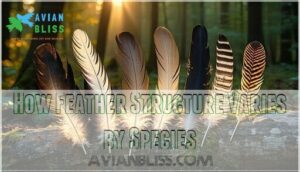
Structural adaptations reveal how bird species solve flight challenges differently. Falcons show vane asymmetry ratios exceeding 2:1 in their pennaceous feathers, while soaring eagles develop broader rachis widths—up to 3 mm compared to songbirds’ sub-1 mm shafts. Barb density ranges from 500 to over 1,500 per feather depending on flight patterns.
Birds engineer feathers differently—falcons pack 2:1 vane asymmetry for speed while eagles build 3mm shafts for soaring, and barb density varies from 500 to 1,500 per feather
Aquatic birds possess fewer, more spaced barbs for buoyancy, whereas forest species pack denser barbs for insulation. These variations in feather morphology reflect millions of years of feather evolution tied to habitat and behavior.
Understanding the feather growth process is essential for comprehending the complex adaptations of bird feathers.
Step-by-Step Feather Identification Techniques

Identifying a feather correctly starts with knowing what to look for and following a clear process. You’ll need to examine several key features in a specific order to narrow down possibilities.
The techniques below will guide you through each step, from initial observation to documenting your findings.
Observing Color Patterns and Markings
Color patterns are your strongest starting point—they often reveal a bird’s identity faster than any other trait. You’ll want to focus on pattern recognition and marking analysis to narrow down possibilities. Color variations between species can be dramatic, while plumage diversity within a single species reflects age, sex, and season.
- Barring and streaking: These feather markings create horizontal or vertical lines that serve as feather camouflage in specific habitats.
- Accent colors: Small patches of color—think wing bars or eye stripes—distinguish otherwise similar bird markings.
- Base coloration: The dominant hue across the feather reveals broad taxonomic clues about the species group.
Examining Feather Shapes and Sizes
Shape tells a story that color alone can’t—whether a feather powered a hawk’s dive or cushioned a sparrow’s landing depends entirely on its contours. Feather morphology reveals function through shape analysis and size variation.
Primary feathers are long and asymmetric for flight power, while contour feathers show balanced proportions. You’ll notice aerodynamic features like tapering edges on raptors versus rounded tips on songbirds. Feather observation of these structural differences narrows identification before you even measure.
Measuring and Documenting Feather Dimensions
Precision matters when fractions of a millimeter separate a Cooper’s hawk from a sharp-shinned hawk in your hand. Use a tape measure for feather length from base to tip, recording feather width at the widest point.
Dimension analysis requires scale calibration—place a ruler in your feather photography for reference.
Data recording captures feather structure details that memory won’t retain.
Recognizing Seasonal Changes and Molt Patterns
Molt cycles reveal timing windows that sharpen your bird feather identification skills throughout the year. Most species follow predictable feather replacement schedules—chickadees and hawks complete one full molt annually, while warblers add a partial pre-breeding molt for seasonal plumage changes. Climate impact now shifts these traditional patterns, with warmer temperatures expanding juvenile molt extent and altering bird migration patterns. Understanding the feather molt process is essential for accurate bird identification.
- Document active molt indicators: Look for simultaneous body feather growth or symmetric flight feather replacement
- Track molt cycle timing: Note whether species undergoes complete or partial molting—most complete theirs post-breeding
- Compare wing feather patterns: Juvenile preformative molts show regional variability, especially in migratory species
- Record seasonal plumage differences: Breeding colors versus winter feathers provide age and species clues
Using Online Feather Identification Tools

You’ve got a feather in hand, but matching it to a specific bird can feel like searching for a needle in a haystack. Online tools cut through the guesswork by letting you filter by color, pattern, and size to narrow down your options.
Let’s walk through three practical resources that’ll help you pin down your mystery feather.
Navigating The Feather Atlas Database
The Feather Atlas functions like a digital library where you can search through nearly 400 North American bird species by browsing high-resolution scans organized by taxonomic families. You’ll find owls, ducks, and raptors grouped together—making database navigation efficient.
The Browse Scans feature lets you explore feather morphology analysis systematically, while the Search Scans function pinpoints specific species verification needs.
| Navigation Method | Best For |
|---|---|
| Taxonomic Browsing | Exploring related species groups (e.g., all waterfowl) |
| Browse Scans | Visual comparison across entire feather classification system |
| Search Scans | Finding specific species when you have partial identification |
| Atlas Search | Quick lookup by common or scientific name |
| Family Groups | Understanding regional bird feather identification patterns |
Utilizing The “Identify My Feather” Feature
When you’ve narrowed down your feather’s family but need that final identification push, the "Identify My Feather" tool works like a visual filter—you select pattern, color, size, and other distinctive traits to generate targeted matches from the database. This Identify My Feather feature streamlines species matching through systematic Atlas navigation:
- Choose primary feather pattern (barred, spotted, solid)
- Select dominant colors and accent markings
- Input approximate size measurements
- Review feather characteristics against database search results
This online resource for birding transforms bird feather identification from guesswork into precise feather identification techniques.
Comparing Results With Field Guides and Apps
Apps and digital tools complement traditional field guides for bird identification, each with distinct strengths. Field guides detail over 400 North American bird species with expert-curated illustrations, while identification software like FeatherSnap achieves 89% accuracy through AI-driven pattern recognition.
Apps simplify searches—cutting identification time by 50%—but feather databases in field guides provide deeper educational context on molt patterns.
Studies show 60% of birders use both online resources for birding and field guides concurrently, combining app accuracy with printed references to overcome field guide limitations and enhance bird species identification through proven feather identification techniques.
Tips to Improve Your Identification Skills

Getting better at identifying feathers takes practice and a few smart habits. You’ll sharpen your skills faster when you follow systematic approaches and pay attention to context.
Here’s how to build confidence and accuracy in your feather identification work.
Systematic Observation Methods
Building a systematic approach to feather identification transforms random observations into reliable data you can trust. Start by examining seasonal plumage changes—breeding feathers differ markedly from winter plumage.
Record feather measurements precisely, noting length and width. Document bird habitat and local species in your field notes.
Practice consistent feather pattern analysis by studying shaft characteristics, barb structure, and color distribution. These observation techniques sharpen your bird identification skills through repeated, methodical species documentation.
Photography and Digital Documentation
Capturing clear photographs of your found feathers builds a permanent reference library that outperforms memory every time. Adjust camera settings for close-up detail, then store images in organized digital folders by species or date. Photo analysis through bird identification apps accelerates your learning curve.
Documentation tips that sharpen your feather analysis:
- Use natural lighting to reveal true color patterns and iridescence
- Include a ruler in shots for scale reference
- Photograph both sides to capture complete feather structure
- Tag images with location and date metadata
- Apply basic image editing to improve subtle markings for identification
Noting Habitat and Local Species
Your feather’s location tells half the story—a woodpecker feather in an oak forest makes sense, while the same feather on a beach should raise questions about migration or unusual sightings.
Study local species overview guides for your region to understand which bird species frequent specific bird habitats. Environmental factors like wetlands, grasslands, or urban areas shape species distribution patterns.
Regional variations in birdwatching records help you eliminate unlikely matches and focus on probable candidates, strengthening your identification accuracy while supporting wildlife conservation awareness.
Recognizing Common Regional Feathers
Once you’ve narrowed your search to likely local candidates, learning to spot the feathers you’ll encounter most often—like the bold stripes of a red-tailed hawk or the speckled brown of a mourning dove—turns identification from guesswork into recognition.
Regional birds leave predictable calling cards based on feather distribution and geographic variations:
- Raptors display distinctive flight patterns reflected in primary feather wear and banding
- Waterfowl show iridescent speculum feathers unique to your watershed’s species
- Woodpeckers present stiff tail feathers with reinforced shafts for tree-clinging behavior
- Songbirds exhibit seasonal plumage shifts affecting feather types and colors throughout the year
Mastering these regional markers sharpens your bird species identification skills through consistent, field-based observation.
Ethics and Legal Considerations in Feather Collection

Finding feathers is exciting, but it comes with responsibilities you need to understand. Laws protect many bird species, and your actions can impact wildlife populations.
Here’s what you should know before collecting or touching any feather.
Conservation Impact and Wildlife Welfare
When you collect feathers, you’re stepping into a world where bird conservation and Environmental Monitoring intersect with Wildlife Protection. The Historical Feather Trade decimated seabird populations—Laysan Albatross numbers plummeted before restrictions enabled recovery to 2.5 million today.
Modern feather analysis aids wildlife conservation through noninvasive biomonitoring of contaminants and DNA sampling for bird species identification.
Conservation Ethics demand that you prioritize bird welfare and conservation biology principles, recognizing that even molted feathers provide Wildlife Forensics data critical for protecting vulnerable populations without causing harm.
Legal Guidelines for Collecting Feathers
Under Federal Regulations, you can’t collect most wild bird feathers without proper authorization. The Migratory Bird Treaty Act prohibits possession of feathers from over 800 protected species, regardless of how you find them. Legal feather collection requires understanding these key exceptions:
- Non-native species (chickens, peacocks, Rock Pigeons) fall outside MBTA protection
- Game birds collected during licensed hunting seasons comply with Wildlife Conservation laws
- Scientific permits enable researchers to legally possess feathers for Wildlife Forensics studies
Permit Requirements vary by state, so check both Federal feather laws and local Feather Legislation before Ethical Collecting begins.
Responsible Handling and Documentation
Proper management protects both the feather’s diagnostic features and your legal standing if questions arise. Store specimens in acid-free envelopes to prevent damage during Feather Storage. Use clean management techniques—oils from bare hands degrade barbule structure over time.
Document each find with photos, GPS coordinates, and habitat notes; these Documentation Methods strengthen Conservation Ethics and support Wildlife Protection if authorities question your Legal feather collection. Your Responsible feather collection practices demonstrate commitment to Ethical feather management while improving Feather identification accuracy.
Frequently Asked Questions (FAQs)
What regulations govern feather possession in your area?
In the United States, the Migratory Bird Treaty Act strictly prohibits possessing most native bird feathers without federal permits.
The National Fish and Wildlife Forensics Laboratory uses forensics to enforce these conservation rules, ensuring feather identification aids species protection rather than illegal feather trade.
How do age and wear affect feather appearance?
A Red-tailed Hawk’s tail feather found in spring looks crisp and vibrant, but by late summer, UV exposure bleaches the rufous hue to pale orange.
Wear patterns reveal a feather’s history. Fraying barbules, color fading, and broken shafts increase with age, while fresh post-molt feathers show intact structure and saturated pigments.
Can damaged feathers still be accurately identified?
Yes, damaged feathers can still be identified, though fragment identification and damage analysis require careful examination. Focus on remaining feather structure and feather anatomy—shaft characteristics, barb patterns, and color markings.
Feather wear and aging signs don’t erase key identification features.
What role does feather color play in camouflage?
Feather color patterns function like nature’s invisibility cloak. Adaptive coloration matches surroundings, while feather mottling breaks up body outlines.
These camouflage strategies provide visual concealment through pigment-based colors and structural colors, helping birds blend seamlessly into their habitats and avoid predators.
How do migratory patterns influence feather characteristics?
Migratory routes shape feathers through altitude effects and climate adaptation. Long-distance travelers experience feather wear from sustained flight and geographical variations in molt cycles.
Seasonal plumage changes align with bird migration patterns, ensuring ideal insulation across diverse environments.
Conclusion
Before GPS, naturalists carried field notebooks and hand lenses—now you’ve got digital atlases and apps. But the discipline remains unchanged: measure, compare, document. Strong bird feather identification techniques rely on systematic observation, not shortcuts.
Record dimensions, note barb structure, photograph under consistent light. Match findings against regional species lists. Each feather tells a story—migration route, molt cycle, even age class.
With practice, you’ll decode them confidently. The trail becomes a library, and every feather a page you can finally read.