This site is supported by our readers. We may earn a commission, at no cost to you, if you purchase through links.
 A flash of color catches your eye, and suddenly you’re staring at a bird you’ve never seen before. Your brain races through questions—what is it, where does it belong, why does it look different from the sparrow on your fence yesterday?
Visual bird identification methods give you a systematic way to answer these questions by breaking down what you observe into patterns ornithologists use every day. Size, shape, color, habitat, and behavior create a puzzle where each piece narrows down possibilities.
Once you know what to look for and how these clues fit together, that mysterious visitor transforms from "some brown bird" into a species you can confidently name.
Table Of Contents
Key Takeaways
- Bird identification starts with observing size, shape, and silhouette—body proportions and bill morphology reveal feeding habits and narrow down species before you even note colors.
- Field marks like wing bars, eye rings, and head stripes function as diagnostic tags, though seasonal molts and lighting conditions can dramatically alter the plumage patterns you see.
- Habitat preference acts as a powerful filter—wetland versus woodland species have distinct anatomical adaptations, and elevation plus geographic range eliminate impossible matches quickly.
- Behavior patterns including foraging style, flight mechanics, and whether birds flock or stay solitary provide identification clues that complement physical appearance and confirm species identity.
Start With Size and Shape
When you spot a bird, your first step is to take in its overall size and shape. These physical traits give you a solid foundation before you focus on colors or sounds.
Let’s break down the key structural features that help narrow down what you’re looking at.
Overall Silhouette and Body Structure
When you first spot a bird, your eyes catch its overall shape before anything else—the rounded chest of a robin, the sleek torpedo form of a falcon, or the chunky outline of a chickadee. This silhouette reveals body shape and structural adaptations before you notice colors or markings.
Identifying birds by shape works because each species has distinctive proportions—short neck versus long, compact versus stretched. Avian anatomy creates these recognizable profiles, making size and shape your first tools for identification.
Comparing Birds to Familiar Species
You’ll pick up identification faster if you compare the mystery bird to species you already know—think "sparrow-sized," "bigger than a crow," or "shaped like a small chicken." These backyard comparisons give you a solid starting point for bird identification and help avoid size misconceptions in the field.
Try these visual bird identification techniques:
- Compare relative size against robins, crows, or chickens
- Watch for common lookalikes that share similar body structures
- Note behavior mimicry patterns that reveal identifying bird species clues
This method sharpens your common bird characteristics recognition skills quickly.
Bill Shape and What It Reveals
A bird’s bill works like a business card—it tells you exactly what that species does for a living. Bill morphology reveals feeding adaptations that help you narrow down species variation fast. Hawks sport sharp, hooked bills for tearing meat, while finches carry thick, seed-cracking tools.
A bird’s bill reveals its lifestyle—hawks tear meat with hooked beaks, finches crack seeds with thick ones, and bill shape guides quick species identification
Warblers have thin, insect-grabbing bills, and ducks show broad, water-filtering designs. Matching bill shape to habitat and behavior sharpens your field marks recognition and connects evolutionary significance to what you’re seeing.
Wing and Tail Proportions
Once you’ve sized up the bill, the wings and tail finish the story—length, shape, and how they work together separate a soaring hawk from a darting swallow in seconds. Long, pointed wings signal fast, direct flight patterns, while short, rounded wings mean quick maneuvers through dense cover.
Tail length adds visual cues too—a long, forked tail versus a short, square one shifts your identification from swallow to flycatcher. Wing shape and tail proportions create flight dynamics that make each species variation unmistakable once you know what you’re looking for.
Decode Color Patterns and Field Marks
Once you’ve got size and shape down, color patterns become your next best friend. Birds wear their field marks like name tags—stripes, bars, and rings that help you tell one species from another.
Let’s break down what to look for and how conditions can change what you see.
Key Plumage Features to Note

When you’re trying to pin down a bird’s identity, the plumage is where the real detective work begins. Start by scanning the breast and belly for solid colors, streaks, or spots. Check the back and rump, too, since these areas often show distinct feather patterns.
Notice whether the plumage looks smooth or scaled. Don’t overlook iridescence, which shifts with light, or subtle camouflage that helps birds blend into their environment.
Wing Bars, Eye Rings, and Head Stripes
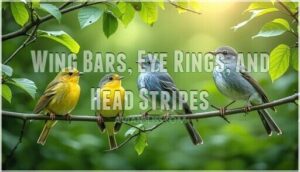
Look for wing bars, eye rings, and head stripes, since these small markings can make or break your ID.
Wing bars appear as light-colored bands across folded wings, and they’re especially useful for separating sparrows and warblers. Eye rings frame the eye with a thin circle of contrasting color, while head stripes create bold patterns like crown stripes or eyebrow lines that help distinguish subspecies and related species with similar overall plumage.
Seasonal and Age-related Color Changes

Throughout the year, plumage variation complicates bird identification as species shift between breeding plumage and non-breeding colors. The molting process transforms avian characteristics dramatically:
- Breeding males display vibrant field marks (e.g., Scarlet Tanagers turn vivid red)
- Fall adults appear duller after molting, resembling females
- Juvenile colors feature streaky, brown-toned patterns masking adult field marks
- First-year birds retain mixed plumage, blending juvenile and adult color patterns
Regional differences add complexity, so note the season when identifying unfamiliar species. Birds undergo this process to replace damaged feathers.
How Lighting Affects Color Perception
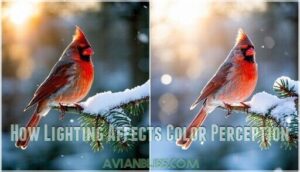
The same bird can look like an entirely different species depending on whether you’re squinting into harsh sunlight or studying it in soft morning shade. Glare effects wash out color patterns, while shadow influence deepens them dramatically.
Time of day shifts the light spectrum—dawn’s warm tones accentuate reds and oranges, but midday’s harsh brightness flattens plumage patterns.
Your brain uses color constancy to compensate, but visual identification still suffers when lighting conditions change rapidly.
What Habitat is It In?

Where you spot a bird tells you a lot about what it might be. Birds pick habitats that match their needs for food, shelter, and nesting. Understanding these preferences helps you narrow down your options fast.
Matching Birds to Their Environment
Birds don’t just randomly show up anywhere—they’re tied to specific habitats as tightly as a fish is to water, and recognizing these patterns can cut your identification time in half.
Habitat specificity means each species has environmental adaptations that link it to particular places. A duck won’t perch in a pine tree, and a warbler won’t wade through marshes.
This niche partitioning helps you narrow down possibilities fast, using habitat alongside size, shape, color pattern, and behavior.
Wetland Versus Woodland Species
If you’re wondering whether that bird wading through cattails is the same one you saw hopping through oaks yesterday, here’s the reality—wetland and woodland birds are as different as their homes, and you won’t find much overlap.
Wetland birds like herons have long legs and bills for catching fish, while woodland species like warblers have short bills for plucking insects from leaves.
These habitat types shape diet differences, nesting choices, and even migration patterns, making habitat a powerful tool for bird identification.
Geographic Range and Elevation Factors
Understanding bird habitats means recognizing that location and elevation matter just as much as habitat type. A cardinal thrives in your backyard oak, but you won’t spot one at 10,000 feet—elevation sets clear boundaries for species distribution. Range maps show where birds live year-round, helping you rule out impossible matches: These maps illustrate species’ seasonal range throughout the year.
- Biogeographic regions determine which species you’ll encounter in your area
- Altitudinal migration brings some birds to lower elevations in winter
- Range overlap occurs where habitat types meet, creating species diversity
- Habitat variation across elevations fosters different bird communities
Seasonal Habitat Shifts
Many birds don’t stay put year-round—they pack up and move to different habitats as seasons change, following food sources and favorable weather. Migration patterns reveal how resource availability drives bird behavior, with breeding habitats differing sharply from wintering grounds. Climate change is altering these seasonal shifts, pushing species to adjust their traditional routes.
| Season | Habitat Type | Example Species |
|---|---|---|
| Spring | Forest edges, grasslands | Warblers, sparrows |
| Summer | Wetlands, meadows | Swallows, bobolinks |
| Fall | Coastal areas, fields | Shorebirds, hawks |
| Winter | Southern woodlands, marshes | Ducks, juncos |
| Year-round | Stable environments | Cardinals, chickadees |
You’ll find different birds depending on when you’re looking—timing your observations helps narrow down identification possibilities.
How’s The Bird Behaving?

Watching how a bird moves tells you as much as what it looks like. You’ll notice patterns in how it hunts for food, flies through the air, or perches on a branch.
Let’s break down the behaviors that help you pin down what you’re seeing.
Foraging and Feeding Patterns
Watching how a bird feeds tells you a lot about what species you’re seeing. Different foraging strategies reflect dietary adaptations and habitat utilization, helping you narrow down your ID. You’ll notice distinct patterns:
- Chickadees hover and grab insects from leaf undersides, then retreat to a perch
- Woodpeckers probe bark systematically, listening for hidden prey
- Warblers move rapidly through branches, gleaning small insects
- Sparrows scratch on the ground, searching for seeds
Seasonal foraging changes matter too. Birds shift from protein-rich insects in summer to seeds and berries in fall. Social feeding behavior varies—some species forage alone while others join mixed flocks for better resource discovery.
Flight Style and Movement
How a bird moves through the air can be just as telling as what it eats on the ground. Wing shape determines flight patterns—hawks soar with broad wings, while falcons use rapid flapping. Hummingbirds hover in place, something most birds can’t do.
Watch for aerial displays during breeding season, when males perform loops and dives.
Migration strategies show up in sustained, direct flight versus weaving movements, revealing distinct avian behavior tied to wing design.
Perching Habits and Posture
When you spot where a bird plants itself—on a vertical trunk, a swaying reed, or an open wire—you’re getting clues about its anatomy and lifestyle. Foot morphology varies by species, with woodpeckers gripping bark differently than warblers balancing on thin branches. Posture variety ranges from upright stances to horizontal crouch layouts, reflecting body shape and size.
Perch selection reveals behaviors tied to hunting or resting, while perching adaptations like zygodactyl toes enable size shape specialists to exploit unique niches.
Flock Behavior Versus Solitary Birds
Some species thrive in bustling crowds, while others live out their days keeping to themselves—and that difference says a lot about survival strategy. Observing bird behavior in flocks versus alone reveals insights into predator avoidance, social learning, and resource competition. Flocks offer safety in numbers but come with the trade-off of sharing food. Solitary birds face higher predation risks but enjoy exclusive feeding zones.
Why flock behavior and habitat matter for identification:
- Starlings swirl in massive flocks—their synchronized movements confuse hawks and signal communal roosting sites
- Cooper’s Hawks hunt alone—solitary ambush predators rely on stealth, not cooperation, to capture prey
- Chickadees form mixed winter flocks—social learning helps them find food and recognize alarm calls across species
- Hummingbirds defend territories fiercely—aggressive spacing reduces competition for nectar at prime feeding flowers
Using Technology and Apps for Identification

Technology has changed the way birders identify species, making the process faster and more accurate. You don’t need to flip through hundreds of pages anymore when you’ve got smart tools in your pocket.
Here’s how modern apps and digital resources can help you identify birds in the field.
Merlin Bird ID and Photo Recognition
The Merlin Bird ID app transforms photo recognition into a powerful tool for identifying birds by size, plumage, and behavior. You can snap a photo of any bird, and the app analyzes over 8,000 species using deep learning trained on millions of images from eBird and the Macaulay Library.
Recognition accuracy reaches roughly 90% with clear shots, though blurry or partial views drop success below 80%. Offline capabilities let you identify birds anywhere, even without cell service.
Algorithm limitations exist—rare species and poor lighting reduce precision—but user adoption exceeds 10 million downloads worldwide, making it indispensable for birders at every skill level.
Audio Identification Tools
Sound ID apps let you record birdsong and get instant species matches, turning your ears into a field guide you never have to flip through. Merlin Bird ID converts vocalizations into sound spectrograms, identifying birds by sound even when ambient noise interrupts.
Recording quality matters—clear clips boost accuracy, while regional dialects and overlapping bird calls can confuse algorithms. You’ll build skills learning bird songs through repeated listening, sharpening your ear for subtle differences.
Digital Field Guides Versus Traditional Books
Apps and e-guides pack search filters, real-time updates, and instant cross-referencing into your pocket, while printed books offer peerless reliability when batteries die or signal drops. Each has trade-offs worth weighing:
- App accuracy improves with algorithm updates, but traditional field guides stay stable across editions
- Offline access matters in remote locations—download guides beforehand or carry a physical backup
- Cost comparison shows apps often cheaper upfront, though quality books last decades
- User interface design varies wildly; some birders prefer tactile page-turning over screen swiping
Building Your Life List Digitally
Tracking every sighting you make creates a personal record that turns casual birdwatching into a measurable journey you can revisit and share. Most bird identification apps now offer app integration with cloud-based data backup, so your life lists survive phone upgrades.
Sharing features let you compare sightings with other birders, while community engagement transforms solitary outings into collaborative discovery in the digital age.
Frequently Asked Questions (FAQs)
What time of day is best for identifying birds?
The early bird catches the worm, and that’s true for identification too. Midday offers the best lighting conditions and visual cues, though dawn chorus brings peak activity from crepuscular birds.
Dusk and dawn reduce accuracy by 21%, while observer fatigue affects afternoon sessions.
How does weather affect bird identification accuracy?
Rain, fog, and snow reduce bird identification accuracy by obscuring color patterns and field marks.
Wind alters bird behavior and habitat use, making observation harder.
Temperature shifts affect birdwatching conditions and species activity levels overall.
Do beginner birders miss more species than experts?
Yes, beginners do miss more species. Observer experience creates a significant detection rate gap—less experienced birders identify roughly 18% fewer species visually than experts, reflecting differences in the learning curve, identification confidence, and cognitive bias affecting bird identification for beginners.
Can binoculars improve visual identification success rates?
Binoculars let you see field marks, visual cues, and fine details from a distance. Magnification levels of 8x or 10x work well for bird watching.
Look for lens coatings, image stabilization, and good low-light performance to boost bird identification accuracy.
How do dense forests reduce identification accuracy?
Dense forests throw up obstacles like a ticker-tape parade of leaves. Limited visibility from thick vegetation blocks your view of key field marks, forcing you to rely more on auditory identification.
Low light conditions under the canopy make color patterns harder to distinguish, while species concealment behind foliage challenges observer positioning during birdwatching.
Conclusion
Picture a warbler flitting through branches—yellow chest, dark streaks, white wing bars. You note its small size, the needle-like bill perfect for insects, and how it stays high in the oak canopy. These visual bird identification methods just turned a fleeting glimpse into a positive ID: Magnolia Warbler.
Each observation you make—size, color pattern, habitat choice, foraging behavior—sharpens your skills. The more you practice connecting these clues, the faster that mystery bird becomes a name you know.