This site is supported by our readers. We may earn a commission, at no cost to you, if you purchase through links.
 Last summer, I left a trail camera on a remote ridgeline for six weeks and came back to 4,000 images—including a family of northern goshawks I never would’ve spotted otherwise. Bird watching camera traps have quietly revolutionized how we document avian life, capturing behaviors that unfold when humans aren’t around to spook the subjects.
These motion-triggered setups let you monitor nesting sites, feeding patterns, and rare species without spending dawn-to-dusk hours in a blind. The trick is knowing which camera bodies manage fast-moving wings, how to position your gear where birds actually show up, and which features separate usable footage from blurry disappointments.
Whether you’re tracking backyard visitors or contributing data to conservation projects, the right setup turns guesswork into documented discovery.
Table Of Contents
- Key Takeaways
- Essential Gear for Bird Watching Camera Traps
- Choosing and Placing Your Camera Trap
- Key Features to Look for in Trail Cameras
- How to Set Up and Optimize Your Camera Trap
- Top 7 Bird Watching Camera Traps Reviewed
- Maximizing Success With Camera Trap Photography
- Frequently Asked Questions (FAQs)
- Should you use a camera trap to photograph birds?
- What are the two types of wildlife camera traps?
- What is wildlife camera trapping?
- Are wildlife camera traps expensive nowadays?
- What is a DSLR wildlife camera trap?
- How do wildlife photographers set up camera traps?
- What permits are needed for camera trapping birds?
- How long should camera traps remain deployed?
- What are ethical considerations for bird photography?
- Can camera traps harm or stress bird populations?
- Conclusion
Key Takeaways
- Camera traps capture authentic bird behaviors invisible to human observers—nesting rituals, territorial disputes, and feeding patterns unfold naturally when motion-triggered sensors fire without your physical presence spooking subjects.
- Success depends on matching gear to field conditions: trail cameras offer weatherproof durability for weeks-long unattended deployments, while DSLR setups deliver superior image quality through manual exposure control and interchangeable lenses.
- Strategic placement beats expensive equipment—position traps near water sources, fruiting trees, or cavity-rich snags where birds naturally congregate, then prefocus manually and disable autofocus to eliminate shutter lag when the infrared sensor triggers.
- Your footage becomes conservation data when shared with platforms like Wildlife Insights, filling geographic gaps in species documentation and enabling rapid responses to population declines that traditional field observations miss.
Essential Gear for Bird Watching Camera Traps
Getting your camera trap right starts with the right tools, and that means more than just a camera body. You’ll need sensors that don’t miss a beat, lenses that match your vision, and power solutions that keep you shooting when birds show up at dawn or dusk.
Let’s break down the five pieces of gear that’ll turn your backyard into a wildlife studio.
Camera Types (Trail, DSLR, Mirrorless)
Your choice between trail cameras, DSLRs, and mirrorless bodies isn’t just about megapixels—it’s about matching your gear to the field conditions, your target species, and how much control you’re willing to trade for convenience.
Trail cameras win on camera durability and weatherproofing, perfect for wildlife camera trap setups you’ll leave unattended for weeks. DSLR camera traps and mirrorless options give you lens compatibility and higher image quality through larger sensor size, but they demand more hands-on camera trap setup and protection from the elements.
Infrared Sensors and Triggers
Once you’ve locked down your camera body, the real magic starts with the trigger—because no bird is going to sit around waiting for you to press the shutter button. Infrared sensors with PIR motion detection fire your camera trap setup when heat signatures shift, and trigger speed matters—fast-moving species demand responses under half a second.
Dial in your sensor calibration and infrared range to match your subject’s size and distance, because signal strength determines whether you capture the shot or just empty frames.
Wide-Angle Vs. Telephoto Lenses
Lens Selection splits into two schools: wide-angle lenses let you frame intimate, in-your-face portraits when your Camera Traps sit inches from feeders or perches, while telephoto Focal Length keeps wary species comfortable by shooting from a distance.
Field Coverage shrinks as you zoom in, but Image Compression tightens backgrounds into silky blur—Depth Control swings with aperture, regardless of focal length. Match your glass to the bird’s tolerance.
External Batteries and Memory Cards
Power and Storage run dry fast when your trap fires thousands of frames unattended, so swapping AA cells for External Battery Packs and slotting in high-capacity Memory Cards keeps you in the field for weeks instead of days.
Here are some key considerations:
- Battery Life multiplies when lithium packs replace alkaline—Power Management circuits in modern Trail Camera rigs sip juice instead of guzzling it.
- Memory Capacity matters: 128 GB cards hold roughly 40,000 JPEGs, so you won’t miss that once-in-a-lifetime shot.
- Storage Solutions like dual-card slots let one fill while the other backs up—insurance against corruption.
- Card Readers with USB-C transfer gigabytes in minutes, cutting your download time between field sessions.
- Wildlife Camera Trap setups demand industrial-grade SD cards rated for temperature swings and constant write cycles—cheap cards fail when it counts.
Protective Housing and Mounts
Rain, mud, and curious raccoons will test every seal and screw in your rig, so wrapping your DSLR in Protective Housing and locking it to a sturdy Mount turns a fragile investment into a weatherproof field station.
Weatherproof Casing with rubber gaskets keeps moisture out, while Mounting Systems like tripod heads or tree brackets anchor your Camera Equipment against wind gusts.
Camera Shields and Protective Enclosures add layers of defense, and Anti-Theft Devices—cables or lockboxes—deter thieves who spot unattended Outdoor Photography Gear on public trails.
Choosing and Placing Your Camera Trap

Getting your camera trap in the right spot can make or break your backyard birding project, and it’s not just about sticking it on a tree and hoping for the best. You’ll want to think about where birds naturally gather, how to get close to elusive species without spooking them, and when it might help to tap into local expertise.
Here’s what you need to keep in mind when choosing and placing your setup.
Understanding Bird Behavior and Hotspots
Think of bird behavior as your treasure map—the X marks where you’ll capture stunning shots. You’re tracking avian behavioral patterns around resource hotspots, those golden zones where birds congregate for feeding, drinking, or nesting. Wildlife observation teaches you that habitat selection isn’t random:
- Water sources draw dozens of species daily, especially during bird migration seasons when exhausted travelers need refueling stops
- Fruiting trees and berry bushes create irresistible magnets for species interactions, from warblers to thrushes
- Cavity-rich snags attract woodpeckers, owls, and nesting songbirds year-round
Spend time watching before placing your camera trap—animal behavior reveals patterns that wildlife monitoring data alone can’t show. These systems often use an infrared sensor to trigger the camera.
Optimal Placement for Rare Species
Rare species demand detective-level fieldwork, where camera trap setup and installation success hinges on strategic placement decisions. Camera height matters tremendously—position traps 2–3 meters high for tree-climbing species or 40 centimeters low with cleared vegetation for ground-dwellers. Spatial arrangement counts too: space stations 50+ meters apart to optimize coverage, since dense deployments detect 25% more species than single traps. The effectiveness of camera traps has been demonstrated in identifying small mammal species within complex forested ecosystems.
| Placement Factor | Optimization Strategy |
|---|---|
| Camera Height | 2–3 m for scansorial birds; 40 cm for ground species |
| Microhabitat Targets | Tree trunks, burrow openings, fallen logs |
| Spatial Arrangement | 50+ m spacing between stations |
| Temporal Coverage | Extended deployments (>4,000 camera-days for rare detections) |
Target microhabitat hotspots like tree trunks for woodpeckers or burrow entrances for secretive ground birds—habitat considerations in old-growth patches yield better animal behavior records. Wildlife monitoring through bird photography requires patience: temporal coverage beyond 4,000 camera-days captures those elusive five additional species that make all the difference.
Minimizing Disturbance to Wildlife
Your camera trap setup becomes invisible to wildlife when you respect their space—the difference between stunning documentation and scaring off subjects forever. Wildlife Protection through Stealth Photography means mastering Minimal Impact techniques that let Animal Habitats thrive undisturbed.
- Deploy during low-activity hours to avoid spooking birds during Camera Trap Setup and Installation
- Use no-glow infrared in your Motion Sensor for true Camera Concealment
- Clear approach paths quietly without disturbing nesting or feeding zones
- Check traps weekly, not daily—Wildlife Monitoring Methods that support Wildlife Conservation require patience, not intrusion
Working With Biologists and Researchers
Partnering with field ecologists unlocks hotspots you’d never find solo—Ecological Input transforms guesswork into precision, while Joint Efforts in Wildlife Research sharpen Data Validation and Species Identification. Biologists guide Wildlife Monitoring Methods that sidestep Analytical Biases, guaranteeing your traps serve Conservation and Research goals.
| Collaboration Benefit | Impact on Camera Trapping |
|---|---|
| Precise placement for rare species | Increases detection success rates |
| Field validation of captures | Improves accuracy and reduces false IDs |
| Multidisciplinary data interpretation | Mitigates biases in Animal Behavior and Ecology |
| Access to centralized systems | Streamlines archiving and broader Wildlife Conservation efforts |
| Protocol-driven survey design | Boosts species accumulation and replicability |
Key Features to Look for in Trail Cameras
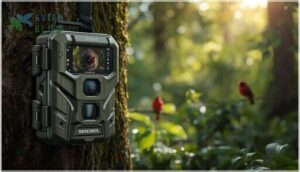
Not all trail cameras are built the same, and knowing what matters can save you time and frustration in the field. The right features make the difference between blurry misses and sharp, detailed shots of birds you’d never see otherwise.
Here’s what you need to focus on when choosing your setup.
WIFI and 4G Connectivity
With modern connectivity features, you can check what’s happening at your camera trap without trudging back through the woods every time you’re curious. WIFI and 4G cellular connectivity let you access images in real-time, streaming photos directly to your phone through cellular networks.
This wireless remote control means you’re always in the loop, adjusting settings or reviewing data transmission without disturbing your setup. Just make sure your network security is solid—you don’t want your bird photos hacked.
Built-in GPS for Tracking
GPS tracking takes the guesswork out of managing multiple cameras spread across different locations, logging exact coordinates so you never lose track of a setup or spend an afternoon searching for that camera you swore you mounted near the oak tree.
Beyond just location mapping, geotagging captures where wildlife shows up, building spatial data that reveals:
- Migration corridors animals use between feeding and nesting zones
- Territorial boundaries showing which species claim specific patches
- Movement patterns that connect habitat fragments across your monitoring area
This wildlife monitoring intel transforms your trail camera from a simple snapshot tool into a research-grade system for spatial analysis.
Night Vision Capabilities
Most birds don’t punch a time clock, so you’ll miss the bulk of their action—feeding runs before dawn, secretive mating displays, nocturnal movements—unless your camera can see in the dark.
Infrared technology and low light sensors let your wildlife camera trap capture nighttime photography without spooking subjects, using invisible IR illumination that triggers motion detection while leaving birds undisturbed in their dark mode settings.
Weather Resistance and Durability
Rain, snow, mud, and the occasional squirrel gnawing session—your camera trap gear needs to survive whatever the wild throws at it if you want more than a week of field time.
Look for waterproof materials and weather sealing rated IP66 or higher, plus reinforced housings that pass real durability tests.
Serious outdoor protection means your trail camera keeps shooting through storms while moisture control prevents that dreaded lens fog that ruins outdoor photography equipment.
Fast Trigger Speed and High Resolution
A bird can cross your frame in under half a second, so if your trigger speed lags behind that split-second window, you’ll end up with empty shots or just tail feathers disappearing into the brush. Aim for trigger speed under 0.3 seconds—that quick capture paired with a fast shutter and motion sensor precision turns your trail camera into a serious camera trap.
Match that with high resolution sensors and high-resolution lenses for sharp focus and outstanding image quality, because high pixels matter when you’re zooming in on field marks later.
How to Set Up and Optimize Your Camera Trap
Getting your camera trap to fire at the right moment is only half the battle—you still need the right settings to actually capture a sharp, well-exposed shot. Manual control over exposure, focus, and depth of field separates keepers from blurry misfires.
Here’s how to dial in your setup so you’re ready when that rare warbler finally shows up.
Manual Mode and Exposure Settings

If you want total control over your camera trap photos, switching to manual mode is the breakthrough that separates blurry guesswork from tack-sharp bird portraits.
You’ll dial in aperture control to manage depth focus, set your shutter speed to freeze wing movements, and adjust ISO settings to manage changing light conditions.
These photography techniques give you exposure compensation power that automatic modes can’t match, letting you nail camera settings before a single feather enters the frame.
Achieving Large Depth of Field
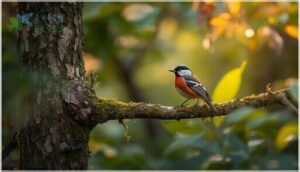
Stopping down your aperture to f/8 or smaller is the single most powerful move for keeping everything from the bird’s beak to its tail feathers razor-sharp in frame. This aperture control tactic works with your focal length and sensor size to extend the hyperfocal distance, securing tack-sharp wildlife photography techniques even when birds land slightly off your predicted mark—especially vital with camera trap setups where you can’t adjust framing on the fly.
Prefocusing and Disabling Autofocus
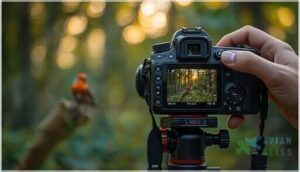
Once you’ve nailed down your aperture, the next step is locking focus on the exact spot where you expect the bird to land—and then switching off autofocus entirely so your camera doesn’t hunt for focus when the sensor fires.
Manual focus techniques bypass autofocus limitations that plague remote camera trapping, where lenses often hunt when the infrared trigger activates. Use focal point adjustment with a test object at the perch height, then disable AF completely—this camera calibration step guarantees the shutter fires instantly without delay, capturing the bird the moment it arrives.
Balancing Shutter Speed and ISO
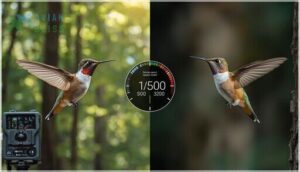
With your focus locked and autofocus disabled, the final piece of the exposure puzzle is dialing in the right shutter speed and ISO combo—too slow and you’ll blur wings, too high and you’ll drown the shot in noise. Wildlife photography with a trail camera demands this balance—your digital camera needs enough light sensitivity to capture crisp shots when the interval timer fires, but clean files matter for conservation work.
Start with 1/500th or faster in Shutter Priority to freeze motion, then raise your ISO settings just enough to maintain proper exposure control without sacrificing image quality.
Daily Maintenance and Photo Inspection
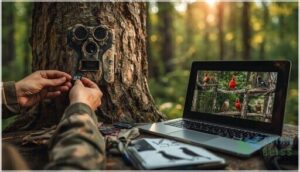
Your memory card fills fast in the field, so checking shots daily isn’t just good practice—it’s how you catch focus drift, lighting fails, and framing issues before you waste another 24 hours shooting blanks. Daily checks transform camera trap photography from guesswork into precision:
- Photo review on your wildlife photography equipment reveals what’s working—analyze image analysis patterns to spot which angles pull birds in versus what scares them off.
- Memory management prevents missed shots when your trail camera maxes out storage mid-sequence, especially during peak activity windows.
- Trap monitoring lets you tweak settings on your wildlife camera trap before conditions change—that golden hour light won’t wait for tomorrow’s adjustment.
Top 7 Bird Watching Camera Traps Reviewed
After weeks of testing camera traps in the field, I’ve narrowed down the options that consistently deliver sharp images, reliable triggers, and features that actually matter for bird photography.
The seven models below represent different price points and capabilities, so you can match your setup to your specific needs.
Here’s what stood out after putting each through real-world conditions.
1. cellular trail camera with gps
 View On Amazon
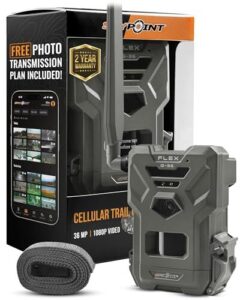
The SPYPOINT Flex-G36 stands out with dual-SIM cellular networks and built-in GPS tracking, letting you monitor locations and receive 36MP images straight to your phone. You’ll appreciate the geofencing alerts that notify you if someone moves your camera trap—perfect for securing remote bird monitoring setups.
This cellular trail camera uses geotagging photos to log exact coordinates, which helps when you’re studying migration patterns or documenting rare species across multiple sites. Location accuracy hits about 99.88% under good conditions, though dense canopy can throw off the signal.
Battery life drops roughly 15-25% compared to non-GPS models, but the wildlife monitoring benefits usually outweigh that tradeoff.
Best For: Hunters, wildlife researchers, and property owners who need remote monitoring with theft protection and precise location tracking across multiple camera sites.
- Dual-SIM cellular connectivity with built-in GPS ensures reliable photo delivery and real-time geofencing alerts if the camera is moved or stolen
- 36MP image quality and 1080p video with geotagged coordinates help document wildlife patterns and recover equipment in remote locations
- Photos sent directly to your phone via the SPYPOINT app eliminate the need for manual SD card retrieval in the field
- Battery drains 15-25% faster than non-GPS models due to continuous location tracking and cellular transmission
- GPS accuracy drops in dense forests or mountains, with potential errors exceeding 10 meters in challenging terrain
- Free plan caps you at 100 images per month, and some users report reliability issues with long-term durability
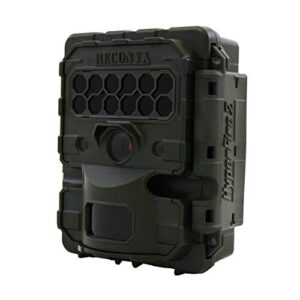
2. Reconyx Hyperfire Trail Camera Equipment
 View On Amazon
Need serious performance for capturing elusive birds? Reconyx Hyperfire trail camera equipment delivers native 4K resolution and a lightning-quick 0.25-second trigger speed—essential when you’re documenting split-second nest visits or fleeting feeders.
This wildlife camera trap manages extreme temps and runs up to 22.5 months on 12 AA batteries, so you won’t miss months of migration data.
Reconyx features include ‘No Glow’ infrared for nighttime wildlife monitoring without spooking subjects, plus a 110-foot detection range that outperforms most trail camera reviews. Password-protected storage and 1TB SD support make it a go-to camera trap for researchers tracking rare species.
Best For: Wildlife researchers and serious birders who need reliable, high-resolution documentation of fast-moving species in remote locations with minimal maintenance.
- Native 4K resolution with 92/100 photo quality rating captures fine details like plumage patterns at distances up to 110 feet
- Exceptional battery life of up to 22.5 months and 5-year warranty reduce field visits and long-term costs
- Lightning-fast 0.25-second trigger speed with 110-foot detection range and No Glow infrared minimizes missed shots and wildlife disturbance
- Higher price point compared to standard trail cameras may be prohibitive for casual users or budget-conscious buyers
- Some users report blurry images when subjects move quickly and disappointment with night photo quality despite IR capabilities
- Requires removing camera from mounting location to access SD card, creating inconvenience during data collection
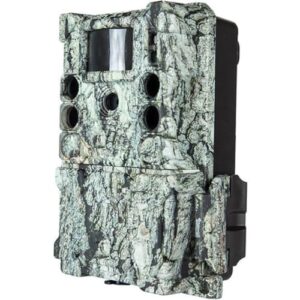
3. Bushnell No Glow Trail Camera
 View On Amazon
Bushnell’s Core S-4K camera trap stands out with 30-megapixel stills and a blazing 0.08-second photo trigger speed—faster than most trail cameras you’ll find in wildlife photography. The no glow technology uses invisible infrared LEDs that won’t spook birds at feeders or nests, making it ideal for bird behavior studies and sensitive wildlife camera trap setups.
You’ll get a 70-foot night range, a 2.1-inch review screen for quick camera trap tips adjustments, and up to 21.5 months of operation on six AA lithiums—solid performance for long-term wildlife monitoring without constant battery swaps.
Best For: Wildlife photographers and researchers who need fast trigger speeds and invisible infrared for monitoring skittish animals or bird behavior without disturbing their subjects.
- Lightning-fast 0.08-second photo trigger speed captures quick-moving wildlife that slower cameras miss
- True no-glow infrared keeps you invisible to animals, perfect for sensitive species and bird nesting studies
- Exceptional battery life up to 21.5 months in photo mode means fewer field visits and less disturbance
- Video recordings max out at 60 seconds per trigger, limiting footage of extended animal behaviors
- Nighttime video quality falls to middle-of-the-pack with increased noise on moving subjects
- Large file sizes from 4K video and 30MP images eat through SD card space quickly on multi-day deployments
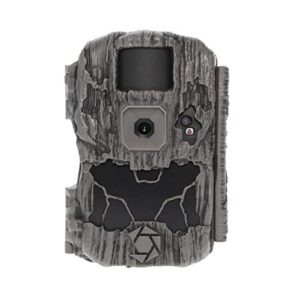
4. Stealth Cam Ultimate Game Camera
 View On Amazon
Stealth Cam’s DS4K Premium game camera pushes resolution even higher with 32-megapixel image quality and 4K video at 30 FPS—serious specs for detailed wildlife camera trap work. The 0.48-second trigger speed captures quick wing movements, while the 850nm infrared night vision reaches 100 feet without alarming skittish species.
Battery life hits 14 months in photo mode on 12 AA lithiums, and the camera durability holds up through rain and temperature swings.
At $249.99, it’s a solid pick for long-term camera trap deployments where you need high-res results without constant maintenance.
Best For: Wildlife researchers and hunters needing high-resolution documentation with minimal maintenance over extended field deployments.
- Exceptional 32MP image quality and 4K video capture sharp details day and night, making it ideal for identifying species and behaviors at distance
- Outstanding 14-month battery life on lithium AAs in photo mode means fewer trips to check or service remote camera sites
- Fast 0.48-second trigger speed reliably captures quick-moving animals without missing the shot
- No cellular connectivity means you have to physically retrieve the SD card to review footage, adding time to your workflow
- Infrared flash can overexpose subjects at very close range during nighttime operation, potentially washing out detail
- Some users report motion sensor issues with false triggers, which can fill your card with empty shots and drain batteries faster
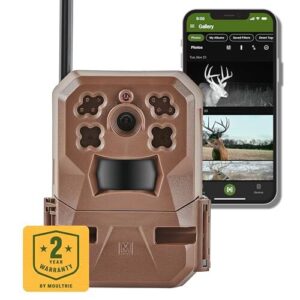
5. Moultrie Edge Cellular Trail Camera
 View On Amazon
Cellular connectivity transforms your Moultrie camera trap into a hands-off monitoring system—the Edge automatically selects the strongest network signal and uploads shots to 16GB cloud storage without SD cards. Battery life runs weeks on 8–16 AA batteries, and smart features like species recognition plus weather forecasts sharpen your wildlife camera trap strategy.
You’ll catch 33-megapixel images and 720p videos with embedded moon phase and temperature metadata, though nighttime image quality shows motion blur on active birds.
Data plans start around $99 annually per camera, with download limits tied to your subscription tier.
Best For: Hunters and wildlife enthusiasts who want remote trail monitoring with automatic uploads and species recognition but don’t mind ongoing subscription costs.
- Auto-connects to strongest cellular network and uploads images to cloud storage without SD cards, letting you check wildlife activity from anywhere
- Strong battery life lasting weeks on AA batteries with smart features like species identification, weather forecasts, and customizable alerts
- Captures 33MP photos with useful metadata (moon phase, temperature, time) and includes security protection—stolen cameras can’t be accessed without app authentication
- Requires separate $99 annual subscription per camera with monthly download limits, making multi-camera setups expensive
- Night photos show motion blur on moving subjects, and the 40-degree field of view is narrow for some monitoring situations
- No SD card option means you can’t download images directly from the camera, and you’re limited to app/website access with sequential file downloads
6. GardePro Trail Camera No Glow
 View On Amazon
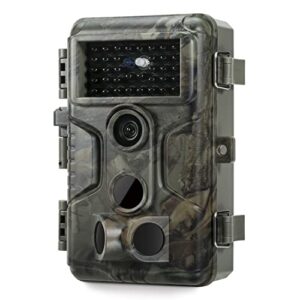
GardePro’s no glow technology keeps your wildlife camera trap invisible at night—940nm infrared sensors won’t spook birds or alert trespassers, and the E6 model pushes coverage to 75 feet with adaptive illumination that prevents overexposed feathers.
You’ll pull 48-megapixel stills and 2304×1296 video through a 110° lens, while motion sensors fire in half a second. Wi-Fi connectivity syncs shots to your phone without fees, and lithium batteries stretch field life past 18 months.
Trail camera tips: pair the IP66 housing with camera trap settings tuned for fast-moving songbirds to optimize your wildlife photography results.
Best For: Wildlife photographers and property owners who need invisible nighttime monitoring without spooking animals or alerting intruders.
- 940nm no glow infrared reaches 75 feet with adaptive illumination that prevents washed-out night shots and keeps the camera undetectable to wildlife and trespassers.
- 48MP images and 2304×1296 video with 0.5-second trigger speed capture fast-moving subjects through a 110° field of view, plus Wi-Fi syncs footage to your phone with no monthly fees.
- Battery life exceeds 18 months on lithium AAs, and IP66 weatherproofing handles temperatures from -4°F to 140°F for year-round outdoor use.
- Some users report the detection range drops for small animals at night, and the onboard LCD struggles to display high-resolution photos clearly.
- Video recording needs a fast SD card to avoid lag, and the on/off switch can be awkward to operate with gloves in cold weather.
- A few customers experienced empty SD cards or poor video quality, likely from setup errors or occasional defective units.
7. Vikeri Trail Camera with Night Vision
 View On Amazon
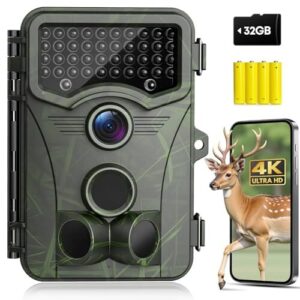
Vikeri’s 48-megapixel sensor and 4K video look sharp on paper, but real-world performance falls short. While the night vision boasts 48 no-glow infrared LEDs with a 100-foot range, the resulting images are disappointingly muddy. The motion sensors, despite a 0.05-second trigger speed, also lag in video capture.
The IP66 camera durability rating ensures it withstands harsh weather conditions, but the touchscreen buttons fail within a year, rendering the wildlife camera trap frustratingly unreliable.
For serious wildlife monitoring, it’s best to invest in a trail camera with proven image quality and responsive camera trap performance instead.
Best For: Budget-conscious users who need basic wildlife monitoring in moderate conditions and don’t mind trading reliability for affordable 4K specs.
- 48MP photos and 4K video with 130° wide-angle lens capture detailed wildlife imagery in good lighting conditions
- IP66 waterproof rating and rugged ABS construction handle rain, snow, and extreme temperatures from -22°F to 158°F
- Fast 0.05-second trigger speed with 100-foot detection range covers large monitoring areas effectively
- Night vision quality is poor despite 48 infrared LEDs, producing muddy and unclear images in low light
- Touchscreen buttons fail within a year and video recording lags despite advertised trigger speed
- No Wi-Fi or cellular connectivity limits remote access, and frequent false triggers reduce reliability
Maximizing Success With Camera Trap Photography

Getting great shots with camera traps isn’t just about gear, it’s about anticipation and adapting to what the birds show you. You’ll need to think like a photographer and a naturalist at once, balancing technical settings with an understanding of the species you’re after.
Here’s how to turn those experimental setups into images worth keeping.
Visualizing and Framing The Shot
The difference between a snapshot and a stunning portrait often comes down to how well you’ve imagined the frame before your subject even arrives. Think through your shot composition ahead of time—where will the bird land, what camera angles work best, and how will your focal length affect the scene?
Manual mode lets you control framing techniques and image stabilization, turning your camera trap into a precision tool for wildlife photography techniques that capture nature’s raw moments.
Capturing Unique Behaviors and Species
Camera traps reveal behaviors most birders never witness—rare courtship displays, secretive feeding rituals, and elusive ground-dwelling species that vanish at the slightest human presence. By positioning your wildlife camera trap strategically in bird habitats and studying animal tracking patterns, you’ll document behavioral studies data that advances wildlife conservation photography.
Species identification becomes easier when your trail camera captures intimate moments of difficult-to-photograph birds, transforming your setup into a powerful tool for wildlife conservation. Master these bird photography techniques, and you’ll reveal nature’s hidden stories frame by frame.
Overcoming Common Challenges
Even with careful planning, you’ll face setbacks—false triggers from swaying branches, overexposed shots in harsh midday sun, and blank frames where your target bird should’ve been. Here’s how to troubleshoot your remote camera trapping setup:
- Sensor issues: Adjust your trail camera’s sensitivity settings to reduce false triggers from wind or vegetation
- Battery life: Use external power packs for extended sessions, especially in cold weather
- Image quality: Shield your wildlife camera trap’s lens from direct sun and check for moisture inside protective housing
- Weather protection: Seal camera addons with weatherproof tape and raise your setup above flood zones
Regular data analysis of failed shots reveals patterns—tweak your positioning, adjust exposure settings, and you’ll turn frustrating blanks into striking captures.
Interpreting and Using Camera Trap Data
Once you’ve captured thousands of frames, data analysis becomes your next adventure—sorting through empty shots, false triggers, and genuine wildlife moments to extract real insights.
Wildlife monitoring requires systematic species identification: look for size patterns (larger birds trip sensors 20% more reliably), distance effects on detection metrics, and temporal activity spikes that reveal feeding schedules.
Your trail camera records aren’t just pretty pictures—they’re scientific gold when you track capture rates per 100 trap nights, adjust for camera calibration variables like habitat type, and use data visualization tools to spot behavioral trends that traditional birding misses completely.
Contributing to Conservation and Research
Your trail camera footage does more than fill memory cards—it strengthens Conservation Efforts when you share observations with Wildlife Monitoring platforms like Wildlife Insights, which documents 48% of bird species’ ranges better than traditional databases.
Conservation Photography directly aids Wildlife Research and Biodiversity Studies by closing data gaps in underrepresented regions.
Your Wildlife Conservation Efforts provide Ecological Insights that guide rapid responses to population declines and emerging threats through Research Methods that integrate artificial intelligence for identifying at-risk species.
Frequently Asked Questions (FAQs)
Should you use a camera trap to photograph birds?
Forget field guides and binoculars for a moment—some bird behaviors only reveal themselves when you’re not there. Camera traps let you witness rare moments, like nocturnal roosting rituals or territorial disputes, without your presence altering the scene, making them invaluable for both wildlife conservation and understanding authentic bird behavior.
Camera traps reveal bird behaviors invisible to human observers—nocturnal rituals, territorial disputes, authentic moments captured without disturbing the scene
What are the two types of wildlife camera traps?
Two main approaches dominate wildlife monitoring: traditional trail cameras that operate independently with battery power and infrared sensors, and DSLR-based camera traps using external triggers for precise sensor technology and manual camera control.
What is wildlife camera trapping?
Wildlife camera trapping, like a Victorian naturalist’s blind reimagined, uses motion-triggered cameras for wildlife monitoring and tracking.
This conservation tool captures animal behavior through automated photography, enabling ecological research without human presence disturbing subjects.
Are wildlife camera traps expensive nowadays?
Prices vary widely, from under $100 for basic models to $500+ for professional-grade equipment. Cost factors include resolution, trigger speed, connectivity features, and durability.
Budget options work well for beginners, while expense reduction comes through comparing trail camera reviews and prioritizing essential photography equipment needs.
What is a DSLR wildlife camera trap?
Imagine this: you’re setting a trap for wild creativity, not with bait but with precision glass and sensors.
A DSLR Camera Trap combines professional digital cameras with infrared trigger systems for exceptional image quality in wildlife photography, offering full manual camera settings control that trail cameras can’t match.
How do wildlife photographers set up camera traps?
Setting up a wildlife camera trap starts with understanding your subject’s behavior and patterns. You’ll connect an infrared sensor to trigger your camera’s shutter, configure manual exposure settings with prefocused composition, then place the trap near resource hotspots while minimizing disturbance to wildlife.
What permits are needed for camera trapping birds?
You’ll need to check local Wildlife Laws and state regulations first, since Permit Requirements vary by location.
Most private property setups don’t require Licensing Fees, but Wildlife Management agencies enforce Regulatory Compliance for Conservation Efforts.
How long should camera traps remain deployed?
Most wildlife photographers leave their traps for 7-14 days, adjusting Deployment Duration based on Seasonal Adjustment patterns and Wildlife Habituation concerns.
Camera Longevity improves with strategic Trap Placement, while Wildlife Monitoring Systems help fine-tune your Camera Trap timing.
What are ethical considerations for bird photography?
Respect wildlife first—never bait, stress, or corner birds for a shot. Conservation ethics demand we prioritize animal welfare over the perfect frame, protecting bird habitat and supporting conservation efforts through mindful nature photography practices.
Can camera traps harm or stress bird populations?
Properly positioned equipment respects bird welfare and minimizes camera impact on natural behavior.
Stress factors remain low when you maintain distance, avoid nesting sites, and follow wildlife ethics—making camera traps less intrusive than human presence for conservation efforts.
Conclusion
Installing bird watching camera traps is like planting seeds in the dark—you trust the system, then wait for nature to reveal what you couldn’t see standing there. Once you’ve dialed in trigger speed, placement, and weather protection, your setup becomes an unblinking witness to behaviors that vanish the moment boots crunch gravel.
Review your images daily, adjust based on what shows up, and remember that patience delivers more than luck ever will. The birds are already there; now you’ll finally have proof.
- https://royalsocietypublishing.org/doi/10.1098/rsos.181748
- https://sawfish-kazoo-6w4a.squarespace.com/s/scansorial-birds.pdf
- https://www.sciencedirect.com/science/article/abs/pii/S1470160X20308013
- https://esajournals.onlinelibrary.wiley.com/doi/10.1002/ecs2.70220
- https://pmc.ncbi.nlm.nih.gov/articles/PMC9746925/