This site is supported by our readers. We may earn a commission, at no cost to you, if you purchase through links.
 Your bird doesn’t need to be "fixed"—they need to be understood. When a parrot screams at dawn, plucks their feathers, or lunges at your hand, they’re not being difficult; they’re communicating the only way they know how.
These behaviors signal unmet needs, environmental stress, or confusion about their role in your flock. The good news? You can decode what your bird is telling you and reshape these patterns using proven, science-backed techniques.
With the right approach to enrichment, body language recognition, and positive reinforcement, you’ll transform frustration into trust and chaos into cooperation.
Table Of Contents
- Key Takeaways
- Common Problematic Bird Behaviors
- Why Birds Develop Behavior Issues
- Recognizing Bird Body Language Signals
- Creating an Enriching Bird Environment
- Positive Reinforcement Training Techniques
- Managing Stress and Anxiety in Birds
- When to Seek Professional Help
- Frequently Asked Questions (FAQs)
- What should I do if my bird’s behavior changes?
- What should you do when your bird misbehaves?
- How do you train a new bird?
- How do you stop a bird from biting?
- How do you tame a bird?
- How do you teach a bird to step up?
- How do I introduce multiple birds safely?
- What diet changes improve bird behavior most?
- Can mirrors or reflections cause behavioral problems?
- How long does behavior modification typically take?
- Conclusion
Key Takeaways
- Bird behavior problems stem from unmet needs, environmental stress, and misunderstood communication—not intentional misbehavior, so understanding your bird’s signals is the foundation for solving them.
- Positive reinforcement training (clicker training, target training, reward-based shaping) works because birds repeat behaviors that earn them treats and praise, while punishment creates fear and escalates problems.
- Environmental enrichment—adequate sleep (10-12 hours nightly), foraging opportunities, varied perches and toys, and rotation of stimuli—prevents behavioral issues by satisfying your bird’s natural instincts.
- Persistent or escalating behaviors, combined with changes in appetite, appearance, or vocalizations, signal underlying health problems or stress that require professional help from an avian veterinarian or certified behaviorist.
Common Problematic Bird Behaviors
Living with a pet bird isn’t always smooth sailing—sometimes you’ll face challenges that test your patience and understanding. About 70% of bird owners deal with behaviors like excessive screaming, biting, or feather plucking at some point.
Here’s a look at the most common issues you might encounter and what they really mean for your feathered companion.
Excessive Vocalization and Screaming
The constant soundtrack of squawks, screams, and ear-piercing calls can turn your peaceful home into an aviary nightmare—but here’s the truth: your bird isn’t being difficult, they’re desperately trying to tell you something. Excessive vocalization often signals unmet needs—boredom, loneliness, fear, or seeking attention.
Your bird isn’t being difficult—they’re desperately trying to tell you that their needs aren’t being met
Identifying screaming triggers helps you address root causes rather than just the noise. Positive reinforcement training rewards quiet moments, teaching your bird that calm behavior earns behavioral rewards, transforming avian behavioral problems into manageable communication.
Aggressive Biting and Lunging
When quiet moments don’t cut it and your bird’s beak becomes a weapon, you’re facing one of the most misunderstood—and preventable—behavioral challenges in avian care. Aggression isn’t personal—it’s communication. Understanding aggression triggers transforms these avian behavioral problems into opportunities for positive reinforcement training and animal behavior modification.
Common bite causes include:
- Fear responses when cornered or startled
- Territorial defense during breeding season
- Redirected frustration from unmet needs
- Lack of bite inhibition training early on
- Pain or illness masked by defensive displays
Attack prevention starts with reading body language and respecting boundaries, building beak control through trust-based bird behavior modification.
Feather Plucking and Self-Mutilation
Biting sends a warning—but when your bird turns its frustration inward, tearing out feathers or mutilating its own skin, you’re witnessing a distress signal that demands immediate attention. Feather plucking ranks among the most complex avian behavioral problems, often reflecting medical issues, environmental stress, or social isolation that positive reinforcement alone can’t fix.
| Mutilation Causes | Assessment & Action |
|---|---|
| Medical (parasites, infections, allergies) | Consult avian dermatology specialist first |
| Psychological stress or boredom | Environmental enrichment + behavior modification |
| Dietary deficiencies | Nutritional evaluation and supplementation |
| Hormonal or breeding triggers | Professional intervention for feather condition restoration |
Plucking prevention requires detective work—not punishment—identifying root causes through veterinary exams and habitat assessment before implementing bird behavior modification strategies.
Destructive Chewing and Property Damage
Your bird’s beak isn’t just a tool for eating—it’s a multipurpose instrument designed to explore, dismantle, and reshape everything within reach, which means your furniture, walls, and baseboards become fair game when natural chewing instincts meet insufficient outlets.
Damage prevention starts with environmental enrichment—rotating chew toy options like balsa wood substitutes redirects destructive behaviors before they escalate. Cage protection and positive reinforcement turn bird behavior modification into a proactive strategy, not a repair bill.
Why Birds Develop Behavior Issues

Your bird isn’t acting out to spite you—there’s always a reason behind the behavior. Sometimes what looks like a problem is actually a natural instinct gone sideways in captivity, while other times it’s a clear signal that something’s wrong in their world.
Let’s break down the three main culprits behind most behavioral issues so you can start connecting the dots.
Natural Instincts Vs. Problem Behaviors
In the wild, a parrot’s instinct to scream at dawn isn’t a problem—it’s a survival tool—but in your living room at 5 a.m., that same behavior becomes a dealbreaker. Understanding the line between instinctual behaviors and problematic behaviors is essential for effective behavioral modification:
- Natural instincts like foraging, vocalizing, and chewing aren’t inherently "bad"—they’re hardwired survival mechanisms
- Behavioral triggers emerge when these avian behavior patterns clash with captivity’s constraints
- Habit formation through social learning turns normal instincts into issues without proper outlets
Environmental Stressors and Triggers
Anthropogenic noise doesn’t just annoy your bird—it triggers stress hormones similar to PTSD symptoms in humans. Environmental stressors like noise pollution, climate shift extremes, and habitat loss wreak havoc on captive birds’ wellbeing, while social stress spreads through flocks like wildfire. Understanding these environmental factors helps you tackle stress and anxiety management in birds through targeted environmental management and enrichment. Research on noise pollution effects is vital for developing effective strategies to mitigate chronic stress in birds.
| Environmental Stressor | Impact on Bird Behavior |
|---|---|
| Noise Pollution & Environmental Chaos | Chronic stress, increased vigilance, impaired foraging |
| Temperature Extremes & Climate Shift | Heat stress, altered body condition, fleeing responses |
| Routine Disruption | Feather picking, stereotypic pacing, appetite loss |
| Habitat Loss & Simplification | Aggressive outbursts, elevated breathing, behavioral stereotypies |
Unmet Social, Mental, or Physical Needs
Deprivation sits at the heart of most behavioral problems in captive birds. Denying social interaction—affecting over 40% of threatened parrot species—sets the stage for stereotypies and self-mutilation.
Mental stimulation matters too: intelligent species need problem-solving opportunities, as cognitive needs explain 25% of oral stereotypies.
Physical exercise is equally critical—wild parrots spend up to 75% of their time foraging and flying, activities your bird can’t replicate in a static cage.
Environmental enrichment addressing these deficits prevents behavioral modification challenges through positive reinforcement of natural behaviors. Providing adequate cognitive stimulation is essential for the well-being of captive birds.
Recognizing Bird Body Language Signals
Your bird’s body language is a window into their emotional world. Learning to read these signals helps you respond appropriately before small issues escalate into serious problems.
Here’s what to watch for in your feathered companion’s posture, feathers, and movements.
Signs of Stress, Fear, and Contentment
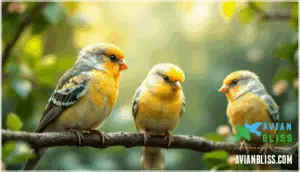
Reading your bird’s emotional state isn’t guesswork—it’s about spotting the subtle shifts in posture, feather position, and movement that reveal exactly what’s going on inside their head. These behavioral cues disclose emotional intelligence that transforms your approach to stress reduction and anxiety management.
- Stress signals include rapid breathing, feather fluffing, and pacing—your bird’s way of saying they need space now.
- Fear responses show through pinned eyes, crouched postures, and retreat attempts when threats appear real.
- Contentment signs reveal relaxed feathers, soft vocalizations, and preening—the green light for positive reinforcement training in avian psychology.
Understanding Aggression and Defensive Postures
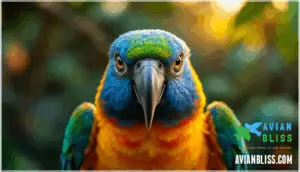
When your bird lunges at your hand with flared wings and a wide-open beak, you’re not dealing with random anger—you’re witnessing a calculated defensive strategy honed over millions of years of survival. Aggression triggers often stem from fear responses—protecting territory, mate, or perceived threats.
Watch for pinned pupils, raised head feathers, and tail fanning—these threat displays telegraph intent before the beak strikes, giving you critical seconds to prevent bites through proper posture analysis and animal behavior modification strategies.
Species-Specific Behavioral Cues

Cockatoos don’t speak the same language as budgerigars—each species evolved distinct visual cues, acoustic signals, and social learning patterns you’ll need to decode.
Your cockatoo’s crest raising signals aggression in 87% of pre-conflict situations, while budgerigars rely on compound auditory-visual cues with 80% accuracy.
Target training through positive reinforcement works across species, but you’ll recognize behavioral adaptation happens differently in each bird.
Creating an Enriching Bird Environment

Your bird’s environment isn’t just a cage—it’s their entire world, and when that world falls short, behavioral problems follow. A bored, understimulated bird will find ways to entertain themselves, and you probably won’t like their creative solutions.
Let’s break down how to build an environment that keeps your bird engaged, healthy, and mentally sharp.
Cage Size and Layout Optimization
Your bird’s cage isn’t just a container—it’s their entire world, and getting the size and layout right can mean the difference between a thriving companion and a stressed, destructive one. Think bigger than minimum requirements—avian behavior thrives when environmental factors support natural movement patterns.
Optimize your cage with these essentials:
- Vertical Expansion allows climbing species to express natural behaviors
- Flight Path Optimization facilitates unobstructed horizontal movement between perches
- Bar Space Planning prevents escapes while accommodating species-specific needs
- Perch Arrangement at varying heights creates territorial zones
- Cage Furniture Design balances enrichment with open space
Strategic environmental enrichment transforms behavior problems at their source.
Providing Perches, Toys, and Swings
Once you’ve nailed the cage dimensions, the real magic happens when you fill that space with perches, toys, and swings that mirror what your bird would encounter in the wild. Smart perch selection and strategic toy rotation create varied avian stimulation that combats boredom and prevents destructive behaviors.
| Enrichment Type | Material Options | Behavioral Benefits |
|---|---|---|
| Natural Wood Perches | Manzanita, java wood, dragon wood | Foot exercise, beak conditioning |
| Interactive Toys | Puzzle boxes, shreddable paper | Mental stimulation, foraging practice |
| Textured Swings | Rope, bamboo, leather strips | Balance training, confidence building |
| Chewable Items | Cork bark, balsa wood, palm leaves | Natural destructive outlet, stress relief |
| Foraging Devices | Treat balls, woven baskets | Environmental enrichment, problem-solving skills |
Rotate enrichment activities weekly—fresh challenges trigger positive reinforcement responses and strengthen your bird training foundation through environmental management.
Foraging Opportunities and Food Puzzles
Wild birds spend up to 80% of their waking hours hunting for food—a stark contrast to your pet bird gobbling pellets from a dish in under five minutes. That’s why food puzzle toys and natural foraging enrichment activities are game-changers for bird behavior modification. Here’s how to bring those instincts back:
- Hide treats inside crumpled paper or cardboard tubes
- Stuff leafy greens between cage bars for extraction practice
- Use commercial puzzle feeders that require problem-solving
- Scatter bird nutrition pellets in shredded paper for search-and-find games
These foraging techniques promote positive reinforcement training and enrichment techniques while satisfying deep-rooted animal behavior modification needs through environmental enrichment.
Rotating and Rearranging Enrichment Items
Even the best foraging setup gets stale if your bird sees the same toys in the same spots day after day—novelty is the secret weapon for keeping curious minds engaged and problem behaviors at bay.
Swap out enrichment items weekly, introducing new foraging variety while rotating familiar favorites back in. Rearrange perch heights and toy placement during your cage refresh to simulate environmental changes that wild birds experience naturally.
This enrichment schedule approach combines positive reinforcement with environmental factors and bird behavior principles, keeping training and enrichment techniques fresh without overwhelming your feathered companion.
Positive Reinforcement Training Techniques

You can reshape your bird’s behavior without force or frustration—positive reinforcement works because it aligns with what your bird naturally wants: rewards, attention, and success. These techniques help you build trust while teaching better habits through consistency and patience.
Here’s how to put these proven methods into practice.
Clicker Training and Treat Rewards
Clicker training transforms abstract praise into a precise language your bird can decode—think of it as capturing the exact moment of brilliance with a sound that says "yes, that’s it!" Here’s how to make it work:
- Master clicker basics by pairing the click sound with immediate treat rewards until your bird understands the connection.
- Choose high-value treats your bird craves—tiny pieces of millet, nuts, or fruit work best for motivation.
- Keep training sessions short at 5-10 minutes to maintain focus and prevent frustration.
- Shape behaviors gradually by clicking closer approximations of your desired outcome, building success step by step.
Target Training for Trust Building
Target training hands your bird the compass to navigate trust—a simple touch of beak to stick becomes the foundation for every interaction that follows. Here’s your roadmap:
| Training Phase | Action Steps |
|---|---|
| Introduction | Present the target stick at beak level, click and reward any interest shown |
| Beak Targeting | Click only when your bird touches the target with their beak, reinforcing precision |
| Distance Building | Gradually move the target further away, encouraging movement and confidence |
| Trust Signals | Watch for relaxed posture and keen approach—proof your Positive Reinforcement is working |
| Behavior Shaping | Use Target Training to guide your bird onto hands, perches, or into carriers without force |
Clicker Methods and Reward Systems transform Bird Training from battle to partnership. Trust Building happens when your bird chooses cooperation over fear.
Replacing Undesired Behaviors With Positive Ones
Transformation isn’t about crushing bad habits—it’s about building better exits your bird actually wants to take. When your bird screams for attention, teach them to ring a bell instead—that’s Behavioral Shaping through Positive Reinforcement training. Reward Systems work because birds repeat what earns them treats, praise, or interaction.
- Identify the trigger, then offer a replacement behavior worth choosing
- Use behavior intervention with training and counterconditioning to redirect energy
- Build Behavior Chains using Desensitization Techniques for lasting behavior modification
Withholding Reinforcement for Negative Actions
Ignoring a behavior can be the loudest thing you say to your bird—silence becomes the consequence that teaches them what won’t work. When you consistently withhold positive reinforcement for negative actions, you trigger Behavioral Extinction—the behavior fades because it earns nothing.
Perfect Reinforcement Timing matters: turn away during screaming, reward quiet moments.
This behavior intervention using training and counterconditioning reshapes avian behavior without punishment, proving Action Ignoring beats scolding every time.
Managing Stress and Anxiety in Birds

Birds are sensitive creatures, and when stress builds up, it shows in their behavior. You can’t fix anxiety overnight, but you can create conditions that help your bird feel safe and settled.
Here are four proven strategies to reduce stress and restore calm.
Reducing Noise and Environmental Chaos
If your bird’s world feels like chaos—constant noise, foot traffic, and unpredictable disruptions—it’s no surprise that stress and behavioral problems follow close behind. Create quiet spaces where your bird can retreat from commotion, and use positive reinforcement when they remain calm in noisy moments.
Environmental enrichment works best in calming environments, so minimize chaos by controlling household volume and limiting sudden disturbances that trigger stress responses.
Ensuring Adequate Sleep and Routine
Sleep isn’t optional—it’s survival; without 10–12 hours of uninterrupted darkness each night, your bird’s stress hormones spike, triggering behavioral issues that no amount of training can fix.
Establish a consistent routine that respects your bird’s circadian rhythm:
- Cover the cage at the same time nightly for environmental calming
- Reduce noise and dim lights to support natural sleep patterns
- Pair routine scheduling with positive reinforcement when your bird settles calmly
Consistent pet bird care and management prevent the behavioral fallout that exhausted bird owners face daily.
Gradual Introductions to New Stimuli
Once you’ve built trust through sleep and routine, you can start broadening your bird’s world—but push too fast with new toys, people, or foods, and you’ll watch that hard-earned calm unravel into feather-picking fear. Socialization techniques require patience: introduce one stimulus at a time, pairing novel food exposure or new toy introduction with clicker training rewards.
| Stimulus Type | Introduction Method | Positive Reinforcement Timing |
|---|---|---|
| New toys | Place outside cage first | Reward calm observation |
| Unfamiliar people | Start at distance | Target training during approach |
| Novel foods | Offer alongside favorites | Praise exploration attempts |
| Cage rearrangement | Change one item weekly | Reinforce foraging behavior |
| Sensory stimulation | Brief, controlled exposure | Mark relaxed bird behavior |
Environmental rotation and environmental enrichment work when you respect your bird’s pace—not yours.
Quality Bonding and Out-of-Cage Time
Your bird doesn’t just need time outside the cage—she needs you there, actively building trust that transforms a cautious captive into a confident companion. Social interaction during cage-free time creates the foundation for lasting bonding techniques:
- Share meals together—eating alongside your bird mimics flock behavior and reinforces positive reinforcement through natural social interaction.
- Engage in playtime activities—bird exercise through interactive games strengthens building trust with birds while satisfying physical needs.
- Practice training and enrichment techniques—even five minutes of target work turns routine bird behavior into collaborative connection.
When to Seek Professional Help

Sometimes your best efforts won’t be enough to turn things around on your own. When behavior problems persist despite consistent training, or when you notice warning signs that something deeper might be wrong, it’s time to bring in expert support.
Here’s how to recognize when professional intervention can make all the difference.
Persistent or Escalating Behavioral Issues
When your bird’s problematic behaviors refuse to budge despite your best efforts—or worse, they’re spiraling into more frequent or intense episodes—it’s time to acknowledge that patience alone won’t crack this particular code.
Escalation patterns—whether aggression that’s intensifying, feather plucking that’s becoming obsessive, or new behavioral issues emerging—signal that you need intervention strategies beyond typical home remedies.
Identifying behavioral triggers and implementing crisis management with professional guidance can prevent irreversible harm and kickstart proper recovery techniques.
Signs of Underlying Health Problems
Sometimes behavior problems aren’t just behavior problems—they’re distress signals pointing to something physically wrong. Respiratory issues like labored breathing, neurological signs such as seizures or imbalance, and plumage changes including persistent fluffing all demand immediate health monitoring.
Lethargy, appetite shifts, abnormal droppings, or sudden aggression can mask infections, metabolic disorders, or pain that no behavioral cue alone will solve. Your bird’s wellness depends on recognizing these red flags fast.
Role of Avian Veterinarians and Behaviorists
Bringing avian specialists into the picture changes everything. A 2025 report shows that 94% of birds with problematic behaviors benefit when veterinary guidance combines medical workups, avian nutrition adjustments, and environmental enrichment.
Certified applied behaviorists use diagnostic approaches and behavioral therapy to tackle feather plucking, aggression, and screaming—improving outcomes by 35% when professionals collaborate.
Together, avian veterinarians and an avian behaviorist decode bird behavior and psychology, turning chaos into progress.
Frequently Asked Questions (FAQs)
What should I do if my bird’s behavior changes?
Notice any shift—however subtle—in your bird’s routine, vocalizations, or body language. Behavioral warning signs often signal stress, illness, or unmet needs.
Consult an avian behaviorist immediately to address these behavioral issues before bird behavior problems escalate.
What should you do when your bird misbehaves?
Punishment? That’s the fast track to a feather-plucking neurotic. When your bird acts out, pause and observe—what triggered it? Keep a Behavior Diary to spot patterns.
Consistency Matters: Use positive reinforcement and bird training to Redirect Attention toward desired actions, Ignore Attention-Seeking screams, and address bird biting behavior through understanding, not scolding.
How do you train a new bird?
Start with target training—teaching your bird to touch their beak to a stick. Use clicker training paired with positive reinforcement to shape behaviors gradually.
Trust building takes patience, but behavioral shaping through consistent training methods accelerates bird socialization during new bird introduction.
How do you stop a bird from biting?
Bites look like aggression, but they’re often fear in disguise. Identify triggers first, then use Positive Reinforcement Techniques and Trust Building to replace biting with Beak Control through Bite Inhibition training, reducing Aggressive Bird Behavior with patient Fear Reduction.
How do you tame a bird?
Taming a bird takes consistent positive interaction and patience matters above all.
Building trust with birds requires daily management techniques using vocal cues, treats, and calm movements.
Behavior modification through positive reinforcement training establishes the foundation for successful bird training and enrichment.
How do you teach a bird to step up?
Offering your finger as a "bridge" teaches step-up through Trust Building and Hand Training. Position your hand near the bird’s perch at chest level, use Target Training with treats for Positive Reinforcement Training, and reward each approach to establish Reward Systems effectively.
How do I introduce multiple birds safely?
Quarantine each bird separately for at least 30 days before introductions. Use neutral territory for supervised interactions, watching closely for aggression.
Monitor flock dynamics and body language. Facilitate environmental enrichment to foster bird socialization and avian compatibility in multi-bird housing arrangements.
What diet changes improve bird behavior most?
Better nutrition often causes problems before solving them—switching foods can trigger temporary behavioral issues.
Prioritize nutrient balance through pellet quality and fresh fruits alongside food variety.
Vitamin supplements support avian health when diet and nutrition for birds address bird behavior problems.
Proper pet bird care transforms bird health and wellness.
Can mirrors or reflections cause behavioral problems?
Yes, mirrors and reflections create serious behavioral problems in birds. Your bird sees its reflection as another bird, triggering mirror anxiety and reflection stress as visual triggers.
This causes excessive vocalization, aggression, or social mimicry that damages mental health. Remove mirrors entirely to prevent these avian behavior problems and environmental factors that fuel behavioral issues.
How long does behavior modification typically take?
Here’s the reality: 90% of bird behavior issues resolve when owners combine environmental changes with consistent training. Behavior modification usually takes weeks to months, depending on how long the problem’s existed and your consistency.
Some birds show progress in days, while deeply ingrained behaviors need sustained positive reinforcement training. Realistic expectations matter—setbacks happen, especially during the maintenance phase. Your persistence pays off more than the calendar does.
Conclusion
A stressed parrot is like a smoke detector going off—it’s not malfunctioning, it’s alerting you to danger. By mastering bird behavior modification, you decode those signals and eliminate the threat.
Your patience with enrichment, body language, and positive reinforcement rewires their nervous system. The screaming stops. The plucking ceases. Trust replaces fear.
This isn’t about controlling your bird; it’s about partnership. When you understand what they need, they stop fighting and start thriving beside you.
- https://archive.news.ufl.edu/articles/2018/01/noise-pollution-causes-chronic-stress-in-birds-with-health-consequences-for-young-1.html
- https://www.frontiersin.org/research-topics/60261/environmental-challenges-to-avian-populations-a-physiological-perspectiveundefined
- https://phys.org/news/2022-03-bird-behavior-linked-climate.html
- https://abcbirds.org/blog/climate-change-impact/
- https://pmc.ncbi.nlm.nih.gov/articles/PMC9526030/