This site is supported by our readers. We may earn a commission, at no cost to you, if you purchase through links.

Watch a flock of geese slicing across the autumn sky in perfect V-formation, and you’re witnessing a marvel of physics and instinct—one that shaves up to 25% off their energy bill for the journey.
Not every bird takes the same approach: a kestrel hovers on a breeze, a goldfinch bounces through the air in a looping arc, and a swallow darts after insects with lightning pivots. Understanding bird flight patterns isn’t just a matter of curiosity; it’s a window into anatomy, adaptation, and the subtle strategies that let these animals thrive in every corner of the world.
Table Of Contents
- Key Takeaways
- Key Bird Flight Patterns Explained
- Anatomy Influencing Bird Flight
- Aerodynamics and Forces of Flight
- Wing Shapes and Flight Adaptations
- Identifying Birds by Flight Patterns
- Energy Conservation in Avian Flight
- Frequently Asked Questions (FAQs)
- What are bird flight patterns?
- What are the basics of bird flight?
- How do birds decide who flies in front?
- How do birds navigate during nighttime migration?
- What causes birds to change altitude while flying?
- How do weather conditions affect flight patterns?
- Do juvenile birds fly differently than adults?
- How do injured birds compensate in flight?
- How do weather changes affect bird migration timing?
- What sensory cues do birds use for navigation?
- Conclusion
Key Takeaways
- Different bird species use unique flight patterns—like direct, soaring, or bounding—not only to save energy but to survive and thrive in their habitats.
- Wing structure, muscle coordination, and tail control all play crucial roles in shaping flight maneuverability, lift, and overall efficiency.
- Birds flying in V-formations can reduce their energy use by up to 25%, swapping leaders to share workload and extend migration ranges.
- Survival strategies include gliding on thermals, rapid takeoffs, and agile maneuvers, with each bird’s anatomy finely tuned for energy efficiency and adaptation.
Key Bird Flight Patterns Explained
When you watch birds overhead, you’re seeing more than random wing flaps—each species moves through the air with distinct patterns shaped by their anatomy and survival needs.
For a deeper look at how unique bird traits and flight styles help them thrive, check out this guide to bird anatomy and adaptations at Avian Bliss.
These flight styles reveal how birds balance energy expenditure with distance, speed, and maneuverability. Let’s break down the primary patterns you’ll observe in the wild.
Direct Flight Pattern
When you spot a duck or pigeon powering through the sky in a ruler-straight line, you’re watching direct flight—the simplest pattern to recognize. Unlike finches that bounce up and down, these birds keep their wings beating in a steady rhythm, never fully folding them mid-air.
That continuous flapping drives flight speed control and aerodynamic forces, though it burns more energy than glide-heavy styles. Wing shape matters too: ducks use long, pointed wings to cut drag and maintain impressive cruising speeds over open water.
Birds like ducks and herons display direct flight patterns in birds that help distinguish them from other species.
V-Formation and Flock Dynamics
When you watch geese or pelicans forming a V in the sky, you’re seeing flock behavior at its most efficient. Each bird rides the upwash from wingtip vortices, slicing energy costs by up to 25%. That’s why these formations stretch migration distances and keep heart rates lower.
Flock dynamics hinge on smart leadership swaps and tight spacing, with formation stability adapting to turbulence. Aerodynamic benefits in V-formation are no accident—these birds work together, not just flying, but orchestrating a symphony of aerodynamic forces.
Recent studies have also measured energy savings for follower birds under controlled conditions.
Hawking and Soaring Patterns
While V-formations showcase teamwork, hawking and soaring patterns reveal the solo artistry of bird flight. Raptors like hawks and eagles use soaring techniques, circling on broad wings to exploit thermal updrafts. These birds barely flap, relying on aerodynamic lift and subtle wing adjustments to stay aloft—think of them as gliders, not marathon runners.
Energy costs drop dramatically; Andean condors, for example, can soar for hours, covering over 170 kilometers with minimal effort. In contrast, aerial pursuit hunters such as swifts and flycatchers use rapid, targeted flight maneuvers—hawking insects midair with precision. Here, wing shape and aerodynamics work together, each adaptation tuned for efficiency and mastery in the sky.
Bounding and Undulating Flight
If you’ve ever seen a finch or woodpecker dart across a clearing, you’ve witnessed bounding and undulating flight in action. Unlike the steady soaring of raptors, these small birds use bursts of rapid wing movement, alternating quick flaps with folded-wing glides. The result? A roller-coaster path, shaped by Flight Mechanics and Aerodynamic Forces, where each bounce and dip reflects evolutionary fine-tuning for Energy Efficiency.
Woodpeckers favor deeper undulations—longer glides punctuated by powerful climbs—while warblers weave a gentler, side-to-side arc. This flight pattern isn’t just about style; it’s about survival. In dense habitats, unpredictable movement helps evade predators and conserve energy during Bird Migration.
Next time you’re out, look for:
- Rhythmic bounce patterns unique to each species
- Folded-wing pauses revealing Wing Movement strategies
- Up-and-down arcs shaped by wing anatomy and flight patterns
Anatomy Influencing Bird Flight
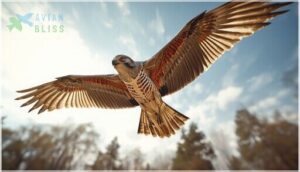
Every bird’s flight anatomy starts with its anatomy, shaping how it moves through the air.
If you’re curious about what makes these creatures so agile, you’ll want to look closer at their bones, muscles, and feathers. Here’s how each part plays a unique role in flight.
If you’d like to dive deeper into their unique adaptations and worldwide habitats, check out this detailed guide to pelican species and their global range Pelican Species: Global Range and Unique Adaptations.
Bone Structure and Weight Reduction
Imagine if your skeleton were trimmed for flight—bird anatomy does exactly that. Pneumatic bones, packed with air spaces, shave off up to 13% of skeletal mass in some species.
Skeletal fusion, especially in the wing structure, cuts unnecessary joints, streamlining movement. Keel placement centers the main flight muscles, anchoring power without excess bulk. Dense bone tissue keeps everything strong yet light, making avian anatomy and physiology a masterclass in efficient bird flight.
Wing Muscles and Their Functions
Precision and teamwork—these are the hallmarks of bird flight muscle anatomy. You’ll find the pectoralis, a powerhouse that makes up nearly 20% of body mass, pulling the wing down and forward with extraordinary force. Deep beneath, the supracoracoideus uses a pulley system to snap the wing upward, ensuring rapid cycles and efficient wing movement control.
This duo manages over 70% of a pigeon’s flight muscle mass, a clear indication to avian physiology’s focus on power output mechanics. For clarity, consider these essentials:
- Pectoralis drives the downstroke, generating both lift and thrust.
- Supracoracoideus elevates the wing, resetting for the next beat.
- Muscle fiber types—red for endurance, white for bursts—shape each bird’s flight style.
Wing shape and aerodynamics hinge on this muscular coordination.
Tail Feather Roles in Maneuvering
Tail control is your bird’s secret to aerial finesse. Through feather flexibility, rectrices fan, twist, and tilt, acting as aerodynamic control surfaces for tight turns and rapid braking.
For instance, hawks carve sharp arcs by spreading one tail side more than the other, tightening their radius. This nuanced anatomy supports maneuvering techniques, balancing flight stability and lift, so birds masterfully adjust to shifting aerodynamics and complex flight patterns.
Aerodynamics and Forces of Flight
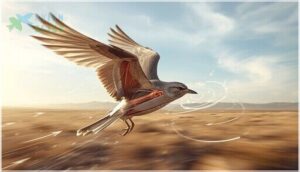
When you watch a bird in bird flight, there’s a lot happening beyond what meets the eye.
The forces at play shape every movement and pattern you see overhead. Let’s break down the key mechanics that make bird flight possible.
Lift, Thrust, Drag, and Gravity
Picture bird flight as a four-way tug-of-war—Wing Lift pulls you up, Thrust Generation pushes you forward, Air Resistance drags you back, and Gravity Effects anchor you down. When these Aerodynamic Forces balance, flight stays level.
Shift the balance, and birds climb, dive, or glide. Your understanding of flight mechanics hinges on how birds master this constant aerial negotiation through specialized wing anatomy.
Angle of Attack and Wing Loading
Ever wonder how birds fine-tune their flight maneuvers so effortlessly? It’s all about angle of attack and wing loading.
By adjusting wing anatomy, birds manipulate airflow dynamics for ideal lift generation. If a bird pushes its wings past the critical angle—about 15 degrees for small wings—a stall occurs.
Wing efficiency hinges on balancing weight and surface area, shaping aerodynamics and flight mechanics. High wing loading demands speed; low wing loading enables agile, slow flight.
The Downstroke and Upstroke Mechanics
If you’ve watched a bird in flight, you’ve seen a masterclass in Wing Motion and Feather Dynamics. The downstroke, powered by the pectoralis muscle, sweeps the wing forward and downward, generating lift and thrust—Aerodynamic Forces at work.
On the upstroke, the supracoracoideus muscle flexes the wing closer to the body, minimizing drag. This Stroke Cycle, with precise Muscle Functions, lets birds balance energy and adapt their wing mechanics for speed, terrain, and the demands of bird flight anatomy and aerodynamics.
Wing Shapes and Flight Adaptations
When you look at a bird’s wings, you’re seeing a story of adaptation and survival. Different shapes and structures give each species its own flight strengths.
Let’s explore how these variations shape the way birds move through their world.
Aspect Ratio and Wingtip Shape

Wing anatomy is your window into bird flight mastery. When you compare aspect ratios and wingtip shapes, you see how birds balance Wing Efficiency and Aerodynamic Forces. High aspect ratio wings excel at Lift Generation and minimize Wingtip Vortices, while elliptical tips boost Flight Maneuvers.
Consider:
- Efficient gliding
- Quick turns
- Reduced drag
- Enhanced wing structure
- Specialized aerodynamics
Short Vs. Long Wing Functions

If you’ve studied aspect ratios, you know how Wing Span Variations shape flight. Now, let’s look at short versus long wings. Grouse, with short wings, burst skyward and zigzag through dense brush—Flight Maneuverability at its finest. Albatross, on the other hand, glide for hours, riding air currents thanks to Aerodynamic Advantages and Energy Efficiency.
Wingbeat Patterns reflect anatomy: rapid flapping for quick escapes, slow strokes for endurance. This trade-off is everywhere in bird flight.
- Rapid takeoffs save lives in tangled habitats
- Tight turns mean survival for forest hunters
- Long wings grant seamless soaring over oceans
- Short wings burn energy fast but deliver explosive speed
Specialized Wings for Habitat Needs

If you compare grouse and albatross, you’ll see how Wing Morphology adapts to Habitat Adaptation. Forest birds—think doves or turkeys—sport short, rounded wings, giving them nimble Flight Maneuvers through tangled branches.
Meanwhile, seabirds like albatrosses rely on high aspect ratio wings for Aerodynamic Efficiency over open water. Anatomy and Feather Structure aren’t just for looks; they’re suited to survival. From dense forests to windswept oceans, wing structure is a blueprint for bird flight, shaped by the demands of each habitat.
Identifying Birds by Flight Patterns

Spotting birds in flight styles isn’t just about quick reflexes—it’s about knowing what to look for.
Different species reveal themselves through distinct flight behaviors.
Here’s how you can recognize them by the way they move through the air.
Songbird and Finch Flight Recognition
Ever noticed how a finch in flight looks like a bouncing ball? That’s the bounding flight pattern—rapid wingbeat clusters, then a smooth glide, making their path undulate across the sky.
You’ll spot Flight Speed Variations and distinct Wingbeat Patterns, especially in finches and warblers weaving through foliage.
Feather Adaptations and specialized wing structure create aerodynamic advantages, letting these birds navigate Migration Routes and dense habitats with notable agility and unmistakable bird behavior.
Large Bird Formations and Behavior
Precision in the sky—watch a V-formation during bird migration, and you’re seeing flock dynamics at work. Large birds like geese rotate leadership, letting each member share the aerodynamic benefits and energy costs. Through constant group coordination, honks and body signals keep the formation tight, while social learning helps younger birds master migration patterns.
This flocking behavior isn’t just about staying together; it’s survival engineering. You’ll notice:
- Rotating lead roles
- Synchronizing wingbeats
- Efficient spacing for lift
- Vigilant predator scanning
- Real-time communication for bird socialization
Observing Flight in Different Habitats
Habitat shapes every bird flight you’ll observe—think of it as nature’s obstacle course. In Forest Flight, warblers dart in bursts, weaving through branches.
Wetland Migration showcases sandpipers hugging waterlines, while Urban Birding forces detours around glass and steel. Grassland Soaring means low, level passes, and Coastal Surveys reveal dense, crisscrossing migration patterns.
Here’s a quick reference:
| Habitat | Flight Pattern Example |
|---|---|
| Dense Forest | Quick, weaving bursts |
| Wetland/Coastal | Low, direct group flights |
Energy Conservation in Avian Flight

Birds have mastered ways to save energy efficiency while flying, and their strategies are surprisingly varied.
Whether they’re crossing continents or circling a forest, efficiency is key.
Let’s take a closer look at how they pull it off.
Efficiency of Formations Like The V-Shape
Picture a flock of geese carving a “V” across the morning sky—what you’re really seeing is nature’s blueprint for aerodynamic benefits in action. The V-formation isn’t just crowd control; it’s a masterclass in flight efficiency. Each bird places itself to ride the upwash from the bird ahead, cutting induced drag and boosting energy savings by up to 25%. That’s how flocks stretch migration patterns, sometimes gaining 70% more range than any lone traveler could hope for.
Geese flying in V-formation harness each other’s updrafts, saving up to 25% energy and soaring farther than any could alone
The secret sauce? Vortex optimization, precise formation dynamics, and a rhythm of rotating leaders. Here’s what’s at stake:
- Less muscle strain, more endurance
- Smoother communication and navigation
- Fair workload sharing through leader rotation
- Sharper group coordination in changing winds
- Dramatically extended migratory journeys
Bird flight, fundamentally, is teamwork elevated by aerodynamics.
Gliding and Soaring Strategies
What if you could travel for hours without breaking a sweat? Birds do just that, harnessing Thermal Soaring, Ridge Lift, and Kinetic Soaring to glide vast distances. By mastering Glide Control, they tweak wing shape and body posture, riding updrafts with minimal effort.
These Soaring Techniques—spiraling in thermals, hugging ridges, weaving through wind gradients—turn aerodynamics into art, letting birds conserve energy and outfly their limits.
| Technique | Key Species | Energy Use |
|---|---|---|
| Thermal Soaring | Vultures, Storks | Minimal |
| Ridge Lift | Hawks, Eagles | Low |
| Kinetic Soaring | Albatrosses | Tiny |
| Glide Control | Many species | Efficient |
Adaptive Behaviors for Long-Distance Travel
When you watch a songbird set off on a 2,500-kilometer crossing, you’re seeing Migration Strategies in action. These Adaptations for LongDistance Flight are stunning: birds double their body mass through premigratory fattening, building Energy Reserves that fuel nonstop journeys.
During Bird Migration, they shrink digestive organs to shed weight while beefing up flight muscles—a trade-off that boosts Flight Optimization. At stopovers, they refuel rapidly, then exploit V-formations for Aerodynamic Benefits that cut energy costs by 25 percent, proving Long Distance Endurance hinges on flexible timing and smart Avian migration patterns.
Frequently Asked Questions (FAQs)
What are bird flight patterns?
Flight patterns describe the unique ways birds move through air—think direct flight, soaring in V-formations, or bounding in curves.
Each style reveals clues about aerodynamics, migration routes, maneuverability, and how birds master energy efficiency.
What are the basics of bird flight?
Bird flight relies on Flight Mechanics and Aerodynamic Principles—lift, thrust, drag, and gravity all interact.
Bird Skeletons are lightweight, Wing Structures generate lift, and Feather Functions reduce drag, letting birds master complex flight patterns through specialized wing anatomy and avian physiology.
How do birds decide who flies in front?
In V-formation bird flight patterns, flock dynamics hinge on leadership roles and energy sharing.
Birds rotate the lead position, using subtle cues and instinctive cooperation to balance flight rotation, reduce fatigue, and support collective migration across vast distances.
How do birds navigate during nighttime migration?
Magnetic compass, celestial navigation, sunset cues, and even olfactory maps work in concert.
Your favorite songbird weaves through the dark by calibrating internal compasses to skylight patterns, using star locations, Earth’s magnetic field, and familiar scents during nocturnal navigation.
What causes birds to change altitude while flying?
Your altitude shifts aren’t fixed when you’re flying—a mix of air currents, thermal lift, wind resistance, and aerodynamic forces constantly push or pull you.
With subtle shifts in wing anatomy and muscle control, you can navigate these altitude shifts efficiently.
How do weather conditions affect flight patterns?
If birds could gripe about anything, it’d be the weather. Wind resistance will force some acrobatics, while storms mean abrupt detours or layovers.
Thermals boost soaring, rain bottles up gliding, and climate shifts invent new migration headaches.
Do juvenile birds fly differently than adults?
You’ll spot clear Flight Development differences—juveniles flap more, tire faster, and show clumsy maneuvers due to weaker muscles, Juvenile Plumage, and less refined anatomy.
Their higher Energy Expenditure and Aerodynamic Differences reflect early Maturity Stages in avian physiology and behavior.
How do injured birds compensate in flight?
Picture a tightrope walker suddenly losing their balance—what do they do?
Injured birds use Asymmetric Flight, modifying wing strokes, tail angles, and flight paths, demonstrating extraordinary Injury Adaptation and subtle Aerodynamic Adjustments for stable, controlled flight.
How do weather changes affect bird migration timing?
When migration begins, Temperature Cues, shifting wind, and Storm Delays all throw off the schedule.
Phenology Mismatch then risks birds arriving after peak food, turning weather into the greatest wild card of bird migration and ecological adaptation.
What sensory cues do birds use for navigation?
Like threads in a tapestry, Magnetic Fields, Sun Compass readings, Star Patterns, Landmarks, and Olfactory Maps all intertwine, guiding avian migration.
Ornithological research shows each cue adapts navigation strategies for ever-changing skies across vast migration patterns.
Conclusion
Like reading the wind’s secret handwriting across the sky, understanding bird flight patterns unlocks a deeper appreciation for adaptability and subtlety in the natural world.
Every swoop, hover, or V-shaped sweep reflects both anatomical finesse and strategies honed by generations. Whether you’re scanning the horizon for distant silhouettes or watching a finch dart between branches, you’ll recognize that each wingbeat sketches a survival story—and, if you listen closely, an invitation to keep asking how and why it all works.
- https://pmc.ncbi.nlm.nih.gov/articles/PMC11285787/
- https://academic.oup.com/icb/article/64/6/1766/7687148
- https://royalsocietypublishing.org/rstb/article/379/1904/20230116/42782/Continental-scale-patterns-in-diel-flight-timing
- https://www.biorxiv.org/content/10.1101/2024.08.18.608464v1.full-text
- https://news.westernu.ca/2023/09/bird-migration-breathing-pattern/