This site is supported by our readers. We may earn a commission, at no cost to you, if you purchase through links.
 Three-quarters of Earth’s bird species call forests home, yet they represent just one chapter in a remarkably diverse story. From the mangrove-lined coasts where herons stalk through tidal shallows to the steel-and-glass canyons where peregrine falcons nest on skyscraper ledges, birds have colonized nearly every habitat our planet offers.
Each ecosystem—whether tropical rainforest, prairie wetland, or bustling city center—shapes the species it harbors through distinct resources, structural features, and survival challenges. Understanding these different types of avian ecosystems reveals not just where birds live, but how evolutionary pressures and environmental conditions have sculpted their anatomy, conduct, and ecological roles across wildly different landscapes.
Table Of Contents
Key Takeaways
- Forests house roughly 75% of Earth’s bird species and showcase how layered canopy structures and vegetation complexity drive evolutionary specialization, with tropical forests supporting three times the avian diversity per area compared to temperate zones.
- Wetlands serve as critical lifelines for over one-third of North America’s bird species, providing essential stopover sites and breeding grounds, though habitat loss has disrupted migration routes for 33 waterbird species and eliminated more than half of original U.S. swamps.
- Urban environments now support about 20% of global bird species, where behaviorally flexible birds demonstrate remarkable adaptations—including reduced fear responses, earlier breeding cycles under artificial light, and 35% faster problem-solving abilities—though building collisions kill over one billion birds annually in the U.S. alone.
- Each ecosystem type—from grasslands facing 53% population declines since 1970 to deserts where birds tolerate body temperatures reaching 45.3°C—imposes distinct selective pressures that shape anatomy, foraging strategies, and survival mechanisms, revealing how environmental conditions continuously sculpt avian diversity across landscapes.
What Are Avian Ecosystems?
When you step into the realm of birds, you’re really exploring the spaces where they live, eat, and thrive. Avian ecosystems are more than just backdrops—they’re vibrant environments shaped by food availability, water sources, shelter options, and the unique ways birds have adapted to each setting.
Let’s break down what makes these ecosystems tick, starting with the basics that every bird depends on.
Definition and Key Characteristics
Avian ecosystems are ecological systems where bird species interact with their physical environment and other organisms within specific habitats. These systems encompass forests, wetlands, grasslands, and urban areas, each defined by distinct climatic, vegetative, and topographic characteristics that shape species diversity and ecological balance.
You’ll find birds occupying varied niches—dispersing seeds, controlling insects, and maintaining ecosystem services that support broader environmental health. Each avian habitat provides essential resources for bird migration, nesting, and reproduction, creating complex networks that reflect both natural adaptation and environmental conditions.
The availability of essential habitat elements plays a pivotal role in determining the suitability of these ecosystems for various bird species.
Essential Elements for Bird Survival
Birds can’t survive on instinct alone—they need specific resources woven into their habitats. Food sources drive everything: insectivorous species consume up to 75% insect biomass in forests, while seed-eaters face 40% population drops when seeds dwindle.
Water quality matters just as much, boosting fledging survival by 37% in arid zones. Nesting sites provide shelter from predators, and climate resilience determines whether populations thrive or crash during extreme weather.
Understanding climate change impacts is essential for managing avian ecosystems effectively.
Role in Bird Adaptation and Diversity
Habitat complexity shapes avian diversity through resource partitioning—when multiple vegetation types coexist, species carve out distinct niches, reducing competition. Structural layers in forest canopies, for example, allow different species to forage at separate heights.
Climate plays an equally powerful role: tropical forests host three times more bird species per area than temperate zones, while mid-elevation sites between 1,000 and 2,000 meters harbor peak biodiversity due to moderate temperatures.
These ecosystem services—pollination, seed dispersal, pest control—create feedback loops that maintain habitat diversity, making avian ecology a cornerstone of biodiversity conservation and species interactions.
Forest Avian Ecosystems
Forests shelter roughly three-quarters of Earth’s terrestrial bird species, making them the richest avian ecosystems on the planet. From the towering canopies of tropical rainforests to the quiet understories of boreal woodlands, these habitats offer layered environments that support an astonishing range of specialized birds.
Forests shelter three-quarters of Earth’s bird species, from tropical canopies to boreal understories, creating the planet’s richest avian ecosystems through layered habitats
You’ll find that each forest type presents unique characteristics that shape which species thrive there and how they’ve adapted to survive.
Types of Forests (Tropical, Temperate, Boreal)

You’ll find three forest types essential to avian ecology, each with distinct characteristics. Tropical forests, covering 18% of Earth’s land, host an impressive 72% of bird species, with Colombia boasting the world’s highest count at 1,917 species.
Temperate forests support complex bird assemblages, but habitat loss has significantly impacted these ecosystems, affecting 66% of species since 1985.
Boreal forests serve as vital breeding grounds for nearly 3 billion birds annually, including 325 migratory species. These ecosystems are critical for conservation strategies, especially amid the growing effects of climate change.
Bird Species Diversity and Specializations

North American forests host 440 bird species organized into 20 ecological guilds, reflecting impressive species richness and avian adaptation. Insectivores dominate diversity within these ecosystems, while granivores concentrate 43% of biomass despite fewer species.
The boreal forest alone sustains 200 bird species, with over 75% of warbler species migrating north annually for breeding—approximately 1 billion birds.
This habitat specialization demonstrates how avian ecology shapes biodiversity conservation strategies, as habitat fragmentation increasingly threatens these intricate bird migration patterns across diverse habitat types.
Structural Features Supporting Bird Life

Layered canopies and dense understory vegetation define habitat complexity in forest ecosystems, directly influencing where birds nest and feed. Vertical stratification matters—forests with varied height profiles support 25% more avian species than single-layer woodlands, while standing snags exceeding eight meters boost cavity-nesting bird abundance by approximately 18%.
You’ll find these structural elements create distinct nesting sites and food sources:
- Canopy diversity: Trees over 20 meters provide perching and foraging opportunities for 40% of woodland species
- Understory density: Thick vegetation increases nest site availability, raising nesting success by 15% for certain passerines
- Deadwood presence: Volumes above 10 m³ per hectare increase foraging site variety across multiple guilds
- Age variability: Mixed-age stands support 22% higher species richness, counteracting fragmentation effects
Water availability and geographic features intersect with vegetation structure to shape avian ecology throughout forest bird habitats.
Wetland and Aquatic Bird Habitats

Wetlands and aquatic environments create some of the richest bird habitats on Earth, where water shapes everything from feeding strategies to nesting conduct.
You’ll find these ecosystems support species that have evolved extraordinary adaptations for life at the water’s edge and beyond.
Let’s explore the specific wetland types, the unique traits birds develop for aquatic living, and why these habitats matter so much for survival.
Marshes, Swamps, and Lake Ecosystems
Marshes, swamps, and lake ecosystems are critical wetland habitats supporting millions of aquatic birds. The Great Lakes alone host over 10 million waterbirds annually, while marshes across this region provide 14% of all marsh bird habitats in the USA and Canada.
Swamp habitats shelter specialists like Prothonotary Warblers, though over half of original U.S. swamps were lost by the 1980s.
Despite habitat loss threatening wetland conservation, recent monitoring shows 50% of marsh-breeding species increased in abundance, demonstrating these ecosystems’ resilience when protected.
Adaptations for Aquatic Living
You’ll find aquatic birds thriving through exceptional physical adaptations shaped by wetlands and aquatic habitats. Waterproof coatings from specialized glands protect feathers while providing feather insulation through trapped air layers.
Beak specialization ranges from dagger-like structures in herons to comb-like filters in flamingos, demonstrating diverse foraging strategies across ecosystems.
Diving techniques vary by species—penguins reach 22.3 mph underwater using wing-propulsion, while diving ducks employ foot-propulsion for depths exceeding 180 feet.
Aquatic vision relies on nictitating membranes functioning as underwater contact lenses, enabling clear sight during submersion in diverse habitat types within avian ecology.
Importance for Migration and Breeding
Wetlands function as critical lifelines for bird migration patterns, supporting over one-third of North America’s bird species through breeding habits and stopover sites. Migratory waterfowl—ducks, geese, and wading birds—rely on these habitats year-round for rest and feeding along avian routes.
The Prairie Pothole region exemplifies outstanding habitat quality, hosting over 200 species with breeding densities exceeding 100 pairs per square mile.
However, wetland loss has disrupted migration routes for 33 waterbird species, demonstrating how habitat degradation threatens survival across bird migration patterns.
Grassland, Desert, and Scrub Ecosystems
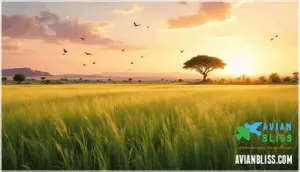
Beyond forests and wetlands, you’ll find birds thriving in open landscapes where grasses stretch to the horizon, deserts test survival limits, and scrublands offer dense, low cover.
These ecosystems demand different adaptations—ground-nesting strategies, heat tolerance, and resourcefulness in sparse environments.
Let’s explore how birds make their homes in grasslands, deserts, and scrub habitats.
Characteristics of Grassland Bird Habitats
Grasslands stretch like golden oceans across continents, yet these bird habitats face severe threats from habitat fragmentation and conversion. Grassland ecology depends on vegetation structure—sites with diverse grass heights support 40% higher bird species richness than uniform areas.
Essential elements of bird habitat here include specific grass cover, with species like dickcissels thriving where grassland cover remains high.
Conservation efforts now protect over 500,000 acres through partnerships, addressing the 53% population decline since 1970 that’s devastated avian ecology and conservation across these critical habitat types.
Avian Adaptations to Desert Environments
Desert bird physiology shows impressive adaptations to arid habitat ecology. While grasslands fade into parched landscapes, desert birds master survival through specialized water conservation and thermal regulation strategies. They’ve evolved notable traits that let them thrive where moisture vanishes and temperatures soar.
You’ll find these birds demonstrate exceptional bird adaptation to habitat:
- Body temperature tolerance reaching 45.3°C helps them manage extreme heat without overheating
- Moisture recapture systems allow species like Cactus Wrens to conserve 75% of exhaled water
- Metabolic efficiency reduces energy needs and respiratory water loss in desert larks
- Behavioral timing shifts activity to cooler dawn and dusk periods, supporting avian migration patterns
These adaptations showcase how avian ecology shapes environmental sustainability in deserts worldwide.
Birds of Shrubland and Scrub Habitats
Beyond arid deserts, shrubland ecology offers a vibrant middle ground where bird adaptation to habitat truly shines. You’ll discover over 40 shrubland-dependent species in New England alone, including Golden-winged Warblers and Prairie Warblers—both facing steep declines as habitat fragmentation transforms their world.
These avian ecology specialists need patches exceeding 10 acres with mixed shrub densities for ideal nesting strategies and breeding success.
Conservation efforts now focus on managing powerline corridors and clearcuts, which provide 75% of active shrubland bird habitat, sustaining these exceptional migrants.
Urban and Modified Avian Ecosystems

You’ll find surprising diversity where concrete meets canopy—urban and modified landscapes now shelter about 20% of the world’s bird species.
Cities and suburbs push birds to rethink their strategies for survival, from nesting on skyscrapers to foraging in parking lots.
Let’s explore how birds navigate these human-dominated spaces, the adaptations that allow them to thrive, and the unique conservation challenges these environments present.
Bird Life in Cities and Suburbs
Surprisingly, urban areas support roughly 20% of the world’s bird species, making city wildlife more diverse than you might expect. Urban birdwatching reveals thriving populations in green space corridors, parks, and suburban habitats where vegetation creates essential bird habitat.
Studies show greenspace area dominates species richness outcomes, proving that strategic urban planning can reverse biodiversity loss. Even small increases in vegetated cover improve avian ecology across metropolitan zones.
Habitat restoration efforts, particularly expanding cemeteries, golf courses, and parks, directly boost abundance and diversity, validating urban planning and wildlife integration strategies.
Adaptation to Human-Altered Landscapes
While cities host diverse bird populations, you’ll notice some species thrive while others struggle with human impact. Birds with flexible traits demonstrate exceptional ecological resilience in urban areas, adjusting to habitat fragmentation, artificial lighting, and noise. Urban planning that prioritizes habitat restoration directly aids avian ecology and wildlife conservation, helping maintain bird migration routes and landscape ecology connectivity across modified environments.
Key adaptations include:
- Behavioral flexibility: Urban-dwelling birds exploit over 20 different food types, achieving 60% higher reproduction success compared to habitat specialists
- Sensory adjustments: Species exposed to artificial light begin breeding 30 days earlier, synchronizing reproductive timing with urban conditions
- Reduced fear responses: Long-term city residents maintain escape distances under 3 meters from humans, compared to 6 meters for recent arrivals
- Cognitive problem-solving: Birds in human-altered landscapes solve novel foraging challenges 35% faster after repeated exposure
- Generalist strategies: Over 70% of urban-tolerant species successfully exploit artificial food sources like feeders and waste sites
Conservation Challenges in Urban Areas
Unfortunately, bird mortality from building collisions exceeds one billion annually in the United States, making urban planning a critical front for ecological conservation and sustainability. Light pollution disorients migrants during peak seasons, while habitat fragmentation reduces bird diversity by 25–50% compared to rural areas.
Habitat restoration through green corridors markedly improves landscape connectivity, and bird-safe glass can cut collisions by over 80%. Wildlife ecology and management strategies must address these environmental impacts of human activity to protect urban areas’ remaining avian populations.
Frequently Asked Questions (FAQs)
How do climate change impacts affect avian ecosystems?
Climate change disrupts avian migration timing, fragments habitats, and threatens ecosystem resilience. Rising temperatures alter food availability and nesting sites, pushing vulnerable species toward extinction.
You’ll see these shifts reshape avian ecology, demanding adaptive habitat management to preserve critical ecosystem services across forest, wetland, and grassland environments.
What role do predators play in bird populations?
Predators shape bird populations by controlling numbers through predation, which influences survival rates and nesting strategies. Birds develop specialized defenses—like alarm calls and flocking patterns—that affect population dynamics and maintain balance in avian ecology throughout different ecosystems.
How do disease outbreaks spread through bird communities?
Disease spreads when birds gather at shared resources like water sources or feeders, where avian pathogens pass through direct contact, droppings, or contaminated surfaces. Migration amplifies transmission as infected individuals carry diseases across continents, affecting bird communities and ecosystem services.
Epidemiology studies reveal these community dynamics shape wildlife ecology patterns.
What are indicator species for ecosystem health monitoring?
Indicator species reveal ecosystem health through their sensitivity to environmental changes, making them valuable for ornithological research and ecosystem management.
Birds like woodpeckers signal forest habitat quality, while shorebirds demonstrate wetland integrity, providing essential biodiversity metrics for wildlife preservation.
How does habitat connectivity influence genetic diversity in birds?
Landscape acts like a bridge between bird communities, weaving populations together. When habitat connectivity thrives, gene flow increases across populations, reducing genetic drift and inbreeding within isolated groups.
This, in turn, strengthens population dynamics and fosters species migration, which is essential for avian biology and ecosystem services.
Conclusion
You might assume that types of avian ecosystems are fixed, static zones, but birds themselves continuously reshape these boundaries through migration, colonization, and behavioral flexibility. From canopy-dwellers threading through rainforest branches to urban specialists nesting on concrete ledges, each habitat type imposes unique selective pressures that shape anatomy, foraging strategies, and reproductive success.
Recognizing these ecosystem distinctions doesn’t just catalog where species occur—it reveals the intricate mechanisms by which environmental conditions sculpt avian diversity. Your understanding of these patterns provides the foundation for predicting how birds will respond to habitat loss, climate shifts, and landscape transformation.
- https://www.jabbnet.com/article/10.31893/jabb.23004/pdf/jabbnet-11-1-e2023004.pdf
- https://vtecostudies.org/blog/forest-bird-monitoring-data-dashboard-goes-live/
- https://www.fws.gov/project/bird-population-indicators-protect-oak-ecosystems
- https://www.audubon.org/magazine/sweeping-new-report-shows-us-birds-declining-sharply-across-range-habitats
- https://www.wetlands.org/wetlands-international-launches-new-online-portal-for-the-worlds-latest-data-on-waterbird-populations/