
This site is supported by our readers. We may earn a commission, at no cost to you, if you purchase through links.
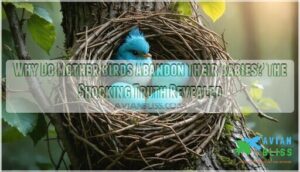 You’ve probably wondered why mother birds abandon their babies, but here’s the surprising truth: they rarely do.
What looks like abandonment is usually smart parenting. Mother birds will leave weak or sick babies to save energy for healthy ones – it’s nature’s tough love.
Sometimes baby birds fall from nests during normal fledgling behavior, not because mom kicked them out. Human interference can also cause temporary abandonment when stressed parents flee perceived threats.
Only about 2-5% of nests are truly deserted. Most "abandoned" babies are actually learning to fly or waiting for parents to return with food. The real story involves fascinating survival strategies you wouldn’t expect.
Table Of Contents
- Key Takeaways
- Reasons for Mother Birds Abandoning Their Babies
- Brood Parasitism in Birds
- The Role of Parental Perception in Nest Abandonment
- Understanding The Natural Population Control Mechanism
- Misconceptions About Birds Abandoning Nests
- What to Do When Encountering a Baby Bird on The Ground
- Frequently Asked Questions (FAQs)
- What to do if a mother bird abandons babies?
- How long will mother birds leave their babies?
- Is it true that if you touch a baby bird the mother will abandon it?
- Why do mother birds abandon their nests?
- How long do birds incubate their eggs?
- What temperature kills developing bird embryos?
- Do weather conditions affect nest abandonment?
- Can birds relocate babies to safer nests?
- Which bird species never abandon their young?
- Conclusion
Key Takeaways
- You shouldn’t assume abandonment when you don’t see parent birds around – Most "abandoned" babies are actually fledglings learning to fly or nestlings whose parents are foraging nearby, with true abandonment occurring in less than 5% of nests.
- You can safely handle baby birds without causing abandonment – The myth that human scent causes mothers to reject their babies is false, since most birds have poor smell abilities and recognize offspring through sight and sound instead.
- You’ll witness nature’s harsh survival strategy when birds do abandon weak chicks – Mother birds strategically abandon sick, deformed, or weak offspring to conserve energy for healthier babies, ensuring species survival through tough resource allocation decisions.
- You should contact wildlife rehabilitators rather than intervene yourself – If you find a truly abandoned nestling (featherless and helpless), don’t attempt care yourself, since they need specialized feeding every 15 minutes that only trained professionals can provide.
Reasons for Mother Birds Abandoning Their Babies
You might think mother birds abandon their babies out of cruelty, but the reality is much more practical and survival-focused.
When you understand the natural triggers like food scarcity, predator threats, and weak offspring, you’ll see that these behaviors actually help guarantee the species’ long-term survival.
Accidental Falls
Imagine this scenario: you’re walking outside when suddenly a tiny nestling tumbles from above.
When a helpless chick suddenly appears at your feet, your heart races—but don’t assume the worst just yet.
These accidental falls create heartbreaking dilemmas for parent birds, who often can’t retrieve their fallen babies despite desperate Rescue Attempts.
Fall Consequences that determine survival:
- Injury Severity varies from minor bruises to fatal trauma
- Parental Response involves evaluating whether rescue is worth precious energy
- Prevention Strategies include choosing secure nesting locations away from windy branches
- Human interference through nest disturbance increases fall risks for vulnerable abandoned nestlings
Sibling Conflicts
Sibling rivalry in bird nests isn’t just squabbling—it’s life or death. When food runs short, chick aggression kicks in as nestlings compete for every morsel their parents bring.
The strongest establish a sibling hierarchy through pecking and shoving, literally pushing weaker siblings out. This resource competition gives survivors a major survival advantage, though it looks brutal to us.
Parents rarely intervene because they’re focused on raising the fittest offspring. Don’t be surprised if you witness this natural selection in action—it’s one of the key reasons for abandonment that guarantees species survival through harsh realities.
This often leads to hunger-driven competition among nestlings.
Deformity
Nature doesn’t always create perfect babies.
When chicks hatch with genetic defects or visible deformities, mother birds face tough choices about parental investment.
These imperfections signal poor survival odds, prompting abandonment to focus energy on healthier offspring.
Common deformity-related bird abandonment scenarios include:
- Cracked or malformed eggshells preventing proper development
- Twisted limbs or wings affecting mobility and feeding ability
- Respiratory issues making chick survival unlikely
- Severe birth defects requiring excessive parental care resources
The decision to abandon is influenced by the severity of the deformity and its impact on the chick’s chances of survival, making genetic defects a crucial factor in this process.
Brood Parasitism in Birds
You’ve probably heard of the sneaky cuckoo that tricks other birds into raising its babies, but brood parasitism goes way beyond this famous example.
When you understand how birds like cowbirds, honeyguides, and even some ducks abandon their own eggs in strangers’ nests, you’ll see that "abandonment" isn’t always about neglect—it’s sometimes a clever survival strategy.
Cuckoos
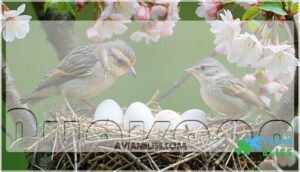
Cuckoos have mastered the art of deception through sophisticated brood parasitism.
You’ll find these sneaky birds don’t abandon their babies—they trick other species into raising them.
Cuckoo mimicry allows their eggs to blend perfectly with host clutches, fooling unsuspecting parents.
This behavior exemplifies cuckoo brood parasitism.
It is a prime example of nature’s ultimate freeloading scheme, ensuring parasitic success while devastating host defenses completely.
| Cuckoo Strategy | Host Response |
|---|---|
| Early egg hatching | Increased feeding demands |
| Egg color matching | Failed recognition attempts |
| Chick size advantage | Resource monopolization |
| Host elimination behavior | Complete brood takeover |
| Parasitic success rates | 70-90% survival advantage |
This cuckoo evolution represents a fascinating case of adaptation, with parasitic success rates reaching as high as 70-90% survival advantage, showcasing the devastating impact on host defenses.
Black Eagle

Unlike most mother birds, black eagles allow their strongest chick to eliminate weaker siblings through brutal sibling aggression. This survival strategy isn’t abandonment—it’s calculated filial cannibalism that guarantees only the fittest offspring survives.
You’ll witness the apex predator’s harsh approach to eagle development, where mother bird behavior actively supports nature’s brutal selection process.
- The stronger nestling attacks and kills siblings within the first week
- Parents continue feeding during deadly sibling conflicts without intervention
- Only one chick survives from each brood despite multiple eggs hatching
- This nest abandonment strategy maximizes resources for the strongest offspring
- Avian parental care focuses entirely on nestling survival of the victor
Black eagles don’t abandon their babies—they orchestrate survival contests where only champions emerge. Raptors can be indicators of change, reflecting the health of their ecosystems.
House Sparrow
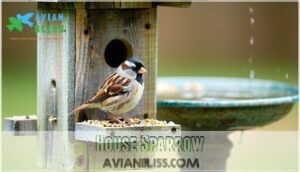
House sparrows shock many people with their ruthless parenting tactics. Female sparrows practice infanticide, deliberately killing chicks fathered by their mates with other females.
This brutal sparrow behavior reduces competition for limited resources and attention. You’ll witness fierce female rivalry as mothers eliminate threats to their own offspring’s survival chances.
Sparrow adaptations include complex mating systems where males defend multiple nests while females compete aggressively. Their varied sparrow diet supports this energy-intensive lifestyle across diverse sparrow habitats.
Unlike true brood parasites, these birds abandon weak nestlings rather than outsourcing parental duties. This mother bird behavior guarantees only the strongest survive, creating effective natural population control.
Understanding sparrow infanticide reveals how nest abandonment serves evolutionary purposes in maintaining species fitness.
The Role of Parental Perception in Nest Abandonment
You might think mother birds abandon their babies based on fear alone, but their decisions actually depend on what they see, hear, and smell around their nests.
When parent birds sense danger from predators or detect unusual scents, they’ll quickly decide whether staying puts their entire family at greater risk than leaving does, which can be influenced by what they see.
Predator Presence

Three major threats trigger nest abandonment when predators lurk nearby.
Nest vulnerability increases dramatically when raccoons, hawks, or snakes target your feathered friends.
Parents recognize attack signs and make tough survival choices:
- Immediate evacuation – Adults flee to protect themselves for future breeding
- Predator identification – Quick assessment of threat level determines response
- Strategic abandonment – Temporary departure prevents leading dangers to offspring
Human Scent

You’ve probably heard the old wives’ tale: touch a baby bird and its mother will reject it forever. This scent misconceptions story has kept well-meaning people from helping fallen chicks for generations.
Here’s the truth that’ll surprise you. Most birds have terrible noses. Their olfactory systems are so weak they couldn’t smell your morning coffee if you poured it in their beaks. Scientific research proves handling precautions aren’t needed because of scent – mother birds simply can’t detect human odor on their babies.
| Bird Species | Smell Ability | Abandonment Risk from Human Scent |
|---|---|---|
| Sparrows | Nearly none | Zero |
| Robins | Very limited | Extremely low |
| Eagles | Poor | None |
| Cardinals | Minimal | Virtually zero |
Parental recognition happens through sight and sound, not smell. Real nest abandonment reasons include predators, illness, or human disturbance – not your fingerprints. Birds may also abandon nests due to extreme weather events.
Understanding The Natural Population Control Mechanism

Beyond predator threats and human interference, mother birds operate under nature’s harsh but effective population control system. You might think it’s cruel, but this process guarantees species survival through strategic resource allocation.
When food scarcity hits, birds can’t afford to waste energy on offspring with poor viability. Evolution has programmed them to make tough calculations about genetic fitness and environmental stressors. It’s like nature’s own quality control department – only the strongest get the full parental investment.
Here’s how this natural selection works:
- Birds eliminate weak or deformed chicks to preserve resources for healthier siblings
- Mothers assess each baby’s survival chances based on genetic markers and development
- Environmental pressures trigger hormonal responses that modify parenting behaviors
This bird offspring neglect isn’t abandonment – it’s evolutionary advantage in action. Understanding why birds abandon certain babies reveals nature’s brutal efficiency in maintaining healthy populations despite harsh conditions. Protecting crucial nesting sites is essential for bird survival.
Misconceptions About Birds Abandoning Nests
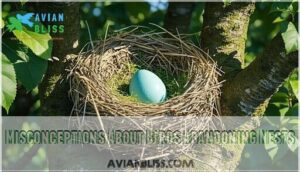
You’ve probably spotted a quiet nest and assumed the mother bird has abandoned her babies, but this common mistake leads to unnecessary worry and harmful interference.
Most bird parents are simply following natural behaviors that can look like abandonment when you don’t understand what’s really happening, which is a result of not recognizing the parents’ abandonment is not actually occurring.
Lack of Adult Bird Presence
You might worry when you don’t see adult birds around their nest, but this adult absence doesn’t mean abandonment.
Parents practice predator avoidance by staying away during daylight hours.
They’re actually protecting their young through strategic nest monitoring.
Feeding frequency naturally decreases as chicks mature, so don’t mistake this normal behavior for bird offspring neglect or parental death.
Sometimes, birds abandon nests due to significant predator threats, which can be a critical factor in nest abandonment.
Nest Activity During Incubation
During the incubation period, you’ll notice dramatically reduced nest activity.
Mother birds aren’t abandoning their eggs—they’re protecting them through strategic parental absence.
This bird nesting behavior serves multiple purposes:
- Egg temperature stays consistent when mothers minimize disturbance
- Predator avoidance keeps threats away from vulnerable nests
- Nest monitoring happens quietly to maintain egg viability without excess nest maintenance
What to Do When Encountering a Baby Bird on The Ground

Now that you understand when birds truly abandon their nests, let’s talk about what you should do if you find baby birds on the ground.
First, don’t panic – most situations aren’t emergencies.
Look closely at the bird to determine if it’s a nestling or fledgling.
Fledglings have feathers and can hop around, which means they’re learning to fly.
Leave them alone unless they’re injured.
For nestlings without feathers, gently return them to their original nest using gloves.
If the nest is damaged, create makeshift nests using small baskets lined with soft materials.
Providing warmth is essential – use a heating pad on low or warm water bottle wrapped in towels.
Keep cats and other predators away from the area.
When you’re truly concerned about orphaned birds, contact wildlife rehabilitators immediately.
They’re trained professionals who can properly assess whether bird rescue is necessary or if the parents are simply nearby, monitoring their young.
Frequently Asked Questions (FAQs)
What to do if a mother bird abandons babies?
Don’t count your chickens before they hatch—observe the nest for several hours first.
If you’re certain she’s gone, contact a wildlife rehabilitator immediately.
Don’t attempt care yourself; babies need specialized feeding every fifteen minutes.
How long will mother birds leave their babies?
Mother birds typically leave babies for 15-20 minutes while foraging, returning up to five times daily.
They’ll stay away longer during incubation but rarely abandon healthy chicks unless you’ve disturbed the nest repeatedly, which can lead to the mother bird abandoning her chicks.
Is it true that if you touch a baby bird the mother will abandon it?
This widespread myth isn’t true.
Birds recognize their babies by sight and sound, not scent.
You can safely handle baby birds when necessary, though wearing gloves protects both you and the bird from potential harm.
Why do mother birds abandon their nests?
Birds abandon their nests when food becomes scarce, predators threaten, or you’ve disturbed their space too much. Sick babies, harsh weather, and parasites also drive mothers away from their nests.
How long do birds incubate their eggs?
Incubation periods vary by species, but you’ll typically see most songbirds sitting on eggs for about two weeks.
Larger birds like ducks need longer—sometimes up to four weeks before their chicks hatch.
What temperature kills developing bird embryos?
Extreme temperatures below 84°F or above 105°F will kill developing bird embryos in their eggs.
You’ll find that even brief exposure to freezing temperatures or excessive heat can stop chick development completely.
Do weather conditions affect nest abandonment?
When it rains, it pours—and severe weather absolutely forces mother birds to abandon their nests.
You’ll find that storms, extreme temperatures, flooding, and harsh winds make nests unsafe, pushing parents to prioritize their own survival over their babies, due to the fact that these conditions make nests unsafe.
Can birds relocate babies to safer nests?
You might wonder if mother birds can move their babies to safety, but they can’t physically relocate them. Instead, they’ll abandon dangerous nests and start fresh elsewhere for future broods.
Which bird species never abandon their young?
While some species seem devoted, no bird species truly never abandons their young.
Even seemingly dedicated parents like eagles, swans, and penguins will abandon nests when faced with extreme threats or resource scarcity.
Conclusion
Understanding why mother birds abandon their babies reveals nature’s complex survival strategies rather than heartless behavior.
You’ve learned that most "abandoned" chicks are actually fledglings learning independence or temporarily alone while parents forage.
True abandonment occurs in less than 5% of cases, usually involving sick offspring or extreme stress.
Next time you spot a baby bird on the ground, remember it’s likely following natural development patterns, not experiencing parental neglect, and this understanding can help you see the situation as part of natural development and not a result of parental neglect.
- https://pmc.ncbi.nlm.nih.gov/articles/PMC10434784/
- https://www.nature.com/articles/ncomms10985
- https://www.quora.com/Why-do-birds-throw-their-baby-birds-away-and-kill-them-sometimes-Is-there-a-chance-of-their-survival-if-a-human-takes-care-of-them
- https://besjournals.onlinelibrary.wiley.com/doi/10.1111/j.1365-2656.2007.01248.x
- https://www.pnas.org/doi/10.1073/pnas.2008955117



Cassie
August 20, 2025 at 12:37 PM
It was so hot and humid for so long this summer, that I worried about the mother and baby birds in the nest on my porch. She sat there all day long, was rarely gone. I added a bit of shade and put out a big bowl of water, but never saw her use it. Now the birds are hatched, and mom is gone all day long. Father still comes at times, calls to the birds, they do not stand up, they must be weak. He fed them for about half a minute, just 2 birds that I saw from below - then he left. I worry that they have abandoned this nest. When I've watched before, the birds leave for hours to forage, but now I rarely see the mom at all.