This site is supported by our readers. We may earn a commission, at no cost to you, if you purchase through links.

A young chickadee that hasn’t mastered foraging dies within weeks—its parents found food thousands of times daily, yet transferring that skill determines whether their offspring sees spring. This stark reality drives one of nature’s most intricate survival systems.
Bird foraging and feeding behaviors encompass far more than simple hunger satisfaction; they represent complex decision-making processes where each choice balances energy expenditure against nutritional gain while managing predation risk. From warblers plucking caterpillars mid-leap to pelicans timing their plunge-dives with wave patterns, these behaviors shape entire ecosystems through pollination, seed dispersal, and pest control.
Understanding how birds locate, acquire, and process food reveals not just their individual survival tactics, but the intricate ecological relationships that maintain forest health, agricultural productivity, and biodiversity across habitats.
Table Of Contents
- Key Takeaways
- What is Bird Foraging Behavior?
- Key Foraging Strategies in Birds
- Morphological Adaptations for Feeding
- Factors Influencing Foraging Choices
- Social Dynamics and Foraging
- Daily and Seasonal Foraging Patterns
- Dietary Needs and Nutritional Requirements
- Feeding and Digestion Processes
- Ecological Roles of Foraging Birds
- Human Impacts on Bird Foraging
- Frequently Asked Questions (FAQs)
- Conclusion
Key Takeaways
- Birds’ foraging behaviors represent complex decision-making processes that balance energy expenditure against nutritional gain while managing predation risk, with each species employing distinct strategies shaped by morphological adaptations like beak shape, leg structure, and sensory systems optimized for their ecological niche.
- Seasonal and daily foraging patterns shift dramatically in response to resource availability—wild birds may forage several times daily in winter but only 2–3 times weekly in summer, while climate-driven mismatches between insect abundance peaks and breeding periods now threaten migratory species’ survival.
- Birds provide essential ecosystem services through their foraging activities, consuming 400–500 million tons of insects annually for pest control, dispersing seeds across vast distances (up to 970 km), and cycling nutrients that directly influence agricultural productivity and forest health.
- Human activities have fundamentally altered foraging landscapes, with urbanization driving a 37% decline in insectivorous feeding while supplemental feeding increases disease transmission risks by 46%, and climate change has already reduced predicted foraging habitat by 23% since 1976 with another 32% loss projected.
What is Bird Foraging Behavior?
Bird foraging behavior is the way birds search for, select, and consume food in their natural environments. Understanding these behaviors helps you appreciate how birds survive, maintain ecosystem balance, and adapt to their habitats.
Let’s explore what foraging means for birds, why it matters for both survival and ecosystems, and how natural feeding habits vary across species.
Definition of Foraging in Birds
Foraging in birds means more than just eating—it’s the complete process of finding, acquiring, and handling food in their environment. You’re witnessing behavioral components like detecting prey, moving toward it, capturing it, and processing it before ingestion.
This avian foraging behavior balances energy spent against energy gained, involving:
- Sensory detection of food sources
- Locomotive behaviors to reach resources
- Risk assessment under ecological constraints
- Decision-making about foraging strategies
These evolutionary adaptations shape distinct foraging guilds across species. Eliminating this behavior can lead to excessive feather care, but it’s important to provide mental and physical stimulation.
Importance for Survival and Ecosystems
Birds’ survival depends on efficient foraging—juveniles with poor skills face up to 50% mortality in their first year. But these behaviors ripple outward, shaping ecosystem functioning. You’ll find birds controlling pest populations, dispersing seeds, and cycling nutrients through food webs. Species showing foraging innovation reduce species extinction risk by 60%, while diverse bird communities boost pest control by 65%, directly strengthening ecosystem resilience and population health across habitats. The ability to adapt is linked to species’ persistence, especially in changing environments.
| Ecological Role | Measurable Impact |
|---|---|
| Pest Control | 65% higher attack rates in diverse plots |
| Nutrient Cycling | Integration across multiple trophic levels |
| Population Regulation | Arthropod control bolsters plant health |
| Food Web Stability | 138 species studied across foraging niches |
Overview of Natural Feeding Habits
Understanding how species eat in the wild reveals patterns shaped by season and habitat. Wild bird diets shift dramatically—most forage daily in winter but drop to 2–3 times weekly in summer. Natural food sources drive these adjustments, with fat reserves prioritized before migration. Avian nutrition varies by niche:
- Ground dwellers consume seeds, insects, and vegetation
- Aerial hunters specialize in capturing flying prey mid-flight
- Aquatic foragers target fish and invertebrates in water
Key Foraging Strategies in Birds

Birds have developed three primary foraging strategies that reflect their evolutionary adaptations and ecological niches. Each approach involves distinct morphological features, behavioral patterns, and habitat preferences that increase feeding efficiency.
You’ll find these strategies correspond to specific environments—ground, air, and water—where birds have perfected their techniques over millions of years.
Ground Foraging Techniques
You’ll notice ground foraging birds like thrushes and sparrows master diverse foraging techniques suited to their environment. Some species use double-scratch methods, jumping and swinging feet to uncover hidden food. Others excel at probing soil or pecking surfaces.
Substrate selection matters—bare ground reveals earthworms easily, while lawn substrates attract different feeders. Urban foraging introduces concrete surfaces, though energetic costs increase with distance from protective cover, affecting risk management strategies.
Aerial Foraging Behaviors
While ground-feeders scan earthbound prey, aerial foragers master the art of catching flying insects mid-flight. You’ll witness families like swallows and swifts demonstrate specialized foraging techniques, with some species achieving hunting success rates of around 26% when capturing prey on the wing.
- Morphological traits matter—long, pointed wings and wide mouths enable efficient prey capture during sustained flight
- Flight dynamics shift with insect abundance, as species like Little Swifts adjust foraging distances based on real-time prey availability
- Hover gleaning and hawking strategies let birds exploit different aerial niches, though success increases with experience
- Conservation impacts loom large, since over 73% of aerial insectivore populations have declined since the 1970s
Water-Based Foraging Approaches
When diving birds plunge beneath the surface, water clarity and turbidity effects shape their success. Water-based foragers like Manx shearwaters average 67 dives daily, reaching depths around 8 meters in moderate conditions.
Dive depth peaks when solar angle and water clarity align—sensory adaptation tied to visual prey detection. Webbed feet propel these aquatic foraging specialists through their element with striking efficiency.
Morphological Adaptations for Feeding
Birds are built for the food they eat, and you can see it in every part of their anatomy. From the curve of a beak to the length of their legs, these physical traits determine what they can catch, how they move, and where they can hunt.
Let’s look at the key adaptations that make different feeding strategies possible.
Beak Shape and Function
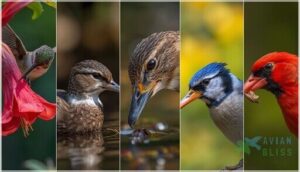
You’ve likely noticed that a hummingbird’s beak looks nothing like a hawk’s—and that’s no accident. Beak morphology directly reflects feeding ecology, with over 1,400 distinct shapes documented across modern bird species. Consider how beak specializations drive functional diversity:
- Nectar feeders sport narrow, elongated bills for probing deep flowers
- Raptors wield hooked beaks for tearing prey
- Waterfowl filter-feed with wide-tipped bills suited for sieving invertebrates
- Insectivores rely on straight, tapered bills for precision strikes
- Seed-crackers possess sturdy, conical bills for crushing tough shells
Genetic regulation through genes like BMP4 and ALX1 controls beak morphologies, with evolutionary rates varying greatly across lineages.
Bill morphology and bill probing techniques are tightly coupled—depth alone explains 86% of measurable variation in honeyeaters, demonstrating how form follows function in avian feeding adaptations.
Leg Structure and Locomotion
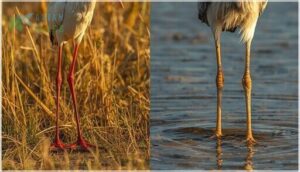
Just as beak shape dictates feeding method, leg structure determines where and how you’ll find birds foraging. Ground foragers like storks possess considerably longer tarsi—leg bones below the knee—optimized for terrestrial locomotion efficiency across open habitats.
Water-based foragers, including wading birds, evolved extended tibiae for depth penetration while hunting aquatic prey.
Genetic adaptation through loci like PTPA drives this limb morphology variation, with habitat influences shaping leg proportions across 11,000 species studied.
Sensory Adaptations in Birds

Your success in finding food depends heavily on sensory adaptations—specialized systems that detect prey and resources across diverse environments. Visual acuity dominates, with over 80% of species possessing tetrachromatic vision to see ultraviolet light and detect ripe fruits. However, sensory perception varies widely:
- Olfactory foraging guides seabirds to phytoplankton hotspots kilometers away
- Tactile receptors in wading bird bills detect prey vibrations in wet substrates
- Auditory cues help owls localize rustling prey within 1–2 degrees
- Magnetoreception aids navigation and spatial memory of food caches
Factors Influencing Foraging Choices
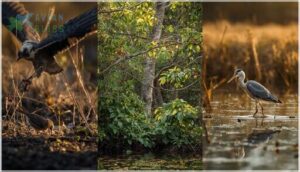
Where a bird chooses to forage isn’t random—it’s a careful calculation shaped by environmental cues, resource availability, and survival instincts. From the structure of their habitat to the ever-present threat of predators, birds constantly weigh competing pressures that determine when, where, and how they feed.
Let’s examine the three primary factors that guide these foraging decisions.
Habitat Type and Structure
You’ll find that habitat type and structure shape where and how birds hunt for food. Mature forests support richer bird communities thanks to forest stratification, offering vertical layers for different foraging techniques. Grasslands boost bird density with abundant prey, while farmland foraging attracts generalists. Wetland avifauna thrives near water edges. Habitat connectivity through corridors allows birds to access scattered resources, improving foraging strategies across fragmented landscapes.
| Habitat Type | Species Richness Impact | Foraging Efficiency |
|---|---|---|
| Mature Forest | Highest diversity, 53% specialists | Superior, shorter foraging paths |
| Secondary Forest | Moderate, 33% specialists | Reduced by 30% in degraded areas |
| Grassland | Higher local density | Good food availability |
| Farmland | Increased numbers, lower evenness | Variable, alternative food sources |
| Wetland | Higher richness, uneven distribution | Dependent on water proximity |
Seasonal Food Availability
Seasonal changes in foraging patterns directly reflect food supply fluctuations throughout the year. Insect abundance drops 50% in northeastern U.S. breeding seasons due to climate impacts, while tropical forests see 44% of birds switching to insects during winter.
Fruit scarcity affects migration patterns—when ripe fruit drops during pre-migration fattening periods, Wood Thrush mortality rises markedly.
Agricultural practices also alter prey availability and foraging, with mixed cropping supporting year-round diversity while monocultures create abrupt resource pulses.
Predation Risk and Safety
Predation risk directly shapes where and when you’ll observe birds feeding. When predator cues appear, foraging time in exposed areas drops 53%, while birds near dense vegetation face 32% fewer interruptions.
Flocking benefits include a 27–45% reduction in individual predation risk. Alarm calls trigger immediate behavioral shifts, cutting visible foraging by 41%.
These vigilance strategies and risk trade-offs fundamentally alter predator-prey dynamics and foraging strategies across habitats.
Social Dynamics and Foraging
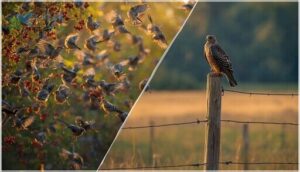
When birds search for food, they don’t always go it alone—some species thrive in flocks while others prefer to hunt solo. The social structure around foraging isn’t just about company, though; it shapes who gets first dibs on the best food and how birds learn where to find their next meal.
Let’s look at how these social dynamics play out in three key ways.
Flocking Vs. Solitary Foraging
When you observe birds feeding, you’ll notice some species prefer company while others hunt alone. Flocking birds achieve higher foraging rates through social information sharing and cooperative vigilance, reducing predation risk considerably. However, these flocking species show greater habitat disturbance sensitivity than solitary foragers.
Behavioral flocking factors include body size, diet type, and foraging strategies, with important conservation flock implications for protecting multiple species simultaneously in fragmented landscapes.
Social Status and Access to Food
Within flocks, dominance hierarchies determine who eats first. You’ll observe house sparrows winning 100% of feeder contests against grosbeaks and finches, while male grosbeaks dominate 80% of interspecific interactions.
This social status translates directly to feeding success—dominant birds consume 28% more food daily than subordinates. Competition stress forces lower-ranking individuals to wait an additional 38 seconds after displacement, though increased feeder density can boost subordinate access by 24%.
Use of Social Information
When you watch birds forage, you’re seeing information transfer in action—great tits with just one informed neighbor are 22 times more likely to find new food. This social information shapes foraging techniques across generations through cultural transmission, influencing habitat exploitation and population impacts.
Individual variation matters too: central flock members respond 37% faster to resource changes, demonstrating how avian foraging relies on collective knowledge for flock safety and foraging benefits.
Daily and Seasonal Foraging Patterns

Birds don’t forage randomly throughout the day—they follow distinct rhythms shaped by energy demands, predation risk, and seasonal changes. Understanding these patterns reveals how birds balance the urgent need to refuel with the equally pressing need to stay alive.
Let’s examine how daily schedules, seasonal shifts, and migration influence when and how intensively birds forage.
Time Spent Foraging Each Day
You’ll find that most wild birds dedicate between 40% and 75% of their daylight hours to feeding activity—that’s roughly 4 to 8 hours daily for many species, though some parrots can push well past 10 hours.
Daily foraging patterns reveal peaks around two hours before sunset, with morning activity starting near sunrise at lower intensity.
Temperature, predation risk, and predictable food sources all shape how long birds spend foraging.
Seasonal Shifts in Behavior
As seasons change, you’ll notice birds alter foraging strategies in response to shifting resources and climate drivers. Breeding season and winter foraging strategies prompt dramatic behavioral adaptations:
- Rufous-capped Warblers drop foraging height 56.5% from wet to dry season
- Insect availability declines 50% in non-breeding periods, triggering dietary changes
- Mixed-species flock composition increases during dry seasons
- Temperature and precipitation directly modulate feeder usage patterns
Impact of Migration on Feeding
Migration patterns impose extreme metabolic demands on birds, reshaping their foraging strategies completely. Two-thirds of North American migratory birds time movements to match food availability, yet climate-driven shifts now create mismatches at breeding sites. Long-distance night-migrants rely on fat metabolism, while day-migrants use protein and glycogen. Urban resources like feeders reduce migratory behavior in 9 of 12 partially migratory species.
| Migration Strategy | Primary Energy Source |
|---|---|
| Night-migrant passerines | Fat metabolism (triglycerides) |
| Day-migrant insectivores | Protein and glycogen |
| Frugivores (long-distance) | Maximized fat storage |
| Urban-adapted residents | Supplemental feeding sites |
Habitat changes at stopovers reduce foraging efficiency, while congregation increases disease risk and competition. Migration timing mismatches, driven by seasonal changes in foraging availability, now threaten energy budgets across migratory birds. You’ll observe that foraging distance and range vary dramatically between migration phases and resident periods.
Dietary Needs and Nutritional Requirements
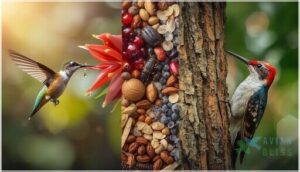
Just like you need a balanced diet to stay healthy, birds require specific nutrients to fuel their high-energy lifestyles and maintain everything from strong flight muscles to vibrant plumage.
Their nutritional needs vary dramatically across species, shaped by evolutionary pressures and ecological niches.
Let’s break down the essential components that keep our feathered friends thriving in the wild.
Protein, Carbohydrates, and Fats
You might think of macronutrient balance as the invisible architecture governing every bird’s dietary habits and feeding habits. Each species navigates unique nutritional needs shaped by their lifestyle, from hummingbirds balancing carbohydrate metabolism to migratory birds prioritizing fat storage.
- Protein requirements vary dramatically: maintenance diets need 7–15%, while growing chicks demand 15–20%
- Carbohydrate metabolism differs by food source—nectarivores process sugars efficiently, carnivores rely on gluconeogenesis
- Fat storage fuels migration through triglyceride oxidation, with diet composition directly influencing synthesis rates
- Species-specific diets reflect distinct prey items and foraging strategies across ecological niches
Vitamins and Minerals
You can’t overlook micronutrients—they’re the hidden drivers of avian health. Vitamin deficiencies plague captive populations: 57.8% consume inadequate vitamin A, while 98.5% fall short on vitamin D3.
Mineral ratios matter too; calcium-to-phosphorus should sit at 2:1 for maintenance, jumping to 10:1 during egg production.
Species requirements vary dramatically, and supplementation impacts become critical when natural food sources lack essential nutrients.
Dietary Diversity in Bird Species
That nutritional groundwork supports substantial variation across species. Dietary diversity in birds spans four major dimensions globally—from herbivores and granivores to carnivores and nectarivores—with 49.6% displaying dietary specialization. Regional variation shapes what you’ll observe: tropical frugivores consume 8–15 distinct fruit species per observation, while temperate insectivores face narrower prey items.
- Mixed-species flocks with 67% invertivores maintaining flexible food source access
- High-elevation specialists experiencing temporal shifts during colder months
- Dietary generalists buffering ecosystem resilience against resource fluctuations
Conservation implications? Specialists face heightened vulnerability as habitat fragments.
Feeding and Digestion Processes

Once a bird spots potential food, a fascinating sequence of physical processes kicks in to get nutrients from the environment into its bloodstream. From the mechanics of how different species grab and swallow their meals to the surprisingly varied ways they stay hydrated, these feeding and digestion processes reveal just how finely tuned birds are to their ecological niches.
Let’s break down the key stages that transform a seed, insect, or sip of water into fuel for flight.
Locating and Selecting Food
Through your eyes and senses, locating food resources begins with sensory mechanisms that detect prey availability and foraging opportunities. You’ll notice habitat influence shapes how birds choose food resources—from visual scanning in open fields to tactile probing in mud.
Food preferences reflect energy content, while social considerations and temporal patterns guide when and where you’ll find birds targeting specific prey items and food sources most efficiently.
Swallowing and Food Processing
Once you’ve watched a bird locate and select food, swallowing mechanics take over. Most species swallow food whole—over 90% lack teeth—so you’ll see them rely on specialized digestion processes. The crop stores food temporarily before the gizzard function grinds it mechanically with ingested grit.
Chemical digestion follows in the proventriculus, where gastric juices reach pH 1.0 in raptors. Intestinal adaptations then boost nutrient absorption:
- The gizzard processes 85% of mechanical breakdown
- Paracellular absorption accounts for 60% of glucose uptake
- Small intestines show 20–30% increased villi surface area
- Food processing rates average just 15–30 minutes in small passerines
Beak morphologies influence what birds can swallow, but digestive efficiency—extracting over 85% of available energy—keeps you witnessing their constant foraging cycles.
Drinking and Hydration Methods
After food processing wraps up, you’ll notice hydration adaptations shaping how birds access water sources. Most species scoop and tilt their heads back—pigeons and doves break the rule by sucking continuously. Free-living zebra finches drink 3.8–5.4 ml daily, with intake peaks at dawn and dusk.
Metabolic water from fat oxidation covers up to one-third of requirements in arid zones, while nectar-feeding birds meet hydration needs through liquid food.
| Water Source | Contribution | Example Species |
|---|---|---|
| Direct drinking | Primary intake | Zebra finches, sparrows |
| Metabolic water | Up to 34% daily | Desert songbirds |
| Food moisture | Variable | Hummingbirds, frugivores |
Ecological Roles of Foraging Birds
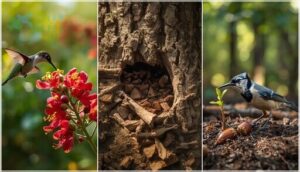
When you watch birds foraging in the wild, you’re witnessing behaviors that shape entire ecosystems in ways most people never realize. Every peck, swoop, and seed grab contributes to processes that keep natural environments balanced and thriving.
Let’s look at three critical ways foraging birds maintain the health of the world around them.
Pollination and Seed Dispersal
You mightn’t realize it, but birds quietly orchestrate plant reproduction across entire continents through pollination and seed dispersal. Hummingbirds alone support 5–10% of tropical flowering plants, while migratory mallards transport seeds up to 970 km.
These bird-mediated services sustain ecosystem functioning, though habitat loss and climate change now threaten these critical plant-bird interactions and their ecological outcomes.
Pest and Prey Population Control
When you consider the sheer scale of insect consumption—birds devour 400–500 million tons annually—you’re witnessing predator-prey dynamics that reshape entire ecosystems.
Insectivorous species can remove 98% of budworm outbreaks, directly boosting crop yields and delivering economic valuation of $7.50 saved per dollar spent on avian pest control.
This prey regulation stabilizes food source availability across agricultural and natural landscapes.
Contribution to Ecosystem Health
Because foraging birds maintain nutrient cycling, seed dispersal, and population control, you’re seeing ecosystem indicators at work. Their ecological impact extends from soil quality improvements to measurable reductions in human mortality rates—bird species richness correlates with lower cardiovascular and cancer deaths across 421 counties. These ecosystem roles demonstrate how foraging directly influences ecological functioning and biodiversity.
- Birds transfer nutrients through droppings, introducing 2.4 gigagrams of phosphorus annually in the UK alone
- Animal-dispersed seedlings recruit three times more successfully in continuous forests than fragmented areas
- Species richness acts as a primary indicator in government environmental monitoring programs
- Avian diversity aligns with longer human life expectancy across distinct regions
- Foraging behaviors regulate prey populations while supporting pollination and vegetation structure
Human Impacts on Bird Foraging

Human activity has reshaped how birds find and consume food in ways both subtle and profound. From backyard feeders to sprawling cities, we’ve altered the foraging landscape that birds have relied on for millennia.
Let’s examine three major ways humans influence bird foraging behaviors and what that means for their survival.
Urbanization and Supplemental Feeding
You’ll notice dramatic shifts in urban bird diets as cities reshape foraging behavior. Urban areas drive a 37% drop in insectivorous feeding, while backyard supplemental food boosts granivorous species by 35%.
Feeder visits increase disease risks by 46%, and urban habitat loss reduces species richness by 52%.
These urban adaptations alter migration changes and species abundance shifts, with feeders encouraging year-round residency in previously migratory populations.
Climate Change Effects
Climate change and foraging have become inseparable, reshaping avian ecology through altered environmental conditions. You’re witnessing three critical disruptions in foraging behavior:
- Habitat range shifts: Predicted foraging habitat declined 23% between 1976–2016, with an additional 32% loss projected
- Mismatched food timing: Earlier springs create a two-week gap between insect peaks and nesting periods
- Extreme weather impacts: Heat waves reduce year-round resident activity by 50%, while dietary resource shifts and foraging pattern changes intensify among specialist species
Conservation and Habitat Protection
You can’t protect what you don’t preserve—that’s the stark reality facing North America’s birds. Since 1970, nearly 3 billion birds have vanished, driven by habitat loss, invasive species, and population declines.
Since 1970, nearly 3 billion North American birds have disappeared due to habitat loss and invasive species
Protected areas deliver measurable conservation outcomes: higher abundance, improved productivity, and stable trends, especially for at-risk species. Conservation funding enables critical habitat restoration, proving that targeted investment in avian ecology and conservation works.
Frequently Asked Questions (FAQs)
How do birds communicate food sources to others?
When resources run scarce, bird communication becomes a lifeline. Vocal signals like food calls and visual cues alert flockmates to discoveries, transforming solitary finds into social learning moments that strengthen survival through recruitment behaviors.
Can birds taste their food like humans do?
Birds can taste their food, but not like you do. They have far fewer taste buds—usually 50 to 500 compared to your 9,000—making their sensory perception much less refined.
Do baby birds forage differently than adults?
Yes—juveniles forage less efficiently than adult males or females, showing simpler techniques and habitat differences.
Physical constraints, skill development, and parental influence shape their avian foraging behaviors during chick rearing.
How do injured birds adapt their foraging methods?
When injured, you’ll notice birds shift toward ground-based foraging rather than aerial hunting, spending up to 47% more time at accessible feeders.
Compensatory foraging strategies include seeking softer prey, utilizing supplemental feeding stations, and relying on sensory compensation through enhanced olfactory cues.
What role does memory play in foraging success?
Memory shapes foraging efficiency in profound ways. Spatial memory helps you track productive feeding sites with impressive precision.
Long-term retention lets birds remember successful locations across seasons, though memory interference can sometimes complicate learning new food sources.
Conclusion
Like a GPS guiding modern travelers, bird foraging and feeding behaviors navigate species through survival’s daily algorithm—each decision calibrated by millions of years of evolution. Your understanding of these intricate patterns unlocks more than academic knowledge; it reveals how fragile threads connect forest canopies to agricultural fields, predator to prey, extinction to resilience.
The chickadees at your feeder aren’t just eating—they’re performing ecological calculus that sustains entire landscapes.
- https://pmc.ncbi.nlm.nih.gov/articles/PMC3652453/
- https://pubmed.ncbi.nlm.nih.gov/31908778/
- https://royalsocietypublishing.org/doi/10.1098/rspb.2024.2156
- https://bioone.org/journals/ardea/volume-113/issue-1/arde.2024.a22/Birds-Foraging-on-Human-Derived-Foods-in-Suburban-Areas/10.5253/arde.2024.a22.full
- https://academic.oup.com/jue/article-abstract/7/1/juab018/6327593