This site is supported by our readers. We may earn a commission, at no cost to you, if you purchase through links.
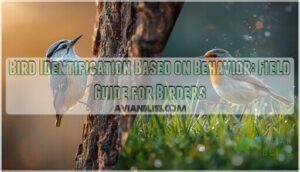
A robin bouncing across your lawn tells you more than field marks ever could. While you’re squinting through binoculars trying to match breast color to a guide’s illustration, that bird’s hopping gait has already given away its identity.
Watch a nuthatch scurry headfirst down a tree trunk—no other bird moves quite like that. Bird identification based on behavior unlocks a parallel system of recognition that works when plumage fails you: in harsh light, at awkward distances, or when juveniles wear confusing feather patterns.
The way a warbler holds its body while feeding, how a falcon carves through air, even the nervous stance of a finch scanning for threats—these behavioral signatures remain consistent when colors blur. Once you learn to read movement, posture, and rhythm, you’ll identify birds you can barely see.
Table Of Contents
Key Takeaways
- You’ll identify birds more reliably by watching how they move—a robin’s bouncing gait, a nuthatch’s headfirst descent, or a falcon’s sharp flight trajectory—because behavioral signatures stay constant when plumage, lighting, or distance make visual marks unreliable.
- Posture, foraging style, and movement rhythm reveal species identity before you check field marks: herons stalk patiently, woodpeckers hitch upward in jerks, and finches trace bouncy roller-coaster arcs through the air.
- Behavioral observation boosts identification accuracy by 30% in poor light conditions, turning what you can barely see into confident species recognition through flight patterns, feeding habits, and social interactions.
- Habitat shapes every behavior you’ll observe—from urban gulls adapting their foraging to seasonal shifts in migration timing—so understanding where and when a bird acts helps you predict what you’re watching before binoculars confirm it.
Key Bird Behaviors for Identification
When you’re trying to pin down a bird’s identity, color and markings only tell part of the story. The way a bird carries itself, moves through its environment, and searches for food can be just as revealing as any field mark.
Let’s break down three core behavioral traits that’ll help you identify birds with confidence.
Posture and Attitude Clues
A bird’s posture reveals its identity before you even check field marks. You’ll notice how some species lean forward with purpose while others sit bolt upright, exuding calm alertness.
- Pine Warblers maintain horizontal posture while feeding, unlike vertical-perched Acadian Flycatchers
- Crows lean forward, ready for mischief or action
- Thrushes display placid, relaxed attitudes when resting
- Owls stretch tall when threatened, abandoning their compact roosting form
- Finches in open areas show constant vigilance through nervous, alert stances
Understanding bird behavior involves studying bird identification techniques to improve observation skills.
Movement Patterns and Rhythms
Watch how a robin bounces boldly across your lawn, then notice a towhee’s cautious skulking through leaf litter—those movement patterns reveal species identity. You’ll see woodpeckers hitch upward in jerky spurts while nuthatches scurry downward, defying gravity.
Bird movement patterns include stride frequency variations between species sizes, and migration routes shift with circadian rhythms—some birds switch to nocturnal behavior during migration, maintaining precise flight patterns linked to sunset timing.
Understanding these patterns is vital for effective bird conservation efforts.
Foraging and Feeding Styles
After noticing how birds move, shift your attention to what they’re eating and how they get it. Foraging behavior separates species faster than plumage ever could. Herons stalk with patience, kingfishers plunge decisively, and swallows snatch insects mid-flight. Smaller birds with shorter legs hover-glean from branches, while longer-legged species work the ground.
Social species adopt adventurous feeding strategies, exploiting diverse food sources with striking dietary adaptations.
Recognizing Birds by Flight Patterns
You don’t always need to see a bird perched to know what it’s. The way a bird moves through the air—its wingbeats, trajectory, and overall flight style—can tell you as much as any field mark.
Once you learn to read these patterns, you’ll start identifying species from impressive distances, even when every other detail remains hidden.
Distinctive Wingbeats and Gliding

When you spot a bird overhead, its wingbeat rhythm tells a story before you ever see color or shape. Hummingbirds blur the air with up to 80 beats per second, while crows lumber along at 20.
Gliding styles matter too—vultures and eagles exploit thermals to soar 100 kilometers without flapping, their wings spread wide in sustained, energy-efficient flight.
Flight Trajectories and Shapes

Three distinct flight paths emerge when you track birds across open sky. Falcons tear through the air in sharp, pointed trajectories—sometimes exceeding 240 km/h—while finches trace bouncy, roller-coaster arcs with fluttering wingbeats. Woodpeckers commit to long, swooping dips between wingbeat bursts.
These aerodynamic shapes reflect wing morphology: pointed wings for speed, elliptical for agility, broad for sustained glides during bird migration.
Identifying Birds in Flight

You’ll notice bird migration routes come alive when you combine wingbeat analysis with aerodynamic traits. Recognizing birds by behavior means watching flight speed—a peregrine’s stoop hits 240 km/h, while thermal-soaring raptors barely flap.
Bird behavior identification sharpens when you track wing posture shifts: extended for gliding, rapid for hovering. Bird flight patterns reveal identity before color ever does.
Interpreting Social and Vocal Behaviors

Birds aren’t solitary creatures—they talk, gather, and claim their ground in ways that reveal their identity just as clearly as their feathers do. Once you tune into their social rhythms and vocalizations, you’ll notice patterns that separate a chatty chickadee from a territorial mockingbird.
Here’s what to watch and listen for when birds interact with their world and each other.
Flocking and Social Interactions
Flocking behavior tells you more than you might expect. When birds gather—whether a dozen sparrows or a starling murmuration reaching hundreds of thousands—watch how they interact. Social hierarchy reveals itself through feeding order: dominant individuals claim first access in 65-80% of cases.
You’ll notice coordinated movements slashing predation risk by 60%, while mixed-species flocks of 3-15 species show complex cooperation across boundaries.
Songs, Calls, and Alarm Signals
Bird songs and calls aren’t decoration—they’re dialects. Songs, those complex phrases males weave during breeding season, help distinguish species with 77% accuracy using acoustic features. Calls are shorter, instinctive signals for year-round communication.
Listen for alarm signals: sharp, loud mobbing calls versus quiet, high-pitched warnings that alert without revealing location. Vocalization patterns and call variations reveal identification when plumage fails you.
Mating and Territorial Displays
Watch a male sage-grouse strut with synchronized chest inflation—over 95% perform this breeding ritual during peak mating. Courtship displays outperform aggression: non-aggressive males secure more mating opportunities. Territorial markers like chases and visual displays signal mate attraction and defense.
Display diversity spans aerial dances in open habitats to elaborate routines in birds-of-paradise. These social interactions and vocalizations separate species when plumage deceives you.
Habitat Influences on Bird Behavior

Where a bird lives shapes everything it does—from how it moves to what it eats and when it’s most active. Understanding these habitat connections unlocks patterns you might otherwise miss in the field.
Let’s look at how the environment molds behavior in ways that help you identify species with confidence.
Preferred Environments and Ecosystems
Understanding where you’ll find a species unlocks identification before you even raise your binoculars. Forest ecology specialists like Red-cockaded Woodpeckers demand old pine stands, while urban landscapes host adaptable generalists.
Habitat preferences reveal ecological niches—wetland conservation areas attract different communities than farmlands. This habitat diversity reflects ecosystem health and biodiversity. Recognizing these patterns connects you to ecosystem services that sustain both birds and their observers.
Behavioral Adaptations to Habitat
When ecosystems change, birds respond with striking ingenuity. You’ll witness this habitat flexibility as species recalibrate their behavioral patterns to survive. Urban foraging has become routine for gulls at landfills, while altered migration routes reflect adaptive migration strategies. Watch for these behavioral shifts:
- Reduced home ranges near abundant food sources
- Modified vocalizations countering city noise
- Closer approach distances showing habituation
- Altered foraging styles matching new terrain
- Intensified territorial displays in restricted spaces
This ecological resilience reveals avian behavior’s exceptional plasticity.
Seasonal and Diurnal Behavior Shifts
As seasons turn, avian behavior patterns shift dramatically with photoperiod responses. Migration patterns adjust, with spring arrivals occurring days earlier in warming regions. Daily rhythms expand remarkably; flying foragers peak at solar noon, while ground feeders maintain steady activity.
These seasonal variations reshape everything: sleep cycles, foraging intensity, and even territorial displays. Watch how behavioral cycles compress or stretch with daylight changes.
| Season | Key Behavioral Shift |
|---|---|
| Spring | Extended daily activity; earlier migration arrivals |
| Summer | Sleep reduced by 4–5 hours; peak foraging at midday |
| Fall | Fat accumulation; delayed autumn departures |
| Winter | Increased sleep duration; constant ground foraging |
| Arctic Breeding | Males active 95%+ of time; fragmented sleep patterns |
Practical Techniques for Behavior-Based Identification

You’ve learned to read a bird’s posture, flight style, and foraging habits—now it’s time to put those insights to work in the field. Sharp observation skills paired with the right tools can turn behavioral clues into confident identifications.
Let’s break down three practical approaches that’ll help you connect what you see with what’s in your field guide.
Observation Skills and Note-Taking
You’ll sharpen your bird identification techniques dramatically when you carry a pocket-sized, waterproof notebook to capture every detail as it happens. Quick sketches and data-driven entries boost accuracy by over 40% during review—transforming fleeting glimpses into reliable records.
Your field recording toolkit:
- Date, time, location, weather: Context anchors every observation
- Permanent ink, circled counts: Data accuracy survives decades
- Behavior notes, not just species: Journaling techniques reveal deeper patterns
Observing bird characteristics demands this disciplined note-taking; your bird watching skills evolve with every entry.
Using Field Guides and Technology
Your field notebook pairs perfectly with digital field guides that achieve 89% AI identification accuracy when you snap a photo. Apps like Merlin or iBird narrow species by location, cutting search time by 30%—ideal for quick behavior-based bird identification.
Offline databases keep you independent, while instant data sharing fuels citizen science platforms. Birdwatching just got smarter: blend app usability with your hard-won observational skills, and online resources become your field partner.
Applying Behavior Clues in The Field
When bird behavior becomes your field guide, identification accuracy climbs by nearly 30% in poor light—because behavioral cues often outperform plumage alone.
In poor light, watching how a bird moves can boost identification accuracy by 30% more than color alone
Watch a flycatcher’s darting eye and perch return, note the woodpecker’s upward hitch, and record sequences in real time. These behavioral patterns sharpen species recognition, turning field observations into reliable wildlife monitoring.
Making every outing a lesson in applying behavior-based identification.
Frequently Asked Questions (FAQs)
How do weather conditions affect bird behavior?
Weather patterns shape avian behavior dramatically. Temperature extremes trigger seeking shade or fluffing feathers. Extreme weather events ground migrating flocks, while climate change shifts habitat use.
You’ll notice reduced foraging during heat waves and delayed migration patterns after storms.
What behaviors distinguish juvenile from adult birds?
Young birds display less flight efficiency and more flapping, spend extra time resting, forage less successfully, and emit higher vocal development rates during social learning.
All migration patterns improve as juvenile foraging skills mature through avian behavior experience.
How do injured birds behave differently?
Like warriors who’ve lost their shields, injured birds reveal trauma through compromised movement and disorientation. You’ll notice abnormal postures, weakened flight patterns, reduced vocalizations, and altered foraging—behavioral changes signaling rehabilitation needs before recovery patterns emerge.
Can bird behavior predict migration timing?
Yes. Pre-migration restlessness, increased feeding, and fat accumulation serve as behavioral cues predicting departure.
Predictive models integrating these migration patterns with climate shifts and bird tracking data improve forecasting accuracy for different bird species recognition.
How does human presence alter bird behavior?
Human presence triggers profound behavioral shifts—birds flush sooner, vocalize louder amid noise pollution, and alter foraging patterns.
Urban adaptation varies wildly: bolder individuals colonize cities while sensitive species vanish, reshaping entire communities through habitat fragmentation and displacement.
Conclusion
Test the theory yourself: spend ten minutes watching chickadees at your feeder without consulting a field guide. Their acrobatic dangles, nervous glances, quick retreats—these movements will identify them before you register their caps. Bird identification based on behavior transforms fleeting glimpses into certainty.
While plumage changes with age and season, a woodpecker’s undulating flight remains constant. Learn these patterns and you’ll recognize birds in silhouette, backlit against sunset, or half-hidden in dense foliage.
- https://www.theguardian.com/environment/2025/jan/18/country-diary-why-does-the-bird-bob-its-head
- https://www.wikihow.com/Bird-Symbolism
- https://apnews.com/article/composting-pumpkins-halloween-jack-o-lanterns-gardening-921757fbb2bf84d9e5c55f55a63b280a
- http://birdnote.org/show/watching-birds-behavior
- https://birdfy.com/blogs/blogs/birdwatching-in-your-backyard?_pos=2&_sid=19737afb3&_ss=r