This site is supported by our readers. We may earn a commission, at no cost to you, if you purchase through links.
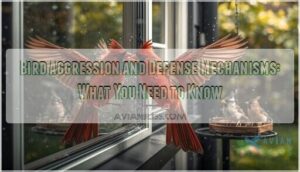
A cardinal slams into your window for the third time this week, not by accident, but because it sees a rival in the reflection—itself. This isn’t confused behavior; it’s tactical warfare. Birds don’t just chirp and flutter through life—they patrol borders, broadcast threats, and occasionally fight to the death over territory that might span less than an acre.
The intricate displays you witness at your backyard feeder represent defense systems honed over millions of years, where a well-timed song can prevent bloodshed and a puffed chest often means more than brute strength.
Understanding these bird aggression and defense mechanisms reveals how species survive in environments where resources are scarce, predators lurk constantly, and even a neighbor can become a mortal threat during breeding season.
Table Of Contents
Key Takeaways
- Bird aggression stems from four strategic drivers—territorial defense, breeding season mate protection, parental offspring defense, and environmental triggers including urbanization and climate shifts—each reflecting calculated survival responses rather than random hostility.
- Territory size and defense intensity directly correlate with diet specialization and resource availability, with carnivorous species maintaining territories 60% larger than herbivores while food-supplemented birds show measurably increased territorial aggression.
- Birds employ a sophisticated defense hierarchy against predators, escalating from camouflage (which reduces detection by 62%) and vocal mimicry to distraction displays documented across 285 species, with nest placement and chemical defenses serving as additional protective layers.
- Habitat fragmentation intensifies territorial conflicts by compressing available space, but strategic conservation interventions—including separated feeding stations (15-20 feet apart), visual barriers, and restored habitat corridors—can reduce aggressive encounters by 30-50% while supporting population stability.
What Drives Bird Aggression?
Bird aggression isn’t random—it’s a strategic response shaped by evolution and survival needs. Understanding what triggers these behaviors helps you interpret the conflicts you observe in your backyard or field site.
Let’s examine the four primary drivers that push birds toward aggressive encounters.
Territorial Defense and Resource Competition
When you understand territorial defense, you’ll see why resource competition shapes nearly every aggressive encounter you witness in birds. Territory establishment isn’t random—it’s a survival investment that boosts food acquisition by 30-60% and slashes nest predation in half.
Here’s what drives territorial behavior in birds:
- Resource monopolization ensures exclusive feeding grounds
- Vocal signals broadcast ownership through species-specific songs
- Boundary patrols maintain territorial borders through persistent surveillance
- Physical displays intimidate rivals with wing-spreading and plumage shows
- Direct aggression escalates to chasing when warnings fail
Territory size varies dramatically—from 0.12 to 0.32 hectares depending on resource density and diet. Birds feeding on animal prey defend larger areas than plant-eaters, adjusting boundaries as breeding cycles progress. This flexibility reflects the economics of defense: territories expand when benefits outweigh the energy costs of patrolling. Understanding territorial behavior can also lead to hormonal changes, such as increased testosterone levels, which can affect aggression and parental care.
Avian aggression intensifies where resources concentrate. Urban birds often display more frequent territorial behaviors than rural counterparts, responding to compressed habitats and elevated competition. These aggression triggers aren’t signs of hostility—they’re calculated responses to survival pressures.
Understanding these defense mechanisms reveals how resource competition fundamentally structures bird communities and determines who thrives where.
Breeding Season and Mate Protection
Breeding season transforms territorial defense into mate-guarding behavior, with males intensifying aggressive displays to secure reproductive access. You’ll observe peak aggression during mating phases—male rufous horneros show elevated testosterone correlating with parental defense rather than initial courtship.
Cooperative breeding adds complexity: helpers participate in nest defense at 50% of cooperative sites, though breeder aggression doesn’t predict helper recruitment. Fatal aggression occasionally erupts during mate competition, particularly among female floaters competing for breeding territories.
Understanding avian dominance problems can further clarify these interactions.
Parental Defense of Offspring
Once eggs hatch, parental defense intensity escalates dramatically—female great tits increase hissing as nestlings age, while defense mechanisms peak when avian young reach their most vulnerable stage.
You’ll notice sex differences: females often show stronger behavioral flexibility, adjusting responses based on predator type and brood size. This creates fitness trade-offs, as fiercely defending parents may sacrifice future reproduction for immediate offspring protection.
Environmental and Human-Induced Triggers
Beyond nest defense, environmental changes and human activities reshape aggression patterns. Urban noise pushes Galápagos warblers toward heightened territorial attacks, while climate variability intensifies conflicts—milder winters raise great tit densities, triggering lethal encounters with flycatchers.
Pesticide exposure weakens competitive ability, and habitat alteration from urbanization forces birds into smaller territories.
Human proximity during breeding amplifies defensive responses, demonstrating how habitat destruction directly modifies behavioral ecology.
Key Factors Influencing Territorial Behavior

Territory defense isn’t one-size-fits-all—what works for a hummingbird won’t work for a hawk. Several ecological and biological factors determine how intensely birds patrol their boundaries and how much space they need to thrive.
Let’s examine the key variables that shape territorial behavior across species.
Resource Availability and Population Density
Resource availability and population density shape how fiercely birds defend their territories. When resources are plentiful, you’ll observe smaller territories but more intense Urban Aggression, particularly in songbirds coping with habitat fragmentation. Consider these Density Impacts on territorial defense:
- Resource Competition intensifies in urban habitats with fewer breeding territories
- Higher population density correlates with increased aggressive displacement behaviors
- Food supplementation experiments demonstrate direct links between resource availability and aggression
- Denser groups exhibit more frequent aggressive encounters and vigilance
- Habitat Quality influences trade-offs between parental care and territorial defense
These patterns inform Conservation Planning strategies.
Diet Specialization and Territory Size
What your feathered neighbors eat determines how much space they need. Diet specialists defend territories 60% smaller than generalists, creating distinct spatial constraints tied to dietary niches. Carnivorous species maintain larger home ranges than omnivores due to food availability patterns—prey density dictates territory dynamics.
| Diet Type | Territory Size | Key Factor |
|---|---|---|
| Carnivorous | Large | Sparse prey distribution |
| Omnivorous | Medium | Mixed resource access |
| Herbivorous | Small | Dense plant resources |
| Specialist | 60% smaller range | Narrow dietary niche |
| Generalist | Larger range | Broad resource use |
Food-supplemented sparrows show greater territorial defense, demonstrating how resource partitioning drives aggressive displacement. When beetle outbreaks boost food abundance, cavity-nesters intensify territoriality. Habitat fragmentation amplifies these patterns—territories shrink, yet competition escalates. Energy expenditure for territorial defense increases with resource quality, shaping resource availability dynamics across populations.
Seasonal Changes and Breeding Triggers
Photoperiod effects dictate when you’ll witness breeding cues unfolding—longer daylight hours trigger gonadotropin-releasing hormone production, launching testosterone surges that fuel territorial defense and aggressive displays.
Climate influences have pushed European birds to breed 2-3 weeks earlier over three decades, while temperature shifts extend breeding periods for multi-brooded species.
These hormonal triggers synchronize resource defense across populations, optimizing reproductive windows during seasonal shifts.
Impact of Invasive Species and Habitat Loss
When invasive species collide with habitat fragmentation, you’re watching territorial defense unravel in real time. These dual pressures reshape avian aggression through:
- Native birds shrinking territories by 30% under invasive competition
- Fragmented landscapes doubling aggressive encounters as space tightens
- Invasive predators triggering 40% spikes in defensive behaviors
- Habitat loss threatening 70% of vulnerable species
Conservation strategies must address both drivers simultaneously to restore ecological balance and resource availability.
Bird Aggression Mechanisms and Displays
When you observe birds defending their space, you’re witnessing an elaborate repertoire of behaviors honed by millions of years of evolution.
These territorial displays range from subtle acoustic warnings to dramatic physical confrontations, each serving a specific function in resource defense and social communication.
Understanding how birds signal ownership, enforce boundaries, and interact with competitors reveals the intricate strategies that govern avian communities.
Vocal Signals and Song Functions

You’ll find that vocal signals in birds function like a complex alarm system—each song frequency carries precise meaning. Males use vocal communication to broadcast ownership and deter rivals, with song aggression escalating through matching patterns. In 80% of encounters, aggressive calls effectively warn intruders. Parental vocalizations play a crucial role in nest defense, varying depending on the type of predator. Mate attraction is influenced by repertoire size and vocal mimicry, while community signaling reduces interspecies communication conflicts through acoustic convergence.
| Signal Type | Primary Function |
|---|---|
| High trill rates | Territory defense and rival deterrence |
| Soft song | Precursor to physical attack |
| Screams vs. meows | Predator-specific nest defense |
Physical Displays and Boundary Patrols

When you observe physical displays in territorial behavior in birds, you’re witnessing defense mechanisms in action—100% of aggressively signaling birds point bills, talons, or wings directly at opponents. These displays of weaponization resolve over 70% of contests without contact.
Boundary patrols intensify by 40% during breeding, with birds spending 35% longer at territory edges, making avian aggression a calculated defense strategy.
Interspecific displays mirror intraspecific ones across species.
Direct Aggressive Behaviors (Chasing, Dive-Bombing)

When physical displays escalate into direct aggressive behavior, you’ll see chasing and dive-bombing tactics in action—nearly one third of North American species routinely employ these physical attacks. Red-winged blackbirds dive-bomb intruders daily during breeding, while attack triggers correlate with nest proximity in 100% of sampled raptors.
These defense mechanisms rarely cause injury but successfully deter threats, with species prevalence highest among territorial songbirds and crows.
Interspecific Aggression and Community Dynamics

Beyond single-species confrontations, you’ll encounter interspecific aggression—where different bird species compete and clash. Species hierarchies emerge based on body size and resource overlap, with aggressive dominants like noisy miners causing 60% population declines in co-occurring species.
These interactions shape community dynamics through:
- Range dynamics restricting subordinate species from available niches
- Habitat partitioning promoting spatial segregation between competitors
- Vocal interactions triggering territorial responses across species boundaries
- Reduced species coexistence in high-aggression zones (30% lower richness)
- Community stability declining as persistent aggression limits environmental adaptability
Interspecific competition fundamentally restructures bird communities, affecting species coexistence patterns across entire landscapes.
Defense Strategies Against Predators

When predators threaten their survival, birds don’t just rely on flight—they’ve evolved an impressive toolkit of defense strategies that can mean the difference between life and death. From blending seamlessly into their surroundings to staging elaborate deceptions, these adaptive behaviors showcase millions of years of evolutionary refinement.
Let’s examine the specific mechanisms birds employ to outsmart, confuse, and deter their predators.
Camouflage and Mimicry Techniques
When threats loom, you’ll find camouflage effectiveness reaches striking levels—studies show background matching cuts predator detection by over 62%. Ground-nesting species in Zambia select sites matching their plumage within centimeters, optimizing egg camouflage for survival. Vocal mimicry adds another layer: brown thornbills deceive avian predators by imitating hawk alarm calls, exploiting Batesian mimicry principles. These behavioral adaptations showcase elaborate predator avoidance across diverse species examples.
| Defense Strategy | Effectiveness & Application |
|---|---|
| Background Matching | Increases predator search time 62.57%; individuals adjust nest sites to match specific plumage patterns |
| Masquerade Camouflage | Boosts search time nearly 295%; mimics environmental objects for best concealment |
| Egg Camouflage | Reduces clutch predation greatly in ground-nesters; species-specific pattern matching critical |
| Vocal Mimicry | Brown thornbills mimic alarm calls, causing predators to flee or scan skies defensively |
Distraction Displays and Broken Wing Acts
While camouflage hides birds from sight, distraction displays flip the script—you’ll see parents deliberately attract attention to save their young. The broken wing display ranks among the most documented predator avoidance behaviors, appearing in 285 species across 52 families. Display effectiveness peaks when ground predators approach: killdeers intensify their act as threats close in, balancing personal risk management against offspring survival.
Birds fake injuries in broken wing displays—documented across 285 species—luring predators away from vulnerable offspring
- Display variations range from wing-quivering walks to false brooding and impeded flight simulations
- Predator lure tactics work best against visual hunters like foxes, with intensity decreasing toward aerial threats
- Plovers and snowy owls perform most intensely just before chicks fledge or hatch
- Evolutionary origins show convergent development across diverse habitats and unrelated lineages
- Solitary nesters rely heavily on these protective behaviors without communal mobbing support
Nest Placement and Structural Defenses
When you’re searching for bird nesting strategies that truly work, nest placement for protection becomes the cornerstone. Weaverbirds and icterids craft pendent nests with extended tunnels, drastically cutting offspring mortality.
You’ll find colonial birds using colony nesting near aggressive insects for added deterrence, while nest height preferences peak around 25 meters.
Nest materials like spider silk secure structures, and some species even build mimicry nests—false entrances that confuse predators hunting avian eggs in dense urban nesting environments.
Chemical and Unique Defense Mechanisms
Toxic bird species like New Guinea’s Pitohui harbor diet-derived toxins—homobatrachotoxin in feathers and skin—that repel predators through chemical defense. You’ll encounter defensive stomach oils in fulmars, fecal spray defense in hoopoe chicks, and projectile vomiting as defense in vultures.
Chemical parasite defense extends to anting behaviors and antimicrobial secretions. These unique bird defense mechanisms, including mimicry of toxic creatures, demonstrate intricate defensive use of toxins beyond physical confrontation.
Implications for Conservation and Management

Understanding bird aggression isn’t just academic—it’s essential for protecting vulnerable populations and managing human-wildlife interactions. Habitat loss, fragmentation, and poorly designed captive environments can intensify territorial conflicts, undermining reproductive success and population stability.
Let’s explore how conservation strategies and management practices can address these challenges effectively.
Effects of Habitat Fragmentation on Aggression
Habitat fragmentation intensifies avian aggression by forcing birds into smaller, more contested territories. You’ll notice song sparrows in fragmented patches display heightened territorial disputes—more frequent chases and vocal confrontations—because population dynamics shift under resource competition pressure.
Habitat loss and urbanization effects increase these behaviors, sometimes reducing recruitment by 50%. However, connectivity mitigation through restored corridors can stabilize aggression levels and support healthier populations.
Strategies to Reduce Territorial Conflicts
You can reduce territorial disputes by separating feeders 15-20 feet apart—this minimizes aggression at feeders by creating distinct zones. Visual barriers like foliage disrupt sightlines, while habitat modification through resource distribution eases competition.
Training techniques, including “step-up” commands, improve control.
Conservation efforts emphasizing kin recognition exploit the “dear enemy” effect, where neighboring relatives tolerate each other.
These strategies for reducing territorial conflicts balance ecological needs with practical management.
Designing Aviaries to Minimize Aggression
When you’re designing aviaries to minimize aggression, you’re basically creating a social contract in feathers. Strategic planning transforms confined spaces into harmonious environments:
- Space Allocation: Expanding from 2 m² to 8 m² per bird cuts aggressive encounters by 40%, giving territorial behavior in birds room to breathe.
- Visual Barriers: Nontoxic plants reduce targeted attacks by 30%.
- Group Composition: Housing six or more birds decreases incidents by 35%.
- Resource Distribution: Doubling feeding stations slashes resource-based aggression by 41%.
Sensory modulation through consistent lighting further reduces outbursts by 31%, addressing avian aggression at its neurological roots.
Monitoring and Supporting Territorial Bird Populations
Tracking territorial behavior in birds requires precision tools and community action. Combining spot mapping—a proven method since 1944—with citizen science platforms like eBird, which has gathered over 500 million observations, enhances monitoring efforts. Habitat management practices, such as timed mowing restrictions, significantly boost breeding success for vulnerable populations. Trend analysis using open-population models captures shifts across 58+ species, guiding conservation outcomes in protected areas where habitat quality directly shapes territorial dynamics.
| Monitoring Method | Key Benefit |
|---|---|
| Spot mapping | Most reliable density estimates since 1944 |
| eBird citizen science | 500M+ observations support trend analysis |
| Fixed-radius point counts | Cost-effective abundance tracking |
| MAPS banding program | Estimates essential rates for vulnerable populations |
Frequently Asked Questions (FAQs)
How do birds recognize individual rivals?
You might say birds “get acquainted” through agonistic communication—vocal signals reveal individual personality, while visual cues trigger neural mechanisms that modulate aggression, shaping social dynamics and behavioral strategies among rivals.
Can aggression levels predict population health trends?
Yes, you can track aggression patterns to anticipate population health shifts. Urban aggression trends and demographic change links reveal resource competition impact, environmental stress effects, and intraspecific dominance—all signaling avian behavior shifts affecting ecological balance and population regulation.
Do urban birds show different aggression patterns?
Urban aggression levels spike dramatically in city environments. Resource competition, population density, and habitat destruction trigger heightened territorial defense.
This demonstrates how urbanization effects reshape avian aggression patterns through breeding impacts and behavioral adaptations, with significant ecological implications.
What role does lighting play in aggression?
Light intensity and spectrum effects directly influence avian aggression through hypothalamic photoreceptors. Daylength influence modulates hormonal aggression triggers, while ALAN disruption intensifies territorial displays.
Blue wavelengths generally reduce aggression compared to red lighting environments.
How does climate change alter territorial boundaries?
Climate change acts like a disruptor, forcing range expansion and territory overlap as species shift boundaries.
Phenological mismatches, habitat fragmentation, and adaptation responses reshape avian behavior, compressing territory size and intensifying competition amid habitat loss.
Conclusion
That cardinal at your window isn’t confused—it’s defending what evolution taught it to value: space, resources, survival. Bird aggression and defense mechanisms aren’t random chaos; they’re finely calibrated systems where song replaces violence, displays communicate boundaries, and every mobbing call strengthens community resilience.
By recognizing these patterns, you’re not just observing birds—you’re witnessing millions of years of adaptation unfolding in real time, territory by hard-won territory.
- https://scholar.google.com/scholar_lookup?title=Hormones%20and%20Animal%20Social%20Behavior&author=E%20Adkins-Regan&publication_year=2005&
- https://doi.org/10.1126/science.95.2464.289
- https://www.nature.com/articles/srep19966
- https://royalsocietypublishing.org/doi/10.1098/rspb.2022.0058
- https://cosmosmagazine.com/nature/australian-birds-use-colour-illusion-confuse-predators/