This site is supported by our readers. We may earn a commission, at no cost to you, if you purchase through links.

You’ve just spotted a striking bird in your backyard, but by the time you pull up a generic online guide, it’s long gone. That frustration—common among new birders—stems from using resources designed for the wrong purpose. The market floods you with options: field guides promising instant identification, all-inclusive references boasting thousands of species, and regional books claiming local expertise.
Yet most beginners grab the first highly-rated book they find, only to discover it covers birds from states they’ll never visit or uses terminology that assumes years of experience. Learning how to choose bird watching books means matching the guide’s design to your actual birding style—whether you’re identifying warblers mid-hike or studying migration patterns from your living room. The right book becomes an extension of your binoculars, while the wrong one just adds weight to your pack.
Table Of Contents
- Key Takeaways
- Key Factors When Choosing Bird Watching Books
- Beginner-Friendly Bird Watching Book Features
- Importance of Regional Relevance in Bird Guides
- Visual Clarity: Photos Vs. Illustrations
- Size and Portability for Bird Watching in The Field
- Authority and Reputation of Birding Book Authors
- Comparing Comprehensive Reference Books Vs. Field Guides
- Evaluating Bird Book Content for Identification and Behavior
- Top 5 Recommended Bird Watching Books
- Leveraging Birding Book Reviews and Community Insights
- Frequently Asked Questions (FAQs)
- Conclusion
Key Takeaways
- Match your field guide to your actual birding style—whether you need quick species identification during hikes or detailed home study—because the wrong book becomes dead weight while the right one extends your binoculars’ power.
- Regional guides covering 200-400 local species outperform nationwide references with 900+ birds for most birders, cutting clutter and boosting identification speed by focusing exclusively on what flies through your habitat.
- Illustrations trump photographs for learning field marks since artists emphasize diagnostic features like wing bars and crown patterns that lighting or distance might obscure in photos, reducing misidentification by 15-24%.
- Your skill level determines essential features—beginners need common species with glossaries and visual aids, while advanced birders require taxonomic depth, vocalization coverage, and behavioral ecology that casual guides skip.
Key Factors When Choosing Bird Watching Books
Choosing the right bird watching book isn’t just about grabbing the prettiest cover off the shelf—it’s about matching the guide to how you’ll actually use it in the field or at home. You’ll want to think about what you’re hoping to accomplish, whether you’re just starting out or already know your warblers from your wrens, and where you plan to crack open the pages.
Let’s look at three essential factors that’ll help you find a book that truly works for your birding journey.
Purpose and Intended Use
Why are you reaching for a bird book in the first place? Your answer shapes everything. You might need quick field identification during a morning hike, detailed home reference for deeper study, or guidance for data collection supporting conservation efforts.
Your reason for reaching a bird book—field ID, home study, or conservation—shapes everything about which guide you need
Some birdwatching books serve recreational desires, while others help beginner birding progress systematically. Clarifying your purpose before choosing bird books ensures you’ll find the perfect match for your goals. Consider reading Rob Hume’s insights for expert advice.
Skill Level—Beginner to Advanced
Once you know your purpose, match it to your experience level. About 74% of birdwatchers identify just 1 to 20 species, meaning most beginner birders need books emphasizing common species and easy identification techniques.
As you progress through skill levels, you’ll want learning resources covering:
- Basic plumage patterns and behavior for newcomers
- Regional variations and vocalizations for intermediate watchers
- Detailed taxonomy and field experience documentation for expert enthusiasts
To start, consider resources that offer beginner guides with introductory tips. Choosing birding books that match your current abilities accelerates your skill progression in bird identification.
Field Vs. Home Reference
Once you know your skill level, think about where you’ll actually use the book. Field guides stay compact and portable, fitting easily into your backpack during excursions, while reference books offer extensive content scope but work best at home.
Field guides prioritize quick bird identification with visual aids highlighting key features, whereas home references provide detailed behavioral details and ecology. Most birders find they need both—portable guides for intended user needs outdoors and deeper reference books for study afterward.
Beginner-Friendly Bird Watching Book Features
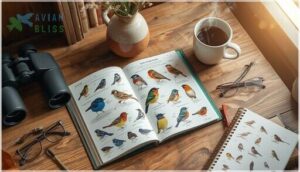
When you’re just starting out in birding, the right book can make all the difference between frustration and falling in love with the hobby. You’ll want a guide that doesn’t assume you already know the difference between a warbler and a wren, or that you can instantly recognize field marks without a little help.
Let’s look at the key features that make a bird watching book truly beginner-friendly.
Easy-to-Use Organization
You’ll want birding books with a clear hierarchy that groups species by family and geographic region, making identification fast and straightforward. Field guide layouts that use visual consistency—standardized poses and similar scales—help you compare birds at a glance.
Quick reference features like color-coded tabs and range maps near illustrations transform bird identification guides into accessible tools you can navigate confidently in the field.
Glossaries and Visual Aids
Glossaries clarify unfamiliar terms you’ll encounter, from “supercilium” to “lore,” helping you build the vocabulary needed for accurate identification.
Visual aids—particularly detailed illustrations showing birds in consistent poses—boost your identification accuracy considerably more than photographs alone. Studies show these elements improve field guide effectiveness by 35%, accelerating your skill development while enhancing visual clarity during real-world birding excursions.
Introductory Bird Watching Tips
Beyond mastering field guide layouts, you’ll need foundational skills to succeed in the field. Look for beginner birdwatching guides that cover binocular basics, local habitats, and weather awareness—practical knowledge that transforms backyard bird identification from guesswork into systematic observation.
The best resources for beginners also introduce ethical birding practices and song identification techniques, ensuring you develop proper habits while building confidence in your abilities.
Importance of Regional Relevance in Bird Guides

Choosing a bird guide that matches your actual location can make the difference between confidently identifying species and flipping through pages of birds you’ll never encounter. A field guide focused on your region cuts through the noise, showing you exactly what’s flying through your backyard or local trail instead of overwhelming you with every species across the continent.
Let’s break down how regional relevance shapes your birding success and why it matters more than you might think.
Regional Vs. Nationwide Coverage
Regional guides zero in on birds you’ll actually see in your area, while nationwide field guides cover all of North America—think 400 species versus 900-plus. That’s why portability factors matter: a lighter regional guide slips into your pack easily, boosting identification ease when you’re out birding.
Consider what works for your needs:
- Regional guides eliminate clutter, showing only birds in your habitat, improving coverage accuracy.
- Nationwide references shine for travelers, offering species diversity across the continent—one of the best birding books for road-trippers.
- Market impact drives updates, with regional editions adapting faster to local conservation shifts and migratory changes.
Understanding Local Bird Species
Knowing your local species transforms you from casual observer to skilled identifier. Studies show birdwatchers identify over half their local native species when equipped with targeted field guides, while regular site visits—91% of birders do this—demand accurate regional bird identification tools.
A regional guide covering roughly 200 species per area sharpens your habitat relationships understanding, connecting bird species to local conservation status and ecological needs uniquely tied to where you live.
Adapting to Various Habitats
Habitat-specific field guides boost your bird identification success by up to 30%, especially when you’re exploring wetlands, forests, or urban parks. Over 78% of top birdwatching guides now include habitat identification sections that link behavioral adaptations to regional ecosystems.
Guide features like color-coded tabs and illustrated habitat backgrounds help you recognize climate impacts on species distribution. Choose field guides that match where you actually watch birds.
Visual Clarity: Photos Vs. Illustrations
When you’re flipping through a birding book, the visual format can make or break your ability to identify that warbler in your backyard. Some guides rely on detailed illustrations that highlight key field marks with scientific precision, while others use full-color photographs that capture birds exactly as they appear in nature.
Let’s explore how each approach helps you recognize birds by their visual features and which might work best for your birding style.
Advantages of Accurate Illustrations

Illustrated guides give you something photographs can’t—enhanced visual clarity through carefully controlled detail. Artists emphasize diagnostic feather details, plumage phases, and subtle species comparison markers that lighting or distance might obscure in photos. These visual mnemonics stick in your memory, making field identification faster. Detailed illustrations and descriptions create a visual learning experience that sharpens your eye, while their conservation impact has historically drawn attention to threatened species.
| Illustration Advantage | Why It Matters for You |
|---|---|
| Highlights key field marks | Speeds up species identification |
| Shows multiple plumage phases | Gets you ready for seasonal variations |
| Standardized visual reference | Reduces confusion in the field |
Benefits of Full-Color Photographs
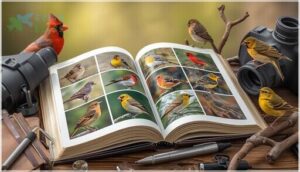
While illustrations sharpen key field marks, photographs bring you face-to-face with birds as they actually appear in nature. Full-color images capture subtle shading, iridescence, and natural postures that improve accuracy improvement and memory retention. Studies show birders using photographic guides experience fewer misidentifications, and user preference surveys reveal over 75% favor photos for visual clarity—a trend production advances have made increasingly affordable.
| Photographic Advantage | Real-World Benefit |
|---|---|
| Realistic color and texture | Builds confidence in field identification |
| Multiple plumage variations shown | Gets you ready for seasonal changes |
| Natural habitat context | Aids environmental recognition |
| Life-stage diversity displayed | Enhances feature depiction accuracy |
Identifying Birds by Visual Features

Once you’ve decided between illustrations and photographs in your field guide, you’ll need to decode what you’re seeing. Visual landmarks—wing bars, eye rings, crown patterns—anchor identification accuracy. Plumage variation by season, sex, and age challenges beginners, so books showing multiple views help you recognize behavioral cues and habitat context. Combining these visual elements generally reduces misidentification by 15–24%.
| Visual Feature | Why It Matters |
|---|---|
| Bill shape and size | Reveals feeding habits and family groups |
| Wing and tail patterns | Critical for flight identification |
| Color distribution | Separates look-alike species instantly |
Size and Portability for Bird Watching in The Field

When you’re out in the field, the last thing you want is a bulky book weighing down your gear or falling apart after a few rain showers. The right size and build can make the difference between a guide you actually use and one that stays in the car.
Let’s look at the practical considerations that’ll help you find a field guide built for real-world birding conditions.
Compact Vs. Comprehensive Formats
When choosing bird watching books, should you grab a pocket-sized guide or invest in a thorough reference? Your decision hinges on how you plan to use it, since compact formats around 5 by 8 inches slip easily into your backpack, while thorough bird guides exceeding 400 pages become hefty home references.
- Species coverage: Compact guides focus on common birds; thorough books catalog over 1,000 species
- Detail level: Quick field marks versus in-depth behavioral descriptions and subspecies variations
- Visual aids: Simplified diagnostic illustrations compared to multi-angle plates showing seasonal plumages
- Portability needs: Lightweight field companions under one pound versus extensive desk references
Ease of Carrying During Excursions
Weight considerations matter more than you might think—a 48-ounce guide feels manageable at home but becomes a burden after miles of hiking. National Geographic’s 27-ounce field guide strikes a better balance for portable field use, while pocket-sized guides slip into jacket pockets without strain.
Digital alternatives on your phone eliminate physical weight entirely, though many birders still prefer tactile pocket guides they can flip through quickly during excursions.
Waterproof or Durable Binding
Beyond weight, the binding types and weather resistance of field guide materials determine survival during real field use. Synthetic paper or laminated pages with spiral coil binding offer full waterproofing, protecting your investment from rain, humidity, and mud—essential features that extend field longevity when birding book reviews consistently highlight durability concerns.
Material durability considerations include:
- Waterproof synthetic pages resist moisture damage and maintain usability when soaked
- Spiral coil bindings enable 360-degree rotation while resisting wear from frequent use
- Reinforced covers protect against dirt accumulation during rugged terrain excursions
- Cost analysis shows durable bird identification guides priced 20-40% higher but requiring fewer replacements
- Best birding books balance portability with resilience through thoughtful birding book features
Authority and Reputation of Birding Book Authors

When you’re investing time and money into a birding book, you want to know it’s written by someone who truly knows their field marks from their tail bars. The author’s credentials and the publisher’s track record can tell you a lot about whether a guide will serve you well in the field or leave you squinting at confusing illustrations.
Let’s look at what separates the trusted experts from the rest, and how you can quickly assess whether a book is worth adding to your collection.
Notable Ornithologists and Experts
You can trace the DNA of today’s trusted field guides straight back to ornithology’s giants. Roger Tory Peterson revolutionized bird identification in 1934, selling over 7 million copies and setting a standard that modern authors like David Allen Sibley and Kenn Kaufman still honor. When you’re choosing books, look for authors with deep ornithological credentials—their expertise ensures accurate identification and up-to-date taxonomy.
| Pioneer | Key Contribution | Modern Influence |
|---|---|---|
| Roger Tory Peterson | Developed field mark system (1934); sold 7M+ copies | Petersons Impact shaped Sibley and Kaufman guides |
| Ludlow Griscom | Established quantitative field records | Griscoms Standards influence scientific rigor today |
| Margaret Morse Nice | Published 250+ papers; annual medal honors her | Nices Contributions behavioral studies |
| John James Audubon | Illustrated 435 species (1827–1838) | Audubons Legacy remains foundational reference |
Modern ornithologists like Dr. John W. Fitzpatrick (170+ publications) and Dr. Bridget Stutchbury continue this tradition, ensuring contemporary guides reflect state-of-the-art research and expert recommendations grounded in ornithology.
Publisher Reputation and Trustworthiness
When scanning birding book reviews or expert recommendations, don’t overlook the publisher’s track record. Authoritative publishing houses maintain editorial accuracy through scientific rigor and updated editions that reflect taxonomic changes—earning community trust among seasoned birders.
- Penguin Random House and Houghton Mifflin Harcourt dominate with decades of proven reliability in birding guide reviews
- Lynx Edicions earned consecutive awards (2002–2004) for scientific distinction
- Academic presses like Johns Hopkins deliver peerless credibility in any birding book buyers guide
User and Peer Reviews
You’ll find that 72% of bird book buyers lean on online reviews before clicking “buy,” and they’re onto something. Review informativeness drives over 80% of decisions in choosing birding books, while rating influence pushes books above 4.5 stars to 65% higher sales.
Tap into forum discussions, expert endorsements, and community trends—birding guide reviews from trusted peers often reveal field durability and illustration clarity that marketing copy never mentions.
Comparing Comprehensive Reference Books Vs. Field Guides

When you’re standing in the bookstore aisle or browsing online, you’ll notice birding books generally fall into two camps: hefty reference volumes meant for your home library and compact field guides built for the trail. Each has a distinct purpose, and understanding the trade-offs between depth and practicality will save you from buying the wrong tool for the job.
Let’s break down what sets these formats apart so you can match the right book to your actual birding habits.
Reference Book Depth and Breadth
Reference books are the powerhouses of your birding library, offering exceptional depth on taxonomic variations and global diversity. Unlike efficient identification guides, thorough reference books deliver extensive species counts—sometimes exceeding 11,000 birds—with precise range accuracy and ecological data that help you understand distribution patterns and habitat preferences. These volumes become indispensable when you’re building a serious birding library, providing context that field guides simply can’t match.
| Feature | Reference Books | Field Guides |
|---|---|---|
| Species Count | 1,000–11,362 species globally | 300–1,000 regional species |
| Taxonomic Detail | Multiple global taxonomies compared | Single accepted taxonomy |
| Ecological Data | In-depth habitat, behavior, migration | Brief habitat notes |
| Range Maps | Comprehensive, data-driven, detailed | Simplified for quick reference |
| Portability | Bookshelf use, heavy | Pocket-sized, lightweight |
Quick-Access Identification Guides
When you’re out in the field and that mystery bird won’t wait, quick-access identification guides become your lifeline. Modern field guides and apps like Sibley operate fully offline, letting you filter by dozens of attributes—color, size, habitat—to nail down species comparison in minutes. Digital integration enhances layout efficiency, while well-designed sections minimize information overload, making bird identification guides practical for real-time discoveries.
| Feature | Digital Apps | Pocket Field Guides | Quick Reference Cards |
|---|---|---|---|
| Species Coverage | 800+ with audio files | 300–810 regional species | 50–200 common birds |
| Offline Functionality | Full operation without network | Always available | Always available |
| Attribute Filtering | 3+ dozen searchable traits | Manual page navigation | Visual scanning only |
| Layout Efficiency | Instant comparison overlays | Organized by family or color | Single-page spreads |
Choosing The Right Format for Needs
Once you’ve zeroed in on quick access tools, matching format to your birding style becomes straightforward. If you’re logging 68% of your time outdoors, a portable field guide wins—reference depth stays home. Beginners benefit from visual preference clarity: illustrations boost identification speed by 17%, while photographs satisfy those craving realism. Your portability needs and learning approach dictate whether birdwatching books live in your backpack or on your shelf.
| Format Type | Best For | Typical Weight | Primary Strength |
|---|---|---|---|
| Portable Field Guide | Active outdoor birding | Under 1 lb | Quick species comparison |
| Extensive Reference | Home study and research | Over 2 lbs | Behavioral and ecological depth |
Evaluating Bird Book Content for Identification and Behavior

When you’re comparing bird books, the content inside matters just as much as the format on your shelf. A good guide needs to give you the tools to identify birds accurately and understand what they’re actually doing in the field.
Here’s what to look for when evaluating whether a book will truly help you recognize species and interpret their behavior.
Species Count and Range Maps
Species count accuracy matters when evaluating field guides, with top North American birds references covering 750 to over 1,000 species. Range maps have undergone significant evolution—modern analytical range maps using citizen science data now reveal seasonal migration patterns traditional guides missed.
Regional species focus helps you zero in on local birds faster, while data-driven approaches are influencing species identification tools, making your field guide choice essential for successful North American birds identification.
Coverage of Bird Behaviors and Ecology
Beyond range maps and species counts, you’ll want books that explain bird behavior and ecology—how birds feed, court, raise young, and adapt to habitats. The Peterson Reference Guide to Bird Behavior dedicates entire chapters to mating rituals, social behavior, and migration patterns.
Modern guides increasingly merge foraging ecology with habitat adaptation, helping you understand why certain species behave as they do in specific environments.
Inclusion of Vocalizations and Calls
Understanding bird songs and calls takes your identification skills beyond what the eye can catch—65% of birds are detected by sound first, not sight. Look for guides with audio integration through QR codes or embedded sound clips, which boost learning retention by 40% and species detection by 35%. Modern AI recognition tools now reach 98% vocalization accuracy, making sound-based bird identification techniques incredibly reliable.
- Real bird calls transform abstract descriptions into instant recognition moments
- Audio-enhanced guides help you confidently identify hidden warblers in dense foliage
- Spectrograms visually decode complex songs, turning confusion into clarity
- Digital sound libraries let you practice calls before dawn chorus field trips
- Vocalization knowledge connects you deeper to territorial disputes and mating displays
Top 5 Recommended Bird Watching Books
After weighing factors like skill level, regional coverage, and visual clarity, you’re probably wondering which books actually deliver.
The following five titles represent the strongest options for different birding needs, from backyard observation to thorough field identification. Each one brings something distinct to your bookshelf, whether you’re just starting out or refining your identification skills.
1. Backyard Birdwatcher’s Bible Birds and Crafts
If you want a backyard bird guide that goes beyond basic identification, “Backyard Birdwatcher’s Bible Birds and Crafts” delivers impressive artistic merit alongside practical species profiles. The book covers over 100 backyard birds with full-color photography showing both male and female plumage, making bird identification straightforward for beginners.
You’ll find detailed regional coverage spanning North America’s habitats, complete with craft instructions for building feeders and birdhouses that actually work.
It’s birding for beginners meets coffee table book—substantial at 416 pages, weighing nearly four pounds, so it’s best kept at home rather than used as a field guide.
2. Sibley Guide to Birds Eastern NA
The Sibley Guide to Birds of Eastern North America stands as the field guide standard for bird identification east of the Rockies, featuring over 4,600 detailed illustrations covering 650 species. David Allen Sibley’s visual identification system presents multiple plumages and poses with annotated field marks, while 601 updated range maps incorporate seasonal patterns and migration routes.
At 464 pages, it balances extensive species data with field usability—compact enough for your backpack yet thorough enough for definitive identification, making it essential for anyone serious about Birds of North America.
3. Sibley Birds West Field Guide
For western birders, Sibley Birds West Field Guide delivers unparalleled visual accuracy through 5,046 illustrations covering 715 species found west of the Rocky Mountains.
David Allen Sibley’s annotated field marks and 652 updated range maps—drawn from 110 regional experts—make bird identification straightforward in the field.
At 504 pages with a compact flexi-back design, it balances thorough species coverage with field usability, earning its reputation among the best birding books for western North America enthusiasts seeking author expertise and practical identification tools.
4. Bird Trivia Funny Strange Bird Facts
If you’re hunting for birding books that entertain as much as they educate, Stan Tekiela’s Bird Trivia: Funny, Strange & Remarkable Facts delivers amusing bird facts paired with stunning bird photography quality. This 80-page gem surprises readers with strange bird behaviors—like blue jays planting oak forests or crows recognizing human faces—making it perfect for unplugged road trips or gift suitability for casual enthusiasts.
While birding book reviews note its modest size and quick read, it’s an accessible entry point when choosing birding books that spark curiosity without overwhelming newcomers seeking best birding books recommendations.
5. North American Bird Field Guide
For extensive coverage of North American birds, you can’t overlook the National Geographic Field Guide—it’s earned its reputation through seven editions of continuous refinement. This field guide covers 1,023 species with over 6,000 hand-painted visual illustrations, making bird identification remarkably precise.
User reviews consistently praise its compact book format that fits field conditions, while authority updates reflect the latest American Ornithological Society taxonomy. With 80 new maps and species coverage that outpaces most competitors, it’s why millions trust this best bird field guide for reliable identification.
Leveraging Birding Book Reviews and Community Insights

You don’t have to choose your next birding book in isolation, and honestly, you shouldn’t. The birding community offers a wealth of firsthand experiences and honest feedback that can save you from purchasing a guide that doesn’t quite fit your needs.
Let’s look at two powerful ways to tap into this collective wisdom before you make your decision.
Participating in Birding Forums
Online communities offer identification help when you’re stumped by a tricky sighting, connecting you with experienced birders who can confirm species from photos or descriptions. These forums complement your birding books by providing real-time expertise and expanding your bird identification skills through collective knowledge.
With forum growth accelerating—96 million U.S. participants in 2025—you’ll find substantial demographics trends supporting everything from reporting sightings to discussing birdwatching techniques.
Consulting Local Birding Groups
Local birding groups offer region-specific field guide recommendations you won’t find online. Expert birders within these clubs know which books accurately cover your area’s species—68% of members cite direct recommendations when selecting guides. Regional expertise matters, especially when club endorsements drive a 40% increase in purchases of locally-focused resources.
- Book Clubs: 55% of new birding book purchases stem from club discussions
- Community Workshops: Over 60% organize annual introductory sessions featuring recommended literature
- Regional Expertise: 76% of recommendations focus on species within 5 miles of club headquarters
- Conservation Impact: Members show 44% greater knowledge after using club-recommended guides
Frequently Asked Questions (FAQs)
Do birding apps replace physical field guides?
Apps offer convenience and digital accuracy, much like compasses replaced celestial navigation, yet field guide reliability endures.
Your learning style determines which birdwatching resources best suit you—many birders value both tools.
How often are bird guides updated?
Most field guides are revised every 5 to 10 years, with update frequency driven by taxonomic changes and new species discoveries.
Digital updates happen more often, sometimes weekly, while regional variations usually follow 3-to-6-year cycles.
Whats the best book for backyard feeders?
The Backyard Bird Chronicles” by Amy Tan pairs beautiful artwork with observational insights.
Stan Tekiela’s “Birding for Beginners: Pacific Northwest” organizes feeder species by color, making backyard birding identification simple for newcomers attracting birds.
Are there birding books for children?
Yes, kids birding guides like “The Young Birder’s Guide to North America” and “National Geographic Kids Bird Guide” offer beginner-friendly content, activity integration, and accessibility features that help young naturalists develop observation skills while exploring birds.
Can one guide cover multiple seasons?
Absolutely—quality field guides feature range maps showing seasonal plumage, migration patterns, and behavior changes.
These tools provide identification across breeding, winter, and migratory periods, offering thorough regional accuracy throughout the year.
Conclusion
Think of your birding library as a custom toolkit—each book serving a distinct role rather than gathering dust as redundant weight. Learning how to choose bird watching books transforms identification from guesswork into confident observation, whether you’re decoding field marks during spring migration or deepening ecological knowledge between outings.
The species you’ll discover don’t wait for perfect preparation, but the right guide ensures you’re ready when that rare warbler finally appears in your viewfinder.
- https://www.basicsofbirding.com/blog/how-to-identify-birds-four-features-in-a-bird-field-guide
- https://lynxnaturebooks.com/lynx-field-guides-survey-results/
- https://blog.aba.org/2012/07/the-top-10-books-every-birder-should-have.html
- https://www.birdforum.net/threads/how-do-you-keep-your-lifelist-and-what-is-included.437875/
- https://www.reddit.com/r/birding/comments/qgxzfd/best_books_for_birding_beginners/