This site is supported by our readers. We may earn a commission, at no cost to you, if you purchase through links.
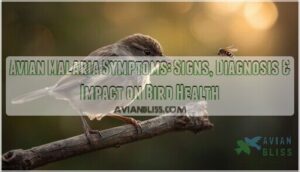
When a wild bird stops singing, refuses food, and struggles to maintain its perch, the culprit might be invisible to the naked eye—microscopic Plasmodium parasites destroying red blood cells from within. Avian malaria symptoms often appear subtle at first: a slight ruffle of pale feathers, labored breathing, or unexplained lethargy that progresses into something far more serious.
Unlike the human form of malaria, which we’ve studied extensively, this avian variant operates through over 30 distinct parasite species, each with unique pathogenic profiles and mortality rates ranging from manageable to catastrophic.
Recognizing these clinical signs early can mean the difference between recovery and population-level decline, particularly for species already facing habitat pressures. Understanding what to look for—from behavioral changes to physical deterioration—prepares you with the diagnostic foundation necessary to identify, distinguish, and respond to this pervasive parasitic disease.
Table Of Contents
Key Takeaways
- Avian malaria, caused by over 30 species of Plasmodium parasites, presents with early warning signs like lethargy and appetite loss that progress to severe anemia, respiratory distress, and behavioral changes—symptoms you’ll need to recognize quickly since delays beyond 48 hours double mortality rates.
- The disease spreads exclusively through female mosquitoes and has devastated vulnerable populations, with Hawaiian honeycreepers facing 50–90% mortality and some species projected to go extinct within 2–10 years without intervention.
- Diagnosis requires blood smears and microscopy to detect parasites in red blood cells, though this method misses up to 61% of low-level infections, making molecular testing essential for accurate identification and differentiation from similar diseases.
- Chronic infections create long-term damage including reduced lifespan (1.6 years versus 2.5 in healthy birds), reproductive output cut in half, and ecosystem-wide disruptions as infected birds abandon their roles in pollination and seed dispersal.
What is Avian Malaria?
Avian malaria is a parasitic disease that affects birds worldwide, caused by microscopic organisms that invade their red blood cells and compromise their health. Understanding this condition starts with recognizing what causes it, which parasites are responsible, and how it differs from the malaria that affects humans.
Let’s examine the fundamental aspects of this disease to better understand its impact on bird populations.
Definition and Overview of Avian Malaria
Avian malaria is an infectious disease affecting bird populations worldwide, caused by protozoan parasites of the genus Plasmodium. You’ll find this disease on every continent except Antarctica, demonstrating its truly global distribution.
Prevalence rates vary widely, ranging from 2.9% to 38% in surveyed populations, though some local areas report up to 80% infection. The parasite diversity is striking, with over 600 distinct genetic lineages identified.
Island devastation has been particularly severe, especially among Hawaiian honeycreepers where mortality reaches 50–90%. Recent incidence increases are concerning, with some temperate species showing infection rates climbing from under 10% to nearly 30% in just decades.
The disease is often spread through the bite of infected female mosquitoes.
Plasmodium Parasites Involved
Understanding the specific Plasmodium parasites behind avian malaria helps recognize the complexity of this disease. Over 30 distinct species infect birds, creating striking species diversity among hosts.
The three most significant parasites include:
- Plasmodium relictum – accounts for 33.3% of infections and causes the SGS1 lineage found globally
- Plasmodium gallinaceum – extremely virulent, causing up to 90% mortality in poultry outbreaks
- Plasmodium circumflexum – increasingly detected in genetic surveys of wild bird populations
These Plasmodium parasites evolved unique genetic features, diverging from mammalian malaria approximately 10 million years ago. This is especially devastating to native honeycreeper populations.
How Avian Malaria Differs From Human Malaria
While these parasites share the Plasmodium genus with human malaria, key differences emerge in host specificity and pathogenic mechanisms. Avian malaria infects over 1,000 bird species through various mosquito vectors, unlike human malaria’s strict Anopheles transmission.
Clinical presentation differs too—birds develop severe organomegaly and chronic infections, while control strategies focus on environmental management rather than drug treatment protocols.
How Avian Malaria Spreads Among Birds

Understanding how avian malaria moves through bird populations starts with the transmission cycle itself. Mosquitoes don’t just bite randomly—they follow specific patterns that put certain birds at greater risk than others.
Several factors, from habitat conditions to species vulnerability, determine where and how quickly this disease takes hold.
Mosquito Vectors and Transmission Cycle
You might be surprised to learn that only female mosquitoes transmit avian malaria, injecting sporozoites during blood meals. The cycle of infection unfolds in precise stages:
- Sporozoites enter bird tissues and develop into exo-erythrocytic forms
- Parasites invade red blood cells, multiplying within
- Gametocytes form in the bird’s bloodstream
- Mosquitoes ingest gametocytes, which mature into gametes
- Ookinetes penetrate the midgut, forming oocysts that release sporozoites
Culex species demonstrate considerable vector competence, transmitting multiple Plasmodium lineages. Transmission rates fluctuate with seasonal patterns, peaking during late summer when mosquito populations surge. Sporozoite detection in salivary glands confirms a mosquito’s ability to spread avian malaria transmission effectively.
High-Risk Bird Species and Habitats
Where species vulnerability meets habitat hotspots, bird populations face a perfect storm. High-risk zones—like the lowland forests of Hawai‘i and migratory stopovers in the Galapagos—see avian malaria threaten endemic and endangered species. Global distribution of Plasmodium, fueled by migratory spread, jeopardizes conservation efforts. Explore key risk areas:
| Habitat Hotspot | Bird Population Risk |
|---|---|
| Hawaiian lowland forest | Hawaiian honeycreepers |
| Tropical dry forest | Passeriformes (songbirds) |
| Migratory stopovers | Parakeets, shorebirds |
| Alpine mountains | Endemic passerines |
Factors Influencing Disease Spread
Beyond habitat and host susceptibility, you’ll find climate change impacts, mosquito ecology, and habitat fragmentation driving avian malaria’s reach. Warmer temperatures push vector dynamics northward, enabling mosquito vectors in previously safe zones. Bird migration introduces new Plasmodium lineages across continents, while habitat loss creates breeding grounds for vectorborne disease.
Key factors accelerating disease transmission include:
- Rising temperatures extending mosquito breeding seasons and expanding geographic range
- Landscape alteration increasing vector abundance through artificial water sources
- Migratory movements transporting parasites to immunologically naïve populations
Common Symptoms of Avian Malaria
When avian malaria takes hold in a bird’s body, you’ll notice changes that signal something’s wrong. Some symptoms appear early and subtly, while others develop as the parasite destroys more red blood cells and weakens your bird’s system.
Recognizing these signs quickly can make the difference between early intervention and serious health decline.
Early Warning Signs (Lethargy, Loss of Appetite)

When you notice your bird withdrawing or losing interest in food, avian malaria symptoms may already be taking hold. Lethargy symptoms usually emerge within 7–14 days post-infection, with over 70% of infected birds displaying clinical listlessness during acute stages. Appetite loss follows closely, reducing feed intake by 12–41% and appearing in 55–92% of cases. Early intervention is critical—delays beyond 48 hours double mortality rates, making prompt malaria detection essential.
| Early Warning Sign | What You’ll Observe |
|---|---|
| Lethargy | Bird spends extended time inactive, avoids normal movement, shows reduced social interaction |
| Appetite Loss | Reduced feeding events (30–60% decline), ignores favorite foods, extended periods without eating |
| Behavioral Shifts | Decreased vocalization (up to 65% drop), isolation from flock, withdrawal from routine activities |
| Movement Changes | Daily travel distances drop 15–50%, reluctance to perch normally, less exploratory behavior |
These changes often precede visible weight loss and anemia by several days, giving you a vital window for action. Birds showing both lethargy and appetite loss face markedly elevated predation risk—studies document a 28% increase in natural settings. Because your bird’s behavior speaks volumes about its internal struggle against Plasmodium parasites, recognizing these subtle shifts enables you to seek veterinary care before the infection progresses to life-threatening stages.
Physical Changes (Weight Loss, Pale Feathers)

Weight loss stands as one of the most telling avian malaria symptoms you’ll observe in infected birds. Acute infections trigger up to 30% body mass decline, while parasitemia exceeding 88.5% often proves fatal. Feed conversion efficiency drops 12–41%, creating visible weight loss even when your bird attempts to eat.
Though feather deterioration and pale plumage are occasionally noted, organ hypertrophy—particularly liver enlargement from 2–3% to 4.5% body weight—drives the most dramatic physical changes, contributing directly to elevated bird mortality rates and severe avian anemia.
Respiratory Issues and Labored Breathing

Breathing difficulties emerge as critical symptoms of avian malaria once Plasmodium parasites invade lung tissues. You’ll observe open-mouthed, rapid breathing in affected birds—100% of fatal kiwi cases exhibited severe interstitial pneumonia causing respiratory failure.
Lung damage manifests as fluid accumulation, congestion, and reduced gas-exchange capacity (up to 40% loss), creating respiratory distress that ultimately results in oxygen deprivation and death.
Anemia and Reduced Oxygen Transport

Plasmodium parasites destroy red blood cells in infected birds, triggering anemia and oxygen impairment that compromises their survival. You’ll see RBC decline of up to 28.5%, with hematocrit levels dropping below 35% in severe cases.
Anemia prevalence reaches 38.3% in some populations, creating fitness effects that reduce endurance and metabolic capacity. Species variation means certain birds maintain function despite infection, while others face mortality rates approaching 90%.
Behavioral Changes in Infected Birds

Beyond physical decline, you’ll observe striking behavioral changes in malaria-infected birds. Locomotor activity drops by 48% during peak parasitemia, with daily movement declining from 6,413 to just 3,309 jumps.
Social withdrawal becomes evident as infected birds isolate from flocks, while appetite suppression and lethargy persist even after parasites subside.
Most alarming: severely infected birds show impaired predator response, remaining motionless when threatened rather than fleeing.
Diagnosing Avian Malaria in Birds
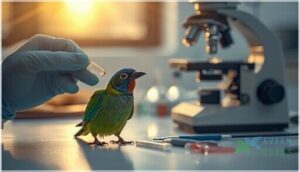
If you suspect your bird has avian malaria, getting an accurate diagnosis is the first step toward effective treatment. Veterinarians use several diagnostic methods to confirm the presence of Plasmodium parasites and rule out other conditions with similar symptoms.
Let’s look at the key approaches used to diagnose this parasitic disease in birds.
Blood Smear and Microscopy
Under the microscope, blood smears reveal Plasmodium parasites hiding inside red blood cells, offering you a window into disease diagnosis. However, diagnostic accuracy depends on several factors:
- Smear preparation quality and staining consistency
- Parasite morphology visibility (trophozoites, schizonts, gametocytes)
- Detection limits of approximately 40 infected cells per microliter
- Observer expertise and training level
- Number of microscope fields examined
Microscopy can miss up to 61% of infections with low parasitemia, meaning prevalence estimates may underrepresent true infection rates in your birds.
Differentiating From Other Bird Diseases
You’ll want to distinguish avian malaria from look-alike illnesses, since misdiagnosis rates between 4% and 11% occur in field settings when diseases overlap. Anemia induction—pale mucous membranes appear in over 60% of confirmed malaria cases versus under 15% in bacterial infections.
Diagnostic specificity reaches 93% using sophisticated platforms, while mortality rates from Plasmodium gallinaceum exceed 80% untreated, far surpassing avian pox. Gene expression profiles and molecular testing confirm disease diagnosis when symptoms of avian malaria mirror other conditions.
Post-Mortem Findings (Organ Enlargement)
When necropsy reveals what microscopy can’t, organ enlargement tells the full story. Splenomegaly prevalence reaches 74% in fatal cases—you’ll notice rounded margins and firm texture.
Hepatomegaly indicators include pallor or bronze discoloration affecting 48% of birds, while pulmonary congestion appears in 52%.
Renal involvement shows congestion in 58% of kidney samples, though adrenal changes remain rare at just 4%.
Long-Term Effects and Bird Population Impact

Even when birds survive an initial bout of avian malaria, the parasitic infection can leave lasting scars that extend far beyond a single sick individual. Chronic infections weaken immune systems, drain energy reserves, and compromise reproductive success in ways that ripple through entire populations.
Understanding these long-term consequences is essential for protecting vulnerable species and maintaining the delicate balance of ecosystems where birds play irreplaceable roles.
Chronic Health Consequences in Birds
When avian malaria becomes chronic, it doesn’t just vanish—it slowly chips away at your bird’s vigor. The long-term health effects create a cascade of problems:
- Chronic anemia drains oxygen-carrying capacity, leaving birds perpetually weak
- Organ pathology manifests as enlarged livers and spleens, compromising important functions
- Telomere shortening accelerates cellular aging, reducing natural lifespan
- Impaired immunity increases vulnerability to secondary infections
This persistent organ enlargement and feather deterioration signal deeper physiological damage affecting population impact.
Reduced Reproduction and Lifespan
Because Plasmodium parasites disrupt normal physiology, you’ll observe fertility decline and shortened lifespan in infected flocks. Reproductive output plummets—infected birds produce roughly four fledglings lifetime versus eight in healthy counterparts.
Mortality rates climb sharply, with infected great reed warblers averaging 1.6 years compared to 2.5 years uninfected. Offspring viability suffers as hatching and fledging rates drop by 39–42%, driving long-term population trends downward through reduced reproduction rates.
Population Declines and Conservation Concerns
When you examine global bird populations, extinction risk from avian malaria now rivals habitat loss in driving population decline. England’s House Sparrow numbers plummeted 70% between 1977–2016, while Hawaiian honeycreepers face projected extinction within 2–10 years without aggressive conservation efforts.
Avian malaria now rivals habitat loss as an extinction driver, with some species facing disappearance within a decade
Climate impacts compound these threats, as warming temperatures expand mosquito ranges into formerly safe high-elevation refuges. This forces conservationists to develop integrated strategies combining mosquito suppression with genetic diversity preservation.
Effects on Biodiversity and Ecosystems
When bird populations crash from avian malaria, you’ll see cascading ecosystem disruption that threatens far more than individual species. Ecosystem health declines as infected birds abandon their ecosystem roles in pollination and seed dispersal, disrupting food web balance.
Habitat loss combines with climate influence to accelerate species decline, particularly in Hawaiian forests where native insectivores once controlled pest populations. This demonstrates the profound conservation impact and long-term ecosystem effects on biodiversity.
Frequently Asked Questions (FAQs)
Can avian malaria be transmitted to humans?
No documented cases exist of natural avian malaria infection in humans. Experimental findings and public health records confirm parasite barriers prevent zoonotic transmission, despite potential exposure in zoos and endemic regions globally.
Which geographic regions have highest infection rates?
Avian malaria infection rates peak in the Sahara-Arabian Region, Hawaiian Islands, North America, Europe, and Australia/Oceania.
In these areas, mosquito activity, climate conditions, and vulnerable wild birds converge, greatly impacting bird populations through accelerated disease spread.
How long does infection last in birds?
Infection duration varies widely—acute parasitemia peaks within 20–44 days, while chronic persistence can span years in individual hosts.
Seasonal patterns, subclinical infections, and fitness impact ultimately determine how long your birds carry these parasites.
Are certain bird ages more vulnerable?
Youth isn’t wasted on the young—unfortunately, avian malaria is. Juvenile susceptibility peaks dramatically, with infection rates and age-related mortality far exceeding adult vulnerability.
This creates severe population impact through compromised transmission dynamics and recruitment failures.
What happens after a bird recovers completely?
Recovery doesn’t always mean full health. Your bird may face lingering issues like reduced lifespan, weaker immune systems, reproductive impacts, and physiological deficits that affect long-term immunity and overall vitality.
Conclusion
Protecting populations requires persistent vigilance. When you recognize avian malaria symptoms—from the faint flutter of weakened wings to the silent struggle for breath—you’re witnessing a parasitic cascade that threatens not just individual birds, but entire ecosystems.
Early detection transforms outcomes, turning potential decline into managed recovery. Your ability to spot lethargy, anemia, and behavioral shifts enables you to intervene before microscopic invaders claim another casualty, safeguarding biodiversity one diagnosis at a time.
- https://pubmed.ncbi.nlm.nih.gov/15763737/
- https://www.gardenwildlifehealth.org/wp-content/uploads/sites/12/2020/02/Avian-Avian-Malaria-factsheet_GWH.pdf
- https://pmc.ncbi.nlm.nih.gov/articles/PMC8909384/
- https://reviverestore.org/wp-content/uploads/2015/03/SamuelEA2011AvianMalariaModel.pdf
- https://www.merriam-webster.com/dictionary/acute