This site is supported by our readers. We may earn a commission, at no cost to you, if you purchase through links.
 You’ll spot hawks circling because they’re riding invisible elevators in the sky called thermals.
These rising columns of warm air let hawks soar without flapping their wings much, conserving energy like a smart shopper hunting for deals.
While circling, they’re scanning the ground below for prey—think of it as their aerial surveillance system.
This energy-efficient flight pattern allows them to patrol vast territories and hunt for hours without getting tired.
Hawks aren’t just aimlessly floating around; they’re strategic hunters using nature’s free lift service.
The science behind their circling behavior reveals fascinating hunting techniques and territorial strategies.
Table Of Contents
- Key Takeaways
- What Does It Mean When a Hawk is Circling?
- The Role of Thermals in Hawk Circles
- The Significance of Hawk Screeching
- Factors That Attract Hawks to Certain Areas
- Hawk Prey Preferences and Hunting Behavior
- Hawk Territory and Nesting Habits
- Can Hawks Capture and Lift Dogs?
- Differences Between Hawks and Other Birds in Circling Behavior
- Frequently Asked Questions (FAQs)
- Why do hawks fly in a circle?
- Why do hawks soar in circles?
- Why are Hawks circling?
- Why do Hawks circle before swooping?
- Why do Hawks circle around thermals?
- Why do Hawks circle their prey?
- What does it mean if hawks are circling?
- Why do black hawks circle?
- How to tell if a hawk is in distress?
- What does it mean when a bird goes in circles?
- Conclusion
Key Takeaways
- You’ll see hawks circling because they’re riding thermals—invisible columns of warm air that act like natural elevators, letting them soar without wasting energy on constant wing flapping.
- When you spot a hawk circling overhead, it’s using this energy-efficient flight pattern to scan the ground below with razor-sharp vision, hunting for prey like rodents and small birds from the perfect aerial vantage point.
- You’re witnessing territorial behavior when hawks circle and screech—they’re essentially marking their hunting grounds and warning other birds to stay away from their claimed airspace.
- You’ll notice hawks choose specific areas to circle based on three factors: abundant prey availability, strong thermal currents from sun-heated surfaces, and open terrain that provides clear visibility for successful hunting.
What Does It Mean When a Hawk is Circling?
When you see a hawk circling overhead, three main purposes drive this mesmerizing hawk circling behavior.
First, it’s hunting from the perfect vantage point, using razor-sharp vision to spot prey below.
Second, energy conservation through riding thermals – those invisible columns of warm air that act like natural elevators.
Finally, it’s making a territorial display, basically telling other birds "this spot’s taken."
Flight physics explains why hawks spiral rather than fly straight – they’re following rising air currents that create the most efficient soaring conditions for successful bird behavior.
The Role of Thermals in Hawk Circles
You’ve probably watched a hawk circle overhead and wondered why it doesn’t just fly straight to where it’s going.
The answer lies in invisible columns of warm air called thermals, which act like natural elevators that hawks use to gain altitude without wasting energy on constant wing flapping.
Formation of Thermals
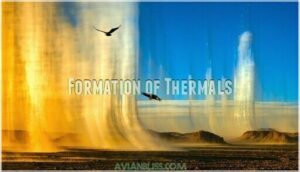
Picture the earth as a giant heating pad, with solar heating creating pockets of warm air that rise like invisible elevators.
When the sun hits different surfaces—pavement, fields, or rocky terrain—it creates uneven heating patterns that generate these natural updrafts.
Here’s how thermals form through atmospheric physics:
- Solar heating warms the ground unevenly throughout the day
- Air pressure differences develop as warm air becomes less dense
- Convective circulation begins when heated air starts rising upward
- Cumulus clouds often mark the top of thermal columns
- Terrain influence affects where and when thermals develop strongest
These air currents have a thermal lifespan of several hours, peaking during midday when the sun’s energy is most intense.
How Hawks Utilize Thermals
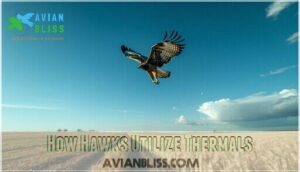
Hawks master thermal soaring like skilled pilots riding invisible elevators through the sky.
When you watch a hawk circling behavior, you’re witnessing remarkable flight efficiency in action.
These raptors don’t waste energy flapping when thermals offer free lifts through convective circulation.
| Thermal Strategy | Energy Benefit |
|---|---|
| Spiral climbing | 90% less wing flapping |
| Thermal hopping | Extended gliding distance |
| Migration aid | Thousands of miles conserved |
| Territory scanning | Effortless prey detection |
Bird thermal use transforms hunting into an art form.
Hawks spiral upward within thermal columns, gaining altitude without exhausting themselves.
Once they reach the thermal’s peak, they glide toward the next updraft.
This energy conservation technique proves essential during long migrations, allowing hawks to travel vast distances while maintaining strength for hunting and survival.
Unlike most hawks, Harris’s hawks sometimes hunt cooperatively.
The Significance of Hawk Screeching
Beyond their mesmerizing circling patterns, you’ll hear hawks communicating through distinctive screeches that serve multiple purposes.
These piercing calls aren’t random noise—they’re sophisticated communication methods that reveal hawk circling behavior and territorial intentions.
When you observe hawks screeching while circling, they’re often engaged in territorial defense, warning other birds to stay away from their hunting grounds or nesting sites.
Red-tailed hawks produce the classic raspy "keeeeeer" sound that movies love, while Cooper’s hawks deliver sharper, more rapid calls.
You’ll notice vocal variations depend on the situation.
Hawks screech to locate mates, request food, or signal alarm when threats appear.
Different species have unique screeching patterns—what works for one doesn’t work for another.
These bird communication signals complement their circling flights perfectly.
As hawks ride thermals and survey their bird territories, their calls establish dominance and maintain social order in the avian world.
Factors That Attract Hawks to Certain Areas

You’ve probably noticed hawks circling over certain spots more than others, and there’s solid science behind their location preferences.
Hawks choose areas based on three key factors: abundant prey like rodents and small birds, strong thermal currents from heated ground surfaces, and open terrain that provides clear hunting visibility.
Hawk Hunting Techniques
Watching from above, you’ll notice hawks employ sophisticated hunting techniques that make them apex predators.
Their circling behavior isn’t random—it’s strategic prey identification at work.
Hawks master three key attack strategies:
- High-speed dives reaching 120+ mph for surprise strikes
- Talon use with razor-sharp precision to immobilize prey
- Thermal-assisted hunting for energy-efficient surveillance.
These hunting speed capabilities boost their success rates dramatically.
Some hunters use specialized gear to better understand hawk hunting equipment.
Role of Thermals
Understanding thermal formation reveals why certain locations become hawk magnets.
You’ll find these birds utilizing uplift from convective currents that create vortex rings over sun-heated surfaces.
Thermal hopping between these invisible air currents allows effortless soaring, making areas with thermal abundance irresistible.
Open fields, rocky terrain, and asphalt roads generate the strongest vortex thermals hawks need, creating a perfect environment for effortless soaring.
Hawk Behavior Patterns
Several key hawk behavior patterns reveal why you’ll spot these raptors in certain locations.
Their solitary behavior shifts during specific seasons, creating predictable opportunities for observation.
Key hawk behavior patterns include:
- Circling benefits from thermal exploitation for energy conservation
- Flocking reasons during migration and winter survival
- Mating rituals involving aerial displays and territorial circling
- Hawk communication through screeching and flight patterns
- Seasonal hunting technique adaptations
Hawk Prey Preferences and Hunting Behavior

Hawks have evolved as precision predators with razor-sharp hunting techniques that’ll amaze you.
Their extraordinary vision—eight times sharper than yours—lets them spot prey from incredible heights.
When hunting, these raptors adjust their seasonal diet based on what’s available, switching from ground hunting for rodents in winter to snatching birds during migration periods.
Prey size matters tremendously in their strategy, with different species targeting different prey, such as small mammals like mice and voles, or medium-sized birds.
Their hunting speed reaches 120 mph during dives, giving prey little chance to escape, and they also target urban prey like pigeons and rats, showing remarkable adaptability.
Hawks achieve impressive hunting success rates by combining patience with explosive action, circling for hours, conserving energy while scanning below, then striking with lightning precision.
This calculated approach makes them incredibly efficient predators in both rural and city environments, allowing them to thrive in various settings, including areas with abundant small mammals.
Some hawks, like the Sharp-shinned hawk, ambush songbirds often, demonstrating their versatility as hunters.
Hawk Territory and Nesting Habits

Once hawks claim their hunting grounds, they’ll fiercely protect their hawk territory through aggressive territorial behavior.
During breeding season, these raptors establish nesting locations spanning 30-600 acres depending on species size. Their habitat selection focuses on tall trees or cliff edges offering strategic views.
Hawks demonstrate remarkable dedication to nest building and territorial defense:
- Territory Defense – They’ll chase away intruders with diving attacks and loud screeches
- Nest Building – Pairs construct sturdy platforms they’ll reuse for years
- Breeding Season – Monogamous pairs return annually, strengthening their nesting habits through complex rituals
To support nesting, consider installing specialized nesting platforms.
Can Hawks Capture and Lift Dogs?

Most pet owners worry needlessly about their furry companions when they spot hawks circling overhead. While these powerful raptors possess impressive hunting abilities, they’re far more interested in natural prey like rodents than your beloved canine.
Hawks circle with purpose—hunting prey, riding thermals, and defending territory with razor-sharp precision.
Hawks prefer hunting small mammals weighing under two pounds. Even large red-tailed hawks struggle lifting anything heavier than four pounds. Your dog’s size matters substantially – tiny breeds face minimal risk, while medium and large dogs remain completely safe.
| Factor | Small Dogs (Under 10 lbs) | Medium Dogs (10-25 lbs) | Large Dogs (Over 25 lbs) |
|---|---|---|---|
| Hawk Strength | Possible lift attempt | Unlikely to lift | Can’t lift |
| Attack Likelihood | Rare but possible | Extremely rare | Virtually impossible |
| Breed Vulnerability | High (Chihuahuas, Yorkies) | Low (Beagles, Cocker Spaniels) | None (German Shepherds, Labs) |
| Pet Safety Risk | Minimal supervision needed | Very low concern | No concern |
These aerial predators focus on natural pest control, targeting mice and rats rather than pursuing domestic pets.
Differences Between Hawks and Other Birds in Circling Behavior
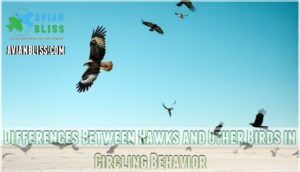
You’ll notice distinct differences when comparing circling behavior among birds of prey.
Hawks utilize thermals with remarkable precision, employing energy conservation methods that differ substantially from other raptors.
Their visual acuity differences enable targeted hunting while circling, unlike vultures who circle primarily for scavenging opportunities.
Hawks often circle to take advantage of rising columns of warm air.
Key distinctions in raptor flight patterns include:
- Hunting vs. Scavenging: Hawks circle to actively hunt live prey, while vultures search for carrion
- Territorial Display: Hawks use circling behavior for dominance, eagles for courtship rituals
- Migration Circling Patterns: Hawks employ soaring vs flapping techniques differently than pelicans or gulls during seasonal movements
Frequently Asked Questions (FAQs)
Why do hawks fly in a circle?
Like medieval knights riding invisible elevators, you’ll spot these raptors spiraling upward on thermal currents.
They’re conserving energy while scanning for prey below, using warm air columns as natural lifts for effortless flight, and in doing so, they utilize thermal currents to their advantage.
Why do hawks soar in circles?
You’ll notice hawks soar in circles because they’re riding thermals – warm air currents that rise from sun-heated ground.
This natural elevator system lets them conserve energy while scanning for prey below.
Why are Hawks circling?
You’re witnessing nature’s energy-saving strategy in action. These raptors ride rising warm air currents called thermals, spiraling upward effortlessly while scanning for prey below—it’s their perfect hunting technique.
Why do Hawks circle before swooping?
Picture a skilled sniper taking aim—that’s exactly what you’re witnessing when hawks circle before swooping.
They’re using thermals to conserve energy while scanning for prey, positioning themselves for that perfect, lightning-fast strike.
Why do Hawks circle around thermals?
Hawks circle around thermals because these rising warm air currents act like natural elevators.
You’ll see them spiraling upward to gain altitude effortlessly, conserving energy while scanning the ground below for prey.
Why do Hawks circle their prey?
You’ll notice hawks don’t actually circle their prey directly.
Instead, they circle high above using thermals to scan vast areas, then dive straight down at incredible speeds to strike with precision.
What does it mean if hawks are circling?
Birds of a feather flock together," and when you spot hawks circling overhead, they’re likely riding thermals to conserve energy while hunting.
Establishing territory, or migrating together in groups called kettles.
Why do black hawks circle?
Black hawks circle for the same reasons as other hawk species.
They’re riding warm air currents called thermals to conserve energy while hunting, establishing territory, or migrating efficiently across long distances.
How to tell if a hawk is in distress?
Like a feathered alarm bell, distressed hawks exhibit unmistakable signs you can’t miss.
Look for labored breathing, drooping wings, inability to fly, aggressive behavior when approached, or sitting motionless on the ground for extended periods, which are clear indicators of distress, often prompting an immediate response.
What does it mean when a bird goes in circles?
When you see a bird going in circles, it’s typically riding thermals—warm air currents that help them soar effortlessly.
This natural flight pattern allows them to hunt for prey, conserving energy, or establishing territory.
Conclusion
Picture yourself as a hawk rider, gliding effortlessly on nature’s invisible escalators.
Now you understand why hawks circle—they’re not just floating aimlessly but executing sophisticated aerial strategies.
These magnificent raptors harness thermal currents to conserve energy while maintaining their watchful hunt for prey below.
Whether you’re observing their graceful spirals or hearing their piercing calls, you’re witnessing millions of years of evolutionary perfection in action.
Hawks circle because they’ve mastered the art of efficient, strategic flight.