This site is supported by our readers. We may earn a commission, at no cost to you, if you purchase through links.
Nearly three billion birds have disappeared from North America since 1970—a staggering loss that signals something fundamentally broken in our landscapes. These declines aren’t just numbers on a chart; they reflect the unraveling of ecosystems that sustain life, including our own.
Birds disperse seeds that regenerate forests, control pests that threaten crops, and transport nutrients between habitats in ways few other animals can. The importance of bird habitat extends far beyond providing homes for feathered species—it’s about maintaining the intricate web of connections that keep natural systems functioning.
When habitats fragment or degrade, the effects cascade through entire ecosystems, diminishing the services we depend on daily. Understanding what birds need to thrive, and why those needs matter, reveals pathways toward landscapes that support both wildlife and human communities.
Table Of Contents
Key Takeaways
- Bird habitats sustain critical ecosystem services including natural pest control worth $310 per hectare to farmers, seed dispersal that boosts forest carbon storage by 38%, and nutrient cycling that enriches marine food webs by over 150% in coastal areas.
- The loss of nearly three billion North American birds since 1970 stems from habitat fragmentation that isolates populations, climate change forcing range shifts faster than species can adapt, and pollution from pesticides like neonicotinoids that reduce grassland bird populations by 2.2% per 100 kg applied.
- Conservation strategies that restore native vegetation, create protected nesting sites, and implement sustainable land use practices have proven effective, with forest bird populations improving 3% following targeted policy interventions and organic farms retaining 35% more grassland species than conventional operations.
- Protecting bird habitats generates measurable economic returns including $66.2 billion in global birdwatching revenue, property value increases up to $32,000 near protected sites, and flood risk reduction of 35% in restored wetland areas through enhanced water filtration and erosion control.
Why Bird Habitats Matter
Bird habitats aren’t just places where birds live—they’re the foundation of healthy ecosystems that support all life, including ours. When you protect these spaces, you’re preserving complex webs of interactions that keep our planet functioning.
Let’s look at three key reasons why bird habitats matter so much for environmental health and human well-being.
Birds’ Roles in Ecosystems
Birds fill essential ecological roles that keep ecosystems functioning. You’ll find them dispersing seeds across landscapes, often traveling farther than wind or water can carry them. They provide natural pest control by preying on insects and rodents that damage crops.
Through nutrient cycling, birds transport essential elements like phosphorus and nitrogen between habitats. Their trophic interactions—whether as predators, pollinators, or scavengers—maintain the delicate balance that sustains ecosystem health.
Birds also contribute to ecosystem services that benefit various species.
Ecosystem Services Provided by Birds
Beyond their ecological roles, the importance of birds in ecosystems extends to critical services you directly benefit from. Consider three key contributions:
- Pest control: Songbirds lessen crop pests considerably, cutting chemical pesticide needs on farms.
- Seed dispersal: Larger birds transport seeds across fragmented landscapes, supporting plant diversity.
- Nutrient cycling: Seabird colonies boost coastal nutrient levels by over 150%, enriching marine food webs. These networks are essential for plant species recruitment and survival.
These ecosystem services provided by birds generate substantial economic value through pollination services and nature-based tourism.
Birds as Indicators of Environmental Health
When
When{{{{
When you observe bird populations carefully, you gain early warnings about habitat degradation that often go unseen. Avian bioindicators respond rapidly to environmental factors like pollution detection and ecosystem health shifts.
As sentinel species, birds reveal toxic contamination in their tissues and altered breeding patterns before other wildlife show distress. Their avian diversity levels directly mirror environmental quality, making bird populations reliable environmental indicators for communities working to protect local landscapes.
Types of Bird Habitats
Birds don’t just live anywhere—they’ve adapted to thrive in specific environments, each offering unique resources and challenges. From dense forests to open grasslands, wetlands to city streets, different habitats support different species with distinct needs.
Understanding these habitat types helps you see how diverse bird populations truly are and why protecting a variety of landscapes matters so much.
Forests and Woodlands

Forest habitats are home to a stunning variety of bird species—some studies document over 37 different kinds in a single area. These woodlands anchor ecosystem service provision, from natural pest control to seed dispersal. Yet forest bird decline continues as habitat loss and deforestation fragment breeding grounds. Conservation strategies that protect mature stands while managing open pine woodlands with prescribed fire help sustain forest species diversity and the conservation benefits these landscapes provide.
- Insectivorous birds consume roughly 400-500 million tons of insects annually, reducing forest pest damage.
- Forest birds cache seeds that kickstart tree regeneration, maintaining healthy plant communities.
- Over 66% of forest bird populations face net habitat loss, with habitat threat factors intensifying in recent decades.
Wetlands and Marshes

Among the richest habitats on Earth, wetlands support remarkable waterbird diversity and serve as essential stopover points for tens of millions of migratory birds each year. Marsh biodiversity peaks in areas where water regimes remain stable—semi-permanent wetlands host 56% more waterfowl usage than seasonal pools.
Coastal squeeze threatens these spaces as water levels rise, making wetland conservation and restoration critical for sustaining avian dependence on these irreplaceable breeding grounds.
Grasslands and Deserts
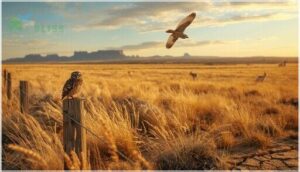
Unlike wetlands, grasslands and deserts challenge birds with harsh conditions, yet host specialists adapted to these extremes. Habitat connectivity is critical in these systems—over 60% of North American grasslands have vanished, taking their bird populations with them.
Key habitat conservation priorities include:
- Maintaining grazing intensity that creates vegetation heterogeneity
- Protecting water availability as climate refugia
- Managing fire regimes to limit invasive plant impacts
- Reducing nest predation through strategic mowing schedules
Urban and Suburban Areas

You’ll find about 20% of all bird species thriving in urban environments worldwide, though urbanization impacts can slash diversity by over 75%. Suburban habitat quality peaks at around 30% natural cover—think parks, streams, undeveloped patches.
Urban green spaces with native trees combat habitat fragmentation, while bird-friendly initiatives like Bird City programs create essential refuges. Even modest habitat restoration boosts urban bird diversity considerably.
Threats to Bird Habitats

Bird habitats face mounting pressures from multiple directions, and understanding these threats is the first step toward meaningful conservation. From sprawling cities that carve up forests to warming temperatures that scramble migration cues, the challenges are both diverse and interconnected.
Let’s look at the primary threats putting bird populations at risk.
Habitat Loss and Fragmentation
Since 1970, nearly three billion birds have vanished from North America, with habitat loss and fragmentation driving most population declines. When you break up forests or grasslands, you’re not just shrinking space—you’re isolating populations, cutting off gene flow, and pushing specialist species toward extinction.
Since 1970, nearly three billion North American birds have vanished as habitat loss isolates populations and drives specialist species toward extinction
Grassland birds alone have dropped 53%, while forest-dependent species struggle in degraded patches. Conservation policies focusing on habitat connectivity and restoration can reverse these troubling trends.
Impact of Climate Change
Climate change reshapes bird populations through range shifts, altered migration patterns, and habitat degradation. You’ll see species moving northward or to higher elevations, while tropical populations have dropped 25-38% since the 1950s.
Two-thirds of North American birds face extinction risks as warming outpaces their phenological adaptations.
Conservation efforts now target protecting critical refuges and restoring stopover sites along increasingly hazardous migration routes.
Pollution and Pesticide Use
Air pollution severely impacts bird populations, with ground-level ozone linked to declines of over 1.5 billion birds in North America. Pesticide use, especially neonicotinoids, reduces grassland and insectivorous species by 2.2% per 100 kg applied.
Water contamination from PFAS and fertilizer runoff degrades wetland habitats, while behavioral disruptions from noise and light pollution interfere with breeding success, underscoring the urgent need for pollution control.
Invasive Species and Human Activities
Beyond pollution, invasive species, and human impact pose severe conservation challenges. Habitat fragmentation from urbanization effects and habitat destruction disrupts migration and breeding, while invasive plants outcompete native vegetation birds depend on. Over one-third of U.S. bird species face moderate to high risk, with population declines accelerating from environmental degradation.
These threats include:
- Nest parasitism by invasive species
- Reduced insect prey from monoculture plants
- Agricultural habitat loss
- Infrastructure development pressures
Benefits of Preserving Bird Habitats

Protecting bird habitats isn’t just about saving birds—it creates a ripple effect that benefits entire ecosystems, local economies, and human communities. When you preserve these spaces, you’re investing in cleaner air and water, healthier landscapes, and opportunities for people to connect with nature.
Let’s look at the key benefits that make habitat conservation worth the effort.
Support for Biodiversity
When you preserve bird habitats, you’re directly supporting species richness and genetic diversity across ecosystems. Habitat heterogeneity—that mix of forests, grasslands, and wetlands—creates varied niches where both common and specialist birds thrive, strengthening ecosystem stability.
Conservation strategies targeting avian biodiversity have proven effective, with forest bird populations improving by 3% following policy interventions. Your efforts to maintain habitat quality help sustain these gains.
Carbon Storage and Climate Regulation
Healthy bird habitats aren’t just havens for wildlife—they’re powerful carbon sinks. Bird seed dispersal helps forests regenerate with high-density tree species, boosting forest carbon storage by up to 38%.
Wetlands and woodlands where you protect avian populations sequester over 100 billion tons of carbon globally.
When you support climate-smart habitat management, you’re building ecosystem resilience while strengthening natural climate solutions that remove CO2 from our atmosphere.
Economic and Recreational Value
Bird habitats deliver impressive economic returns that strengthen human wellbeing through ecosystem services. Birdwatching revenue reached $66.2 billion globally in 2024, supporting 1.4 million jobs through ecotourism and community involvement.
You’ll see property values climb up to $32,000 near protected sites, while pest control by birds saves farmers $310 per hectare.
Wetland recreation alone generates millions, proving conservation pays dividends.
Enhanced Water Quality and Flood Control
When wetlands thrive with diverse bird communities, you gain powerful allies in water purification and flood mitigation. Wetland habitats filter up to 70% of suspended solids while reducing agricultural phosphorus by 44%, safeguarding downstream water quality. Floodplain connectivity in restored sites cuts local flood risk by 35%, and enhanced erosion control traps 19% more sediment per hectare.
- Nutrient filtration: Waterbirds boost nitrogen cycling by 36% during migration, accelerating pollutant removal
- Hydrological regulation: Bird-populated wetlands increase groundwater recharge rates by 24% in managed systems
- Erosion control: Dense riparian habitats reduce bank erosion by 42% through vegetation stabilization
Wetland conservation delivers measurable protection for your community.
Strategies for Habitat Conservation
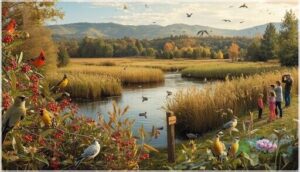
Protecting bird habitats requires thoughtful action at multiple levels, from individual backyards to entire landscapes. You can make a real difference by focusing on habitat quality, reducing threats, and building community support for conservation.
Let’s look at four practical strategies that work together to create safer, more sustainable environments for birds.
Restoring Native Vegetation
Restoring native vegetation forms the backbone of effective habitat preservation. When you plant native species and control invasive plants, you’re rebuilding the food webs birds depend on—native oaks alone support over 450 caterpillar species that feed 95% of breeding birds.
Successful habitat restoration requires attention to habitat complexity and hydrological management, with community involvement ensuring these conservation efforts create lasting change for bird habitats.
Creating Nesting Sites and Safe Spaces
Protecting vulnerable nesting spots directly shapes breeding success and population survival. When you create nesting sites through thoughtful nest box design and habitat restoration, you’re providing essential shelter that many species struggle to find in fragmented landscapes.
Key elements for creating effective bird habitats include:
- Artificial structures: Nest boxes show 60-80% fledging success when properly designed with predator protection features
- Natural cavity preservation: Maintaining dead trees and dense shrubs provides urban nesting opportunities cavity-nesters need
- Island sanctuaries: Constructing nesting islands in wetlands protects wading birds from ground predators while offering nearby foraging access
Strategic fencing and nesting materials availability further reduce disturbance, especially in high-traffic areas where human activity threatens reproductive success.
Sustainable Land Use Practices
Sustainable land use practices bridge agricultural productivity with habitat conservation, addressing bird population declines driven by intensive farming. These practices transform landscapes through agroforestry integration, bolstering diverse bird communities while maintaining economic viability. Agricultural methods that incorporate native restoration and polyculture systems consistently outperform monoculture approaches.
| Land Use Approach | Bird Diversity Impact | Key Conservation Benefit |
|---|---|---|
| Agroforestry orchards | Noticeably higher species richness | Fosters forest-affiliated birds |
| Organic low-intensity farms | 35% greater grassland species retention | Reduces herbicide-related habitat loss |
| Native vegetation buffers | Increased specialist bird abundance | Enhances habitat complexity |
Conservation tools, such as GIS mapping platforms, help identify priority areas where sustainable land use practices deliver maximum impact for wildlife management and conservation initiatives.
Community Involvement and Education
When nearly 100 million Americans watch birds, you can see the power of engaging the public and raising awareness. Citizen science projects like the Great Backyard Bird Count turn your observations into conservation data.
Education programs boost bird populations by over 50% in some regions, showing broader ecological benefits. Volunteer participation helps overcome barriers like limited funding, while community projects transform landscapes through practical steps individuals can take—from habitat restoration to school brigades—strengthening both biodiversity and local stewardship.
Frequently Asked Questions (FAQs)
How do migratory birds navigate across continents?
Migratory birds rely on magnetic navigation through Earth’s field lines, celestial cues like star patterns, and visual landmarks such as rivers.
They also use olfactory signals for position correction and inherited genetic programs guiding their remarkable journeys across flyways.
What sounds do different bird species make?
Bird vocalizations range from songs and calls to warbles and squawks. Sound frequencies usually span 5 to 11 kHz, enabling species identification and acoustic monitoring that aids bird conservation across diverse avian populations.
How long do common backyard birds live?
Lifespans vary dramatically among species you’ll spot at your bird feeders. Northern cardinals usually live 3 to 5 years, while American robins surviving their first year often reach 5 to 6 years in natural bird habitats.
Can birds recognize individual human faces?
Yes, crows and mockingbirds demonstrate impressive facial recognition. Their brain structure facilitates individual human identification even after years, showcasing crow intelligence and avian cognition that rivals primates, with implications for social learning in bird populations.
What should I feed wild birds safely?
High-quality black oil sunflower seed, safflower, and nyjer provide essential nutrition supporting bird populations through seasonal diets.
Maintain clean feeders regularly to prevent disease transmission, protecting species important for seed dispersal, pollination, and healthy bird habitats year-round.
Conclusion
Healthy bird populations don’t just signal thriving ecosystems—they anchor them. Every wetland restored, every native plant established, every pesticide eliminated creates ripples that extend far beyond individual species.
The importance of bird habitat lies in recognizing that protecting these spaces protects the intricate systems sustaining all life.
Your choices—whether planting native gardens, supporting conservation policies, or simply learning which birds need help—translate directly into landscapes where both wildlife and communities can flourish together.
- https://www.audubon.org/press-room/new-study-reveals-where-conservation-can-deliver-birds-communities-and-climate
- https://www.sciencedirect.com/science/article/pii/S1439179123000208
- https://pmc.ncbi.nlm.nih.gov/articles/PMC9495260/
- https://www.wellbeingintlstudiesrepository.org/cgi/viewcontent.cgi?article=1003&context=es_nexus
- https://academic.oup.com/bioscience/article/68/4/264/4913793