This site is supported by our readers. We may earn a commission, at no cost to you, if you purchase through links.

Step into a forest in Papua New Guinea and you’ll encounter over 230 bird species—a staggering concentration that illustrates how profoundly habitat shapes avian life. The same principle governs every ecosystem on Earth: wetlands host waders with specialized bills, grasslands shelter ground-nesters adapted to open vistas, and even scorching deserts support birds with exceptional water-conservation mechanisms.
Understanding bird species by habitat type reveals not just where different birds live, but why certain features—canopy density, water availability, vegetation structure—determine which species can thrive.
As habitats face mounting pressures from fragmentation to climate shifts, recognizing these intricate connections becomes essential for protecting the diversity that makes each ecosystem unique.
Table Of Contents
Key Takeaways
- Habitat structure—canopy complexity, vegetation density, water availability—directly determines which bird species can thrive, with forests alone supporting over 230 species in Papua New Guinea’s layered ecosystems while grassland birds require 40-80% grass cover with minimal tree interference.
- Specialized adaptations like short rounded wings for forest maneuverability, waterproof feather insulation for aquatic life, heat-dissipating bills in deserts, and behavioral flexibility in cities reveal how birds evolve precise survival mechanisms matched to their specific environments.
- Habitat loss drives catastrophic population declines across all ecosystem types, with grassland birds down 53% since 1970, wetlands losing 670,000 acres since 2009, and urban development eliminating up to 50% of species in heavily developed cities through fragmentation and resource depletion.
- Conservation success hinges on protecting microhabitat diversity, maintaining connectivity between habitat patches, and integrating green infrastructure in human-modified landscapes, as even small interventions like adding 0.16 square kilometers of urban greenspace annually can measurably boost bird diversity.
Forest Habitats and Bird Diversity
Forests stand as nature’s most architecturally complex habitats, where layered canopies and dense understory create countless niches for avian life. These ecosystems harbor exceptional species diversity—Papua New Guinea’s rainforests alone support over 230 recorded bird species.
Let’s explore what makes forest habitats so essential for birds and examine the key features that shape their outstanding communities.
Key Features of Forest Ecosystems

Forests are marvels of habitat complexity, with vertical layers from the canopy to the forest floor creating diverse ecological niches. Tree species composition significantly shapes avian ecology, as structural diversity across these layers supports rich biodiversity preservation.
The interplay between dense underbrush and open mature stands maintains the ecosystem balance vital for forest habitats. This habitat diversity directly influences which birds thrive in these intricate woodland environments.
Understanding the role of forest structure is essential for conservation efforts.
Notable Forest Bird Species Worldwide

You’ll encounter exceptional avian diversity across the globe’s forest habitats, with Colombia, Peru, and Brazil each hosting over 1,800 bird species. These hotspots represent critical areas for bird migration and avian research, where forest conservation efforts protect species like the critically endangered Imperial Woodpecker and Madagascar Pochard.
Ornithology reveals that species endangerment threatens many forest-dependent birds, making habitat restoration essential for preserving this impressive biodiversity. The conservation of endangered bird species is vital for maintaining ecosystem balance.
Adaptations of Forest-dwelling Birds

Forest-dwelling bird species thrive through striking bird adaptations shaped by avian ecology. You’ll notice how these creatures have evolved to navigate their complex environment:
- Short, rounded wings in over 60% of Neotropical forest birds improve maneuverability through dense vegetation
- Forest canopy specialists develop broader vocal ranges for communication across vertical strata
- Feather insulation increases density by 30% in overwintering species, supporting survival during harsh conditions
- Tree climbing specialists like woodpeckers possess reinforced crania and zygodactyl feet for vertical foraging
These morphological features reflect avian physiology’s response to forest habitats, ensuring species can exploit resources throughout different layers—from understory to forest canopy—while managing seasonal challenges like bird migration timing and temperature fluctuations.
Importance of Micro-habitats in Forests

Beyond broad forest habitats, you’ll discover that microhabitats—those smaller pockets of varied structure—drive bird diversity in striking ways. Tree species richness correlates directly with avian abundance, while vertical forest canopy layers and horizontal vegetation density create distinct ecological niches.
Forest regeneration areas with denser understory support endangered insectivores, and microhabitat diversity ensures both generalist and specialist birds coexist. This structural complexity matters for habitat conservation, as it stabilizes communities and enhances resilience.
| Microhabitat Feature | Impact on Bird Nesting & Diversity |
|---|---|
| Canopy complexity | Facilitates vertical stratification of species |
| Understory density | Critical for forest specialists and insectivores |
| Tree species variety | Increases functional richness year-round |
| Small forest openings | Creates niches for shrubland-adapted birds |
Threats to Forest Bird Habitats

Vulnerability shadows every forest habitat, with deforestation impacts and logging effects driving habitat loss for countless bird species. Habitat fragmentation leaves breeding populations isolated, while climate change amplifies survival challenges—even in remote rainforests. Invasive species and disease outbreaks further accelerate habitat degradation.
That’s why conservation efforts must weave together solutions addressing fragmentation, climate shifts, and the relentless pace of forest transformation.
Wetland and Aquatic Bird Species
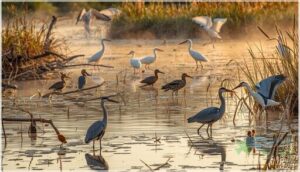
Wetlands and aquatic habitats shape a fascinating variety of bird life, each with its own story. You’ll find birds thriving in places as different as marshes, lakes, and coastal waters. Let’s take a closer look at the types of environments these species call home.
Types of Wetland and Aquatic Habitats
Picture wetlands as nature’s living mosaics—marshes, swamps, bogs, and fens each offer unique Ecosystem Services. Wetland Ecology reveals how aquatic plants anchor freshwater wetland and marine habitats, while mangroves support Coastal Management.
Aquatic farmland, reedbeds, and estuaries bridge Freshwater Conservation and biodiversity, making these aquatic habitats indispensable for sustaining birdlife and ecological balance.
Waterbird Diversity and Habitat Requirements
Imagine wetlands as intricate networks, each thread supporting waterbird diversity and essential Ecosystem Services. Your understanding of Wetland Ecology reveals that habitat fragmentation and urbanization threaten these communities, especially during Bird Migration and breeding. For effective Waterbird Conservation, consider:
- Buffer zone connectivity
- Sufficient wetland area
- Seasonal habitat requirements
These factors shape aquatic habitats and sustain bird species diversity.
Specialized Adaptations for Aquatic Life
Ever wondered how birds master aquatic habitats? Your exploration of avian ecology reveals Diving Mechanics in penguins, Beak Specialization in spoonbills, and Underwater Locomotion in cormorants. Feather Insulation and Aquatic Vision are essential, shaping survival in aquatic and marine habitats. These adaptations highlight the importance of habitat diversity across bird habitats.
| Adaptation | Example Species |
|---|---|
| Diving Mechanics | Penguin, Puffin |
| Feather Insulation | Cormorant, Anhinga |
| Aquatic Vision | Auklet, Grebe |
| Beak Specialization | Spoonbill, Flamingo |
Wetland-dependent Endangered Birds
Did you know nearly half of the U.S. endangered animals rely on wetlands? Your understanding of wetland ecology is essential—habitat restoration can mean life or extinction for species like the Liben Lark, now fewer than fifty breeding pairs. Endangered birds depend on healthy aquatic habitats for migration, nesting, and survival, making species conservation inseparable from habitat conservation.
- Liben Lark population decline
- Wetlands critical for bird migration
- Habitat restoration aids endangered birds
- Aquatic habitats essential for species conservation
Conservation of Wetland Habitats
You can’t afford to overlook wetland restoration—since 2009, the U.S. has lost 670,000 acres of vegetated wetlands, equivalent to seven football fields every hour. Conservation efforts now focus on ecosystem services worth $14.9 trillion globally, sustaining habitat preservation for 40% of all species. Environmental policy shapes biodiversity conservation success, with mitigation projects achieving 74% effectiveness in freshwater wetlands protection.
| Conservation Strategy | Impact on Bird Habitats |
|---|---|
| Wetland Restoration Projects | Sustains 138 wetland-dependent U.S. species |
| Habitat Preservation Policies | Protects critical nesting and migration zones |
| Ecosystem Services Valuation | Funds conservation of bird habitats globally |
| Federal Water Regulations | Influences freshwater wetlands protection |
| Integrated Watershed Management | Enhances biodiversity conservation outcomes |
Grassland and Savanna Bird Communities
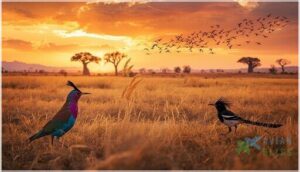
Grasslands and savannas stretch across continents as vast open landscapes where you’ll find birds that have mastered life without the shelter of dense vegetation. These habitats demand specialized adaptations, from ground-nesting strategies to foraging techniques suited for open terrain.
Let’s explore what makes these bird communities unique and why their survival hinges on preserving these increasingly threatened ecosystems.
Characteristics of Grassland and Savanna Habitats
You’ll find grasslands and savanna habitats offer distinct structural blueprints for avian life. Grassland ecology thrives where herbaceous vegetation dominates—grasses covering over 80% of native systems. Savanna biodiversity emerges from a different formula:
- Grass cover between 40–80% mingles with scattered trees
- Seasonal rains govern resource availability and breeding windows
- Habitat fragmentation reduces patch connectivity, lowering bird presence by over 40%
- Conversion to farmland decreases bird density by one-third
These terrestrial habitats demand customized conservation strategies to counter ecosystem services loss.
Prominent Grassland and Savanna Bird Species
You’ll encounter distinct avian diversity across these open landscapes. North American grasslands host iconic species like the Eastern Meadowlark and Grasshopper Sparrow—both grassland ecology specialists now facing species extinction risk as habitat fragmentation intensifies.
African savanna habitat sustains 794 bird species, including the endangered martial eagle. Savanna conservation urgently matters: grassland birds have declined 53% since 1970, a sobering reflection of habitat diversity importance during bird migration and breeding cycles.
Nesting and Survival Strategies in Open Habitats
Ground-nesting birds in open habitats face immense predation pressure—91% of nest failures stem from predators. These species rely on camouflage techniques and strategic nest site selection, choosing tall vegetation far from edges where predator avoidance proves most effective. Daily survival rates climb to 96% when overhead concealment is ideal.
Habitat fragmentation disrupts these finely-tuned survival adaptations, threatening birds that depend on habitat diversity importance for reproductive success.
Impact of Habitat Loss on Grassland Birds
Beyond survival tactics, you’ll witness habitat loss reshaping grassland bird populations with alarming speed. North American grassland birds have plummeted 53% since 1970—that’s 720 million individuals lost to agricultural conversion and habitat fragmentation.
Since 1970, North American grassland birds have plummeted by 53%—720 million individuals lost to agricultural conversion and habitat fragmentation
Five stark realities of grassland ecosystems under threat:
- Over 60% of native grasslands converted to farmland
- Some species declining 70-90% in four decades
- The Northern Great Plains lost 385,000 acres in 2022 alone
- Species extinction thresholds approaching as local populations vanish
- Conservation efforts through habitat restoration show promising recovery in targeted areas
These declines signal broader ecosystem instability. Grassland bird migration patterns shift as suitable breeding habitats disappear, forcing species into suboptimal territories. Tree encroachment compounds the crisis, eliminating open spaces these specialists require. Yet avian diversity can rebound—landscape-level conservation programs demonstrate that protecting core breeding areas helps vulnerable bird species recover, offering hope amid the losses.
Desert and Arid Region Bird Species
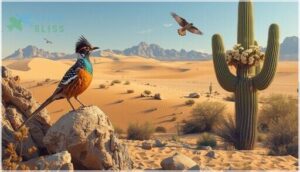
Desert environments test birds in ways few other habitats can match. From scorching daytime temperatures to freezing nights and scarce water sources, these arid regions demand ingenious adaptations from the species that call them home.
You’ll discover how desert birds have evolved impressive strategies to not just survive, but thrive in some of Earth’s harshest conditions.
Unique Features of Desert Bird Habitats
Desert microclimates define survival for birds traversing arid environments where annual precipitation rarely tops 500 mm. Thermal regulation becomes critical as temperatures swing wildly—scorching days give way to frigid nights. Water scarcity drives every behavioral choice, from foraging patterns to nesting site selection in shaded cactus cavities or dry stream beds.
| Habitat Feature | Bird Challenge | Ecological Impact |
|---|---|---|
| Sparse vegetation patches | Limited food resources | Concentrated foraging zones |
| Extreme temperature fluctuations | Physiological stress | Reduced breeding success |
| Ephemeral water sources | Dehydration risk | Group travel to oases |
| Microhabitat complexity | Predator exposure | Nest concealment strategies |
| Climate change intensification | Habitat fragmentation | 50% species occupancy decline |
Conservation efforts now target less than 20% of protected climate refugia, essential for maintaining avian ecology amid accelerating habitat threats.
Specialized Desert Bird Species and Their Adaptations
You’ll find striking feather adaptations in species like the Southern Yellow-billed Hornbill, whose oversized beak dissipates heat while specialized “eyelashes” shield eyes from sand.
Heat tolerance in these desert bird migration specialists reaches 44.5°C through efficient water conservation mechanisms—cutaneous loss drops nearly 50% compared to non-arid ecosystems.
Camouflage plumage and compressed feather structures further support bird survival strategies, making habitat preservation critical for these arid-adapted populations.
Strategies for Surviving Extreme Conditions
You’ll witness exceptional climate adaptation as desert birds employ three critical survival tactics to maintain ecological balance against extreme migration pressures and habitat loss.
- Heat tolerance kicks in at body temperatures reaching 43.5–45.3°C, with specialized vascular bill structures offloading excess heat without sacrificing precious water reserves
- Water conservation mechanisms include highly concentrated urine and strategic foraging during cooler dawn hours when moisture-rich insects are most abundant
- Behavioral thermoregulation through gular fluttering and seeking shaded microclimates represents essential bird survival strategies against the growing impact of climate change
Conservation Challenges in Arid Environments
You’re facing a perfect storm in Arid Ecosystems where habitat loss has slashed bird populations by 46% since 1968.
Desert Conservation demands coordinated action: Water Management must balance human needs with riparian Habitat Restoration, while Climate Adaptation strategies counter 2°C warming.
Without aggressive conservation efforts targeting invasive species and habitat preservation, you’ll witness accelerating species extinction across these fragile landscapes.
Urban and Anthropogenic Habitats for Birds

Cities might seem like unlikely havens for wildlife, but you’d be surprised how many bird species have learned to thrive alongside humans. From pigeons moving through subway platforms to hawks nesting on skyscraper ledges, urban environments support a fascinating mix of adaptable avian residents.
Let’s explore how these birds make the most of concrete jungles and what factors determine their success in human-dominated landscapes.
Urban Bird Species Diversity
You’ll find urban areas host about 20% of global bird species, though urbanization effects dramatically reshape avian diversity. Urban green spaces become critical refuges where bird diversity hinges on vegetation complexity and area extent. City planning that prioritizes green infrastructure fosters broader ecological traits among urban bird communities.
However, urbanization creates challenging conditions where:
- 3 to 5 dominant species comprise 65% to 90% of urban bird populations
- Species richness declines as impervious surfaces increase and habitats fragment
- Approximately 78% of bird species struggle tolerating human-dominated environments
- Larger parks demonstrate stronger positive correlations with avian behavior patterns and bird migration stopover success
Influence of Habitat Structure in Cities
Urban planning decisions shape city ecosystems more powerfully than you might expect. Native tree diversity can lift bird species richness by 30% compared to exotic-dominated sites, while urban greenspaces with complex vegetation structures sustain 25% greater avian diversity.
Yet habitat fragmentation and sealed surfaces drive losses exceeding 40% of resident species. Green infrastructure and vegetation complexity remain your most effective tools against urbanization effects.
Adaptations to Human-modified Environments
You’ll notice how birds thriving in anthropogenic habitats demonstrate impressive Behavioral Flexibility—adjusting vocalizations to cut through Urban Noise Pollution, modifying foraging tactics to exploit novel food sources, and nesting on human structures.
This Ecological Resilience emerges from genetic shifts affecting metabolism and nervous systems, coupled with reduced fear responses enabling survival despite habitat fragmentation.
Such adaptations showcase nature’s capacity for rapid microevolutionary responses to Human Bird Conflict challenges across urban areas.
Effects of Urbanization on Bird Populations
While those adaptations help some birds survive, urbanization still triggers severe consequences you should understand. Bird populations face up to 50% species loss in heavily developed cities, driven by habitat fragmentation that isolates forest patches and disrupts ecosystem functioning.
Urban planning rarely accounts for bird migration corridors, accelerating species extinction risks. Insectivorous specialists decline sharply while granivores increase, fundamentally altering community structure and threatening conservation efforts aimed at preserving urban biodiversity.
Role of Green Spaces in Urban Bird Habitats
Green roofs and strategic urban planning can turn cities into lifelines for bird migration and habitat conservation. Adding just 0.16 square kilometers of urban greenspaces annually measurably boosts bird habitats, supporting diverse avian ecology even in dense urban areas.
Habitat restoration works—unsealed soil and native trees within 50 meters directly increase species richness, proving eco conservation thrives when you prioritize vegetation quality over sheer connectivity.
Frequently Asked Questions (FAQs)
How do mountain habitats shape bird evolution?
Mountains sculpt evolution like a chisel on stone. Elevational adaptation drives mountain speciation through high-altitude evolutionary pressures.
Alpine birds show striking genetic divergence, while habitat compression intensifies avian ecology challenges in these critical bird habitats.
What birds thrive in coastal cliff environments?
You’ll find resilient seabirds like puffins, gannets, and razorbills thriving on rocky shores. These cliff nesting specialists form dense bird colonies, capitalizing on coastal ecosystems’ inaccessibility to predators while accessing rich marine feeding grounds during seabird migration seasons.
Do island birds differ from mainland species?
Island birds demonstrate distinct morphological shifts from mainland species, evolving toward intermediate body sizes and flightlessness trends.
Species isolation drives genetic adaptation, producing rounded wings, longer legs, and reduced flight muscles—predictable evolutionary patterns shaped by limited predation pressure.
How does altitude affect bird species distribution?
Ever wonder why fewer birds soar at higher peaks? Altitude migration and elevation gradients dramatically shape bird species richness.
Climate effects, avian adaptations, and alpine habitats create distinct mountain communities, illustrating how habitat types define avian distribution patterns.
What role do caves play for birds?
Caves provide critical bird habitats through cave nesting opportunities, stable microclimates, and protection from predators. These unique avian habitats support swiftlets and swallows while maintaining ecosystem balance, making cave protection essential for bird conservation and preserving cave ecology.
Conclusion
Every bird you’ll ever see carries the signature of its habitat—etched in bill shape, plumage pattern, and behavioral repertoire. From wetland waders to desert specialists, understanding bird species by habitat type unlocks the ecological logic governing distribution and survival.
As habitats fragment and shift, your awareness becomes a conservation tool. Recognizing these connections doesn’t just deepen appreciation; it equips you to advocate for the landscapes that sustain avian diversity across forests, grasslands, wetlands, and beyond.
- https://doi.org/10.1016/j.landurbplan.2014.11.003
- https://repository.si.edu/bitstream/handle/10088/27854/NZP_Marra_2015-Direct_Mortality_of_Birds_from_Anthropogenic_Causes.pdf
- https://birdcast.info/science-to-action/lights-out/
- https://www.cambridge.org/core/books/ecology-and-conservation-of-forest-birds/forest-birds-and-their-adaptations/58581AA03554ECC4F6C415CBF88ED1EF
- https://pmc.ncbi.nlm.nih.gov/articles/PMC6010736/