This site is supported by our readers. We may earn a commission, at no cost to you, if you purchase through links.
Every year, North America loses three billion birds—a staggering 29% decline since 1970. You might not notice the missing birdsong in your neighborhood, but the effects of habitat loss on birds ripple through ecosystems in ways that touch your daily life.
When forests become parking lots and wetlands turn into farmland, birds lose more than homes. They lose food sources, safe migration routes, and places to raise their young. Some species adapt, but many can’t keep pace with the speed of change.
Understanding why birds disappear matters because they pollinate crops, control pests, and signal environmental health. The good news? You can help reverse these trends through conservation efforts that protect both birds and the ecosystems we all depend on.
Table Of Contents
Key Takeaways
- Habitat loss from urban growth, farming, and pollution has caused North America to lose nearly 3 billion birds since 1970, with ripple effects across ecosystems.
- Birds struggle to survive as food sources vanish, migration routes break apart, and breeding seasons fall out of sync with nature’s rhythms.
- Fragmented habitats make birds more vulnerable to predators and disease, while also breaking down crucial ecosystem services like pest control and pollination.
- Conservation efforts—such as habitat restoration, sustainable farming, protected areas, and community engagement—have proven effective in helping bird populations recover.
Causes of Habitat Loss in Birds
Understanding what’s threatening bird populations starts with looking at where those threats come from. Habitat loss doesn’t happen in a vacuum—it’s the result of several interconnected human activities that reshape the landscape birds depend on.
Let’s explore the main culprits behind this growing crisis.
Human Development and Urbanization
Across our growing cities, urban sprawl doesn’t just reshape landscapes—it erases the homes birds depend on. Consider what you’re witnessing in your own community as habitat loss accelerates:
- Urban expansion has driven the disappearance of over 2.9 billion birds in North America since 1970
- Habitat fragmentation from human development threatens 70% of endangered bird species globally
- Agricultural expansion further reduces habitats.
- Green infrastructure and sustainable cities offer hope for species displacement recovery
Industrialization and Pollution
Beyond urban sprawl, industrialization adds another layer of danger through pollution. Air pollution, particularly ozone, has been linked to a 20% reduction in bird populations—though regulations have saved 1.5 billion birds since 1980.
Chemical exposure from mercury and zinc causes reproductive failure and death, while oil spills like Deepwater Horizon killed an estimated 700,000 seabirds. The Deepwater Horizon spill led to significant seabird losses, impacting populations in the Gulf of Mexico.
Industrial pollution also disrupts bird microbiomes, weakening their immune systems and digestive health.
Deforestation and Land-Use Change
While pollution damages bird health, deforestation outright destroys their homes. Between 1985 and 2020, over 282,000 square kilometers of forest breeding habitat vanished, eliminating 33.5 to 104.5 million individual birds.
Agricultural land conversion drives much of this loss—Colombia’s traditional pastures support 60% fewer species than remnant forests.
Forest management practices prioritizing timber over biodiversity worsen habitat fragmentation, threatening specialized birds with extinction.
Climate Change Effects
Climate change impacts on birds extend beyond habitat destruction. Rising temperatures now force species into range shifts—61% of U.S. birds have moved over 200 miles northward since the 1970s.
Extreme weather and heat events kill millions during migration, while phenology changes create mismatches between breeding seasons and food availability.
These shifting habitats drive extinction rates upward, with two-thirds of North American species now at risk.
Agricultural Expansion and Resource Depletion
As farmland swallows millions of acres annually, you’re witnessing habitat destruction that’s pushing 61% of bird species toward decline. Agricultural intensification strips away the resources birds need to survive:
- Pesticide impact decimates insect prey, leaving forest birds and grassland species starving
- Habitat transformation converts native prairies to monocultures, slashing populations by over 50%
- Resource scarcity from intensive farming depletes water and soil, eliminating nesting sites
Sustainable agriculture and better resource management can reverse these trends.
Impacts of Habitat Loss on Bird Species
When birds lose their homes, the consequences ripple through every aspect of their lives. From finding enough food to raising their young, habitat loss creates a cascade of challenges that push species closer to the brink.
Let’s look at the specific ways these changes affect different bird populations and what it means for their survival.
Food Scarcity and Starvation Risk
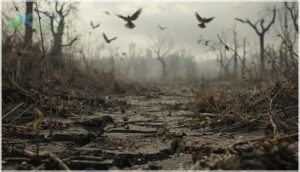
When food sources disappear, birds face immediate starvation risk. North America has lost nearly 3 billion birds since the 1970s, driven by food shortages tied to insect decline and forest degradation. Urban deserts—landscapes stripped of native plants—leave birds scrambling for survival.
When native food sources vanish, nearly 3 billion North American birds have disappeared, starving amid landscapes stripped of insects and plants
Population declines follow quickly: where habitat drops, bird abundance falls nearly eight times. Food scarcity reshapes population structure and triggers behavioral responses, as desperate birds expand their ranges or abandon familiar territories entirely.
Disrupted Migration and Breeding Cycles
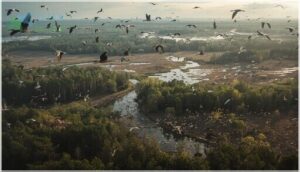
When breeding season arrives out of sync with food availability, you witness a cascade of failures. Habitat fragmentation forces 70% of tracked forest birds to reroute migrations, while migration stopover points vanish beneath development. Shifting habitats create phenological mismatches—insects now emerge 22 days earlier than bird arrivals.
- Altered migration patterns: Arctic terns now migrate 9.2 days earlier per decade
- Route deviations: Stopover site loss increased nonstop flights 20% since 1990
- Breeding success drops: Fragmented forests show 35% lower fledgling survival
Increased Vulnerability to Predators and Disease

Fragmented forests turn into danger zones where predation pressure and disease susceptibility spike dramatically. Edge effects draw crows and raccoons to nest sites, boosting predation rates by 50% in smaller forest patches.
You’ll find parasite transmission surges 200% in overcrowded remnants, while immune stress from novel pathogens weakens survival chances.
Habitat specialization makes threatened species especially vulnerable to these combined threats.
Decline in Endemic and Migratory Birds

Endemic birds and migratory birds are disappearing at alarming rates, with 61% of bird species worldwide now experiencing population declines. Here’s what you need to know about these losses:
- Endemic species face extinction risks as habitat specialization makes them vulnerable—66% lost breeding habitat between 1985 and 2020
- Migratory birds struggle with connectivity disruption as fragmented landscapes alter their routes
- Population dynamics have shifted dramatically, with nearly a third of North America’s birds vanishing
Conservation focus must address habitat loss urgently.
Effects on Forest, Grassland, and Wetland Birds
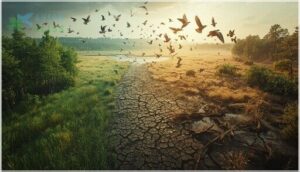
Forest bird decline has accelerated dramatically—a billion birds lost, with 66% of species experiencing habitat loss between 1985 and 2020. Grassland habitat loss drives even steeper declines, with populations plummeting 53%. Wetland bird impacts mirror this crisis, as destroyed wetlands directly reduce populations.
Species specialization makes recovery harder—old-forest specialists and grassland experts need large, intact spaces. Without strong habitat fragmentation consequences addressed, conservation projections predict continued losses across forests, grasslands, and wetlands.
Habitat Fragmentation and Ecosystem Disruption

When habitats break apart into smaller, isolated patches, the damage goes far beyond what you can see on a map. Fragmentation creates invisible barriers that disrupt how birds move, feed, and interact with their environment.
Let’s look at three critical ways fragmented landscapes unravel the ecosystems birds depend on.
Fragmented Landscapes and Bird Movement
When forests are broken into smaller pieces, habitat fragmentation creates dispersal barriers that trap birds in isolated patches. Patch isolation reduces movement effects by up to 95% for some species, cutting off gene flow and blocking migratory birds from reaching critical resources.
Matrix permeability—how easily birds cross open areas—determines survival. Habitat corridors and connectivity metrics help scientists prioritize restoration efforts that reverse population decline.
Loss of Biodiversity and Ecological Interactions
When habitat disappears, you’re not just losing birds—you’re watching entire ecosystems unravel. Declining bird diversity leads to biodiversity loss that ripples through trophic cascades, threatening population viability and genetic diversity. Specialist species vanish while generalists dominate, simplifying once-complex communities and triggering ecosystem imbalances that weaken the ecosystem services we all depend on.
Here’s what disrupted ecosystems mean for birds and nature:
- Pollination partnerships fail: Eleven percent of bird-pollinated plant interactions have vanished in degraded habitats
- Seeds don’t travel: Seed dispersal drops by 40%, stunting forest recovery
- Predator-prey balance breaks: Insect outbreaks jump 25% when insectivorous birds decline
- Plant recruitment falls: Loss of ecological interactions cuts new plant growth by 15%
- Genetic bottlenecks form: Isolated populations lose 15–40% genetic diversity, risking species extinction
Disruption of Food Webs and Ecosystem Services
Beyond losing individual species, you’re witnessing food web stability collapse. When birds vanish, trophic cascades ripple outward—pest control fails, seed dispersal stops, and nutrient cycles break down.
This ecosystem service decline hits hard: crop damage soars as insect populations explode, and food sources for other wildlife disappear. The cascading effects threaten everything from forest regeneration to your local food supply, with economic implications reaching billions globally.
Conservation Strategies for Bird Populations

You might be wondering what you can actually do to help protect bird populations from habitat loss. The good news is that conservation strategies exist at every level, from large-scale habitat restoration to simple backyard changes you can make today.
Let’s look at five proven approaches that are making a real difference for birds around the world.
Habitat Preservation and Restoration
You can bring birds back from the brink. Restoration benefits are real and measurable—when you protect and restore habitat, bird populations recover. Here’s what the evidence shows:
- Native bird species richness increases directly with years since restoration planting
- The Endangered Species Act achieved a 78% recovery success rate for mainland U.S. birds
- Conservation Reserve Program plantings conserved breeding habitat for 4.5 million grassland birds annually
- Restoration efforts on private land help recover imperiled species through strategic habitat preservation strategies
- Long-term trends confirm that direct habitat restoration remains the primary method for re-establishing native forest bird communities
Conservation efforts work.
Sustainable Land Management Practices
When you change how you farm, birds notice. Agroforestry benefits show up quickly—diversified Costa Rican farms supported 32 species of forest birds in long-term population growth. Rotational grazing boosted field sparrows and indigo buntings considerably.
Organic methods delivered 34% more biodiversity by ditching synthetic chemicals. Field margins and adaptive management matter too, creating the heterogeneous landscapes birds desperately need.
Creation of Alternative Habitats
Creating artificial nests lifts breeding success—songbirds achieve 64% compared to 50% in natural cavities. Urban greenspaces boost species richness by 20%, while wetland restoration increases diversity by 25%. Agroforestry and forest patches outperform monocultures by 30%.
Smart project siting and habitat mitigation through these alternative habitats creation strategies deliver measurable conservation gains. You’re witnessing habitat conservation plans that actually work.
Protected Areas and Reserves
Protected areas deliver real results—reserves covering over 50 hectares show significant increases in bird frequency, with species recovery rates reaching 78% for mainland populations. Network expansion remains critical since only 10% of key bird diversity sites receive coverage.
Financial investment matters: $102.9 million in 2025 grants support habitat restoration across 548,242 acres, directly mitigating threats and strengthening conservation efforts where birds need protection most.
Community Engagement and Education
You hold more power than you might realize. Educational programs boost children’s bird identification skills by 78% in just six months, while citizen science platforms like eBird collect over 100 million observations annually—data that directly shapes conservation action.
Community involvement increases native bird survival rates by up to 40%, and public awareness campaigns spark lasting habitat stewardship, with 41% of participants continuing restoration work long-term.
Global Initiatives and Future Solutions

The good news is that conservation doesn’t stop at local borders—it’s a worldwide effort. From international treaties to citizen scientists in your own neighborhood, people are taking meaningful steps to protect bird habitats.
Let’s look at some of the most promising solutions that are making a real difference today.
International Cooperation and Agreements
International bird conservation efforts depend on countries working together across borders. The East Asian-Australasian Flyway Partnership coordinates habitat protection across 22 nations, while the Berne Convention shields European species.
Treaty effectiveness varies—protected areas show 17.8% better habitat retention, yet funding mechanisms and agreement enforcement remain challenging.
You’ll see future directions emphasizing implementation over creating new agreements, with policy and legislation strengthening conservation efforts needed worldwide.
Climate Change Mitigation for Bird Habitats
Addressing climate change directly protects bird habitats through strategic action. You can support three key Adaptive Strategies that make a real difference:
- Renewable Siting outside critical bird zones reduces fatalities by thousands annually
- Wetland Restoration boosts waterbird populations by 60% through habitat recovery
- Forest Management converting plantations to native stands prevents diversity loss
Sustainable land management, carbon sequestration, and reforestation work together, giving vulnerable species a fighting chance against warming temperatures.
Large-Scale Reforestation Efforts
Beyond mitigation, reforestation brings birds back to life. Over 420 million hectares of forest vanished from 1990 to 2020, but restoration projects now cover 500,000 km² globally. Studies show 90% of bird species—including 82 forest specialists—quickly recolonize reforested areas.
These efforts deliver Species Recovery and Carbon Sequestration together, creating migratory stopovers while offsetting emissions.
Yet Restoration Challenges remain: invasive predators and poor connectivity can limit success without adaptive Forest Management.
Policy, Legislation, and Strategic Planning
Strong laws make real change possible. The MBTA Modernization now protects over 1,000 species, while Habitat Funding through the proposed Migratory Bird Recovery Fund drives Conservation Planning nationwide. Yet Policy Challenges persist—2025’s rollbacks weakened protections. International Agreements like the Berne Convention unite countries in strategic habitat conservation, giving environmental agencies tools for conservation action. You can support these conservation efforts through advocacy and staying informed.
Key policy tools include:
- Migratory Bird Treaty Act reforms with enhanced regulatory clarity
- Federal and state wildlife grants for conservation planning assistance
- North American Wetlands Conservation Act funding streams
- Farm Bill investments in private lands bird habitats
- International treaties coordinating cross-border protections
Citizen Science and Monitoring Programs
You can help track bird populations through citizen science programs that now power conservation outcomes worldwide. Over 23 million bird records fuel platforms like eBird, achieving 97% data accuracy.
Technology impact is real—AI apps identify bird songs instantly, while geographic coverage expands through public participation.
Community engagement turns everyday observations into research that shapes bird conservation strategies, and your smartphone makes you part of the solution.
Frequently Asked Questions (FAQs)
How does habitat loss affect bird behavior?
Let’s test a theory: when bird habitats shrink, aggression increases sharply as birds compete for space and food sources. You’ll also see foraging changes, migration disruption, predator vulnerability, and breeding modifications—all direct results of habitat loss.
What role do invasive species play in habitat loss?
Invasive species drive habitat loss by modifying landscapes, outcompeting native birds, and causing cascading effects on ecosystems.
Management strategies, like eradication trends, aim to restore bird habitats and curb invasive habitat modification and competition displacement threatening biodiversity.
How does noise pollution impact bird populations?
Imagine a city’s constant hum drowning out bird songs—noise pollution triggers song frequency shifts, lowers reproductive success rates, and sparks physiological stress responses.
Over time, this leads to species diversity decline and evolutionary adaptations, compounding population declines and environmental impact.
Are urban birds adapting to shrinking habitats?
Urban birds show striking behavioral plasticity, adapting to shrinking bird habitats through urban trait syndrome, breeding season shifts, and changes in food resource use and migration timing.
Still, many struggle as urban expansion alters nesting sites and reduces food sources.
What technologies aid bird conservation efforts?
If birds could tweet about their struggles, they’d rave about Conservation tools like Acoustic Monitoring, GPS Tagging, AI Applications, and Remote Sensing.
Citizen Science platforms, such as eBird, weave people into Habitat restoration and real-time Conservation efforts.
Conclusion
Imagine a world so quiet, you could hear a pin drop in the forest—this is the true cost of ignoring the effects of habitat loss on birds. Their absence signals more than silence; it marks a breakdown in the web of life that sustains us all.
By protecting habitats, you’re not just saving feathers and wings—you’re preserving the heartbeat of nature itself. Every garden, every choice, every action can tip the balance back toward harmony and hope.
- https://www.audubon.org/magazine/sweeping-new-report-shows-us-birds-declining-sharply-across-range-habitats
- https://www.nature.com/articles/d44151-022-00053-1
- https://www.sciencedirect.com/science/article/abs/pii/S0006320703000983
- https://pmc.ncbi.nlm.nih.gov/articles/PMC8079992/
- https://www.fws.gov/library/collections/threats-birds