This site is supported by our readers. We may earn a commission, at no cost to you, if you purchase through links.
 You’ll spot several common birds with red heads across North America, each showing off their crimson crowns for different reasons.
Northern cardinals flash bright red all over, while house finches sport rosy patches that intensify during breeding season.
Woodpeckers like the downy and red-bellied varieties use their scarlet caps to communicate with mates and rivals.
Red-winged blackbirds display bold shoulder patches, and acorn woodpeckers show off striking red, white, and black patterns.
These birds with red heads evolved their vibrant coloring to attract partners and establish territory.
The secret to attracting these feathered gems lies in understanding their unique feeding preferences and habitat needs.
Table Of Contents
- Key Takeaways
- Birds With Red Heads
- Red Headed Bird Types
- Physical Characteristics
- Attracting Red Headed Birds
- Conservation Status
- Frequently Asked Questions (FAQs)
- What types of birds have red heads?
- Why do some birds have red heads?
- Are red headed birds found in all regions of the world?
- Are red headed birds only found in adult birds?
- Are red headed birds protected species?
- Can red headed birds be kept as pets?
- What kind of birds have red on their head?
- What bird has a red head but not a cardinal?
- What looks like a sparrow but has a red head?
- What is a GREY bird with a red head?
- Conclusion
Key Takeaways
- You’ll find diverse red-headed species across North America, including woodpeckers, cardinals, finches, and tanagers, each with unique red markings that serve important roles in mate attraction and territorial displays.
- You can attract these vibrant birds by offering varied food sources like black oil sunflower seeds in tube feeders for finches and cardinals, suet cakes for woodpeckers, and planting native berry-producing plants like elderberry and dogwood.
- You’ll notice their physical traits vary dramatically based on feeding habits – cardinals have thick seed-cracking beaks, woodpeckers sport chisel-like bills, and tanagers use slender insect-catching tools that directly influence their body size and appearance.
- You should know that many red-headed species face serious conservation challenges from habitat loss and climate change, with some populations declining over 50% in recent decades, making habitat protection and conservation efforts crucial for their survival.
Birds With Red Heads
You’ll find red-headed birds across North America, from the brilliant crimson crown of a Northern Cardinal to the striking scarlet crest of a Pileated Woodpecker.
These species include woodpeckers, finches, tanagers, and cardinals, each displaying unique red markings that serve important roles in mate attraction, territorial displays, and species identification.
Red-headed birds turn backyards into living galleries, their crimson crowns catching sunlight like nature’s own stained glass windows.
Woodpeckers With Red Heads
You’ll often spot woodpeckers with striking red heads across North America’s forests and backyards.
The Redheaded Woodpecker displays complete crimson coverage, while the Redbellied Woodpecker shows red head variation with partial crowns.
These birds’ red head coloring serves important mating rituals and territorial displays.
Habitat differences influence their regional abundance, from eastern forests to southwestern deserts, with specialized feeding habits targeting insects and tree sap.
Finches and Tanagers With Red Heads
Among backyard favorites, finches and tanagers showcase brilliant red heads that’ll catch your eye instantly.
House Finches display reddish-orange foreheads, while Scarlet Tanagers sport completely red breeding plumage.
These species differ substantially in their habits and preferences.
- Finch identification: Look for conical seed-cracking bills and streaked patterns on House Finches versus solid coloring on Purple Finches
- Tanager migration: Scarlet Tanagers travel thousands of miles between eastern woodlands and South American wintering grounds
- Diet differences: Finches prefer seeds at feeders while tanagers hunt insects in forest canopies
Red Headed Bird Types
You’ll encounter several distinct types of red-headed birds, each with unique characteristics that make identification easier once you know what to look for.
From the acorn-storing woodpeckers with their striking red caps to the seed-cracking cardinals with their brilliant crimson plumage, these species represent different bird families that have evolved red coloring for various reasons including mate attraction and territorial displays.
Acorn Woodpecker
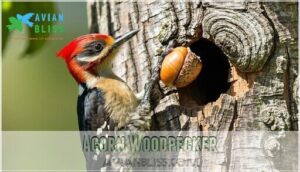
You’ll recognize the Acorn Woodpecker by its striking red cap and clown-like facial pattern.
This California specialist practices cooperative breeding, with families working together to maintain massive acorn granaries.
Their habitat dependence on oak woodlands makes them unique among North America’s red headed birds, storing thousands of acorns in specially drilled holes.
Some red-headed birds, like the Northern Cardinal, are common across North America.
| Characteristic | Details |
|---|---|
| Size | 8-9 inches long |
| Diet | Acorns, insects, sap |
| Habitat | Oak-pine woodlands |
| Behavior | Food storage specialists |
Northern Cardinal
The Northern Cardinal stands out among birds with red heads as North America’s most recognizable backyard visitor.
Males display brilliant crimson plumage variations year-round, while females sport warm brown tones with reddish tinges.
Their distinctive vocalizations include clear whistles and chips, supporting complex matting rituals.
Regional differences in size and coloration occur across their expanding habitat range from Canada to Mexico.
House Finch

House Finches rank among the most common birds with red heads at backyard feeders across North America.
Male Plumage features bright reddish-orange coloring on the forehead, breast, and rump, while females display brown streaking.
Their remarkable Urban Adaptation allows them to thrive in cities and suburbs.
Finch Diet consists primarily of seeds, fruits, and occasional insects, making identification easier than other finches, due to their remarkable ability to adapt.
Downy Woodpecker
You’ll spot North America’s smallest woodpecker easily with proper Downy ID techniques.
Males display a distinctive red patch on their head’s back, while females lack this marking entirely.
These tiny birds with red head identification features prefer mixed woodlands and suburban areas for their Habitat Preference.
Their Feeding Habits include drilling small holes in bark for insects, and their Nesting Behavior involves excavating cavities in dead wood.
Conservation efforts differ from the downy woodpecker, as the red cockaded woodpecker faces habitat loss.
Red-bellied Woodpecker
You’ll find Red-bellied Woodpeckers throughout eastern North America, where these medium-sized birds red head identification becomes tricky since only males sport red caps.
Their striking black-and-white barred backs make them easy to spot at suet feeders.
These woodpeckers red heads aren’t fully red like other species, creating confusion among birders seeking proper birds red head identification in woodlands.
Physical Characteristics
When you’re identifying red-headed birds, you’ll notice their physical traits vary dramatically based on their feeding habits and habitats.
A cardinal’s thick, seed-cracking beak differs completely from a woodpecker’s chisel-like bill or a tanager’s slender insect-catching tool, and these adaptations directly influence their body size, wing shape, and overall appearance.
These adaptations are crucial as they directly impact how each bird interacts with its environment, and understanding these differences is key to identifying red-headed birds.
Seed-Eating Birds
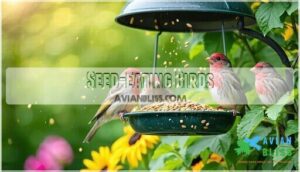
Seed-eating birds with red heads, like finches, bring charm to your backyard.
They prefer sunflower seeds, millet, and nyjer, which fuel their active lives. House Finches and Purple Finches rely on feeders for nutrition and play a role in seed dispersal, shaping habitats.
These birds often display red plumage during mating season.
- Bright red heads make finches easy to spot.
- Their diets impact plant growth.
- Feeder types attract specific species.
Fruit-Eating Birds
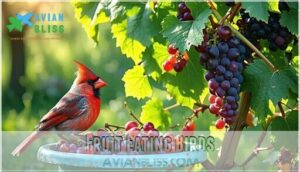
Fruit-eating red-headed birds showcase remarkable adaptations in their digestive systems.
These species have evolved specialized beaks and stomachs to process various berries efficiently.
Their fruit preferences directly impact seed dispersal across bird habitats in North America, creating essential ecological connections.
| Species | Primary Fruit Diet |
|---|---|
| Summer Tanager | Wild berries, grapes |
| Scarlet Tanager | Elderberries, mulberries |
| Western Tanager | Mountain ash berries |
The table highlights the primary fruit diet of different species, demonstrating their unique preferences.
Insect-Eating Birds
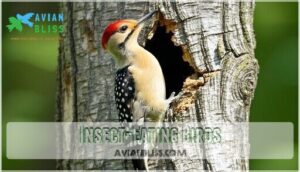
Many red-headed birds in North America rely on an insect diet for survival.
Woodpeckers showcase impressive foraging behavior, drilling into bark to extract beetle larvae and carpenter ants.
Their specialized bird behavior helps them locate prey through sound vibrations.
These bird habitats require abundant dead wood and standing trees.
Predation risks increase during active foraging, but nesting habits provide protection for vulnerable young birds, illustrating the importance of nesting habits.
Nectar-Drinking Birds
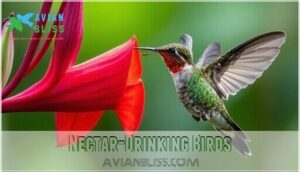
While insects fuel many red-headed species, some birds with red plumage have evolved remarkable hummingbird adaptations for accessing nectar sources.
These specialized feeders play vital pollination roles in their bird habitats, though nectar robbing sometimes occurs when they bypass flowers entirely.
Key nectar-drinking features:
- Anna’s Hummingbird – Ruby throat, hover-feeding capability
- Iiwi – Curved beak matching native Hawaiian flower shapes
- Sugar water preference – High-energy bird diet requirement
- Rapid metabolism – Constant feeding necessary for survival
Attracting Red Headed Birds
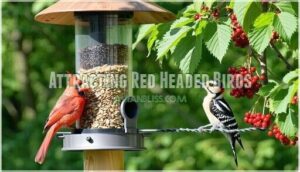
You can attract these vibrant red-headed species to your yard by offering a variety of food sources that match their specific dietary needs, from black oil sunflower seeds in tube feeders for finches and cardinals to suet cakes for woodpeckers.
Setting up multiple feeder types at different heights, along with native berry-producing plants like elderberry and dogwood, creates an irresistible buffet that’ll have red-headed birds visiting your space regularly throughout the seasons, with a focus on native berry-producing plants.
Seed Feeders
You’ll attract vibrant red-headed birds by understanding their specific seed preferences and strategic feeder placement.
House Finch and Northern Cardinal species thrive on diverse seed mixes, while Pine Grosbeak prefers sunflower seeds.
Many enthusiasts find birds enjoy sunflower seeds.
Proper squirrel control and regular feeder hygiene guarantee consistent visits from finches and other birds red head feeder enthusiasts love watching.
| Bird Species | Preferred Seeds |
|---|---|
| House Finch | Nyjer, sunflower hearts |
| Northern Cardinal | Sunflower, safflower |
| Pine Grosbeak | Sunflower, maple seeds |
| Red-headed Woodpecker | Peanuts, cracked corn |
Suet Feeders
Suet feeders work like magnets for woodpeckers and other birds red head species during winter feeding seasons.
You’ll want to choose high-fat suet types and focus on proper feeder placement near tree trunks where these birds feel comfortable.
Consider using specialized suet products to attract a wider variety of birds.
Regular feeder maintenance keeps the suet fresh, while understanding bird preferences helps you select the right bird feeders for your birds red head habitat needs.
Platform Feeders
Platform feeders offer the perfect staging area for red-headed birds across North America.
These open-tray designs accommodate various seed variety while allowing natural bird behavior observation.
Position your feeder at different heights to attract cardinals, finches, and woodpeckers.
Install squirrel baffles below to protect contents. Consider various feeder designs for ideal bird attraction.
Regular cleaning frequency prevents disease spread, ensuring your birds red head feeder remains a healthy gathering spot.
Berry Bushes and Fruit Trees
Native fruit trees and berry bushes create a natural buffet that’ll have red-headed birds flocking to your North America garden.
Strategic bush placement near windows lets you watch their feeding habits up close. Choose varieties with seasonal fruiting patterns to guarantee year-round berry availability for ideal bird diets.
Native plants also support local food webs, enhancing habitat enrichment.
- Elderberries ripening in late summer – watching cardinals devour purple clusters feels like nature’s reward
Summer’s crimson jewels arrive as tanagers dart through cherry blossoms, their scarlet heads catching morning light like tiny flames.
- Serviceberry blossoms turning to fruit – the anticipation builds as finches wait for the perfect moment
- Wild cherry trees heavy with red fruit – tanagers dart between branches like living flames
- Dogwood berries glistening after rain – woodpeckers tap rhythmically while selecting the juiciest morsels
Conservation Status
You’ll find that many red-headed bird species face significant conservation challenges, from habitat loss to climate change impacts that affect their breeding and feeding patterns.
Understanding these threats helps you appreciate why protecting these vibrant species requires immediate attention, as some populations have declined by over 50% in recent decades, which highlights the need for conservation.
Endangered Species
You’ll find that red-headed woodpeckers face serious conservation challenges, with their population classified as Near Threatened due to habitat loss and climate change.
Bird conservation efforts focus on protecting these species through conservation programs that maintain genetic diversity and monitor bird population trends.
Bird conservation status reports show declining numbers, making bird habitats essential for their survival.
Threats to Red-Headed Birds
Red-headed birds face mounting challenges that threaten their survival across North America.
You’ll find these species struggling against multiple pressures that directly impact bird conservation efforts and population trends.
The main threats include:
- Habitat Loss from urban development removing nesting sites
- Climate Change creating extreme weather and habitat shifts
- Pesticide Use reducing insect food sources
- Invasive Species competing for resources
- Collisions with buildings and vehicles during migration
Many species, like the red-headed woodpeckers, are impacted by these threats.
Conservation Efforts
How can you help protect red-headed birds?
Bird conservation organizations lead habitat preservation projects, focusing on oak woodlands and forest management.
Population monitoring tracks species health, while reducing pesticides protects food sources.
Climate change adaptation and public awareness campaigns strengthen bird conservation efforts.
These bird conservation programs and habitat restoration initiatives offer hope for declining populations.
| Conservation Strategy | Key Actions |
|---|---|
| Habitat Restoration | Protecting oak savannas, managing forests |
| Population Monitoring | Tracking species numbers, breeding success |
| Public Engagement | Education campaigns, volunteer programs |
Unique Adaptations and Abilities
Several birds with red heads showcase remarkable bird adaptations that set them apart.
Woodpeckers develop specialized bills and reinforced skulls for drilling, while their bristly feathers prevent wood particle inhalation.
Cardinals exhibit complex social structures and territorial behaviors.
House finches display varied foraging strategies, adapting their bird anatomy to urban environments.
These unique bird morphology features enhance their survival success.
Frequently Asked Questions (FAQs)
What types of birds have red heads?
Like crimson jewels scattered across the sky, you’ll spot woodpeckers, cardinals, finches, and tanagers wearing nature’s boldest color.
Each species displays unique red patterns, from full scarlet heads to distinctive crimson crowns and crests, showcasing nature’s most vibrant hues.
Why do some birds have red heads?
You’ll find that birds develop red heads through carotenoid pigments from their diet.
They also develop red heads through sexual selection for attracting mates, species recognition signals, and territorial displays.
These displays help them communicate dominance within their social hierarchies.
Are red headed birds found in all regions of the world?
You’ll discover red-headed birds aren’t everywhere on Earth.
These vibrant species cluster mainly in North and South America, with some scattered across Europe and Asia.
Antarctica and Australia lack true red-headed bird populations.
Are red headed birds only found in adult birds?
No, you’ll find red-headed coloring isn’t exclusive to adult birds.
Many juvenile birds display different plumage patterns than adults, with some species developing their characteristic red head markings as they mature into breeding age.
Are red headed birds protected species?
Ironically, while flashy red caps seem attention-grabbing, most aren’t federally protected. Red-cockaded Woodpeckers are threatened species , while Red-headed Woodpeckers are "least concern" . Protection varies by species and location.
Can red headed birds be kept as pets?
Most red-headed birds, like woodpeckers and cardinals, are protected by laws like the Migratory Bird Treaty Act, so you can’t keep them as pets.
Instead, attract them to your yard with feeders and habitat!
What kind of birds have red on their head?
You’ll spot several species with crimson crowns: cardinals, woodpeckers like the pileated and red-headed varieties, house finches, purple finches, and tanagers.
These colorful crests help with identification and mate attraction in nature.
What bird has a red head but not a cardinal?
You’ll find red-headed woodpeckers with their striking crimson caps, house finches sporting bright red foreheads, and pileated woodpeckers flaunting red crests.
Scarlet tanagers and summer tanagers also display brilliant red heads during breeding season, showcasing their vibrant red colors.
What looks like a sparrow but has a red head?
You’re likely spotting a House Finch!
Male House Finches have bright reddish-orange heads and streaked brown bodies that resemble sparrows.
They’re common backyard visitors with conical beaks perfect for cracking seeds at feeders.
What is a GREY bird with a red head?
You’re likely spotting a Dark-eyed Junco with its slate-gray body and rusty-red crown.
Or perhaps a Red-breasted Nuthatch displaying blue-gray plumage with distinctive reddish head markings that make backyard birdwatching absolutely delightful, with the rusty-red crown being a notable feature.
Conclusion
Spotting birds with red heads becomes easier once you understand their behavior patterns.
Like nature’s living jewels scattered across landscapes, these crimson-crowned species reward patient observers with unforgettable encounters.
You’ll discover that providing appropriate food sources, maintaining clean water features, and preserving natural habitats creates ideal conditions for attracting these remarkable birds.
Remember, each species has specific preferences, so diversifying your approach increases your chances of witnessing these stunning red-headed visitors in your own backyard sanctuary.
- https://www.allaboutbirds.org/guide/Red-headed_Woodpecker/overview
- https://www.birdwatchingdaily.com/beginners/birding-faq/birds-with-red-heads
- https://www.birdfy.com/blogs/blogs/31-birds-with-red-heads-red-elfs-in-the-sky
- https://lauraerickson.substack.com/p/red-headed-woodpeckers
- https://www.iucnredlist.org/species/22681694/93218414